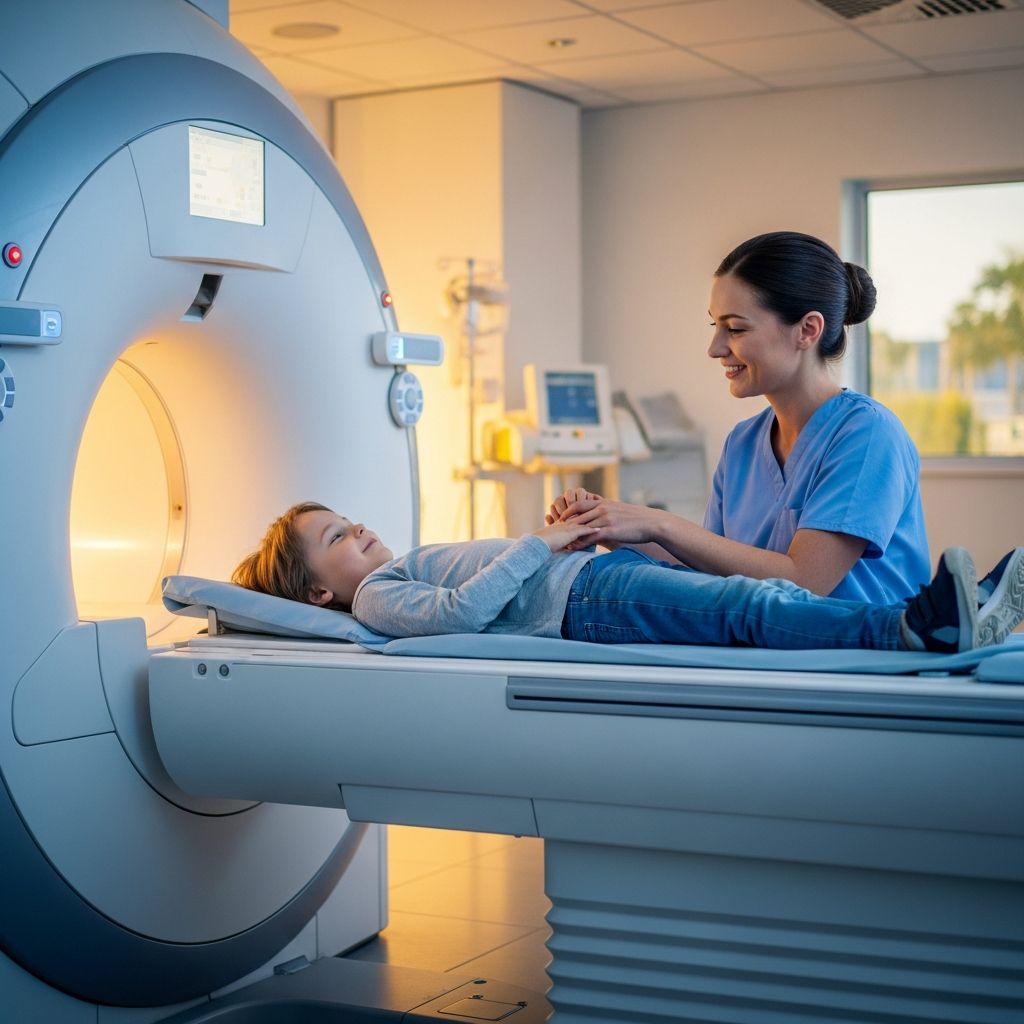
Hearing that your child needs a brain scan can feel overwhelming, but understanding what a brain MRI is and what happens during the test can make the experience more manageable for the whole family. This guide explains the test in everyday language and offers practical tips to help your child feel safe and prepared.
What Is a Brain MRI?
A brain MRI (magnetic resonance imaging) is a medical test that uses a powerful magnet, radio waves, and a computer to create detailed pictures of the brain and structures in the head. It does this without using X-rays or any form of ionizing radiation, so it does not expose your child to the same type of energy used in CT scans or standard X-rays.
- The images are very detailed and can show both normal and abnormal brain tissue.
- The test is painless, but it requires your child to lie very still inside a large machine that looks like a tunnel.
- The test may be done with or without a special dye (contrast) that makes certain areas easier to see.
Why Doctors Order Brain MRI Scans
Doctors use brain MRIs to look closely at structures inside your child’s head when they need more information than a regular exam can provide. Often, a brain MRI is ordered when symptoms suggest a problem with the brain, nerves, or surrounding tissues.
Common reasons a doctor may request a brain MRI include:
- Frequent or severe headaches, especially if they are new or worsening.
- Seizures or unexplained episodes of staring, shaking, or loss of awareness.
- Weakness, changes in balance, or trouble walking.
- Vision or hearing changes that are not explained by eye or ear exams.
- Developmental delays or changes in school performance.
- Head injuries where the doctor needs a more detailed view of the brain.
- Follow-up of known conditions such as tumors, infections, or structural brain differences.
What Conditions Can a Brain MRI Help Detect?
A brain MRI does not diagnose every possible condition on its own, but it can provide valuable clues. It helps doctors identify or monitor issues such as:
- Brain tumors or growths.
- Areas of bleeding, swelling, or bruising inside the head.
- Blood vessel problems like aneurysms or malformations.
- Infections such as abscesses or inflammation of brain tissue.
- Conditions that damage the protective covering of nerves (for example, demyelinating diseases).
- Hydrocephalus (extra fluid in the brain spaces).
- Structural changes your child may have been born with.
How a Brain MRI Works (In Simple Terms)
At first glance, an MRI machine can look intimidating, but the basic idea is straightforward. The machine uses magnetism and radio waves to create signals from water molecules in your child’s body, and a computer turns those signals into clear images for the doctor.
Think of it this way:
- The magnet lines up tiny particles in the body.
- Radio waves briefly disturb that alignment.
- As the particles return to their normal position, they send out signals.
- The computer collects these signals and builds detailed pictures of the brain layer by layer.
This process is safe, painless, and happens entirely inside the machine; nothing touches the brain itself.
Safety and Who Should Avoid MRI
Because MRI uses a strong magnet, safety is focused mainly on metal objects. Before the test, the health care team will ask careful questions about your child’s medical history and any metal in or on their body.
Be sure to tell the team if your child has:
- A pacemaker or implanted heart device.
- Inner ear implants, certain types of braces, or metal clips in the brain.
- Any implanted pumps, stimulators, or shunts.
- Metal fragments from past injuries or surgeries.
- Tattoos or permanent makeup done with older metallic inks.
Most children can safely have an MRI, but some implants are not compatible with strong magnets. The radiology team will review all this information before confirming that the scan can proceed.
Metal and MRI: A Quick Overview
| Item or Situation | What Parents Should Do |
|---|---|
| Jewelry, watches, hair clips, belts | Remove all before the scan; leave valuables at home when possible. |
| Dental braces or fillings | Usually safe, but inform the staff; images may sometimes have mild distortion. |
| Implanted devices (shunts, pacemakers, cochlear implants) | Bring device cards or paperwork; the team will check if MRI is allowed. |
| Recent surgeries with metal hardware | Tell the doctor and MRI staff; they may review records or X-rays first. |
Understanding Contrast Dye
Sometimes doctors need an even clearer look at certain parts of the brain or blood vessels. In those cases, they might recommend a contrast dye, often based on a substance called gadolinium. This dye is given through a small IV line in your child’s arm or hand during the scan.
- The contrast helps certain areas appear brighter or more defined on the images.
- It can highlight tumors, inflammation, blood vessels, or areas where the normal blood–brain barrier is disrupted.
- Most children tolerate the dye well, though mild side effects like a cool feeling in the arm or brief nausea can happen.
Serious allergic reactions are rare, but the staff will ask about past reactions to contrast dyes and any kidney problems before using it.
Preparing Your Child for the Scan
Good preparation can make the experience smoother and less scary for kids. Your goals are to explain what will happen in age-appropriate terms and to help your child practice staying still.
What to Tell Your Child
- Describe the MRI machine as a big camera or tunnel that takes pictures of the brain.
- Explain that it makes loud tapping or thumping sounds, but nothing will touch or hurt them.
- Reassure your child that you will be nearby and that staff will be able to see and hear them the whole time.
- Practice lying still like a statue for short periods at home.
What to Bring on Test Day
- A comfort item that is allowed in the room, such as a non-metallic stuffed toy (ask ahead).
- A list of your child’s medicines and medical conditions.
- Previous imaging reports if requested by your doctor.
- Snacks and a drink for after the scan, especially if your child needed to fast.
Sedation and Anesthesia: Helping Kids Stay Still
For clear images, your child must stay almost completely still during the scan. This can be difficult for very young children or those who are anxious, have sensory sensitivities, or cannot tolerate confined spaces. In these cases, light sedation or anesthesia may be recommended.
- Sedation helps your child relax or sleep through the test, reducing movement.
- An anesthesia specialist monitors breathing, heart rate, and oxygen levels throughout the scan.
- Fasting may be required for several hours before sedation to reduce the risk of vomiting.
If your child may need sedation, ask in advance about the type of medication, possible side effects, and how long your child will need to stay afterward for monitoring.
What Happens on the Day of the MRI
Knowing the step-by-step process can ease anxiety for both you and your child. While details may vary by hospital or imaging center, the general flow is similar.
- Check-in and paperwork: You will sign consent forms and answer screening questions about metal and medical history.
- Changing clothes: Your child may be asked to change into a hospital gown and remove all jewelry, hair accessories, and clothing with metal snaps or zippers.
- Placement of IV (if needed): If contrast or sedation is planned, a nurse may place a small IV in your child’s hand or arm.
- Positioning on the table: Your child lies on a narrow, cushioned table. The technologist may use soft straps or foam pads to help keep them comfortable and still.
- Head coil: A special padded device is placed around the head like a helmet; it helps capture detailed brain images.
- Moving into the scanner: The table slides into the tube-shaped part of the machine until your child’s head is in the center.
- During the scan: Loud knocking and humming sounds begin as the machine takes pictures. Your child will be given earplugs or headphones, and many centers offer music or stories to listen to.
- Communication: Your child can speak to the technologist through an intercom, and some centers allow a parent to stay in the room (without metal).
- End of the scan: When all images are finished, the table slides out. If there was an IV, it is removed, and a small bandage is placed over the site.
Most brain MRIs take between 30 and 60 minutes, depending on how many images are needed and whether contrast is used.
Sounds, Sensations, and Emotions During the Scan
Knowing what your child may feel or hear during the scan can help you prepare them. The experience is unusual but not painful.
- Noise: Rapid knocking, thumping, or buzzing sounds are normal when the machine is working.
- Temperature: The room may feel cool, but your child can usually have a light blanket.
- Movement: The table may move slightly between sets of images.
- Contrast sensation: If contrast is given, your child might feel a brief coolness in the arm or a metallic taste in the mouth.
Some children feel nervous in the confined space of the scanner. Calm breathing, reassurance, and distraction like music or storytelling can help, and for some kids, sedation is the best option.
After the MRI: Recovery and Results
Once the scan is over, most children can return to normal activities right away, especially if no sedation was used. If sedation or anesthesia was given, your child may need to stay for a short observation period until fully awake and stable.
- Your child may feel slightly tired or wobbly after sedation; plan for a quiet day at home.
- The IV site may be a little sore or bruised; this usually improves quickly.
- Encourage fluids, especially if contrast was used, unless your child’s doctor advises otherwise.
A doctor who is specially trained to read imaging studies, called a radiologist, will review the pictures and write a report. That report is then sent to the doctor who ordered the test, who will explain the findings, answer questions, and discuss next steps with you.
How Brain MRI Differs from Other Tests
Parents are often curious about why an MRI is recommended instead of, or in addition to, other imaging tests. Each type of imaging offers different strengths.
| Test Type | What It Uses | Typical Uses |
|---|---|---|
| Brain MRI | Strong magnet and radio waves | Detailed brain and spinal cord images, evaluation of tumors, infections, structural changes, and some vascular problems. |
| CT (Computed Tomography) | X-rays | Quick assessment after trauma, detection of bleeding or major changes when results are needed urgently. |
| Head X-ray | Single-dose X-ray | Less common for brain problems; may be used for bones or foreign objects. |
MRI often provides more detailed images of soft tissues like the brain and spinal cord. However, CT may be chosen in emergencies because it is faster and more widely available in urgent settings.
Supporting Your Child Emotionally
Beyond the technical details, your child’s emotional comfort matters. Children often take cues from their parents’ reactions, so staying as calm and informed as possible helps.
- Use simple, honest explanations rather than saying “it’s nothing.”
- Offer choices when possible, such as which music to listen to or which comfort item to bring.
- Practice relaxation techniques like slow breathing together before the scan.
- Praise your child for their bravery and cooperation afterward.
Frequently Asked Questions (FAQs)
Is a brain MRI painful?
No, the scan itself does not hurt. Your child will not feel the magnet or radio waves. The only discomfort may come from lying still for a long time, the sound of the machine, or from having an IV placed if contrast or sedation is needed.
How long does a brain MRI take for a child?
Most pediatric brain MRIs last between 30 and 60 minutes. The total time at the imaging center may be longer if your child needs sedation, contrast dye, or time to prepare and recover.
Can I stay with my child during the MRI?
At many centers, a parent is allowed to stay in the room during the scan as long as they also remove metal objects and meet safety requirements. Some places may have different rules, so ask ahead of time what is allowed.
Are there risks from the magnetic field?
For most children without incompatible metal implants, the magnetic field is considered very safe. The main risk is if there is metal in or on the body that can move or heat up in the magnet, which is why screening questions are so important.
Will my child glow or become radioactive after the MRI?
No. The MRI machine does not use radiation that stays in the body, and your child will not be radioactive or glowing afterward. If contrast dye is used, the body gradually removes it through the kidneys.
When will we get the results?
Timing varies, but many families receive results within a few days. In urgent situations, the ordering doctor may get a preliminary report more quickly. Ask your child’s doctor or the imaging center when and how you will receive the results.
What if my child is too scared to go through with it?
If anxiety is high, talk with your child’s doctor about options. These may include meeting the staff and seeing the scanner ahead of time, practicing in a mock scanner, using distraction techniques, or scheduling the exam with sedation or anesthesia.
Key Takeaways for Parents
- A brain MRI is a detailed, radiation-free way to look at your child’s brain and head structures.
- The test is painless but can be noisy and requires stillness, which may be challenging for some children.
- Clear communication with the medical team about metal, implants, allergies, and anxiety is essential for safety and comfort.
- With preparation, reassurance, and support, most children handle a brain MRI very well, and the information it provides can be crucial for diagnosis and treatment planning.