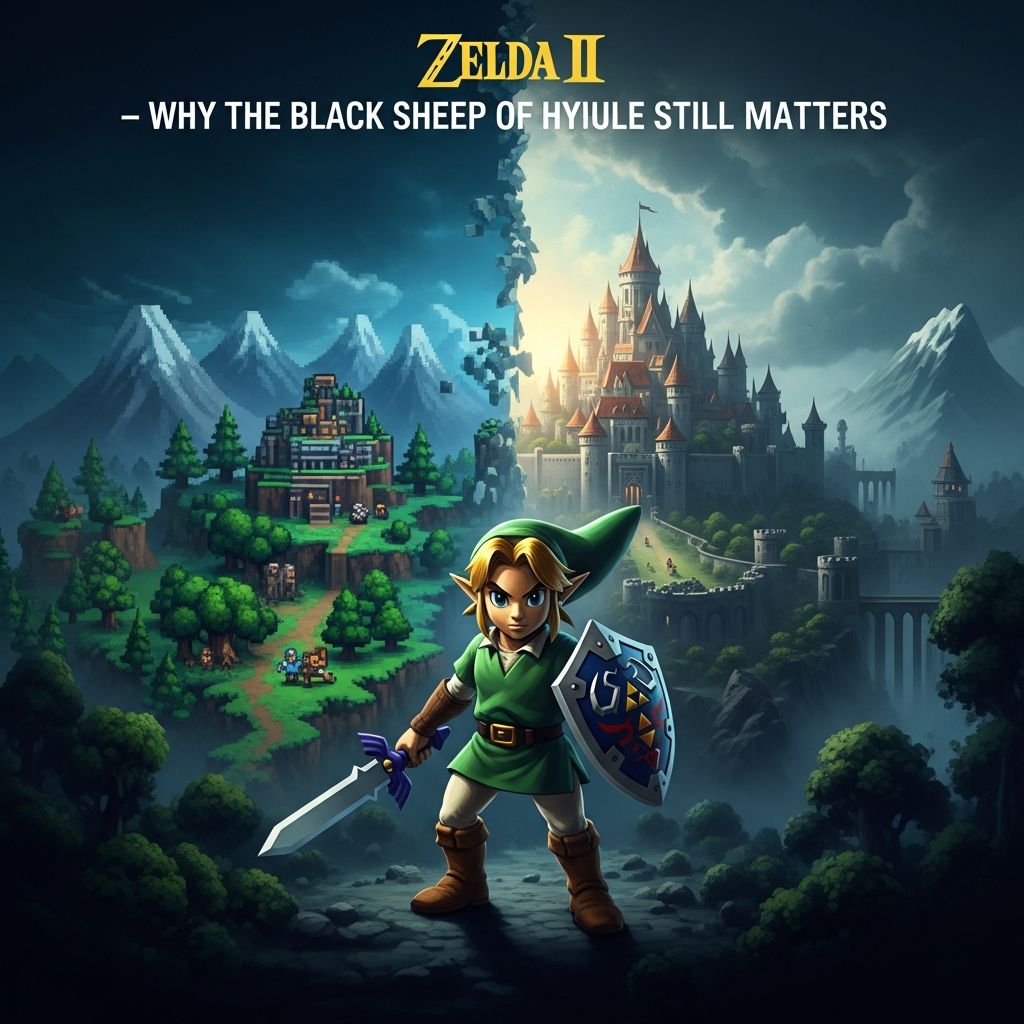
The Legend of Zelda II: The Adventure of Link is often remembered as the odd one out in the series: a side-scrolling, experience-based RPG that feels more like a daring experiment than a true sequel. Released in 1987 for the Famicom Disk System and later on the NES, it swapped the top-down exploration of the original for a mix of platforming, combat, and light role-playing systems. While many fans still consider it the weakest mainline Zelda, that reputation overlooks how much it shaped the series’ DNA and why its bold choices deserve a second look.
Breaking the Zelda Mold
When The Legend of Zelda launched in 1986, it defined the action-adventure genre with its open world, item-based progression, and puzzle-heavy dungeons. Zelda II, however, took a completely different path. Instead of a top-down overworld, it used a side-view perspective for towns, the overworld, and combat, turning Link into a platforming hero who could jump, crouch, and strike up or down . This shift was intentional: Shigeru Miyamoto wanted to explore a sword-and-shield action game that emphasized timing and positioning, not just exploration .
The game also introduced mechanics that would feel alien to fans of later Zelda titles. Link now earns experience points from enemies, levels up his attack, magic, and defense, and manages a magic meter for spells . This RPG layer made progression feel more gradual and punishing, especially with limited lives and no save battery in the NES cartridge version. These changes weren’t just cosmetic; they fundamentally altered how players interacted with Hyrule, turning it into a grind-heavy, trial-and-error experience that many found frustrating at the time .
Gameplay That Felt Like a Different Genre
- Combat is based on directional strikes (high, low, jump attacks) and blocking, requiring precise timing rather than simple button mashing .
- Random enemy encounters appear as symbols on the overworld map, triggering side-scrolling battles that feel more like a traditional RPG than a Zelda game .
- Spells like Jump, Shield, and Fire replace many of the item-based abilities from the first game, making magic a core part of both exploration and combat .
- Link can only carry a limited number of lives, and losing them all means restarting from the beginning (or from a password), which adds a layer of tension absent from most other Zelda entries .
This design made Zelda II feel more like a hybrid of action, platforming, and early JRPG than a pure adventure game. For players who loved the freedom and exploration of the original, this shift could be jarring. The overworld is smaller and more linear, with towns that offer hints and side quests rather than just shops, and the dungeons (called Palaces) are more combat-focused and less puzzle-heavy than in later titles .
Why It Was So Divisive
At launch, Zelda II was a commercial success and received strong reviews in Japan and North America, but its reputation soured over time as the series evolved . Later Zelda games like A Link to the Past and Ocarina of Time returned to the top-down or 3D action-adventure formula, making Zelda II’s RPG mechanics feel like a one-off experiment rather than a step forward .
Several factors contributed to its “worst Zelda” label:
- High difficulty and repetition: Grinding for experience, memorizing enemy patterns, and managing lives made the game feel grindy and unforgiving, especially for younger players .
- Unfamiliar structure: The mix of side-scrolling combat, random encounters, and level-based progression felt closer to Dragon Quest or early Final Fantasy than to Zelda, alienating fans of the original’s pure exploration .
- Technical limitations: On the NES, the lack of a save battery meant relying on long passwords, and the limited hardware made some areas and enemy behaviors feel unfair or poorly tuned .
- Story and tone: Zelda II introduced a more defined narrative (Link seeking the Triforce of Courage to awaken Princess Zelda), but its cryptic townspeople and abstract world design made the story feel distant and confusing to many .
Over the years, this combination of punishing mechanics and unfamiliar design cemented Zelda II’s status as the series’ black sheep, often cited as the least accessible and least beloved mainline entry.
Hidden Innovations That Shaped Zelda
Despite its reputation, Zelda II introduced several ideas that quietly became staples of the franchise. Many of these elements are easy to overlook because they were later refined or reworked, but their roots are clearly visible in later games.
- Link’s magic and spells: The concept of a magic meter and spellcasting (like Shield, Jump, and Fire) laid groundwork for magic systems in later Zelda titles, even if they were later tied to items rather than experience .
- Directional combat: The high/low/jump attack system influenced how swordplay evolved in later games, where timing and positioning matter more than simple button presses .
- Triforce of Courage: Zelda II is the first game to explicitly name and focus on the Triforce of Courage, giving Link’s piece a central role in the story and setting up its importance in the series’ lore .
- Dark Link: The final boss, Link’s shadowy doppelgänger, became an iconic recurring enemy and concept in later Zelda games, symbolizing Link’s inner struggle .
- Named towns and NPCs: Towns like Ruto, Saria, and Rauru later inspired character names in Ocarina of Time and beyond, showing how Zelda II’s worldbuilding subtly fed into the series’ mythology .
In this sense, Zelda II wasn’t just a misstep; it was a laboratory for ideas that would be polished and reused in more successful entries.
How Zelda II Fits in the Series’ Timeline
Chronologically, Zelda II is set shortly after the original Legend of Zelda, with Link now a teenager searching for the Triforce of Courage to awaken Princess Zelda from an eternal sleep . This story directly continues the events of the first game, where Link recovered the Triforce of Power and Wisdom but left the Triforce of Courage behind.
Within the official Zelda timeline, Zelda II belongs to what fans now call the “Downfall” or “Adult Timeline” branch, which leads into games like A Link to the Past and the classic 2D entries. This placement means that, despite its odd mechanics, Zelda II is a canonical part of Hyrule’s history and helps explain how the Triforce was eventually reunited and how Ganon’s threat persisted across generations .
Reevaluating Zelda II Today
With modern retrospectives and re-releases (like on the NES Classic and Switch Online), Zelda II has started to receive a more nuanced reappraisal. What once felt like a broken or unfair game now reads as an ambitious, if flawed, attempt to expand what a Zelda game could be.
- Its RPG mechanics, while grindy, give a sense of progression that’s rare in the series, making Link feel like he’s genuinely growing stronger over time .
- The side-scrolling combat and platforming feel more deliberate and skill-based than random, rewarding players who master timing and positioning .
- For fans of classic JRPGs or challenging NES titles, Zelda II offers a unique blend of genres that few other games in the series replicate .
Seen through this lens, Zelda II isn’t a “bad” game so much as a bold experiment that prioritized innovation over comfort. It’s a reminder that the Zelda series has always been willing to take risks, even if not all of them land perfectly.
Legacy: The Unlikely Blueprint
While later Zelda games abandoned most of Zelda II’s RPG systems, its influence can still be seen in subtle ways:
| Element in Zelda II | Legacy in Later Zelda Games |
|---|---|
| Experience points and leveling up | Not reused in mainline games, but inspired progression systems in spin-offs like Hyrule Warriors . |
| Magic meter and spells | Evolved into magic systems tied to items (e.g., Farore’s Wind, Din’s Fire) and later into stamina and resource management . |
| Directional sword attacks | Influenced combat depth in games like Twilight Princess and Breath of the Wild, where attack angles and timing matter . |
| Dark Link / shadow self | Became a recurring motif, appearing in Ocarina of Time, Majora’s Mask, and other titles as a symbolic boss . |
| Named towns and NPCs | Names like Ruto, Saria, and Rauru were reused for major characters, linking the worldbuilding across decades . |
In many ways, Zelda II served as a prototype for ideas that would be refined in later entries. Its willingness to experiment with genre, progression, and combat helped keep the series from becoming formulaic, even if most of its specific mechanics were later discarded.
FAQs About Zelda II: The Adventure of Link
Is Zelda II canon in the official timeline?
Yes, Zelda II is part of the official Zelda timeline, specifically the branch that includes A Link to the Past and the classic 2D games. It directly follows the original Legend of Zelda and explains how Link obtained the Triforce of Courage .
Why is Zelda II so hard compared to other Zelda games?
Zelda II is harder because it uses RPG mechanics like experience grinding, limited lives, and a password system instead of save points. Enemy patterns and platforming sections are also more punishing, requiring precise timing and memorization .
Did any later Zelda games reuse Zelda II’s RPG elements?
Mainline Zelda games largely abandoned experience points and leveling, but Zelda II’s magic meter, spells, and directional combat influenced later titles. Spin-offs like Hyrule Warriors and some handheld entries have drawn more directly from its RPG side .
What makes Zelda II worth playing today?
Zelda II is worth playing for its unique blend of action, platforming, and light RPG mechanics, as well as its historical importance in the series. It offers a different kind of challenge and a glimpse into how Nintendo experimented with the Zelda formula early on .
Is Zelda II considered the worst Zelda game?
Among fans and critics, Zelda II is often ranked as the weakest mainline entry due to its difficulty and unfamiliar mechanics. However, many modern analyses argue that it’s an unfairly maligned experiment that introduced key ideas later refined in the series .