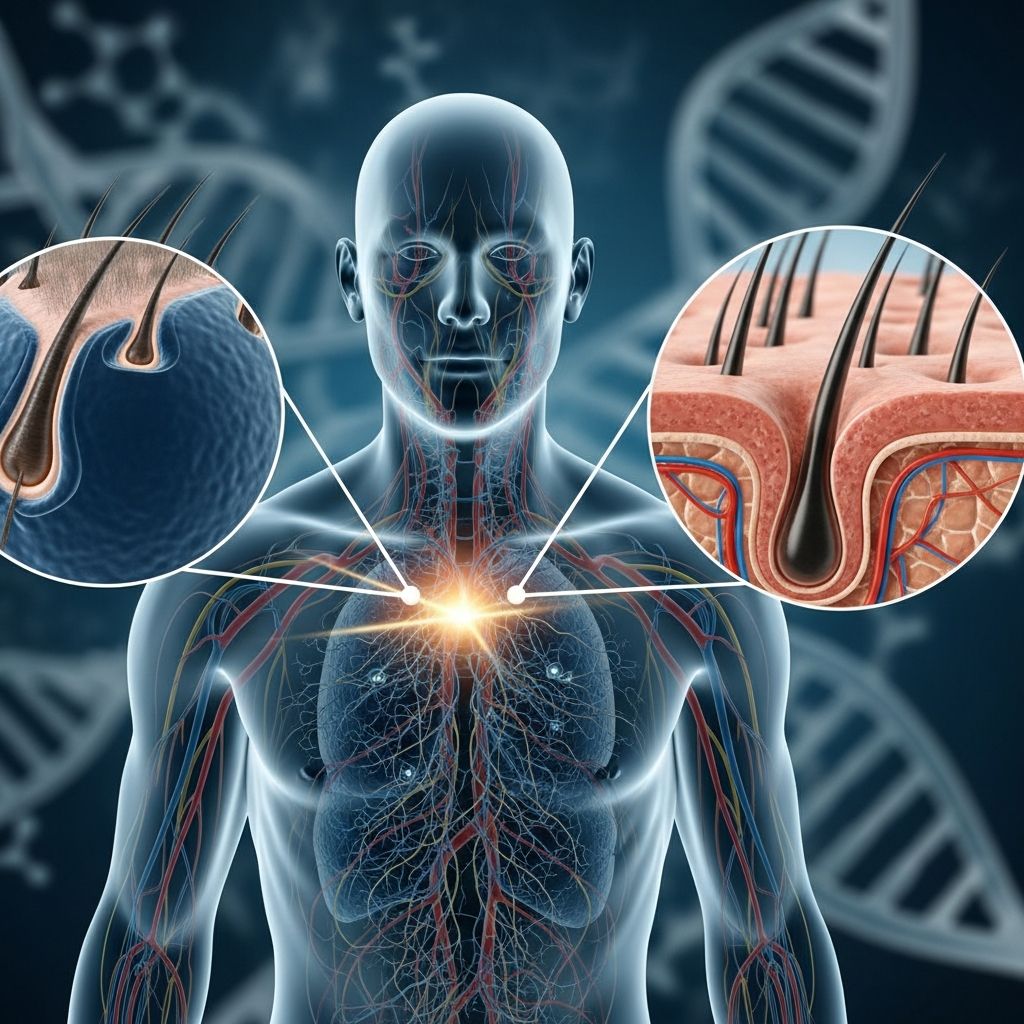
It’s a common sight: a man with a bald or thinning scalp who also has noticeably thick hair on his back, chest, shoulders, or ears. This isn’t just a random coincidence; it’s the result of how male hormones, especially dihydrotestosterone (DHT), affect different hair follicles in the body. While DHT shrinks scalp follicles and leads to male pattern baldness, it can actually stimulate hair growth in many other areas, creating what some jokingly call the “bald but hairy” look. This article explains the biology behind this phenomenon, the role of genetics and hormones, and what options exist for managing both hair loss and excess body hair.
How Male Pattern Baldness Works
Male pattern baldness, also known as androgenetic alopecia, is by far the most common cause of hair loss in men, affecting roughly two out of three men to some degree as they age . It follows a predictable pattern: a receding hairline at the temples, thinning at the crown, and eventually a bald spot on top, often leaving a horseshoe-shaped ring of hair around the sides and back of the head .
This type of hair loss is driven by a combination of genetics and hormones. Hair follicles on the scalp become sensitive to dihydrotestosterone (DHT), a powerful androgen made when the enzyme 5-alpha reductase converts testosterone . In genetically predisposed men, DHT causes these scalp follicles to miniaturize over time: hairs grow thinner, shorter, and weaker until they stop growing altogether .
Crucially, baldness is not simply about how much testosterone a man has; it’s about how sensitive his scalp follicles are to DHT. That’s why some men with high testosterone keep a full head of hair, while others with normal levels go bald early . The condition is strongly hereditary, with genes from both parents influencing when and how much hair is lost .
Why Body Hair Increases as Scalp Hair Decreases
At the same time that DHT is shutting down hair growth on the scalp, it’s often doing the opposite on the body. DHT is a key driver of many male secondary sex characteristics, including thick, dark terminal hair on the face, chest, back, shoulders, and other areas .
The reason for this “opposite effect” lies in the biology of different hair follicles. Scalp follicles in balding men are genetically programmed to respond to DHT by shrinking and eventually dying, while body and facial follicles respond to the same hormone by growing thicker, longer, and darker hairs . This is sometimes called the “androgen paradox” of hair: androgens promote hair growth in some areas while suppressing it in others .
Because roughly 10% of a man’s testosterone is converted into DHT by 5-alpha reductase, men with higher testosterone levels tend to produce more DHT, which can both accelerate scalp hair loss and increase body hair growth . Over time, as men age and their follicles are exposed to more hormones, body hair can become longer, coarser, and more noticeable, especially on the back, shoulders, ears, and nose .
The Role of DHT in Hair Growth and Loss
Dihydrotestosterone (DHT) is a derivative of testosterone that is much more potent at binding to androgen receptors in hair follicles . It is produced locally in tissues like the scalp and prostate by the enzyme 5-alpha reductase, which is especially concentrated in these areas .
In the scalp, DHT shortens the hair growth cycle, reduces the size of follicles, and leads to progressively finer, shorter hairs until growth stops . In contrast, in areas like the beard, chest, and back, DHT stimulates the transformation of fine vellus hairs into thick, dark terminal hairs, a process that begins at puberty and can continue into middle age .
Studies show that men with androgenetic alopecia often have higher levels of 5-alpha reductase, higher free testosterone, and higher free androgens (including DHT) compared to men without hair loss . This hormonal profile explains why some men experience both early balding and prominent body hair, while others with lower androgen activity may keep their hair longer but have less body hair .
Genetics vs. Hormones: What Really Matters?
While hormones like DHT are the direct trigger for hair loss and body hair growth, genetics determine whether a man’s follicles will respond to those hormones in a balding pattern . Male pattern baldness is considered a genetic condition, inherited from either the mother’s or father’s side, and it requires the presence of androgens to develop .
Research suggests that about 80% of bald men have bald fathers, indicating a strong paternal influence, though the exact inheritance pattern is complex and likely involves multiple genes . These genes affect how sensitive scalp follicles are to DHT and how strongly body follicles respond to androgens .
It’s important to note that baldness is not a reliable indicator of overall “virility” or current testosterone levels. Men with androgenetic alopecia may have had higher free androgens earlier in life, but testosterone naturally declines with age, while hair loss is cumulative . A receding hairline or bald spot is more a sign of past androgen exposure and genetic predisposition than a measure of present sexual health .
Other Factors That Influence Hair Patterns
Besides genetics and androgens, several other factors can influence hair growth and loss:
- Age: Hair loss tends to progress with age, and body hair often becomes coarser and more noticeable in middle age and beyond .
- Nutrition: Deficiencies in protein, iron, or certain vitamins (like vitamin A in excess) can contribute to temporary hair shedding or thinning .
- Medical conditions: Thyroid disorders, chronic illness, and some medications (such as anticoagulants or chemotherapy drugs) can cause temporary hair loss known as telogen effluvium .
- Stress and illness: Major physical or emotional stress can push large numbers of scalp hairs into the resting phase, leading to noticeable shedding a few months later .
- Scalp health: Emerging research suggests that oxidative stress, the scalp microbiome, and local signaling pathways (like Wnt-beta-catenin and prostaglandin D2) may also play roles in hair follicle activity .
Common Hair Patterns in Balding Men
Male pattern baldness and body hair growth often follow recognizable patterns:
| Area | Typical Change in Balding Men | Primary Driver |
|---|---|---|
| Scalp (front and crown) | Thinning, receding hairline, bald spot | DHT sensitivity in genetically predisposed follicles |
| Back and shoulders | Increased thickness and length of hair | DHT stimulation of body follicles |
| Chest | Darker, denser terminal hair | Androgen-driven terminal hair growth |
| Face (beard) | Thicker, fuller beard growth | DHT and testosterone on facial follicles |
| Ears and nose | Longer, coarser hairs | Age-related androgen exposure |
Managing Scalp Hair Loss
For men concerned about hair loss, several evidence-based options are available:
- Minoxidil (Rogaine): A topical treatment that can slow hair loss and promote regrowth in some men by prolonging the growth phase of hair follicles .
- Finasteride and dutasteride: Oral medications that block 5-alpha reductase, reducing DHT levels and slowing or stopping further hair loss in many men .
- Low-level laser therapy: Devices that use light to stimulate follicles; results vary, but some studies show modest improvement in hair density .
- Hair transplants: Surgical procedures that move hair follicles from the back and sides of the scalp (which are resistant to DHT) to balding areas .
- Healthy lifestyle: Managing stress, eating a balanced diet rich in protein and iron, and treating underlying medical conditions can help maintain overall hair health .
It’s important to note that without treatment, hair loss due to male pattern baldness is permanent, and early intervention usually yields the best results .
Dealing with Excess Body Hair
For men who find increased body hair on the back, chest, shoulders, or ears bothersome, several cosmetic approaches can help:
- Shaving: A quick, inexpensive way to remove unwanted hair, though it requires regular maintenance and can cause irritation or ingrown hairs .
- Trimming/clipping: Using electric trimmers to keep body hair short and neat without completely removing it .
- Waxing or sugaring: Removes hair from the root, providing longer-lasting results than shaving, but can be painful and may irritate sensitive skin .
- Depilatory creams: Chemical creams that dissolve hair at the skin’s surface; convenient but can cause allergic reactions in some people .
- Laser hair removal: A more permanent option that uses light to damage hair follicles, reducing growth over multiple sessions; best suited for darker hair and lighter skin tones .
- Electrolysis: A method that destroys individual follicles with electric current, offering permanent hair removal, though it can be time-consuming and expensive .
Because body hair growth is hormonally driven, directly altering hormone levels (for example, with anti-androgens) is generally not recommended just to reduce body hair, as it can cause side effects like low libido or erectile dysfunction .
When to See a Doctor
Most cases of male pattern baldness and increased body hair are normal variations of male aging and do not require medical treatment. However, a healthcare provider should be consulted if:
- Hair loss is sudden, patchy, or accompanied by scalp redness, pain, or scaling, which could indicate a different condition like alopecia areata or a fungal infection .
- There are signs of a hormonal imbalance, such as very low libido, erectile dysfunction, fatigue, or unexplained weight changes .
- Body hair appears in unusual patterns (for example, rapid growth in women or in children), which might suggest an underlying endocrine disorder .
- A man is considering medications like finasteride and wants to understand the risks, benefits, and realistic expectations .
Frequently Asked Questions
Does having a lot of body hair mean I’ll go bald?
Not necessarily. While both male pattern baldness and prominent body hair are influenced by androgens like DHT, genetics play the biggest role in whether a man will lose scalp hair . Some men with thick body hair keep a full head of hair, while others with little body hair go bald; it depends on how sensitive their scalp follicles are to DHT .
Can lowering testosterone stop balding?
Artificially lowering testosterone is not a safe or recommended way to prevent balding. Testosterone is essential for many bodily functions, including muscle mass, bone health, mood, and sexual function . Treatments like finasteride work by blocking the conversion of testosterone to DHT in specific tissues, not by reducing overall testosterone levels .
Why do bald men still have hair on the sides and back of the head?
The hair follicles around the sides and back of the scalp are genetically resistant to the shrinking effects of DHT, which is why they usually survive even in advanced male pattern baldness . This is also why these areas are used as donor sites for hair transplants .
Is there a link between baldness and heart disease or other health problems?
Some studies have found associations between male pattern baldness (especially early, vertex balding) and a slightly higher risk of heart disease, insulin resistance, and prostate issues, but the exact reasons are not fully understood . These links appear to be related more to shared underlying factors (like genetics and hormone patterns) than to baldness itself causing disease .
Can lifestyle changes prevent balding?
While a healthy lifestyle (good nutrition, stress management, avoiding smoking) supports overall hair health, it cannot override the genetic and hormonal drivers of male pattern baldness . However, treating conditions like thyroid disease or iron deficiency can prevent or reverse some types of temporary hair loss .