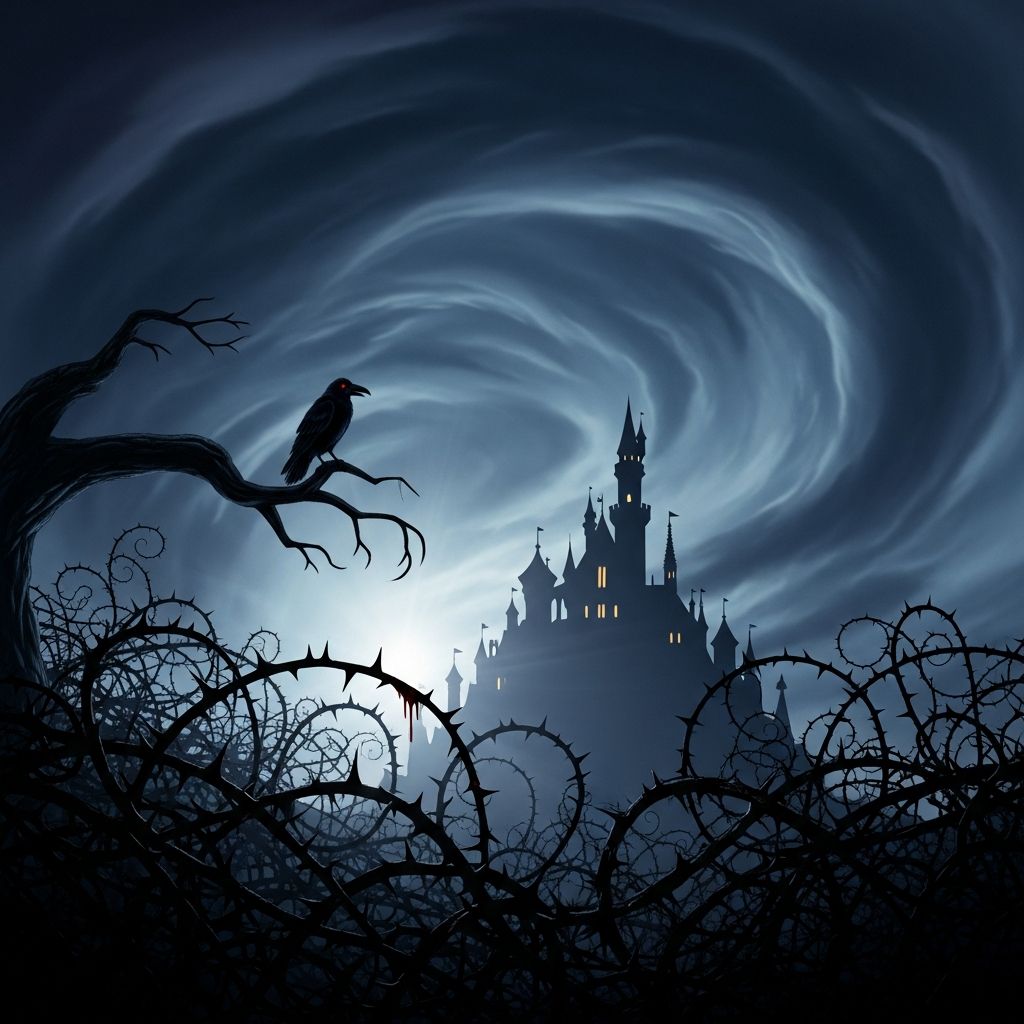
When most people open Disney Plus in search of something scary, they scroll past Sleeping Beauty without a second thought. Yet buried inside this pastel fairy tale is one of the most unsettling, horror-adjacent films in the Disney animated canon. Beneath the songs and romance lies a story about a curse, bodily danger, and a villain who behaves more like the star of a gothic horror film than a children’s cartoon.
This article explores how Sleeping Beauty operates as a secret horror movie, why it unnerves children and adults alike, and how families can watch it thoughtfully when younger viewers are involved.
The Dark Heart of a Familiar Fairy Tale
Disney’s Sleeping Beauty (1959) adapts a centuries-old European fairy tale rooted in violence, magical revenge, and generational fear. Scholars of folklore note that classic tales often served as cautionary stories about real-world dangers, dressed in fantastical clothing.
Under the bright colors and musical numbers, the movie’s core ingredients are unmistakably dark:
- A curse on an infant that promises death on her 16th birthday.
- A villain motivated by spite rather than practical gain.
- A land-wide sleep that resembles a magical plague.
- A final battle against a dragon born from pure malice and fire.
These are horror tropes in fairy-tale clothing: a doom-laden prophecy, an unstoppable deadline, and an evil figure who seems to take pleasure in the suffering she causes.
Maleficent as a Full-Fledged Horror Villain
Maleficent is often described as one of Disney’s most frightening villains, and her design borrows heavily from gothic and horror iconography. Critics and historians have pointed out that Disney’s early animations experimented with techniques similar to those in contemporary horror films, using lighting and sound to evoke fear and suspense.
Why Maleficent Feels So Unnerving
- Her entrance is framed like a jump scare. The royal christening plays as a bright, orderly scene until a violent crack of thunder and a wash of green light announce her arrival.
- Her powers are deliberately cruel. She doesn’t simply inconvenience the kingdom; she chooses a curse designed to hang over a family for 16 years.
- Her body language is predatory. Slow, deliberate movements, a fixed gaze, and a calm, amused tone make her feel like a classic movie monster who knows she has already won.
- Her transformations escalate. By the time she becomes a dragon, the film has shifted into full monster-movie mode.
In horror storytelling, the most effective villains often embody a kind of absolute, impersonal malice. Maleficent fits this pattern: she is not after money, territory, or even power. She wants the satisfaction of watching a kingdom break under the weight of her curse.
Visual Language: When a Fairy Tale Looks Like a Nightmare
One of the reasons Sleeping Beauty reads as horror to many modern viewers is its art direction. The film’s stylized backgrounds, angular character designs, and heavy use of shadow create a sense of unease that distinguishes it from softer-looking Disney films of the same era.
How the Imagery Channels Horror
| Visual Element | Fairy-Tale Function | Horror Effect |
|---|---|---|
| Thorn forest | Obstacle to reach the castle | Feels like a living barrier or grasping monster, enclosing the kingdom |
| Maleficent’s castle | Lair of the villain | Reads as a haunted fortress; jagged shapes and green light mimic horror-film castles |
| Green fire and smoke | Magic signature | Acts like toxic fog or hellfire, a recurring visual cue of danger |
| Sleeping kingdom | Spell effect | Resembles a mass curse or supernatural catastrophe that freezes life in place |
These visuals echo the atmosphere of mid-century gothic and supernatural horror movies, which also used stark contrasts, looming architecture, and unnatural lighting to keep viewers uneasy.
Sound, Silence, and the Art of Children’s Suspense
Horror movies rely heavily on sound to build tension, and Sleeping Beauty uses similar techniques, though in a softer key suitable for a family audience.
Key Sound-Horror Techniques in the Film
- Lullaby turned warning. The gentle melodies that follow Aurora through the forest are comforting, but when the spindle scene arrives, the music takes on a hypnotic, ominous quality.
- Strategic quiet. Right before pivotal moments — Maleficent’s curse, Aurora’s trance, the dragon fight — the score often drops into near-silence, echoing the still-before-the-jump pattern common in horror cinema.
- Nonhuman sounds. Maleficent’s raven, cackling goblin-like minions, and the dragon’s roar fill the soundscape with unsettling noises that break the illusion of a safe fairy-tale world.
Media researchers studying children’s responses to frightening content have found that both sound and implied danger can be more frightening than visible violence, particularly for younger viewers who fill in the gaps with their imagination.
The Spindle Scene: A Hypnotic Descent into Terror
The moment Aurora touches the spinning wheel is one of the most horror-coded sequences in the Disney animated catalog. There is no visible gore, yet the staging taps into some of the same fears that drive adult horror films.
Why This Scene Feels Like a Horror Set Piece
- Entrapment. Aurora moves through the castle like a sleepwalker in a haunted house, following a disembodied voice and eerie glow.
- Possession imagery. Her eyes are unfocused, her movements rigid, and her will overridden — visual shorthand very similar to possession or mind-control scenes in horror.
- Unstoppable fate. The fairies chase her, but the audience understands the curse must play out. Horror often leans on this feeling of inevitability.
- Symbolic bodily harm. She pricks her finger, a small act that stands in for the much darker ‘death’ promised by the curse.
For young viewers, the scene can be especially memorable because it reframes an everyday household object — a spinning wheel spindle — as dangerous, echoing the way horror films turn ordinary spaces into sources of fear.
A Dragon, a Castle, and a Classic Monster Showdown
The final act of Sleeping Beauty leaves fairy-tale delicacy behind and leans fully into monster-movie spectacle. When Maleficent transforms into a dragon surrounded by flames and thorns, the film adopts the rhythm of a creature feature climax: hero versus beast, high stakes, and a fortress-like setting.
Horror Elements in the Climax
- Transformation horror. Watching a human-shaped villain morph into a giant, fire-breathing dragon evokes the unease of body transformation stories common in horror and mythology.
- Encircling danger. The wall of thorns and the ruined castle create a confined battleground, minimizing escape routes.
- Fire and falling. The dragon’s flames and the abyss below the crumbling bridge introduce primal fears of burning and falling.
For some children, this sequence is the first time they see a large monster rendered with such intensity in animation, which can leave a lasting impression similar to an early brush with live-action horror.
Why Kids Find Sleeping Beauty So Scary
Parents sometimes report that Sleeping Beauty frightens their children more than more obviously spooky movies filled with jokes and comic relief. Developmental psychologists note that children’s media fears often revolve around themes of separation, bodily harm, and the loss of control — all central to this story.
Core Fears at Work
- Fear of being cursed or marked. Aurora is doomed before she can speak or make choices, a potent metaphor for bad things happening for no clear reason.
- Fear of parental helplessness. The king and queen, despite their power, cannot completely protect their child, echoing real anxieties about safety.
- Fear of sleep and vulnerability. A magical sleep that engulfs an entire kingdom frames beds and rest — normally safe spaces — as dangerous.
- Fear of the unknown adult figure. Maleficent, an imposing stranger who appears at a baby’s celebration, resonates with children’s unease around menacing unfamiliar adults.
Research on children’s reactions to frightening media suggests that even when the danger is resolved, the emotional memory of intense scenes can linger — especially if those scenes involve realistic emotions like helplessness and separation.
Comparing Sleeping Beauty to Other Disney+ “Horror” Choices
Disney Plus features a spectrum of spooky offerings, from Halloween-themed comedies to genuinely intense live-action thrillers and Marvel’s horror-leaning specials. Sleeping Beauty sits in a unique position on that spectrum.
| Type of Title on Disney+ | Typical Tone | Where Sleeping Beauty Fits |
|---|---|---|
| Light Halloween comedies | Jokes, mild peril, happy chaos | Darker, less comedic; fewer safety valves through humor |
| Superhero horror hybrids | Action plus horror imagery, often for teens/adults | Shares gothic visuals and monstrous villains, but told as a fairy tale |
| Classic animated features | Whimsy with occasional scares | Pushes more heavily into sustained dread than many counterparts |
The result is a film that can serve as a bridge between gentle spooky stories and more direct horror, especially for older children looking for something more intense without stepping into full-blown adult horror territory.
Watching with Kids: Turning Fear into a Conversation
Because Sleeping Beauty threads horror elements through a family-friendly frame, it can be a useful tool for helping children learn to process fear with support. Experts on children and media suggest that co-viewing and conversation are key strategies for minimizing distress from frightening content.
Practical Tips for Parents and Caregivers
- Pre-watch if you’re unsure. If you have a very sensitive child, watch the movie yourself first to gauge which scenes might be too intense.
- Stay present during the scariest parts. Sit nearby during Maleficent’s curse, the spindle sequence, and the dragon fight so kids can look to you for reassurance.
- Pause and talk. If a child seems overwhelmed, pause to explain what is happening and remind them that the story is make-believe and will end safely.
- Decompress afterward. Follow the movie with a lighter activity or a favorite show so the last emotional note of the evening is comforting, not fearful.
- Invite questions. Ask what they thought of Maleficent, which parts were scary, and how they felt when the characters woke up.
Handled this way, the film can become less a source of nightmares and more a structured, shared experience of manageable fear — similar to a child-friendly haunted house.
Why This “Hidden Horror” Still Matters
In an era when horror is easy to find across streaming platforms, it is intriguing that one of the most quietly terrifying experiences on Disney Plus is wrapped inside a 1950s animated musical. Sleeping Beauty shows how much fear you can conjure without blood, explicit violence, or adult themes. Its power lies in mood, symbol, and suggestion — the same tools that made early gothic tales so enduring.
For adults revisiting the film, recognizing its horror DNA can deepen appreciation for its craftsmanship. For families, understanding the darker currents running beneath the surface can transform a potentially overwhelming watch into a guided journey through fear, bravery, and relief.
So the next time you browse Disney Plus in search of something spooky, consider that one of its most effective horror experiences might be hiding in plain sight under the guise of a timeless fairy tale.
Frequently Asked Questions (FAQs)
Q: Is Sleeping Beauty too scary for young children?
A: It depends on the child. The movie includes a vengeful villain, a hypnotic curse, and an intense dragon battle. Sensitive viewers under six may find some moments overwhelming, especially the spindle scene and the climax. Co-viewing and talking through frightening parts can help.
Q: How is Sleeping Beauty different from typical kids’ Halloween movies?
A: Many kids’ Halloween movies lean heavily on humor and constant reassurance. Sleeping Beauty uses a slower build, serious stakes, and a truly menacing villain, which makes it feel closer to classic gothic horror wrapped in fairy-tale form.
Q: Why does Maleficent seem scarier than other Disney villains?
A: Unlike comedic or bumbling villains, Maleficent is calm, controlled, and relentlessly cruel. Her design, voice performance, and use of shadow and green fire give her the presence of a traditional horror antagonist rather than a cartoonish foe.
Q: Can Sleeping Beauty be a good introduction to horror for older kids?
A: For children who are ready for something tenser than light Halloween specials but not yet prepared for full-fledged horror films, Sleeping Beauty can act as a bridge. It provides suspense, frightening imagery, and a monster battle while still ending with clear safety and closure.
Q: What should parents do if their child has nightmares after watching?
A: Reassure the child that the story is fictional, invite them to describe what scared them, and offer comforting bedtime routines. Some families find it helpful to reframe scary images through play or drawing, giving children a sense of control over the story.
References
- From Fairy Tale to Film Screen: Adapting the Grimms’ Fairy Tales — Armando Maggi / Wayne State University Press. 2016-01-01. https://www.wsupress.wayne.edu/books/detail/fairy-tale-film-screen
- The Disney Version: The Life, Times, Art and Commerce of Walt Disney — Richard Schickel / Simon & Schuster. 1997-10-01. https://www.simonandschuster.com/books/The-Disney-Version/Richard-Schickel/9781566632200
- Film Art: An Introduction (11th ed.) — David Bordwell, Kristin Thompson, Jeff Smith / McGraw-Hill. 2016-01-01. https://highered.mheducation.com/sites/0073514248/index.html
- Children, Adolescents, and the Media — Victor C. Strasburger, Barbara J. Wilson, Amy B. Jordan / American Academy of Pediatrics. 2017-11-01. https://publications.aap.org/pediatrics/article/140/Supplement_2/S97/34182/Children-Adolescents-and-the-Media
- 13 Horror Movies and Series to Watch Before Halloween — Disney+. 2025-10-23. https://www.disneyplus.com/explore/articles/horror-shows-movies
- Horror movies and shows — Disney+. 2025-10-01. https://www.disneyplus.com/en-gb/browse/page-62250dcb-8d3d-45a5-84ad-bd95068c908a