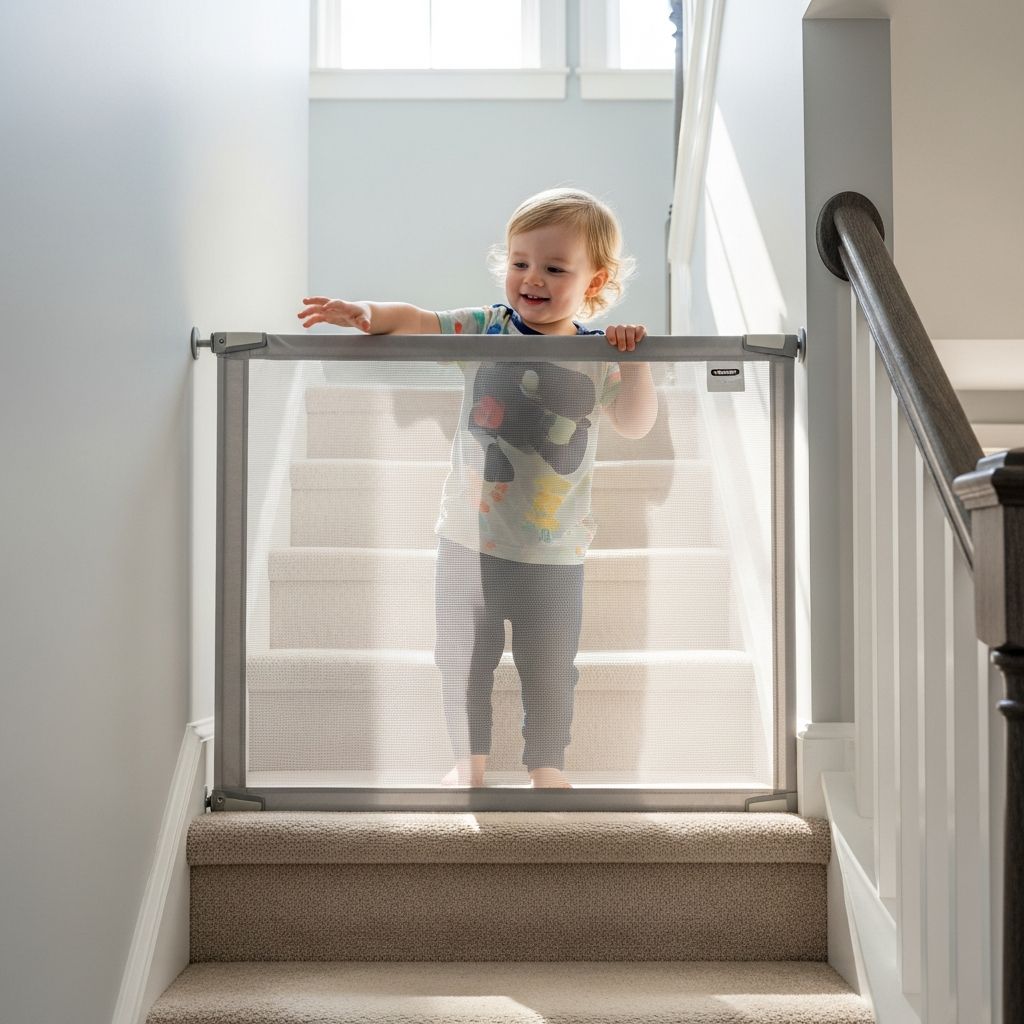
Parenting with a mobile baby or toddler quickly becomes a full-contact sport. One day your child is happily rolling on a play mat, and the next they are pulling up on furniture, testing every stair, and heading straight for the one room you forgot to baby-proof. A well-chosen retractable safety gate can turn that chaos into something closer to controlled exploration, giving kids room to roam while dramatically cutting the risk of falls and household injuries.
This guide explores why retractable gates are so useful, what makes them different from traditional hardware or pressure-mounted gates, how to choose the right one, and how to use it safely without turning your home into a maze of barriers.
Why Gates Matter So Much Once Kids Start Moving
As soon as babies learn to crawl, they begin to reach unsafe areas long before they understand danger. That mismatch between curiosity and judgment is exactly why safety gates exist.
- Falls are a major injury risk: In the United States, falls are a leading cause of nonfatal injuries in young children, and many of those occur in or around the home, especially on stairs and elevated surfaces.
- Exploration is healthy but risky: Toddlers naturally seek out new spaces, including kitchens, garages, and outdoor steps. Blocking access to high-risk areas reduces injuries without limiting normal development.
- Supervision has limits: Even the most attentive caregiver cannot physically shadow a child every second. Gates serve as a backup layer when your attention is pulled to cooking, work, or another child.
Public health guidance recommends creating barriers to dangerous areas as part of a broader home safety strategy, especially around stairs, windows, and exterior doors. Gates are one of the simplest ways to follow that advice without remodeling your house.
What Makes Retractable Gates Different?
Traditional baby gates usually come in two main types: pressure-mounted (tension-based) and hardware-mounted (screwed into walls or door frames). Retractable gates add a third option: a mesh or fabric panel that rolls or folds into a compact housing when not in use.
| Gate Type | How It Works | Best Uses | Main Advantages | Main Drawbacks |
|---|---|---|---|---|
| Pressure-mounted | Expands to press between two walls or frames | Doorways, between rooms (not top of stairs) | Easy to remove, no drilling | Not as secure for stairs, tripping hazard at threshold |
| Hardware-mounted | Screws into studs or solid surfaces | Top/bottom of stairs, high-risk areas | Very secure, recommended for stairways | More permanent, more visible |
| Retractable | Mesh panel pulls out and locks, then rolls back into a side housing | Doorways, hallways, top/bottom of stairs (if rated for it) | Discreet when open, flexible width, minimal trip hazard | Requires careful installation; some models need two hands |
Many retractable gates are technically hardware-mounted because they use brackets and screws, but they behave differently in everyday use: you extend them only when needed and they nearly disappear when retracted.
Everyday Advantages of a Retractable Safety Gate
Parents who switch from a bulky traditional gate to a retractable design often wonder why they waited so long. Several practical advantages explain the appeal.
1. Space-Saving Design That Respects Your Home
- Low visual impact: When rolled away, the gate leaves an opening that looks and feels almost like a normal doorway or hallway.
- No permanent barrier across traffic paths: Wide hallways and open-plan spaces feel less chopped up because the gate is only visible when in use.
- Better for small or narrow spaces: In tight corridors or near stair landings, a swinging gate can be awkward; a retractable panel hugs the wall when open.
2. Flexible Fit for Awkward Openings
Older homes, open layouts, and non-standard doorways can make baby-proofing tricky. Retractable gates can cover a range of widths with a single unit, often much wider than typical fixed-panel gates.
- Works on wide archways that exceed the span of most standard baby gates.
- Handles baseboards and slightly uneven walls with adjustable brackets or spacers.
- Many models are rated for indoor and outdoor use, so one design can manage a deck, porch, or patio step.
3. Easier Movement for Adults and Older Kids
- Reduced tripping hazard: The thin bottom bar or rim sits close to the floor, and when retracted there is no gate to step over.
- One-hand operation on many models: Helpful when carrying a baby, laundry, or groceries.
- Less noise: No loud metal clank from swinging bars, which can matter during naps or nighttime checks.
4. Dual Use for Babies and Pets
Many households use a retractable gate for both young children and animals—from keeping a dog downstairs at night to blocking a curious toddler from a litter box or pet feeding station. Pet-specific retractable gates often feature reinforced mesh and higher push-out resistance.
Safety First: What To Look For in a Retractable Gate
No matter how convenient a gate is, safety comes first. There are widely recognized standards and best practices that apply across brands.
Check for Safety Certification
- In the U.S., look for compliance with the ASTM F1004 standard for expansion gates and expandable enclosures, which sets requirements for strength, latch performance, and gap sizes.
- In Europe, check for conformity with EN 1930 (safety barriers for domestic use), which covers similar criteria like height, openings, and mechanical strength.
- Confirmation of independent testing (by recognized labs or safety organizations) is a strong positive sign.
Key Safety Features That Matter
- Height appropriate for age and use: Many safety agencies recommend gates at least about 75–80 cm high to prevent climbing for toddlers.
- Secure top and bottom attachment: Especially at the top of stairs, hardware-mounted brackets into solid framing are advised to reduce the risk of collapse.
- Child-resistant latch: The mechanism should be simple enough for adults to operate but difficult for toddlers to figure out or open accidentally.
- Tight mesh with no footholds: A smooth fabric or fine mesh surface minimizes places for a child to climb or trap fingers.
- No head entrapment gaps: Safety standards define maximum opening sizes to prevent a child’s head from fitting through.
Where to Install (and Where Not To)
Authoritative safety guidance consistently stresses that the top of stairs is the most critical location for a securely mounted gate.
- Top of stairs: Use only gates that can be hardware-mounted and are specifically rated safe for stairways. Avoid pressure-only gates here to reduce the risk of the gate being pushed loose.
- Bottom of stairs: A retractable gate can help keep eager climbers off the steps altogether.
- High-risk rooms: Kitchens, garages, laundry rooms, and workshops often store chemicals, tools, and appliances that shouldn’t be freely accessible to toddlers.
- Indoor–outdoor transitions: Doors leading to decks, patios, or pools should be restricted for young children, in combination with other layers of water safety when near pools.
Installation Tips So Your Gate Works As Intended
A safety gate is only as effective as its installation. Following the manufacturer’s instructions and basic safety guidance from pediatric and consumer safety agencies is crucial.
Before You Drill or Mount
- Measure accurately: Measure both the top and bottom width of the opening; older homes sometimes have walls that are not perfectly parallel.
- Locate solid backing: Use a stud finder or check for masonry so brackets anchor into strong material, not just drywall.
- Check for obstructions: Baseboards, handrails, and trim may require spacers or alternative bracket positions.
Smart Mounting Practices
- Use all supplied hardware—including wall anchors where recommended.
- Position the bottom edge as close to the floor as allowed by the instructions to minimize the gap beneath.
- Confirm the gate panel is level and fully tensioned when extended; loose mesh can be pushed out more easily.
- Test the latch repeatedly to ensure it fully engages and that you can operate it quickly in an emergency.
Routine Safety Checks
- Monthly inspection: Check screws, brackets, and the housing for looseness or wear.
- Mesh condition: Look for fraying, small tears, or chew marks (especially in homes with pets) and replace the gate if its integrity is compromised.
- Latch reliability: If the mechanism becomes stiff, sticky, or too loose, contact the manufacturer about maintenance or replacement.
Making a Gate Part of a Child-Friendly Home, Not a Cage
Parents sometimes worry that using gates will make their home feel restrictive. Used thoughtfully, they do the opposite: they expand the safe area kids can explore by clearly separating high- and low-risk zones.
Zone Your Home for Sanity and Safety
- Green zones: Living rooms, playrooms, and bedrooms where children can explore freely with minimal hazards.
- Yellow zones: Kitchens and bathrooms where supervised access is okay but unsupervised time is not.
- Red zones: Garages, workshops, laundry rooms, and areas with significant fall, chemical, or burn risks.
Retractable gates work especially well between green and yellow/red zones because adults can open them wide during active, supervised time and close them quickly when attention shifts.
Supporting Development While Staying Safe
- Give toddlers plenty of safe challenges (soft climbing blocks, supervised low steps) so they develop coordination without risky falls from full-height stairs.
- Explain the gate’s purpose in simple language: “This keeps you safe from the stairs. When we go together, we open it.”
- Involve older siblings by teaching them how and when to close the gate, and when to ask an adult before opening it.
Buying Checklist: How to Choose the Right Retractable Gate
Before purchasing, use this quick checklist to narrow your options:
- Location: Is it for the top of stairs, between rooms, or for an outdoor doorway?
- Safety rating: Does it comply with recognized standards and clearly state suitability for stair use if needed?
- Width and height: Does it fully cover the opening and offer adequate height for your child’s age and stage?
- Operation: Can you open and close it with one hand? Is the latch intuitive for adults but secure against toddlers?
- Durability: Is the mesh scratch-resistant and strong enough for both kids and pets if you have them?
- Mounting surface: Are your walls or frames suitable for screw-in brackets, and do you have the tools to install them properly?
Frequently Asked Questions About Retractable Safety Gates
Are retractable gates as safe as traditional baby gates?
A high-quality retractable gate that meets relevant safety standards and is correctly hardware-mounted can offer comparable protection to traditional gates in many locations. For the top of stairs, always confirm that the gate is explicitly rated for stair use and follow installation guidance from pediatric and consumer safety organizations.
Can I use a pressure-mounted retractable gate at the top of stairs?
Safety guidance generally advises against any pressure-mounted barrier at the top of stairs because a strong push can dislodge it, creating a fall hazard. Use only hardware-mounted solutions designed for stairways in that position.
How long should I keep using safety gates?
Many families continue using gates until around age 2–3, depending on the child’s height, coordination, and ability to follow safety rules. Discontinue use if your child can reliably open the gate or climb over it, and consider additional education and environmental changes at that stage.
Are retractable gates safe for outdoor use?
Some retractable gates are specifically designed for both indoor and outdoor environments and use UV-resistant, weather-tolerant materials. Check the manufacturer’s labeling; if outdoor use is not specified, assume the product is intended for indoor settings only.
Do retractable gates damage walls?
Because most retractable gates are hardware-mounted, they require screws and brackets that leave small holes similar to shelf or curtain rod mounts. Using proper anchors, hitting studs when possible, and following the instructions helps prevent cracks or excessive damage.
References
- Protect the Ones You Love: Child Injuries Are Preventable — Centers for Disease Control and Prevention. 2022-03-21. https://www.cdc.gov/safechild/index.html
- Child Safety at Home: Falls — American Academy of Pediatrics / HealthyChildren.org. 2021-06-21. https://www.healthychildren.org/English/safety-prevention/at-home/pages/Falls.aspx
- Retract-A-Gate Pet and Dog Safety Gate Features — Retract-A-Gate. 2023-01-10. https://retract-a-gate.co.uk/retractable-pet-and-dog-safety-gate-features/
- Standard Consumer Safety Specification for Expansion Gates and Expandable Enclosures (ASTM F1004) — ASTM International. 2020-06-15. https://www.astm.org/f1004-20.html
- Child Use and Care Articles – Safety Barriers (EN 1930) — European Committee for Standardization (CEN). 2011-06-01. https://standards.cencenelec.eu/dyn/www/f?p=104:110:0::::FSP_PROJECT:27036