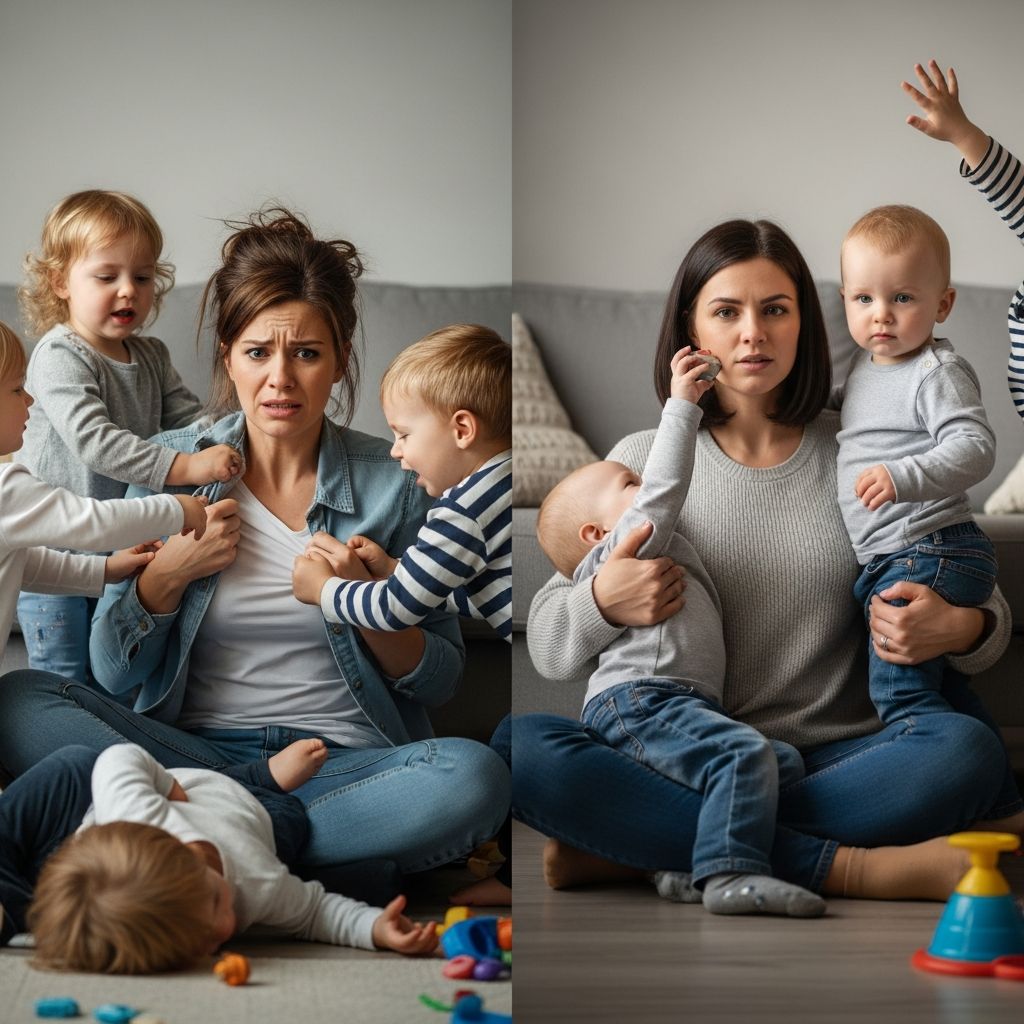
Mothers of three children frequently report the highest levels of parenting stress compared to those with fewer or more kids, with stress peaking around this family size before easing with additional children. This counterintuitive pattern emerges from large-scale surveys and psychological analyses, revealing how family dynamics shift dramatically beyond the third child.
Understanding the Stress Curve in Growing Families
Parenting stress does not increase linearly with the number of children; instead, it follows a U-shaped pattern where mothers of one or two kids feel relatively manageable pressure, those with three hit a peak, and families with four or more often experience a decline. A study involving over 7,000 parents found that moms rated their stress at the highest average on a 1-10 scale when managing three children, surpassing even smaller or larger broods.
This phenomenon ties into resource allocation and household logistics. With one or two children, parents can maintain tight control, dividing attention effectively. The third child disrupts this equilibrium, demanding coordination that feels overwhelming without built-in support systems. In contrast, larger families develop self-sustaining structures where children contribute more actively.
Peak Stress at Three: The Tipping Point
The transition to three children represents a critical tipping point for maternal stress. Everyday tasks like outings or mealtimes become exponentially harder without enough hands or eyes to manage all kids simultaneously. Authors and psychologists note that simple activities, such as crossing a street, amplify anxiety because parental oversight stretches thin.
Research from China echoes this, showing mothers of two preschoolers experience significantly higher stress than those with one, with stress scores rising from 29.50 to 32.55 on standardized measures. Factors like birth order exacerbate this: in two-child families, mothers report more stress parenting the first-born, especially when both are young and demanding. Extrapolating to three, the load compounds without proportional relief.
| Family Size | Average Stress Score (M ± SD) | Key Stress Factors |
|---|---|---|
| 1 Child | Lower baseline | Individual focus, manageable |
| 2 Children | 29.50-32.55 | Birth order, age gaps |
| 3 Children | Highest (peak on 1-10 scale) | Logistical overload, no sibling help |
| 4+ Children | Declines post-peak | Sibling teamwork, routines |
This table summarizes stress patterns across family sizes, highlighting the anomaly at three.
Relief with Four: Sibling Power and Team Dynamics
Adding a fourth child often flips the script, reducing maternal stress through emergent family benefits. Older siblings in larger families entertain younger ones, share chores, and provide emotional buffers, lightening the parental load. Psychotherapists observe that this fosters teamwork, where kids “look out for each other,” creating a self-regulating household.
Norwegian research supports this, linking larger sibships—especially close in age—to fewer mental health issues in children, implying lower home stress. Mothers in these families report streamlined routines: laundry batches grow but get divided, playtime becomes group-led, and discipline spreads across peers.
- Sibling Bonding: Kids occupy each other, freeing moms for essential tasks.
- Shared Responsibilities: Older children help with younger ones, from diapering to homework.
- Economic Scaling: Fixed costs per child decrease; hand-me-downs and bulk buying ease budgets.
- Emotional Resilience: Larger families build conflict-resolution skills early, reducing parental mediation.
Demographic Influences on Maternal Pressure
Beyond sheer numbers, demographics modulate stress. In two-child families, low income (under 3000 yuan) correlates with markedly higher stress than higher earners (over 6000 yuan). Gender combinations and age gaps also matter: closer ages demand simultaneous high-energy parenting, spiking pressure.
Surveys reveal additional stressors: 46% of moms attribute more tension to partners than kids, 60% find raising girls tougher, and 90% worry about post-baby fitness. Time-related stress hits new mothers hardest, tripling that of fathers post-birth, persisting lifelong but easing in larger families with distributed care.
Time and Financial Pressures Across Family Stages
New motherhood amplifies time stress disproportionately for women, regardless of prior children, though those with young siblings under six feel it most acutely. Financial stress rises similarly for both parents but resolves quicker, unlike enduring time crunches.
In complex families, multiple partners can heighten stress via economic shifts and divided loyalties, but stable larger units with siblings buffer this. Pro-natal policies must address mothers’ time burdens, as offsetting new-child stress equates to doubling household income in perceived value.
Practical Strategies for Stressed Moms of Three
For families at the three-child stress peak, targeted strategies can mimic larger-family benefits:
- Encourage peer-like play among siblings to build independence early.
- Implement age-based chore charts to distribute load.
- Prioritize age gaps when planning; wider spacing allows older kids to assist.
- Seek community or partner support to simulate extended family networks.
Boosting income or education also mitigates pressure, as higher socioeconomic status consistently lowers scores.
Frequently Asked Questions
Why do moms of three kids feel the most stressed?
Moms of three report peak stress due to logistical overload without sufficient sibling help, disrupting household balance.
Does adding a fourth child really reduce stress?
Yes, larger families benefit from sibling teamwork, shared duties, and routines that ease parental burden.
How does income affect parenting stress?
Low-income mothers in multi-child families experience significantly higher stress than higher earners.
Is stress higher with boys or girls?
60% of surveyed moms find raising girls more stressful.
Can age gaps between kids lower stress?
Yes, wider gaps allow older siblings to help, reducing simultaneous demands.
Larger Families: Long-Term Wins for Well-Being
While initial childbearing spikes stress—especially for mothers—four-plus kids yield long-term calm through resilient dynamics. Children in these homes develop fewer behavioral issues, and parents enjoy delegated responsibilities. This doesn’t negate three-child challenges but highlights adaptability.
Economic scaling helps: per-child costs drop, and family cohesion strengthens mental health. Mothers adapt by surrendering perfectionism, embracing chaos as a feature, not a bug.
References
- Assessing Mothers’ Parenting Stress: Differences Between One- and Two-Child Families — National Library of Medicine (PMC). 2021-02-09. https://pmc.ncbi.nlm.nih.gov/articles/PMC7845658/
- How Many Kids Cause Moms the Most Stress? — Learning Liftoff (K12 Inc.). 2015-07-15. https://learningliftoff.com/family/parenting/how-many-kids-cause-moms-the-most-stress/
- How new mothers experience more time-related stress than fathers — World Economic Forum. 2015-07-28. https://www.weforum.org/stories/2015/07/how-new-mothers-experience-more-time-related-stress/
- Family Complexity, Childbearing, and Parenting Stress: Comparison of Mothers and Fathers — Princeton Fragile Families & Child Wellbeing Study. N/A. https://ffcws.princeton.edu/publications/family-complexity-childbearing-and-parenting-stress-comparison-mothers-and-fathers
- Parenting Stress Among Mothers of One and Two-Child Families — NIH (via PMC cross-ref). 2021. https://pmc.ncbi.nlm.nih.gov/articles/PMC7845658/