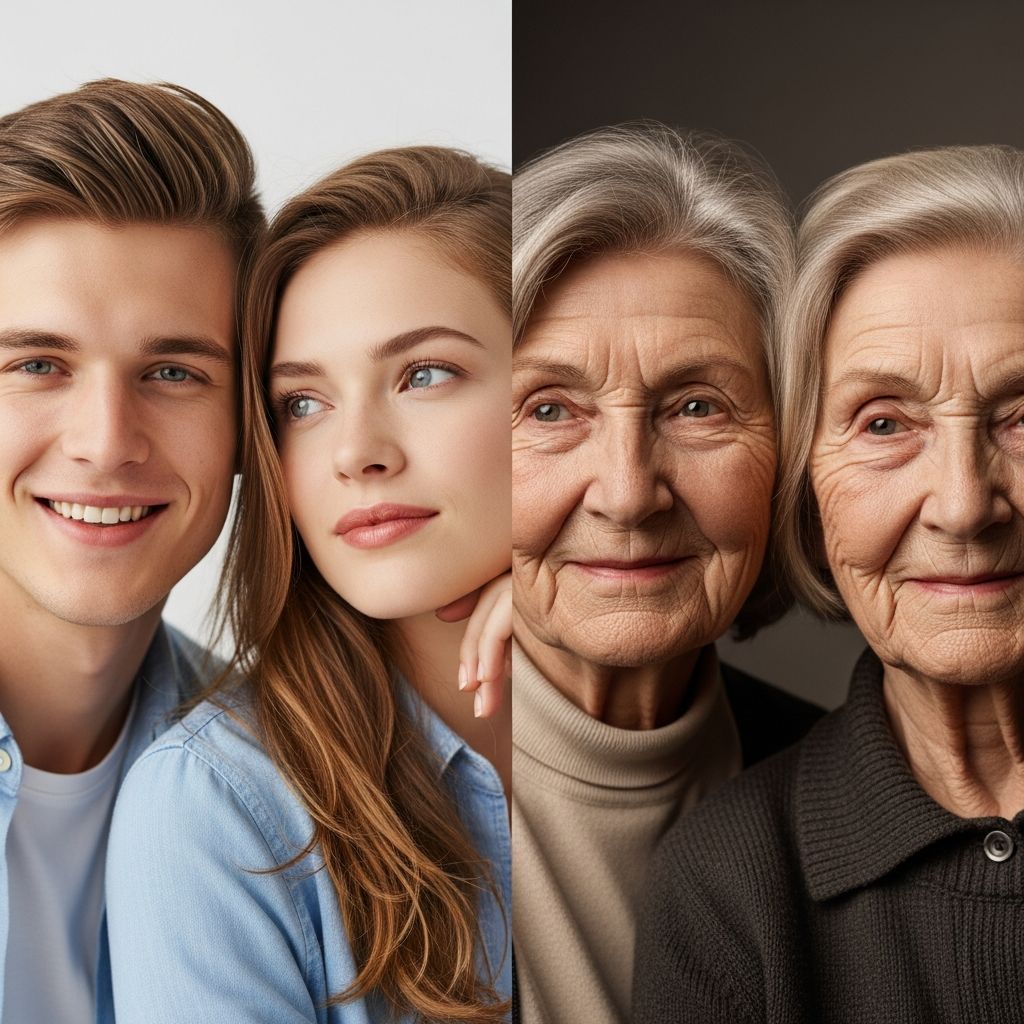
Have you ever noticed how some long-term couples seem to mirror each other’s features? This phenomenon sparks curiosity worldwide, prompting questions about whether love truly shapes our appearances. Scientific inquiry reveals that partners often share facial similarities right from the beginning of their relationships, driven by deep-rooted psychological and evolutionary mechanisms rather than years of shared living.
The Illusion of Convergence: What Research Actually Shows
Popular belief suggests that couples grow to look more alike over time due to synchronized lifestyles, diets, and expressions. However, rigorous studies challenge this idea. A comprehensive analysis of 517 married couples’ facial images, captured at marriage and revisited 20 to 69 years later, found no evidence of increasing similarity. Using both human judges and advanced facial recognition algorithms like VGGFace2, researchers confirmed that spouses’ faces were comparable initially but remained static over decades.
This aligns with patterns in other traits: partners match in personality, intelligence, and values from the start, without further convergence. The study concludes that shared environments maintain, but do not enhance, pre-existing resemblances. Earlier experiments, such as those rating engaged versus 25-year married couples, echoed these findings—no progressive likeness.
Homogamy: The Power of Initial Attraction to Like-Minded Looks
At the heart of couple resemblance lies homogamy, the tendency to select partners with similar physical traits. People gravitate toward faces that echo their own, a preference rooted in evolutionary biology. This ‘assortative mating’ ensures compatibility in health, age, and attractiveness levels, as dating markets pair individuals of comparable appeal.
- Facial symmetry and structure: Partners often share jawline shapes, eye spacing, and nose profiles, making them appear related to observers.
- Age and build alignment: Couples typically match in height, weight, and maturity markers, amplifying visual harmony.
- Ethnic and genetic cues: Shared backgrounds lead to overlapping skin tones, hair textures, and bone structures.
Social homogamy amplifies this: individuals encounter potential partners within similar geographic, educational, and cultural circles, naturally filtering for look-alikes. Psychology Today outlines nine drivers, including how others perceive personality through faces, reinforcing these matches.
Evolutionary Roots of Facial Familiarity in Love
From an evolutionary standpoint, resembling one’s partner signals genetic viability. Humans instinctively prefer faces akin to their own or family members, as these suggest healthy, compatible genes. This ‘imprinting’ from childhood—where we bond with parental features—extends to romantic choices.
Research indicates that viewing one’s face morphed with a stranger’s boosts attraction ratings, hinting at an innate draw to self-similarity. In long-term bonds, this familiarity fosters trust and emotional syncing, without altering physical traits over time. Behavioral genetics further explains: shared diets or activities influence health markers like wrinkles, but baseline faces stay distinct.
| Factor | Impact on Resemblance | Evidence |
|---|---|---|
| Genetic Homophily | High initial similarity in features | Partners match pre-relationship traits |
| Environmental Sync | Maintains, doesn’t increase likeness | No change in 69-year follow-up |
| Social Perception | Reinforces attraction via judgments | Personality inferred from faces |
Beyond Faces: How Similarity Shapes Broader Compatibility
Facial likeness extends to lifestyle parallels. Couples often align in fitness routines, leading to comparable body compositions. Emotional mimicry—mirroring smiles or frowns—creates wrinkle patterns, yet studies show these don’t evolve uniformly. Diet convergence affects skin quality and weight, but again, without amplifying core facial structures.
Personality plays a pivotal role: extroverted pairs may adopt animated expressions, while introverts share subtler ones. Yet, as with attitudes and intelligence, these traits match upfront, per longitudinal data. Social psychology highlights ‘behavioral assimilation,’ where proximity breeds habit mimicry, but physical changes remain minimal.
Perception Tricks: Why Strangers Think Couples Are Siblings
Observers frequently mistake dating pairs for siblings due to subtle cues. Experiments reveal that shared eye shapes, hair colors, and nose forms trigger kinship assumptions, even when absent. Dating couples scored higher on ‘sibling quizzes’ than actual relatives in one analysis, debunking pure genetic links.
Vibes matter too: physical closeness, matching attire, and gestures amplify perceived similarity. Rare traits like identical eye hues or curly hair tip scales toward family labels. This perceptual bias underscores how brains prioritize holistic patterns over isolated features.
- Eye traits: Color, shape, spacing—three matches flag ‘related.’
- Hair: Type (curly/straight) and shade rarity.
- Nose and forehead: Profile symmetry.
Modern Influences: Media, Culture, and Choice
In today’s world, apps like Tinder curate homogamous matches via algorithms favoring similar profiles. Social media bubbles reinforce echo chambers of looks and lifestyles. Cultural norms—valuing symmetry or youthfulness—steer selections toward familiar ideals.
Cross-cultural studies affirm universality: from Western marriages to global samples, initial facial homogamy persists. Diversity in partnerships challenges this somewhat, yet core patterns hold, especially in stable unions.
Implications for Relationships and Self-Perception
Recognizing initial similarity empowers better partner choices. Seeking complementary traits can balance dynamics, while embracing homogamy leverages natural affinities. Therapists note that perceived likeness boosts satisfaction, as it signals ‘rightness.’
For parents, this explains why offspring resemble both sides evenly—genetic averaging at play. In aging, couples’ parallel health trajectories maintain parity, without new convergences.
Frequently Asked Questions
Do couples really become more alike over time?
No, research on hundreds of couples shows facial similarity at marriage persists but does not increase, even after 69 years.
Why do some couples look like siblings?
Shared features like eyes, noses, and hair from homogamy trick observers; dating pairs often score higher than relatives on similarity tests.
Is facial resemblance genetic?
Partly—evolutionary preferences for self-like faces drive it, alongside social and market factors.
Can lifestyle changes make partners look alike?
They maintain existing similarities through synced habits but don’t create new ones, per empirical data.
How does culture affect couple looks?
homogamy thrives in similar social circles, amplified by modern dating tech narrowing options.
Key Takeaways on Partner Resemblance
Ultimately, couples resemble each other due to smart, innate selections—not magical merging. This blend of evolution, psychology, and society crafts visually harmonious pairs from day one. Understanding it enriches how we view love’s visual poetry.
References
- Spouses’ faces are similar but do not become more similar with time — Apostolou M, O J, & Hamamori T. 2020-10-14. https://pmc.ncbi.nlm.nih.gov/articles/PMC7550338/
- Why Do SO Many Couples Look Alike? (Siblings or Dating?) — Style Theorists (YouTube). 2023 (approx.). https://www.youtube.com/watch?v=b4gsyRxMoRk
- 9 Reasons Why Many Couples Look Alike — Psychology Today. 2021-12. https://www.psychologytoday.com/us/blog/the-modern-heart/202112/9-reasons-why-many-couples-look-alike
- The Science Behind Why We Morph Into Our Loved Ones — The Gazelle. 2023 (approx.). https://www.thegazelle.org/issue/246/why-do-we-start-looking-like-our-loved-ones-social-psychology