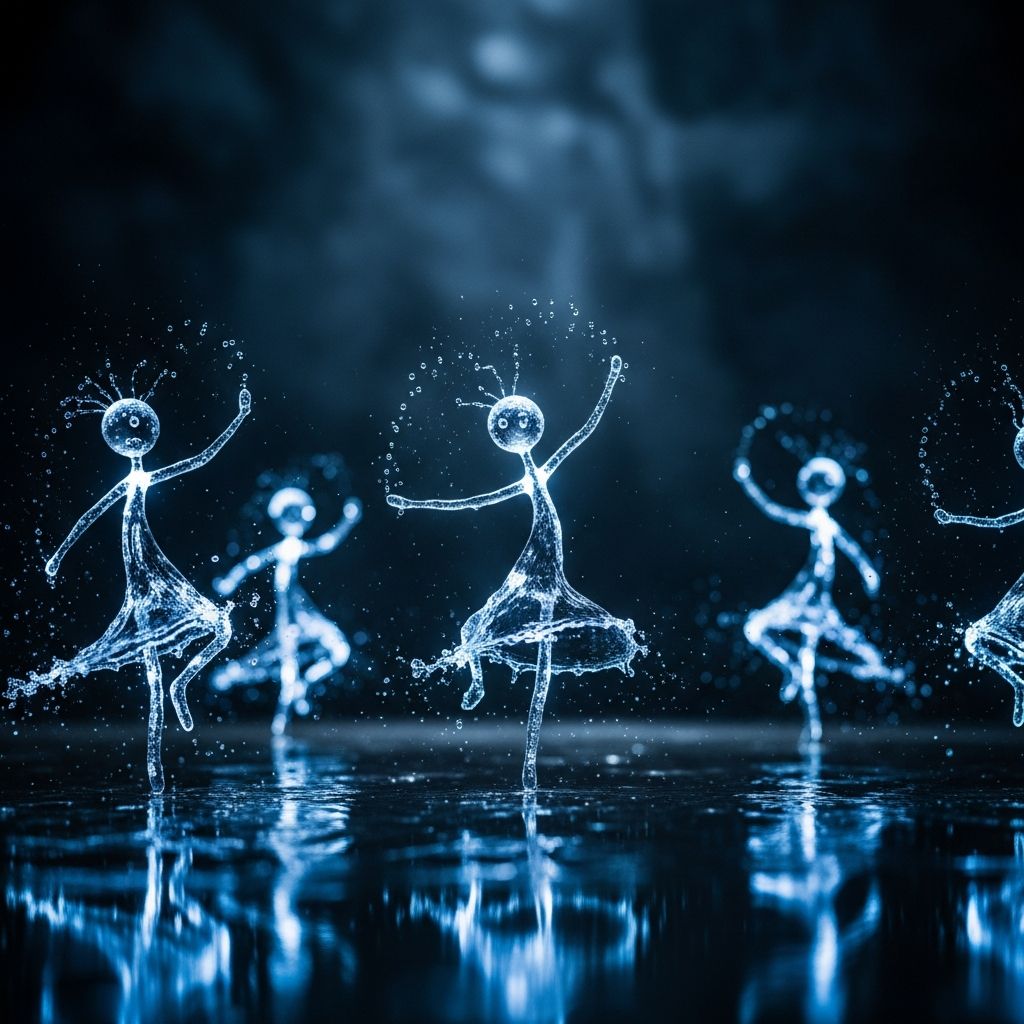
Every so often, the internet rediscovers a simple little trick that looks like magic, feels brand new, and yet relies on ideas that scientists have known for generations. A drawing coming to life as a stick figure that suddenly breaks free and “dances” across a puddle of water is one of those moments. Kids point, adults laugh, and underneath the surprise is a quiet lesson in physics and chemistry waiting to be noticed.
This article unpacks how that viral dancing-water illusion works, why it fascinates us, and how parents, teachers, and curious kids can use it as a doorway into real science rather than just a passing meme.
Why Moving Drawings Captivate Us
Watching a rigid little figure float off the surface and wobble around in the water hits a sweet spot between play and wonder. To a child, it is a cartoon escaping the page. To an adult, it is a rare reminder that the everyday world is still capable of surprise. That emotional reaction is exactly what makes this trick so useful for learning.
- It is instantly visual: No explanation is needed for the effect to be entertaining.
- It is simple to repeat: With the right marker and a smooth surface, anyone can try it at home.
- It invites questions: Children naturally ask, “How did it move?” and “Can I make other shapes do that?”
Those questions open the door to important ideas: what water does at surfaces, how some solids stick and others don’t, and how vibrations or flowing water can turn a rigid shape into a moving one.
The Everyday Science Behind a Viral Trick
To understand a dancing drawing, it helps to zoom out and look at a few core pieces of physics and chemistry that quietly shape our world: surface tension, interactions between water and different materials, and how vibrations or flows can make liquids appear to dance.
Surface Tension: Why Water Behaves Like It Has Skin
Water molecules attract one another strongly through hydrogen bonding, especially at the surface where they have fewer neighbors. This attraction creates surface tension, which makes water behave as if its surface were covered by an invisible, stretchy film.
- It is why small insects can stand on water without sinking.
- It helps droplets keep a rounded shape on a clean surface.
- It resists the spreading and breaking of the surface when something disturbs it.
When a drawn figure seems to lift off and glide, the water’s surface tension is part of what keeps the drawing intact as a single piece instead of dissolving instantly.
Hydrophobic vs. Hydrophilic: Who Likes Water and Who Avoids It
Not all surfaces get along with water in the same way. Some attract water strongly and let it spread; others repel it and encourage droplets to bead up.
- Hydrophilic surfaces attract water. Think of clean glass where water quickly spreads into a thin film.
- Hydrophobic surfaces repel water. Waxed car paint or nonstick cookware tend to make water bead into rounded drops.
The ink used in the stick figure trick is usually more compatible with the smooth surface than with water. When water is poured gently over the dried drawing, the liquid sometimes creeps under parts of the ink that do not adhere strongly, peeling them up and allowing the solid pigment or binder to detach and float. The result looks like a drawing coming alive.
When Water Itself Starts to Dance
The illusion feels even more magical when the stick figure does not only float but appears to jiggle, spin, or drift in a playful way. That motion can be nudged by tiny flows or vibrations. In many science demonstrations, water visibly “dances” when subjected to sound or heat.
- Vibrations and sound: When a bowl or plate vibrates at certain frequencies, standing wave patterns form on the water surface, causing droplets and thin films to jump and move.
- Hot surfaces: In the Leidenfrost effect, droplets on a very hot pan skate around on a cushion of their own vapor, giving the impression of lively, dancing water.
Though the viral stick figure trick usually does not require extreme heat, the same broad idea holds: tiny motions at the surface, from pouring or tapping, can make a floating piece of solid ink twist and wobble like it is dancing.
From Sink to Science Lab: How the Illusion Works
The precise behavior depends on the exact pen, surface, and water used, but most versions of the trick follow a similar pattern. Here is a simplified breakdown in conceptual steps rather than a recipe.
| Step | What You See | What Is Happening |
|---|---|---|
| 1. Drawing on a smooth surface | A stick figure or shape appears crisp and solid. | Ink dries as a thin layer on a relatively non-porous, smooth material such as glazed ceramic or tempered glass. |
| 2. Adding water | Water creeps toward and over the drawing. | Water wets the bare surface better than it wets the dried ink, sneaking underneath cracks or weak spots. |
| 3. Separation | Parts of the drawing lift off and float. | The solid pigment plus binder detaches where adhesive forces to the surface are weaker than the forces between water and the surface. |
| 4. Movement | The detached figure drifts, spins, or “dances.” | Subtle flows, convection currents, or vibrations move the floating piece across the water surface while surface tension keeps it mostly intact. |
From a child’s point of view, the drawing has learned to swim. From a scientific point of view, a delicate balance between adhesion, cohesion, and motion has been tipped just enough for a thin solid film to become a mobile raft on a liquid surface.
What Dancing Water Teaches About Real Research
Although the kitchen version is playful and imprecise, the underlying ideas show up in serious scientific work. Researchers who study water at the smallest scales routinely describe its behavior as a kind of intricate dance around other molecules.
The Molecular Ballet Around Proteins
Inside the body, water does far more than simply fill space. Experiments and simulations show that water molecules near a protein move and rearrange differently than water farther away, forming a dynamic “solvation shell.” This shell can:
- Influence how proteins fold into their working shapes.
- Alter reaction rates at biological surfaces.
- Help or hinder the formation of damaging clumps associated with certain diseases.
Physicists and chemists use tools such as molecular dynamics simulations and advanced spectroscopy to uncover how this microscopic dance works. The language is more technical, but the image is not so different from the viral illusion: structures surrounded by water, surfaces being wetted and unwetted, and motion emerging from countless small interactions.
Why Water at Surfaces Matters Everywhere
Beyond biology, the way water behaves where it meets air or solid materials shapes countless phenomena, from cloud chemistry and climate to industrial processes. Understanding who sticks to what—whether a gas molecule sits at the surface or dives into the bulk liquid, whether a thin film detaches or stays put—matters in fields as diverse as atmospheric science and materials engineering.
The dancing stick figure in a household sink does not solve any of those problems, but it provides a miniature, visible hint of how complex water can be when it interacts with surfaces and forces at just the right scale.
Turning a Viral Trick Into a Learning Moment
For parents, caregivers, and teachers, the real value of the trick is not in performing it perfectly; it is in using it as a springboard for questions and experiments.
Conversation Starters for Kids
Instead of treating the illusion as a one-time show, try inviting kids to be co-investigators:
- “What do you think made it move?” Encourage them to guess first, even wildly.
- “Can all drawings do this?” Lead them toward testing different pens and surfaces.
- “What changed when we poured the water?” Focus attention on the moment when the figure lifts off.
These discussions build habits of observation, prediction, and explanation that underlie scientific thinking, even for very young children.
Simple Variations to Explore
Without listing step-by-step instructions, you can suggest safe variations that highlight different aspects of the physics:
- Compare how much the drawing moves when the container is perfectly still versus when the table is gently tapped.
- Try broader shapes versus thin lines and see which stay together on the water.
- Observe what happens when water is added all at once compared with adding it slowly along the edge.
Each small change becomes an experiment that tests a child’s guess about what matters: shape, speed, or vibration.
Safety, Expectations, and Real-World Messiness
Not every surface, pen, or water temperature will produce the internet-ready effect. Sometimes the drawing disintegrates, sometimes nothing moves, and sometimes the result is a streaky blur instead of a clean dancing figure.
- Embrace imperfect results: Failures are data, and noticing patterns across many tries can be more educational than a single success.
- Protect surfaces: Use dishes or tiles that are easy to clean and not easily stained.
- Focus on the questions, not the performance: The goal is understanding, not viral perfection.
These practical limits are themselves a useful lesson: science in the real world is often messy, and repeating an effect is part of what turns a curiosity into genuine knowledge.
Frequently Asked Questions (FAQs)
Why does the stick figure stay together instead of breaking apart in the water?
The dried ink or pigment sometimes acts as a thin, flexible solid film. When water seeps under it, the film lifts as a mostly intact piece. Surface tension holds the water together at the surface, and the floating film behaves like a tiny raft, so it can drift without instantly dissolving.
Is heat necessary to make water or drawings “dance”?
No. Heat can create spectacular effects such as the Leidenfrost effect, where droplets skate on a cushion of vapor over a very hot surface. However, the popular stick figure trick typically relies more on surface properties, ink composition, and gentle flows or vibrations than on high temperatures.
What role does vibration play in moving the floating figure?
Even small vibrations—like a hand bumping the table—can create waves and standing patterns on the water surface. Similar demonstrations with specialized bowls show water forming stable wave shapes where droplets leap and dance in response to sound-driven vibrations. In a household setup, the effect is usually subtler but follows the same idea: motion in the container becomes motion of the floating drawing.
How does this relate to real scientific research on water?
Researchers investigate how water behaves at interfaces, like where it meets proteins or aerosol particles, because this behavior shapes everything from biological reactions to atmospheric chemistry. They find that water near other molecules often moves in organized, dynamic patterns—sometimes described metaphorically as a dance—rather than acting like a featureless liquid.
Can kids learn meaningful science from such a simple trick?
Yes. The illusion is an opportunity to practice asking questions, forming explanations, and testing ideas. Concepts like surface tension, adhesion, and the way vibrations create motion are central to physics and chemistry. Even if the language stays simple, the experience lays a foundation for deeper understanding later on.
References
- The Water Dance — U.S. National Science Foundation. 2010-06-21. https://www.nsf.gov/news/water-dance
- When water dances: The mystery of the bouncing water droplets — JUnQ (Journal of Unsolved Questions). 2013-10-25. http://junq.info/?p=3806
- Dancing with the Molecules — University of Illinois Department of Chemistry. 2009-12-31. https://chemistry.illinois.edu/news/2009-12-31t163858/dancing-molecules
- Science Minute from the MOST: Dancing Water Bowl — Museum of Science & Technology (YouTube). 2016-01-07. https://www.youtube.com/watch?v=izixhE5CrhY