Navigating Your Child’s Path to Independent Walking
Walking represents one of the most celebrated developmental achievements in early childhood, yet it remains one of the most variable milestones across children. Parents often find themselves anxiously awaiting that first independent step, comparing their child’s progress to peers, and wondering whether their toddler’s walking patterns are typical. Understanding the range of normal development, recognizing the foundational skills required, and knowing when professional evaluation is warranted can help alleviate parental anxiety and support optimal physical development.
The Timeline of Walking Development: What to Expect
Babies typically begin independent walking somewhere between 10 and 18 months of age. However, most children take their first steps around 12 to 15 months. It’s important to recognize that this timeline represents a broad range, and children who fall at either end of this spectrum are often developing typically. Research indicates that approximately 10% of typically developing toddlers may not achieve independent walking until 14.4 months or later. The World Health Organization has documented that independent ambulation can occur anywhere between 8 and 18 months of age, demonstrating the significant natural variation in this milestone.
The progression toward walking typically unfolds over several months, with babies building the necessary strength, balance, and coordination through a series of interconnected developmental stages. This progression is not rigid—some children follow a traditional sequence while others skip certain steps entirely and still develop perfectly normal walking patterns.
Foundational Skills That Precede Independent Walking
Before a child takes their first independent steps, numerous developmental prerequisites must be in place. These skills build upon one another, creating the physical and neurological foundation necessary for autonomous movement.
Early Stability Development
Around 4 months of age, babies begin lifting their heads with control when placed on their stomachs, establishing the foundation for upper body strength. By 6 months, most infants actively roll from back to belly and can sit upright without support. These early achievements establish the trunk stability and upper body control that will eventually support walking.
Crawling and Ground Mobility
Around 8 months, many babies begin crawling on hands and knees, though not all children follow this path. Interestingly, some infants shuffle on their bottoms instead, while others move directly toward standing without significant crawling phases. Research shows that children who crawled on hands and knees walked on average 0.9 months earlier than those who shuffled on their bottoms, though both groups developed typical walking patterns. By 9 months, babies typically take full weight on their legs while standing and can walk when supported on furniture or when hands are held.
Weight Bearing and Balance
Between 7 to 10 months, infants begin pulling up to stand by relying on furniture or a caregiver’s hands and legs. This crucial stage requires sufficient leg strength to support body weight and emerging balance mechanisms. Babies generally learn to stand without support—at least momentarily—between 10 to 16 months of age. The transition from supported standing to unsupported standing represents a major milestone, as children’s confidence and balance improve with each day of practice.
The Walking Progression: From First Steps to Confident Movement
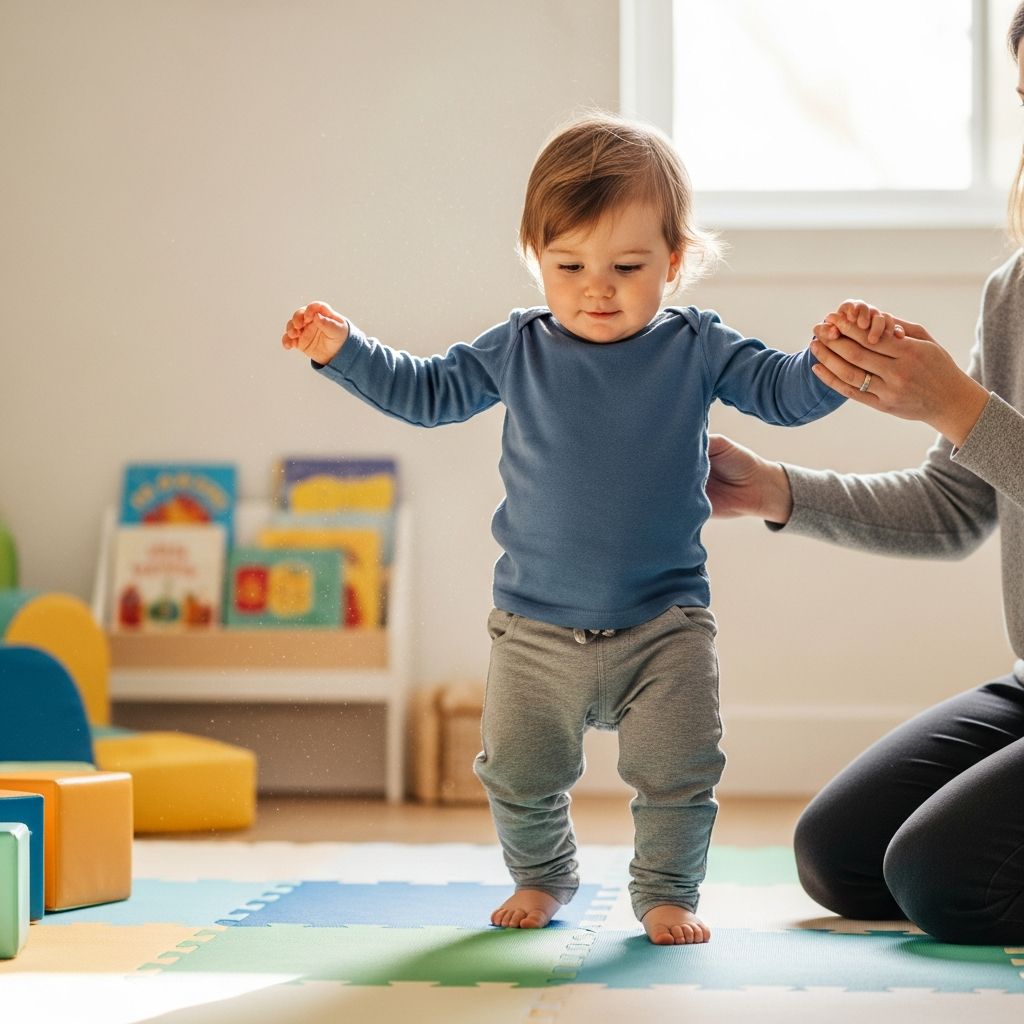
Once a child begins taking independent steps, distinctive characteristics emerge that gradually transform into more mature walking patterns. Understanding these typical patterns can help parents recognize normal development.
Initial Walking Characteristics
New walkers typically display several recognizable features:
- A wide base of support, with feet positioned far apart for stability
- Short stride length and high stepping gait patterns
- Foot contact that begins with a flat foot or forefoot strike rather than a heel strike
- Arms held in a “high guard” position, with shoulders raised and elbows flexed
This distinctive “waddling” appearance is completely normal and serves an important purpose—the wide stance and arm position provide maximum stability while the child’s balance systems are still developing. Many parents describe this phase as adorable precisely because it looks so different from adult walking.
Maturation of Gait Patterns
With practice and repeated exposure to varied environments and surfaces, the toddler’s gait pattern gradually becomes more sophisticated. About 6 months after taking their first steps, toddlers develop a more mature gait, holding their hands at their sides rather than in the high guard position and moving with their feet closer together. These changes include:
- Decrease in the base of support as balance improves
- Decrease in the time spent in double limb support during the gait cycle
- Increase in step and stride length
- Increase in walking cadence or speed
- Emergence of heel strike, typically around 2 years of age
- Development of reciprocal arm swing
The transition to heel-toe walking typically emerges once a child is a proficient walker, around 2 to 3 years of age. This mature pattern, where the heel makes contact with the ground first and weight shifts through the midfoot and ball of the foot, represents significant neurological and muscular coordination.
Individual Variation: Why Every Child’s Timeline Differs
One of the most important concepts for parents to understand is that walking timelines vary considerably among typically developing children, and this variation does not predict future athletic ability or developmental outcomes.
Factors Influencing Walking Onset
Multiple factors influence when children begin walking:
- Age and individual developmental readiness of the child’s neurological systems
- Body dimensions, including muscle-fat ratio and proportions
- Maturation of the central nervous system
- Head and trunk postural stability
- Environmental opportunities for practice
- Personality and confidence level of the individual child
Some children are naturally more cautious and may take longer to venture into independent walking, preferring the security of furniture cruising for extended periods. Others are naturally bold and may attempt walking earlier. Neither approach indicates future development; they simply reflect individual temperament and learning styles.
Environmental Influences
The physical environment where children practice significantly impacts their walking development. Research demonstrates that less crowded homes enabled more walking practice, supporting developing walkers and allowing infants to practice in comfortable environments. Children who have open spaces to explore and safe furniture to cruise along tend to have more opportunities for the repetitive practice that builds walking confidence and skill.
Normal Variations in Walking Patterns
Parents often worry about variations in how their children walk, but many patterns that appear unusual are actually normal developmental variations that resolve without intervention.
Toe Walking
Occasional toe walking is a typical part of toddler development and should not cause concern. Rising onto their toes helps with later motor skills like reaching overhead and jumping. The calf muscles involved in toe walking are developing important strength and coordination. Most children naturally transition to a flatter foot strike as their walking skills mature, typically by 3 years of age.
Side Stepping and Waddling
Once your child starts walking, you’ll notice considerable horizontal movement—side stepping or waddling side to side with tiny forward steps. This variation is completely typical and reflects the child’s balance system still organizing itself. With months of practice, these waddles naturally transform into confident strides as children bring their legs closer together and take larger forward steps.
Asymmetrical Patterns
Some children develop slightly asymmetrical walking patterns, favoring one side or walking with an uneven stride. While persistent significant asymmetry warrants professional evaluation, minor variations often resolve as children practice and their neurological systems mature.
The Role of Practice and Environmental Exploration
Research emphasizes the importance of natural, variable practice regimes in enabling toddlers to develop adaptive locomotor behaviors. Unlike formal training, children’s natural practice involves a distinctive pattern that optimizes learning.
Variable Practice Patterns
Toddlers engage in variable practice, taking short bursts of steps followed by resting periods, exploring diverse movements, surfaces, and directions during locomotion. This intermittent practice approach—rather than prolonged forced practice—appears optimal for developing walking skills. Children intuitively take breaks when they need them, rest, and then resume practice, creating a natural rhythm that supports skill development.
Environmental Diversity
As children practice walking, they encounter and learn to navigate different environments and challenges, including:
- Different terrain textures such as slippery surfaces and rough ground
- Grades, slopes, and stairs
- Stepping over obstacles
- Running and quick stops
- Directional changes
- Jumping and climbing
- Carrying and maneuvering objects
This variability in practice helps toddlers develop a perceptual-motor system adept at change, allowing them to adapt and learn to walk in ever-changing environments. Parents can support this natural learning by providing access to varied spaces and surfaces during supervised play.
When to Consult a Healthcare Provider
While walking timelines vary considerably, certain signs warrant professional evaluation to rule out developmental concerns.
Developmental Red Flags
Parents should consult a pediatrician if their child by 18 months of age:
- Has not begun cruising along furniture or pulling up to stand
- Shows no interest in practicing walking even with support
- Cannot stand independently, even for brief moments
- Demonstrates significant imbalance or coordination difficulties
- Shows marked asymmetry in movement or strength
- Has limited head and upper body control
Additionally, parents should report to their pediatrician if their child demonstrates persistent toe walking beyond 3 years of age, significant toe-in or toe-out positioning, or walking patterns that appear to worsen over time rather than improve.
The Importance of Professional Assessment
Skilled clinical examination and knowledge of locomotor milestones are the most common methods to identify potential motor impairments in toddlers. A pediatrician or developmental specialist can differentiate between normal variation and patterns that warrant intervention. Many concerns that worry parents resolve naturally without intervention, but professional evaluation provides reassurance and identifies the small percentage of children who would benefit from early support services.
Supporting Healthy Walking Development
Creating Safe Practice Environments
Parents can optimize walking development by providing a safe environment for early walking, giving lots of playtime, and encouraging babies to move around independently and experiment. This includes ensuring that heavy furniture is secure so children cannot pull it over onto themselves while cruising.
Footwear Considerations
Once your baby starts walking, they only need to wear shoes if they are going outside. Barefoot walking at home provides valuable sensory feedback that supports balance and coordination development. When shoes are necessary, flexible options that allow natural foot movement support optimal development better than rigid or overly supportive shoes.
Avoiding Walkers
Baby walkers should be avoided, as research demonstrates they delay development of walking skills and may cause injuries. Instead of mechanical walkers, children benefit more from having open spaces to explore, furniture to cruise along, and opportunities for independent movement.
Frequently Asked Questions About Toddler Walking
Is my child delayed if they’re not walking by 12 months?
No. While 12 months is a common age for first steps, the typical range extends to 18 months. Approximately 10% of typically developing children don’t walk until 14.4 months or later. If your child is progressing through prerequisite skills like pulling to stand and cruising, early delay is often not concerning.
Should I be concerned about toe walking?
Occasional toe walking in young toddlers is normal and helps develop muscles needed for jumping and reaching. However, if toe walking is persistent and exclusive by 3 years of age, mention it to your pediatrician.
Why does my toddler waddle instead of walk normally?
The characteristic waddle with a wide base of support is normal for beginning walkers. This stance provides stability while balance systems develop. With practice over months, this pattern naturally matures into an adult-like gait.
How much practice does my child need to develop walking skills?
Children naturally practice in short bursts followed by rest periods. This variable, self-directed practice is optimal and more effective than forced practice sessions. Provide safe space and encouragement, then let your child lead.
When should my child transition to shoes?
Shoes are only necessary when going outside. Barefoot walking indoors provides valuable sensory feedback supporting balance and coordination. When shoes are needed, choose flexible options that allow natural foot movement.
What if my child skipped crawling and went straight to walking?
This is completely normal. Not all children crawl, and skipping this stage does not indicate developmental problems. As long as your child progresses through other milestones like pulling to stand and cruising, development is on track.
References
- Early Development of Toddler Walking and Other Locomotor Tasks — Physio-pedia. Accessed 2026. https://www.physio-pedia.com/Early_Development_of_Toddler_Walking_and_Other_Locomotor_Tasks
- Walking: When do babies start and how to encourage it — Lovevery. Accessed 2026. https://blog.lovevery.com/skills-stages/walking/
- When do babies start walking? The stages of learning to walk — Medical News Today. Accessed 2026. https://www.medicalnewstoday.com/articles/when-do-babies-start-walking
- Movement, Coordination, and Your 1- to 2-Year-Old — Kids Health. Accessed 2026. https://kidshealth.org/en/parents/move12yr.html
- Learning to walk — Pregnancy Birth and Baby. Australian Government Department of Health. Accessed 2026. https://www.pregnancybirthbaby.org.au/learning-to-walk
- Developmental Milestones For Walking In Children — YouTube. Accessed 2026. https://www.youtube.com/watch?v=GUgb4s_MCD4
- CDC’s Developmental Milestones — Centers for Disease Control and Prevention. 2024. https://www.cdc.gov/act-early/milestones/index.html