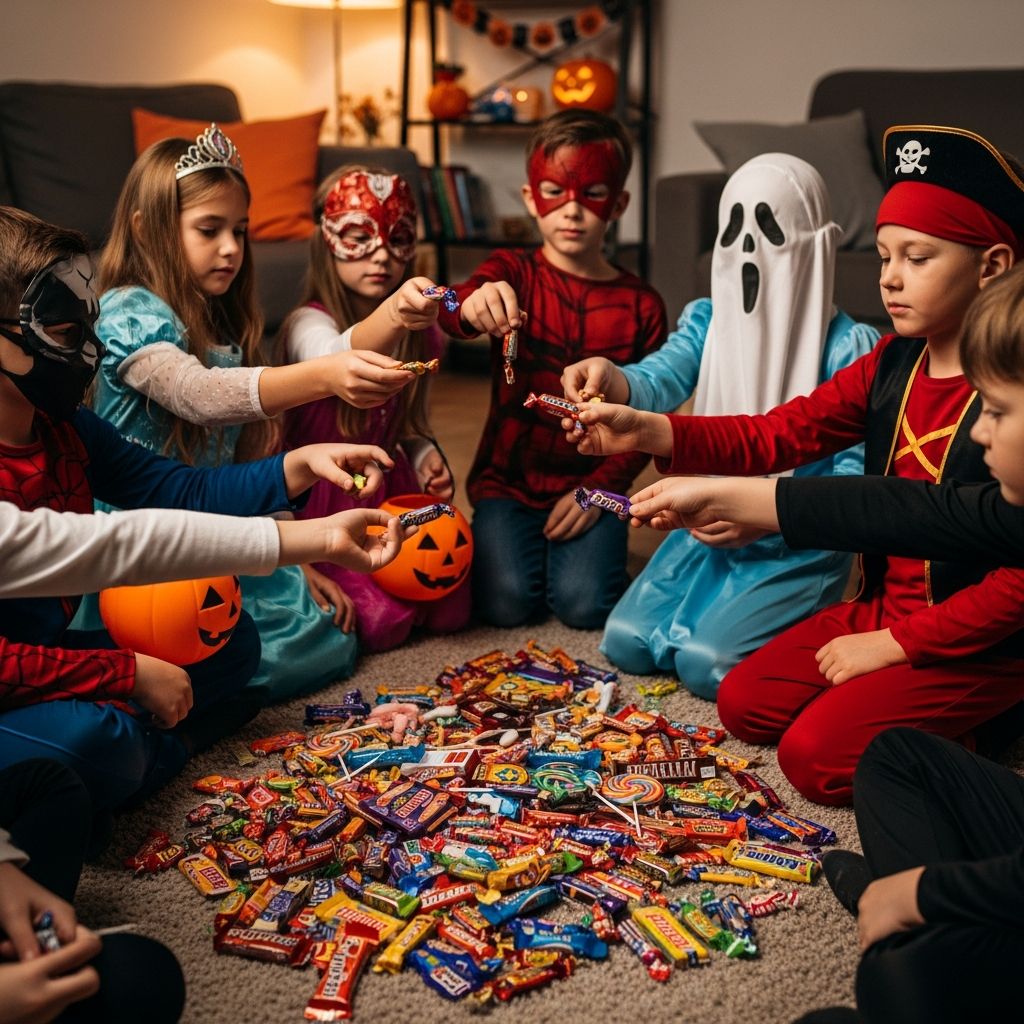
Every Halloween, children return home with pillowcases brimming with sweets, setting the stage for one of the most spirited economic experiments of the year: candy trading. This playful ritual transforms living rooms into bustling marketplaces where young traders negotiate, barter, and strategize to optimize their hauls. Far from mere childish haggling, these exchanges embody key economic principles like subjective value, voluntary trade, and opportunity cost, offering parents a unique chance to foster financial savvy.
The Birth of a Mini-Market on the Floor
As soon as the candy hits the carpet, kids instinctively sort their treasures. Chocolate bars pile in one corner, gummy treats in another, while less favored items like hard candies or fruity chews face uncertain fates. This sorting phase reveals the first economic truth: value is subjective. What one child prizes as a top-tier treat might be another’s reject.
Economists note that this mirrors adult markets where goods hold different worth based on personal preferences. A child with a surplus of peanut butter cups might view them as abundant and thus less precious, while another craves them intensely. Trading begins when these mismatched desires align, creating opportunities for mutual gain.
- Sorting by preference: Kids rank candies from favorites to discards.
- Scouting opportunities: Eyeing peers’ piles for desired items.
- Initial propositions: Simple swaps like ‘your gummy worms for my chocolate coin.’
These early deals highlight voluntary exchange, a cornerstone of free markets. Both parties walk away happier, having converted unwanted items into delights.
Subjective Value: Why Your Snickers Isn’t My Treasure
At the heart of candy trading lies subjective value—the idea that worth depends on the individual. A full-size chocolate bar might dazzle one trader, but if it’s not their flavor profile, it’s just bulk to offload. Kids quickly learn to gauge not only their own valuations but also infer others’ through observation and questions.
Consider a scenario: Child A adores licorice but despises caramel. Child B feels the opposite. A straight swap elevates both hauls without loss. But when preferences don’t perfectly align, ratios emerge—two caramels for one licorice twist. This negotiation teaches that trade terms reflect relative desires, much like currency exchange rates in global commerce.
| Candy Type | Child A’s Value (1-10) | Child B’s Value (1-10) | Potential Trade Ratio |
|---|---|---|---|
| Milk Chocolate Bar | 9 | 4 | 1 bar = 2 fruity candies |
| Gummy Bears | 3 | 8 | 2 packs = 1 chocolate bar |
| Hard Candies | 2 | 5 | 3 pieces = 1 gummy pack |
This table illustrates how differing valuations drive trades. Parents can use such visuals to discuss why no universal price exists for candy—it’s all about personal utility.
Diminishing Returns: The More You Have, The Less Each Piece Means
As piles grow, children encounter diminishing marginal utility. The first Snickers bar brings pure joy, the second still thrills, but by the tenth, its allure fades. A kid swimming in chocolate might trade extras for variety, recognizing that additional units add less satisfaction.
This principle explains why trades often involve bundles. Three identical bars for one rare full-size treat makes sense when the trader has plenty. It introduces scarcity too—limited favorites become premium commodities, commanding higher ‘prices’ in candy terms.
- First unit: High value, reluctant to trade.
- Middle units: Balanced trades possible.
- Excess units: Eager to exchange for novelty.
Encouraging kids to track their pile’s composition helps them spot these patterns, turning impulse into strategy.
Negotiation Tactics: From Honest Barter to Sly Bluffing
Trading isn’t just about values; it’s a negotiation arena. Younger kids propose boldly, older ones probe weaknesses. Honesty builds long-term partnerships—vital with siblings who trade yearly. Yet, some employ poker faces, exaggerating disinterest to snag better deals.
Parents observe dynamics: older siblings might leverage experience to ‘buy low,’ trading small for big from naive juniors. This reflects real-world power imbalances but also teaches resilience. Guiding with questions like ‘Does this deal improve your haul?’ promotes fair play without stifling fun.
Key tactics include:
- Information gathering: Asking ‘What’s your favorite?’ to uncover leverage.
- Bundling: Offering multiples to sweeten offers.
- Walk-away power: Being willing to end talks preserves value.
Risks and Rewards: Embracing Uncertainty in Trades
Not all deals are sure wins. Kids face risk when trading for unknowns, like a wrapped surprise or peer’s vague description. This parallels investing, where potential gain tempts despite uncertainty. A safe swap yields certain improvement; a gamble might yield bounty or bust.
Games amplifying this—trading for lottery-style draws—teach probability. One candy for a chance at prizes weighs immediate gratification against upside. Older kids (third grade+) grasp this better, balancing candy’s low cost with thrill of possibility.
Parental Role: Guiding the Marketplace Without Controlling It
Adults shouldn’t dictate trades; that kills learning. Instead, facilitate: set trading zones, mediate disputes, impose a light ‘tax’ (1-2 pieces per pile) to discuss real taxes playfully. Post-trade, debrief: ‘What worked? What would you change?’
This low-stakes environment—candy’s ephemeral—builds skills safely. Resentments fade by morning, unlike adult finances. Respect property rights: each child’s haul is theirs, fostering ownership.
Real-World Parallels: From Candy to Careers
Halloween trading foreshadows life. Stock markets thrive on differing valuations; salaries negotiate preferences; entrepreneurship spots unmet needs. Kids practicing now enter adulthood equipped.
Economists affirm: these rituals instill property rights, voluntary cooperation, and market signals intuitively.
Frequently Asked Questions
What age is best for candy trading lessons?
Start around 5-6 years, when kids grasp preferences. Younger ones observe; third grade+ handles complex ratios and risks.
Should parents intervene in unfair trades?
Only if coercion occurs. Let natural consequences teach; discuss post-trade to build reflection.
How does the ‘parent tax’ work?
Claim 10-25% of hauls as ‘costs’ for chaperoning. Use it to illustrate government roles transparently.
Can this teach beyond economics?
Yes—negotiation, empathy, delayed gratification, and social dynamics all emerge organically.
What if a child refuses to trade?
Respect it. Hoarding teaches opportunity cost; future Halloweens offer retries.
Building Lasting Skills Through Sweet Deals
Halloween candy trading distills economics into edible form. By valuing subjectivity, honing negotiation, and navigating risks, kids gain tools for life. Parents amplify this by observing, questioning, and connecting dots to broader concepts. Next All Hallows’ Eve, embrace the chaos—it’s a classroom in disguise.
(Word count: 1624)
References
- Economics of Halloween Candy Trading — Susquehanna University. 2020. https://www.susqu.edu/787-the-economics-of-candy-trading/
- Halloween: The Night Kids Discover Economics — Foundation for Economic Education (FEE). 2018-10-30. https://fee.org/resources/halloween-the-night-kids-discover-economics/
- What Halloween Taught Me About Economics — America’s Future Foundation. 2023. https://americasfuture.org/what-halloween-taught-me-about-economics/
- The Weird, Wild Economics of Halloween Candy Trading — Fatherly. 2023. https://www.fatherly.com/life/halloween-candy-trading-kids-economics
- What Halloween Candy Can Teach You About Money — Stacking Benjamins (YouTube). 2025-10-28. https://www.youtube.com/watch?v=e7wwFvKcPGA