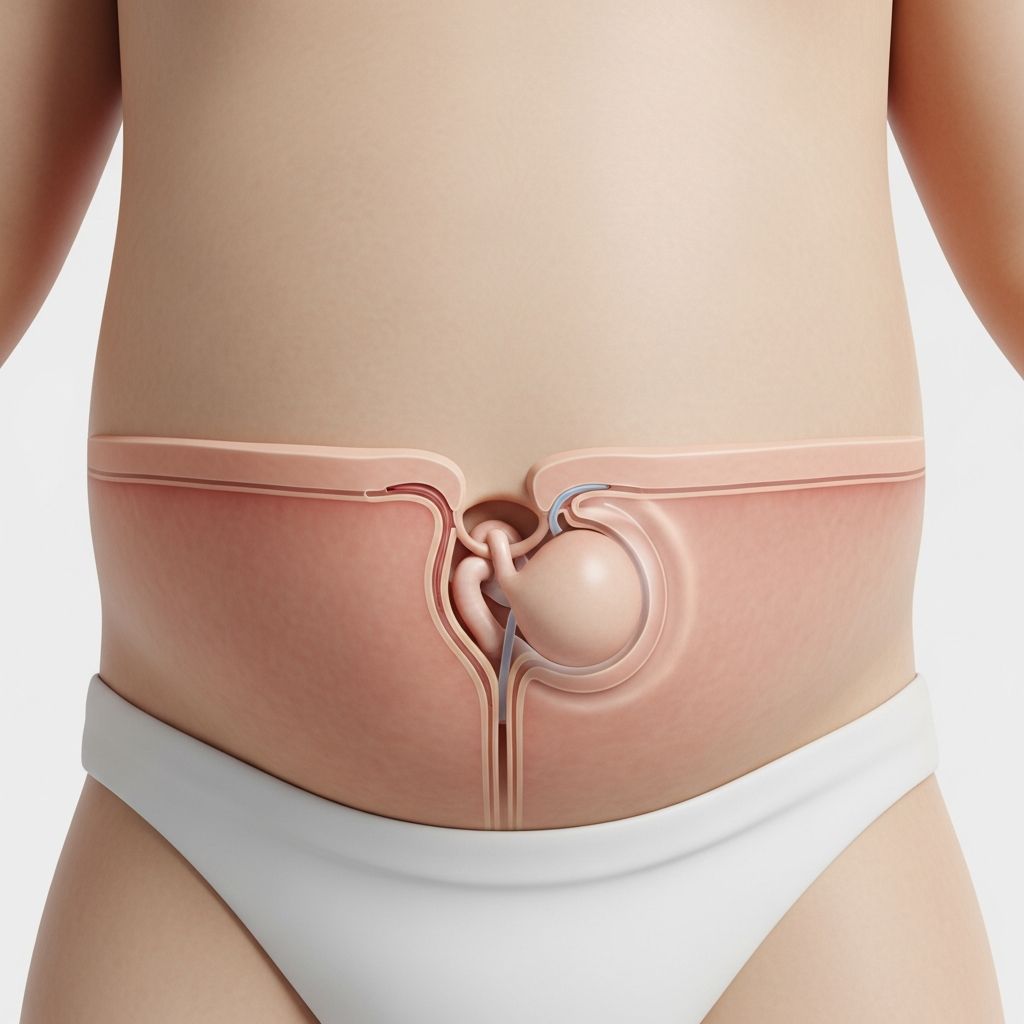
What Is an Umbilical Hernia in Children?
An umbilical hernia is a common condition in infants and young children where a small lump or bulge appears near the belly button. This happens because a small opening in the abdominal wall, created during fetal development for the umbilical cord, does not fully close after birth. As a result, a bit of fatty tissue or part of the intestine can push through this weak spot, creating a soft, visible bump.
These hernias are usually painless and most often harmless. They are especially noticeable when a child is crying, coughing, straining, or sitting up, because these actions increase pressure inside the abdomen. When the child is relaxed or lying down, the bulge often shrinks or disappears completely.
How Umbilical Hernias Develop
During pregnancy, the umbilical cord passes through a small opening in the baby’s abdominal muscles. After birth, this opening normally closes as the abdominal muscles grow together. In some babies, however, the muscles do not fully seal, leaving a small gap. This gap is the weak spot where an umbilical hernia forms.
The hernia itself is not a disease, but rather a structural variation. The bulge is usually made up of peritoneum (the lining of the abdominal cavity) and sometimes a small loop of intestine. Because the opening is typically small, serious complications are rare in early childhood.
Recognizing the Signs in Babies and Toddlers
Parents often first notice an umbilical hernia when their baby is crying or straining. The main signs include:
- A soft, round or oval bulge at or near the navel
- The bulge becomes more obvious during crying, coughing, or bowel movements
- The bulge flattens or disappears when the child is calm or lying down
- No pain or discomfort in most cases
- Skin over the bulge looks normal—no redness, warmth, or discoloration
In many children, the hernia is only a few centimeters wide. Larger hernias may be more noticeable and may persist longer, but size alone does not always predict whether treatment will be needed.
When to See a Doctor
Most umbilical hernias do not require urgent medical attention, but it is important to have a pediatrician evaluate any belly button bulge to confirm the diagnosis. A doctor can usually diagnose an umbilical hernia just by looking at and gently feeling the area.
Parents should contact a healthcare provider if any of the following occur:
- The bulge becomes hard, swollen, or discolored (red, purple, or dark)
- The child is in pain, especially if the pain is severe or worsening
- The child is vomiting, especially repeatedly
- The bulge cannot be gently pushed back in or remains enlarged even when the child is relaxed
- The child seems unusually fussy, lethargic, or unwell
These symptoms could indicate that part of the intestine is trapped (incarcerated) or has its blood supply cut off (strangulated), which is a medical emergency requiring immediate care.
Who Is More Likely to Have an Umbilical Hernia?
Umbilical hernias are very common in newborns and infants. They can occur in any baby, but certain factors increase the likelihood:
- Being born prematurely
- Having a low birth weight
- Being of African descent (some studies suggest a higher incidence)
- Having certain genetic conditions that affect connective tissue
There is no strong evidence that specific behaviors, such as how a baby is held or whether the belly button is “popped in,” cause or worsen umbilical hernias. The condition is related to how the abdominal wall develops before birth, not to anything parents do or do not do after delivery.
Do All Umbilical Hernias Need Treatment?
No, most umbilical hernias in children do not require treatment. In fact, the majority close on their own as the child grows and the abdominal muscles strengthen. Many close by age 1–2 years, and most resolve by age 4–5 years.
Doctors typically recommend a “watch and wait” approach for:
- Small hernias that are not causing discomfort
- Hernias that can be gently pushed back in (reducible)
- Children who are otherwise healthy and active
During regular well-child visits, the pediatrician will monitor the size and behavior of the hernia and advise whether any intervention is needed.
When Surgery Might Be Recommended
Surgery is not usually the first step, but it may be advised in certain situations. A pediatric surgeon might recommend repair if:
- The hernia is very large (often defined as wider than 1.5–2 cm)
- The hernia is still present after age 4–5 years
- The hernia is causing pain, discomfort, or limiting activity
- There is a history of the hernia becoming incarcerated (trapped)
- The hernia is growing instead of shrinking over time
The decision to operate is individualized. Factors like the child’s age, overall health, and the hernia’s characteristics are all considered. In many cases, surgery is a straightforward, low-risk procedure that can be done as an outpatient.
What Happens During Umbilical Hernia Surgery?
Umbilical hernia repair in children is usually performed under general anesthesia. The surgeon makes a small incision near the belly button, gently pushes the protruding tissue back into the abdomen, and then closes the muscle opening with strong, dissolvable stitches.
Key points about the procedure:
- The incision is small and often hidden in the natural folds around the navel
- Mesh is rarely used in children because their tissues are strong and the defect is usually small
- The surgery typically takes less than an hour
- Most children go home the same day
After surgery, the belly button may look slightly different for a short time, but it usually returns to a normal appearance as healing progresses.
Recovery After Surgery
Recovery from umbilical hernia repair is usually quick and uncomplicated. Most children feel better within a few days and can return to normal activities within 1–2 weeks.
Parents can expect:
- Mild discomfort or soreness around the belly button for a few days
- Instructions to keep the incision clean and dry
- Advice to avoid rough play, heavy lifting, or strenuous activities for a short period
- Follow-up visits to check healing and remove any non-dissolvable stitches if used
Parents should contact the surgeon if they notice:
- Signs of infection (increasing redness, swelling, warmth, pus, or fever)
- Severe or worsening pain
- Repeated vomiting
- Any new or unusual bulge near the incision
Common Myths and Misconceptions
There are many myths about umbilical hernias that can cause unnecessary worry. Here are a few that are not supported by medical evidence:
- Myth: Taping a coin or button over the belly button helps the hernia heal. Reality: This does not speed up closure and can irritate the skin or delay proper evaluation.
- Myth: Umbilical hernias always need surgery. Reality: Most close on their own without any treatment.
- Myth: Crying or straining causes the hernia. Reality: Crying makes it more visible, but it does not cause the hernia to form in the first place.
- Myth: An umbilical hernia can turn into an inguinal hernia. Reality: These are different types of hernias in different locations and are not related in that way.
Parents should rely on guidance from pediatricians and pediatric surgeons rather than home remedies or old wives’ tales.
Supporting Your Child at Home
For most children with an umbilical hernia, daily life is completely normal. Parents can support their child by:
- Following the pediatrician’s advice on monitoring the hernia
- Ensuring regular well-child checkups
- Encouraging healthy eating and drinking to prevent constipation, which can increase abdominal pressure
- Teaching older children not to worry about the bulge, especially if it is painless and reducible
- Reassuring the child that the condition is common and usually resolves without problems
If surgery is needed, preparing the child with simple, age-appropriate explanations and maintaining a calm, supportive environment can help reduce anxiety.
Long-Term Outlook
The long-term outlook for children with umbilical hernias is excellent. The vast majority of hernias close on their own or are successfully repaired with surgery if needed. Serious complications are rare, especially when parents know the warning signs and seek care promptly.
After the hernia is gone—whether by natural closure or surgery—children can participate in all normal activities, including sports and physical play, without restrictions.
Frequently Asked Questions
Can an umbilical hernia hurt my baby?
In most cases, no. Umbilical hernias are usually painless. If your baby seems to be in pain, especially with a hard, tender, or discolored bulge, contact a doctor right away.
Will my child’s belly button look different after the hernia goes away?
Often, the belly button returns to a normal appearance once the hernia closes. After surgery, there may be a small scar, but it usually fades over time and is not very noticeable.
Can umbilical hernias come back after they close?
Once a small hernia closes on its own, it rarely comes back. After surgical repair, recurrence is uncommon but possible, especially if there are ongoing factors that increase abdominal pressure.
Should I avoid letting my baby cry to protect the hernia?
No. Crying does not cause the hernia or make it worse in a harmful way. It only makes the bulge more visible. Babies need to cry to communicate, and restricting normal behavior is not necessary or helpful.
Do umbilical hernias affect a child’s growth or development?
No. Umbilical hernias do not interfere with a child’s growth, digestion, or overall development. They are a localized issue of the abdominal wall and do not affect internal organs in a way that impacts long-term health.
References
- Umbilical Hernia in Children — StatPearls, National Center for Biotechnology Information (NCBI). 2023. https://www.ncbi.nlm.nih.gov/books/NBK459312/
- Umbilical Hernia: Symptoms & Causes — Mayo Clinic. 2023. https://www.mayoclinic.org/diseases-conditions/umbilical-hernia/symptoms-causes/syc-20378685
- Umbilical Hernia in Infants and Children — Cincinnati Children’s Hospital Medical Center. 2023. https://www.cincinnatichildrens.org/health/u/umbilical-hernia