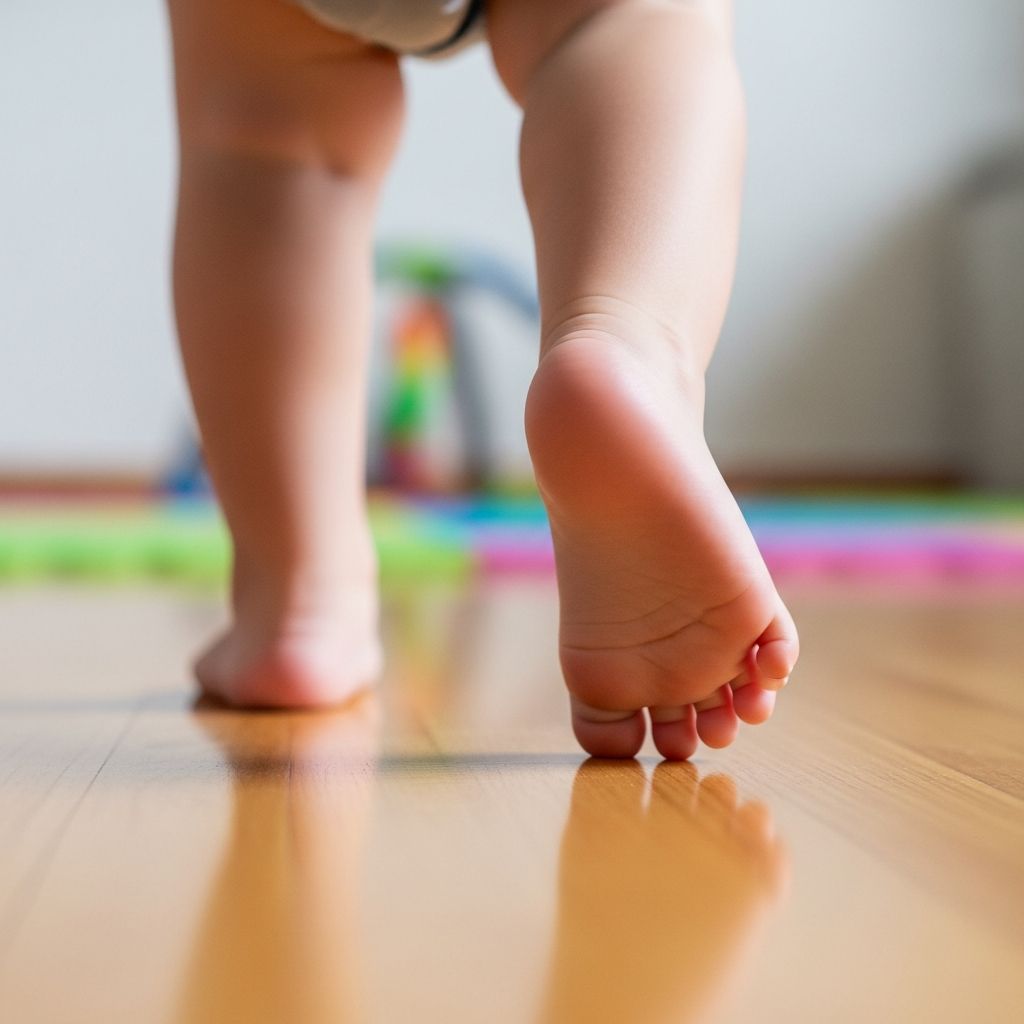
Seeing a toddler walk on their tiptoes can be both adorable and unnerving. Many children experiment with toe walking as they learn to balance, but in some cases, this pattern lingers and raises questions about development, muscles, or even nerves. This guide explains why toe walking happens, when it is usually harmless, and when it deserves a closer look by your child’s healthcare team.
What Counts as Toe Walking?
Toe walking means a child regularly walks on the balls of their feet or the tips of their toes, with the heels barely touching or never touching the ground. A child might:
- Walk mostly on toes during free play
- Run on toes but stand flat when still
- Seem unable or unwilling to put heels fully down while walking
Toe walking is very common in toddlers who are just mastering their first steps and is often part of normal gait development.
Normal Development: Why Many Toddlers Walk on Their Toes
Early walking is messy and uncoordinated. Toddlers are learning balance, figuring out where their body is in space, and experimenting with different ways of moving. Toe walking in this stage can be:
- Exploratory – trying out a new way of moving
- Enjoyable – some kids simply like the sensation of bouncing or being “taller”
- A balance strategy – shifting weight forward can help some toddlers feel more stable
Most children who toe walk as they learn to walk will stop on their own by about age 2 as their balance, strength, and coordination improve.
Common Reasons Kids Toe Walk
Not all toe walking has the same cause. Some are simple and benign; others are linked to medical conditions. Healthcare professionals often group causes into broad categories.
1. Habitual or Idiopathic Toe Walking
When a child older than toddler age continues to walk on their toes and no specific medical reason is found, it is called idiopathic toe walking (ITW). Idiopathic simply means “no known cause.” In these children:
- Strength and reflexes are usually normal
- Neurologic and orthopedic exams do not show a clear problem
- They often can walk with heels down when asked, especially at younger ages
2. Tight Muscles or Short Tendons
Some children toe walk because the structures in the lower leg make it hard to put the heel down:
- Tight calf muscles that resist stretching
- Short Achilles tendon, which connects the calf muscles to the heel bone and can physically limit heel contact with the ground
These children may struggle to keep their heels down even when they try, and may complain of stiffness or discomfort.
3. Neurological and Muscle Conditions
Less commonly, toe walking is linked to conditions that affect the brain, nerves, or muscles. Toe walking can be seen in:
- Cerebral palsy – increased muscle tone and stiffness in the legs can pull the heel off the ground
- Muscular dystrophy – progressive muscle weakness can change gait and posture
- Other neuromuscular disorders that affect coordination or muscle control
In these cases, toe walking is rarely the only concern. Parents or doctors usually notice other signs, such as delayed milestones, abnormal reflexes, or unusual movement patterns.
4. Developmental and Sensory Factors
Toe walking has also been reported more often in children with certain developmental conditions, including:
- Autism spectrum disorder (ASD)
- Other developmental or sensory processing differences
Some specialists think sensory preferences play a role: walking on the toes changes how the foot feels the ground and how the body senses movement, which some children might seek out or find calming.
When Is Toe Walking Usually Harmless?
Toe walking is more likely to be benign when:
- The child is younger than 2–3 years and still refining their gait
- They can walk flat-footed on request, even if they prefer toes
- There are no other developmental concerns: language, social skills, and motor milestones are on track
- They keep up with peers in play, running, and climbing
- No obvious weakness, stiffness, or frequent falls are present
Even in these reassuring scenarios, parents should still mention toe walking at regular checkups so the pediatrician can monitor change over time.
Red Flags: When to Call the Doctor
Experts recommend a medical evaluation if toe walking persists or is accompanied by other concerning signs. Seek professional input if:
- Your child is still toe walking most of the time after age 2
- Toe walking continues beyond age 3–4 without improvement
- Your child cannot walk with heels down even when asked
- You notice stiffness in the ankles or tight calf muscles
- Your child seems weak, uncoordinated, or has trouble with fine motor tasks (like using buttons or utensils)
- They fall often or struggle with running, jumping, or stairs
- There are concerns about speech, social interaction, or learning
- One leg looks or moves very differently from the other
Possible Complications of Persistent Toe Walking
Not every toe-walking child will develop problems. However, long-term toe walking can lead to:
- Shortened calf muscles and Achilles tendon, making flat-footed walking uncomfortable or impossible
- Gait abnormalities and altered posture that may stress the knees, hips, or lower back over time
- Increased tripping or falling, especially on uneven surfaces
- Self-consciousness or social attention if peers notice the difference in walking style
How Doctors Evaluate Toe Walking
A thorough evaluation helps distinguish habitual toe walking from signs of an underlying condition. A pediatrician may assess your child directly or refer you to a specialist such as a pediatric neurologist, physiatrist, orthopedic surgeon, or developmental pediatrician.
1. Detailed History
The clinician will usually ask about:
- When your child started walking and when you first noticed toe walking
- Whether toe walking happens all the time or only sometimes
- Pregnancy, birth history, and early milestones
- Any family history of toe walking, neuromuscular disorders, or developmental conditions
- Concerns about language, social skills, or learning
2. Physical and Neurological Exam
The exam often includes:
- Looking at muscle tone, strength, and reflexes
- Checking the range of motion in the ankles, knees, and hips
- Assessing Achilles tendon length and calf tightness
- Watching your child walk, run, and stand in different positions
If the exam is normal and no red flags are found, many children are diagnosed with idiopathic toe walking and monitored over time.
3. Additional Tests (When Needed)
If the doctor suspects a neurological or muscular condition, they may order further testing, such as:
- Imaging of the brain or spine
- Blood tests to look for muscle disease
- Formal gait analysis or specialist assessments
These tests are not necessary for every child and are usually reserved for situations where history or exam findings raise specific concerns.
Treatment Options for Persistent Toe Walking
Treatment depends on your child’s age, the severity of toe walking, and whether a cause is identified. In many cases, especially in younger children, careful observation and simple interventions are enough.
| Treatment Approach | Best For | Typical Goals |
|---|---|---|
| Watchful waiting & monitoring | Young children with mild toe walking, normal exams | Allow natural resolution while tracking development |
| Physical therapy & stretching | Idiopathic toe walking, mild tightness | Improve flexibility, strengthen muscles, encourage heel strike |
| Bracing or serial casting | Significant tightness or persistent idiopathic toe walking | Gradually stretch calf and Achilles tendon, retrain gait |
| Botulinum toxin injections | Selected cases with increased tone (e.g., cerebral palsy) | Reduce muscle overactivity to allow stretching and training |
| Surgery | Severe, rigid tightness not responding to other measures | Lengthen tendon or correct structural problems |
Physical Therapy and Home Exercises
Physical therapists can teach stretches and strengthening exercises tailored to your child’s needs. Goals typically include:
- Improving flexibility in the calves and Achilles tendon
- Strengthening muscles that support a normal heel-to-toe gait
- Practicing walking patterns that emphasize heel contact
Parents are often given home programs to reinforce therapy sessions.
Bracing and Casting
For some children, doctors recommend:
- Ankle–foot orthoses (AFOs) to limit excessive toe pointing and encourage heel strike
- Serial casting, where casts are changed regularly to gradually stretch tight muscles and tendons
These interventions are usually temporary and combined with physical therapy.
Surgical Options
When conservative treatments fail and a child has a very tight Achilles tendon or other structural limitation, surgery may be considered. Procedures aim to:
- Lengthen the Achilles tendon or calf muscles
- Improve ankle motion and allow the heel to reach the ground
Surgery is typically followed by casting, bracing, and therapy to protect the repair and retrain gait.
How Parents Can Support a Toe-Walking Child Day to Day
While medical teams focus on diagnosis and treatment, parents play a crucial role in everyday support.
- Stay observant, not alarmed. Track how often your child toe walks, and whether it is improving or worsening over months.
- Encourage barefoot play on safe surfaces (indoors or on grass) to give the feet rich sensory input.
- Incorporate stretching into playful routines if recommended by a therapist (e.g., games that involve squatting or heel walking).
- Focus on function, not appearance. Can your child participate comfortably in play, sports, and daily activities?
- Communicate with caregivers and teachers so they understand what to watch for and how to support your child.
Frequently Asked Questions About Toe Walking
Is toe walking always a sign of autism or another disorder?
No. Although toe walking can be seen more often in children with autism spectrum disorder or certain neurologic conditions, most persistent toe walking in otherwise healthy children is idiopathic, meaning no underlying condition is found.
At what age should I worry if my child is still walking on their toes?
Mention toe walking to your pediatrician at any age, but evaluation becomes more important if your child still toe walks most of the time after age 2, and especially if it continues beyond age 3–4 or your child cannot walk flat-footed on request.
Can toe walking fix itself without treatment?
Yes. Many children, especially younger ones with mild toe walking and normal exams, gradually shift to a typical heel-to-toe gait as they grow. Doctors may recommend simple observation with periodic follow-up in these cases.
Will my child have long-term problems if they toe walk?
Many idiopathic toe walkers do not develop serious long-term issues, particularly when monitored and treated early if needed. Persistent, untreated toe walking with significant tightness can contribute to joint stiffness, gait changes, or discomfort later on, which is why evaluation and follow-up are important.
What should I do while we are waiting for our appointment?
Keep a simple log of how often your child toe walks, note any falls or complaints of pain, and collect questions for your provider. Avoid forcing the feet flat in a way that causes pain, but you can encourage varied play positions, such as squatting, crawling, or walking on different surfaces, if your child is comfortable.
References
- Toe walking in children – Symptoms & causes — Mayo Clinic. 2022-10-21. https://www.mayoclinic.org/diseases-conditions/toe-walking/symptoms-causes/syc-20378410
- Idiopathic Toe-walking — Ann & Robert H. Lurie Children’s Hospital of Chicago. 2023-05-10. https://www.luriechildrens.org/en/specialties-conditions/idiopathic-toe-walking/
- Positive Insights on Toe Walking in Children: Causes & Care — Pediatric Foot & Ankle. 2021-08-30. https://pediatricfootankle.com/foot-conditions/toe-walking-in-children-causes-symptoms-and-treatment/
- Toe Walking — Nemours KidsHealth. 2022-06-15. https://kidshealth.org/en/parents/toe-walking.html
- Pediatric Toe Walking Care — Shriners Children’s. 2023-02-01. https://www.shrinerschildrens.org/en/pediatric-care/toe-walking
- Toe Walking — OrthoInfo, American Academy of Orthopaedic Surgery. 2021-03-01. https://orthoinfo.aaos.org/en/diseases–conditions/toe-walking/