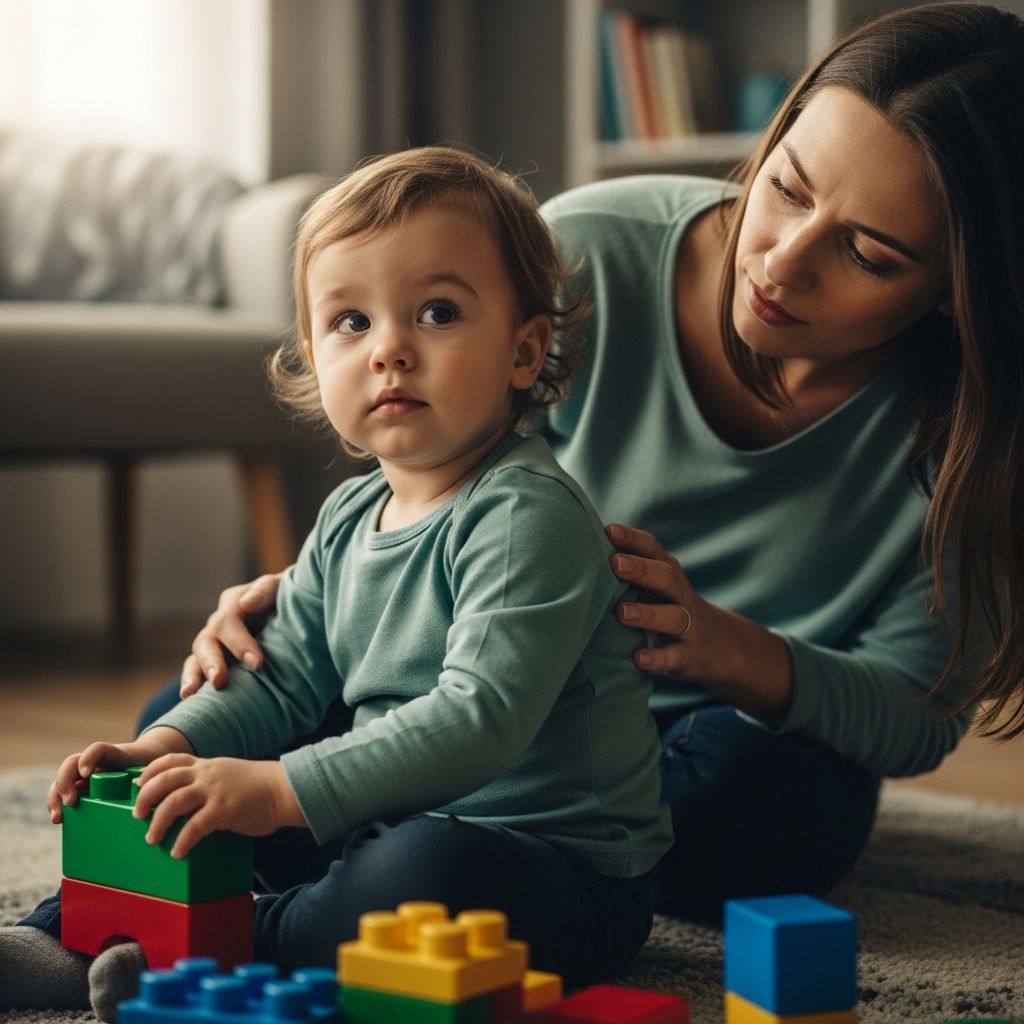
Few things rattle a parent’s confidence like noticing that other children your toddler’s age are chattering away while your child says little or nothing. You may feel guilty, confused, and even scared that something is seriously wrong. This guide is designed to calm the panic, give you clear information, and offer concrete steps you can take right now.
Why Some Toddlers Talk Later Than Others
Children do not all follow the same timeline for language, even when they grow up in the same home, with the same parents, toys, and routines. Some begin talking in full sentences before their second birthday, while others quietly observe for a long time and then suddenly “burst” into speech later on. A child might put energy into gross motor skills like climbing and running first, and only afterward shift focus to talking.
Several factors can influence how quickly a toddler talks, including temperament, personality, opportunities for interaction, hearing ability, and underlying developmental differences. What matters most is not whether your child’s path matches that of a neighbor’s child, but whether progress is happening over time and whether basic communication is emerging through gestures, sounds, eye contact, or other means.
Typical Early Communication Milestones (Big-Picture View)
Every child is unique, but it can help to compare your toddler’s skills with a very broad outline of early communication milestones. Try to use this as a guide rather than a scorecard. If your child is not “on schedule” in one area, look for skills in others, such as gestures or understanding words.
| Age Range | Understanding (Receptive) | Expressing (Expressive) |
|---|---|---|
| Around 12 months | Turns to name, looks at familiar people or objects when named, responds to simple routines like “bye-bye”. | Babbles with different sounds, may say 1–2 simple words like “mama” or “dada”, uses gestures such as waving. |
| Around 18 months | Understands many everyday words (like “cup”, “shoe”), follows simple directions like “give me the ball”. | Uses several meaningful words on their own, may imitate new words, points to express wants. |
| Around 24 months | Understands short phrases and simple questions like “Where is your nose?” or “Where is Daddy?”. | Often has 50 or more words and begins to combine two words such as “more milk” or “my truck”. |
| Around 30–36 months | Follows 2-step directions, understands many action words and simple questions. | Uses simple sentences with several words, strangers can understand much of what is said. |
Remember that this table is a snapshot, not a test. Some late talkers eventually catch up on their own, while others benefit enormously from early support. The key is noticing patterns over time, rather than obsessing over any one milestone on a particular birthday.
How to Tell If Your Child Is Communicating (Even Without Words)
A toddler who is not speaking yet may still be communicating a great deal. When you focus only on spoken words, it is easy to miss the many subtle ways your child might be saying “I need you” or “Look at this” without talking. These nonverbal signs can be encouraging, because they show that your child understands the basics of back-and-forth interaction.
- Eye contact and shared attention: Does your child look at you and then back at a toy, book, or interesting event to make sure you see it too?
- Gestures and pointing: Does your child reach, point, wave, or lift their arms to be picked up as a way to ask for something or share an idea?
- Facial expressions and sounds: Does your toddler smile, frown, squeal, whine, or make different noises in response to people and activities?
- Response to you: Does your child turn when you call their name, pause when you say “no”, or come toward you when invited?
- Interest in social games: Does your toddler enjoy peek-a-boo, tickle games, songs with motions, or chasing games that depend on interaction?
If your child uses at least some of these tools to connect with you, that is a strong sign that the foundation for spoken language is present. Words are simply one more layer on top of these early communication skills.
Possible Reasons a Toddler Isn’t Talking Yet
Many different things can lie behind speech and language delays. In some cases, a child is simply developing more slowly in this area, while in other situations there may be a medical or developmental reason. Sorting this out is not about blame; it is about understanding what kind of help, if any, your child might need.
- Hearing challenges: Repeated ear infections or undiagnosed hearing loss can make it harder to learn speech sounds and words, even if the child seems to hear some noises.
- Oral-motor or physical issues: Difficulties with muscle strength and coordination in the mouth, tongue, or jaw can interfere with producing clear speech.
- General developmental delay: Some children show delays across many areas, including language, motor skills, and problem-solving.
- Autism or social-communication differences: Children on the autism spectrum may talk later, use language differently, or prefer solitary play, even if they have strong skills in other areas.
- Environmental factors: Limited opportunities for conversation, high screen time, or chronic stress in the household can reduce the amount of rich, responsive interaction a toddler experiences.
- “Late bloomer” variation: Some toddlers have no underlying difficulty, yet simply talk later than peers and eventually catch up, often with support and extra practice.
Only a qualified professional can sort out which of these (if any) apply in your child’s case. However, understanding the possibilities helps you ask better questions and advocate more effectively.
Practical Ways to Support Language at Home
Regardless of the cause of a speech delay, there is a great deal you can do at home to create a language-rich environment. The goal is not to drill your toddler with flashcards, but to surround them with meaningful, warm, back-and-forth interactions tied to everyday life.
Talk Through Daily Routines
Ordinary moments are perfect times to build language, because they are predictable and full of concrete actions your toddler can see and feel. Narrating what you are doing gives your child a running commentary that links words to experiences.
- Describe each step during diaper changes, meals, bath time, and getting dressed using short, simple phrases.
- Repeat key words frequently: “Wash hands. Hands in water. Splash, splash. All done washing hands.”
- Pause often so your child can respond with a look, a sound, or a gesture before you continue talking.
Follow Your Child’s Lead
Children learn language best when adults talk about what truly interests the child. Instead of directing play constantly, pay attention to what draws your toddler’s attention and join in there. This helps your words feel relevant and motivating.
- Notice what your child is looking at or touching and comment on that object or activity.
- Match your language level to your child’s abilities—if they use single words, you can respond with two- or three-word phrases.
- Avoid quizzing (“What’s that? Say truck!”) and instead focus on describing, modeling, and taking turns.
Use Gestures and Visuals
Gestures are not a crutch or a replacement for speech; they are a natural part of communication that often pave the way for words. The more you pair gestures with language, the more your child sees how communication works.
- Point to objects, people, and pictures as you name them to show the connection clearly.
- Use simple, consistent gestures for common words like “more”, “all done”, “up”, and “come”.
- Show your child pictures in books and on family photos, labeling what you see together.
Limit Passive Screen Time
Even high-quality educational videos cannot replace live, responsive conversation. For toddlers, especially those with language delays, screens often crowd out the very interactions they most need. If your child already watches a lot of videos, consider slowly replacing some of that time with shared activities.
- Set aside phone- and TV-free blocks every day dedicated to simple, face-to-face play.
- If you do allow screen time, watch together and comment, pause, and interact instead of using it as background noise.
Red Flags: When to Seek an Evaluation
- No babbling, pointing, or meaningful gestures by around 12 months.
- No single words by around 16–18 months.
- No two-word combinations by around 24 months.
- Little eye contact, minimal response to name, or seeming “in their own world” much of the time.
- Loss of words or skills your child had previously used.
- Concerns about hearing, such as not reacting to loud sounds or missing speech when there is background noise.
What a Speech and Language Evaluation Looks Like
- History and questions: You will usually be asked about pregnancy, birth, medical history, hearing, and your child’s development in different areas.
- Play-based observation: The specialist will likely play with your toddler using toys and books, watching how your child responds, explores, and interacts.
- Structured tasks: Some simple games or prompts may be used to check understanding of words, gestures, and early problem-solving skills.
- Discussion of results: You should receive feedback on your child’s strengths and challenges, along with suggestions for next steps, which might include therapy, monitoring, or home strategies.
How Speech Therapy Helps Young Children
- Play-based sessions: For toddlers, therapy often looks like guided play with toys, songs, and books that are chosen to encourage specific communication goals.
- Parent coaching: You may learn strategies such as how to model words, wait for responses, expand on your child’s sounds, or encourage turn-taking.
- Small, realistic goals: Instead of jumping straight to long sentences, therapy may focus first on increasing gestures, sounds, or single words that serve a clear purpose.
Handling Comparisons, Pressure, and Guilt
- Remind yourself that every child has a different timeline and path; comparing children rarely leads to helpful action.
- Acknowledge your feelings—worry, frustration, sadness—but try not to turn them into self-blame.
- Seek out supportive communities, whether online or in person, where parents of late talkers and children with delays share both struggles and successes.
Simple Daily Language-Boosting Activities
- “Special talk time”: Spend 10–15 minutes each day with all distractions off, following your child’s play and talking about whatever they are doing.
- Song and rhyme time: Sing simple songs with actions—clapping, tapping, bouncing—so your child can participate even without words.
- Picture book ritual: Choose a few sturdy books with clear pictures, and instead of reading every word, talk about what you both see, imitate sounds, and wait for your child to react.
- Choice-making moments: Offer choices with words and visuals: “Do you want milk or water?” while pointing or holding up each option.
- Imitation games: Take turns copying your child’s sounds, faces, or actions, then slowly introduce new ones for them to copy.
Frequently Asked Questions
Is it my fault that my child isn’t talking yet?
Parents often blame themselves when a child’s development does not match expectations, but language delay is usually the result of many interacting factors. While your day-to-day interactions do matter, they are only one piece of a larger picture that includes genetics, health, and temperament. The most helpful thing you can do is focus on what is in your control now—creating a responsive environment and seeking evaluation if needed—rather than replaying past decisions.
Can learning more than one language cause a speech delay?
Growing up with multiple languages does not cause true language disorders. Bilingual toddlers sometimes mix words from both languages or take a bit longer to sort out grammar, but this is not the same as a significant delay. If there are difficulties in both languages and other red flags are present, an evaluation is still important, but families do not need to drop a home language to “fix” a delay.
Should I avoid baby talk or simplified speech?
Exaggerated, singsong speech that highlights sounds, emotions, and key words can actually help toddlers tune in and learn. It becomes less useful when it is too complex or constant. Aim for short, clear phrases that match your child’s level and emphasize important words, while gradually adding more complexity as your child’s understanding grows.
Will my child catch up without any help?
Some late talkers do catch up on their own, particularly if they show strong understanding, good eye contact, and many nonverbal communication skills. However, it is hard to predict which children will outgrow delays and which will continue to struggle. An evaluation and early support are like checking the map during a trip: they do not guarantee the destination, but they greatly increase your chances of taking the most helpful route.
What if my partner or relatives think I’m overreacting?
Differences of opinion are common in families, especially around child development. Try sharing specific examples of what you see, rather than vague worries, and explain that an evaluation does not lock your child into a label. Framing it as “getting more information” rather than “proving something is wrong” can make others more open to the idea.
A Final Word of Encouragement
If your toddler is not talking yet, you are navigating a confusing and often lonely road. Yet you are far from powerless. By tuning into your child’s current ways of communicating, enriching daily interactions, watching for red flags, and seeking professional guidance when needed, you give your child a strong foundation—even if the timeline is different from what you imagined.
Your child’s worth is not measured in words per minute, and your value as a parent is not measured in how closely you match a milestone chart. What matters most is the ongoing relationship you build, one small, responsive moment at a time.