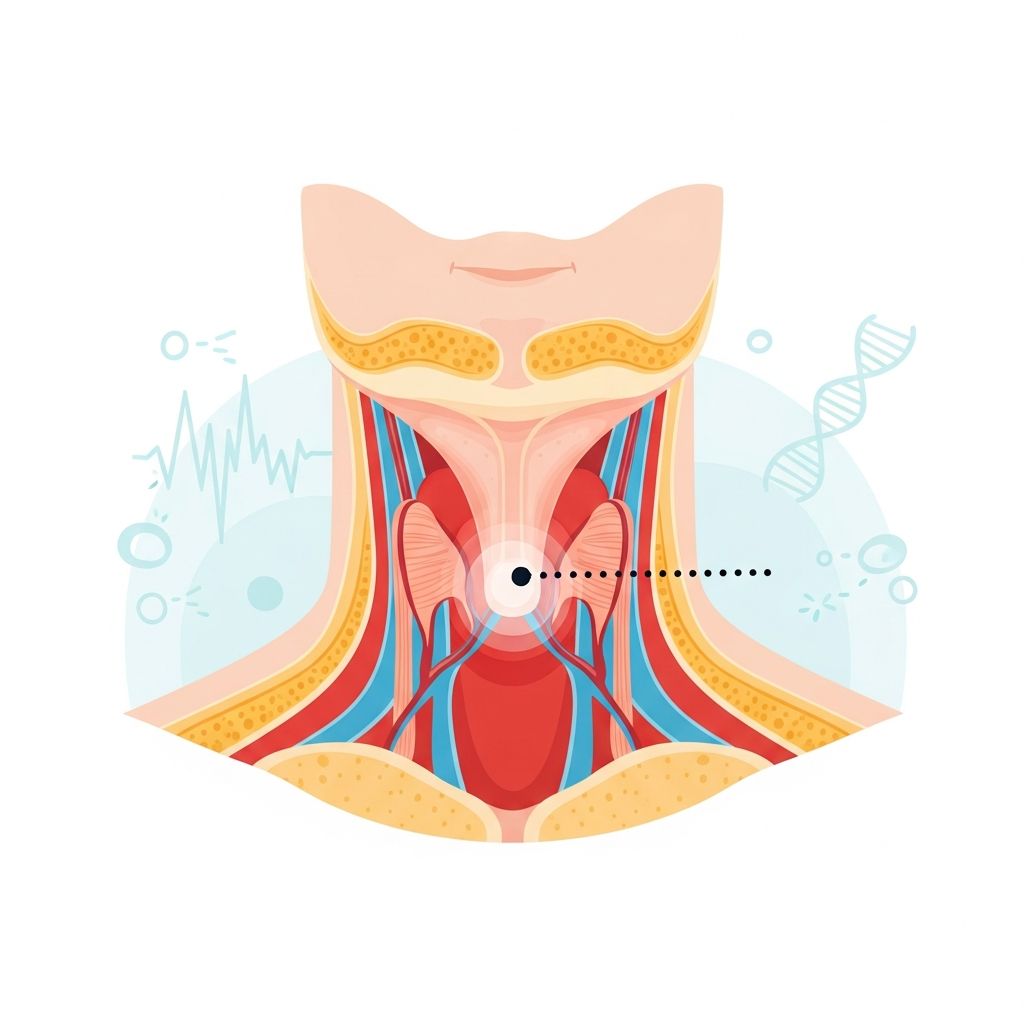
As kids grow into teenagers, their bodies start changing in lots of surprising ways, and one of those changes can be a small bump that shows up in the front of the neck called an Adam’s apple.
This bump is not a separate body part but a visible part of the voice box that becomes easier to see as the neck grows and the voice matures.
Meet Your Voice Box: The Larynx
Deep in the front of your throat sits a structure called the larynx, often nicknamed the “voice box” because it helps you talk, laugh, sing, shout, and whisper.
The larynx is made of firm but flexible tissue called cartilage, and it surrounds and protects your vocal cords while also helping air move from your mouth and nose down into your lungs.
- The larynx sits just above the windpipe (trachea), the tube that carries air into the chest.
- Inside the larynx are two small folds of tissue called vocal cords that vibrate to make sound when air passes through them.
- The outside front wall of the larynx forms the bump that people call the Adam’s apple.
So What Exactly Is the Adam’s Apple?
The Adam’s apple is simply the front part of a large piece of cartilage in the larynx that forms a protective shield around the vocal cords.
When this shield grows bigger and angles forward, it can create a visible bump right under the skin at the center of the neck.
- It usually feels firm to the touch, because cartilage is stronger than skin but softer than bone.
- You can often feel it move up and down when you swallow or talk.
- It is not a separate organ or a special “ball” in your throat; it is just part of your voice box structure.
Everyone Has One (Even If You Can’t See It)
Many people think only boys or men have Adam’s apples, but everyone has the same basic parts in the larynx, including the cartilage that can form the bump.
The difference is that for many boys, this cartilage grows larger and sticks out more, while for many girls it stays smaller and flatter so it is harder to see from the outside.
- All children, no matter their sex, are born with a larynx and the cartilage that can form an Adam’s apple.
- In some girls and women the bump is visible, and in some boys and men it barely shows at all.
- The size and shape are normal parts of how each person’s body develops and do not say anything about health or personality.
Growing Up: How Puberty Changes the Throat
Puberty is the stage of life when a child’s body begins to mature into an adult body, and during this time the larynx grows just like many other parts of the body.
As the larynx becomes larger and the vocal cords get longer and thicker, the neck can look different, and the Adam’s apple may become more noticeable.
- Before puberty, the larynx in boys and girls is about the same size.
- During puberty, hormones cause the larynx in many boys to grow more quickly and to a larger size.
- Girls’ larynges also grow, but usually not as dramatically, so the bump often stays smaller.
Why Voices Change When the Adam’s Apple Grows
When the larynx grows, the vocal cords inside it also change, and these changes are a big reason voices start to sound deeper or more mature.
Longer and thicker vocal cords vibrate more slowly, which usually creates a lower pitch, causing many boys’ voices to deepen noticeably and many girls’ voices to become slightly lower and richer.
- As the larynx grows, the space where air vibrates gets larger, affecting how sound is produced.
- The changing size and shape of the throat, mouth, and nose also help shape the new sound of the voice.
- It can take months or even a couple of years for the voice to settle into its new deeper sound.
Voice Cracks and “Squeaks”: Totally Normal
When the larynx and vocal cords are growing quickly, they do not always stay perfectly in sync, and that is when voice “cracks” and sudden squeaks can happen.
These quick changes in pitch are simply the sound of the voice adjusting to its new size, and they happen often in boys but can also show up in girls.
- Voice cracks may sound funny or embarrassing, but they are a normal sign that the voice is maturing.
- The more the body finishes growing, the fewer surprise squeaks usually occur.
- Being relaxed, breathing well, and not shouting all the time can help the voice feel more comfortable during this stage.
Why Some Adam’s Apples Look Bigger Than Others
Just like noses, ears, and hands, Adam’s apples come in many shapes and sizes, and no single size is more “right” than another.
The height of a person, the shape of the neck, the angle of the cartilage, and differences in hormones all play a role in how visible the bump looks from the outside.
- Taller people and those with thinner necks may have Adam’s apples that stand out more.
- Some people have cartilage that tilts forward at a sharper angle, making the bump look more pronounced.
- Others have more body tissue over the cartilage, which can make the Adam’s apple harder to see or feel.
Quick Anatomy Table: Where the Adam’s Apple Fits In
| Neck Part | Where It Is | What It Does |
|---|---|---|
| Adam’s apple | Front of the neck, under the skin | Visible bump formed by the front of the larynx cartilage |
| Larynx (voice box) | Inside the throat, above the windpipe | Houses the vocal cords and helps make sound and protect the airway |
| Vocal cords | Inside the larynx | Vibrate as air passes through to create your voice |
| Trachea (windpipe) | Tube running from larynx into the chest | Carries air to and from the lungs when you breathe |
Is the Adam’s Apple Important?
The Adam’s apple itself is just the front of the larynx, and its most important job is to help shield the delicate vocal cords and parts of the airway behind it.
People can still talk, breathe, and live normally even if their Adam’s apple is small or not very visible, because it is the whole larynx and lungs, not just the bump, that keep the body working well.
- It helps protect the voice box from bumps or pressure to the front of the neck.
- It forms part of the structure that keeps the airway open for breathing.
- The size of the Adam’s apple does not decide how “good” someone’s voice sounds or how loudly they can talk.
Myths and Misunderstandings
There are many myths about the Adam’s apple, and understanding the facts can make kids feel more comfortable with their changing bodies.
These myths can lead to teasing or worry, so it helps to know what is true and what is not.
- Myth: Only boys have Adam’s apples.
Fact: Everyone has the same throat structures; some are just more visible than others. - Myth: A bigger Adam’s apple means a better singing voice.
Fact: Singing well depends on practice, breath control, and technique, not just the size of the throat. - Myth: If you can’t see your Adam’s apple, something is wrong.
Fact: Many perfectly healthy people have barely noticeable bumps.
Taking Care of Your Voice Box
Even though you cannot change how your Adam’s apple looks, you can keep your larynx and vocal cords as healthy as possible with simple everyday habits.
Caring for your voice is especially helpful during puberty, when your throat is already busy growing and adjusting.
- Drink enough water so the tissues in your throat stay moist.
- Avoid shouting for long periods or screaming into pillows or at events.
- Rest your voice if your throat feels sore or tired.
- Stay away from smoke and other irritants that can bother your airway.
When to Talk to a Grown-Up or Doctor
Most changes in the neck and voice during puberty are normal, but sometimes it is smart to mention certain signs to a parent, school nurse, or doctor.
Paying attention to unusual pain or trouble breathing is important, because these problems are not caused by normal Adam’s apple growth.
- Tell a grown-up if you have pain in the front of your neck that does not go away.
- Ask for help if swallowing feels very difficult or you feel like something is always stuck in your throat.
- See a doctor if you have noisy breathing, severe hoarseness that lasts for weeks, or if your voice suddenly changes without a clear reason like a cold.
Feeling Confident About How Your Neck Looks
Because the Adam’s apple sits right in the middle of the neck, some kids start to notice it in the mirror and compare themselves with classmates or people on TV.
Remembering that every neck and every voice develops on its own timeline can make these comparisons feel less stressful.
- Some teens are proud of their new, more noticeable Adam’s apple as a sign of growing up.
- Others feel shy about it, especially if it seems bigger or smaller than their friends’, but both are normal.
- Talking openly with trusted adults can make it easier to accept and even appreciate these changes.
Frequently Asked Questions About the Adam’s Apple
1. At what age does the Adam’s apple usually appear?
The bump tends to become more noticeable around the same time other puberty changes begin, which for many kids is somewhere between about 10 and 15 years old.
Some people notice it earlier and some later, and in a few people it never becomes very visible at all, even as adults.
2. Can girls have a visible Adam’s apple?
Yes, some girls and women do have Adam’s apples that you can see or feel, because everyone has the same larynx structure in the throat.
Theirs are often smaller or less angled, which is why the bump usually shows less than it does in many boys and men.
3. Does the Adam’s apple control how high or low my voice is?
The Adam’s apple itself does not control your pitch, but it is part of the larger larynx that holds the vocal cords, and their length and thickness are what really affect how deep or high your voice sounds.
As those cords grow, the surrounding cartilage can grow too, which is why a bigger bump often appears in people whose voices have become deeper.
4. Can you hurt your Adam’s apple?
A strong hit to the front of the neck can be painful and could injure the larynx, so it is important to protect this area during contact sports by following safety rules and using the right gear.
Everyday activities like talking, singing in a healthy way, or gently touching the bump are safe and do not damage the Adam’s apple.
5. Will my Adam’s apple keep getting bigger forever?
No, the larynx and its cartilage, including the Adam’s apple, grow mostly during the main years of puberty and then slow down and eventually stop as you finish your teenage years.
Once your body has fully matured, the size and shape of your Adam’s apple usually stay pretty much the same, even though the rest of your body continues to age.
Key Takeaways for Kids and Parents
- The Adam’s apple is the front part of the voice box cartilage, not a separate “extra” part of the throat.
- Everyone has the same basic throat structures, but the bump becomes more obvious in some people as they go through puberty.
- Changes in voice and the appearance of the Adam’s apple are normal parts of growing up, and size differences are usually just natural body variation.
- Healthy voice habits and open conversations about body changes can make this stage feel more comfortable and less confusing.