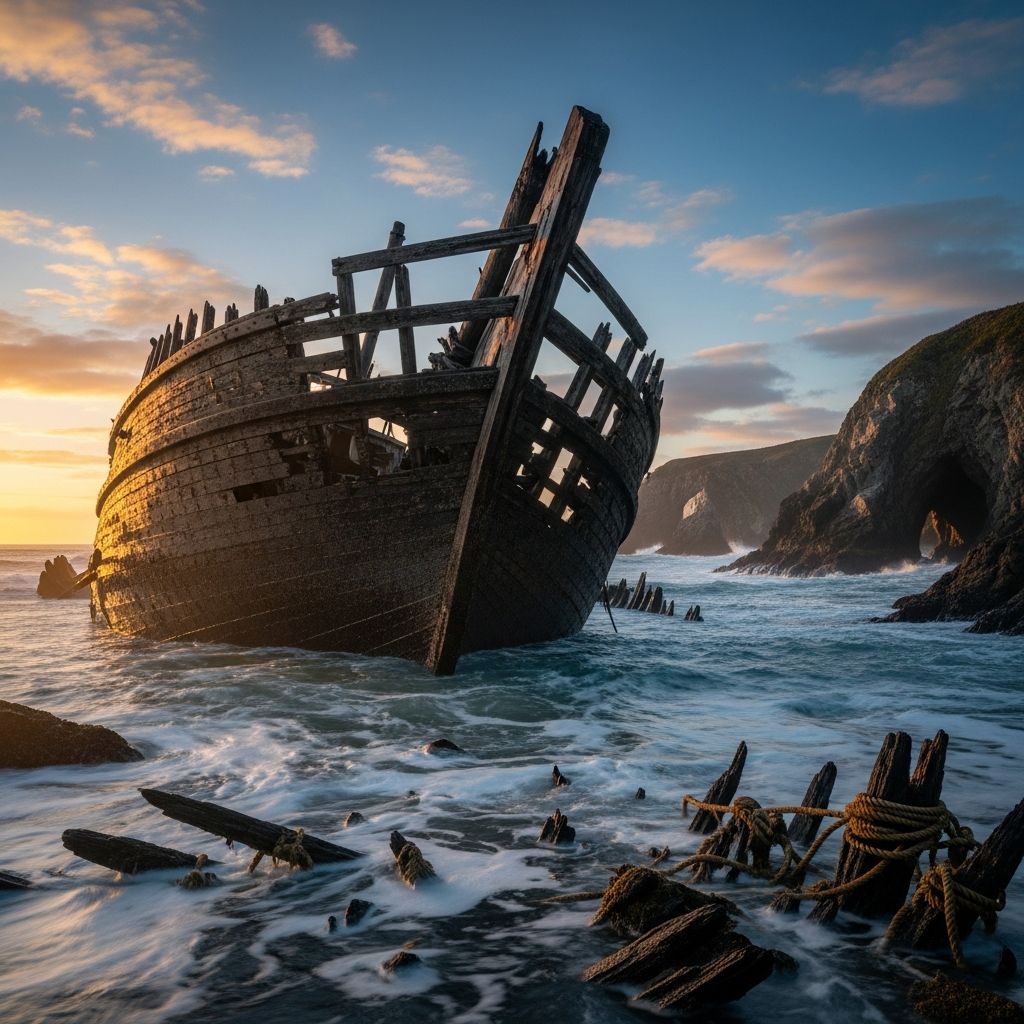
The Legend That Sailed Into a Movie
Every great adventure film draws from somewhere — a myth, a rumor, a half-remembered tale told around a campfire. For The Goonies, the 1985 classic about kids chasing pirate treasure through tunnels and traps, that spark may have come from a very real, very old shipwreck off the Oregon coast. While the movie’s pirate ship, the Inferno, and its one-eyed captain are pure fiction, the idea of a long-lost Spanish galleon buried beneath sand and surf isn’t just Hollywood fantasy. For centuries, people along the northern Oregon shore have found strange artifacts: porcelain shards, carved wood, and blocks of beeswax stamped with Spanish markings. These clues point to a real maritime mystery — one that may have quietly shaped the story of Mikey, Chunk, and the rest of the Goonies.
A Wreck Without a Name
Long before the film’s release, residents of the Astoria and Nehalem Bay areas noticed something unusual. For generations, pieces of a ship had been washing ashore after storms. Broken tiles, wooden beams, and large blocks of beeswax — a valuable trade commodity in the 17th century — kept appearing along the beaches. Locals began calling it the “Beeswax Wreck,” a name that stuck even though no one knew exactly what ship it was or when it had gone down.
Historians and archaeologists eventually traced the clues back to the Pacific trade routes of the Spanish Empire. In the late 1600s, Manila galleons carried silver, porcelain, and other goods from the Philippines to Acapulco, Mexico, crossing the North Pacific. Occasionally, storms or navigational errors sent these massive ships far off course. One such vessel, the Santo Cristo de Burgos, disappeared in 1693 while en route from the Philippines to Mexico. Records show it never arrived, and it was presumed lost at sea.
Over time, researchers began to suspect that the Beeswax Wreck might be the remains of the Santo Cristo de Burgos. The types of porcelain, the beeswax blocks, and the style of wood used in the recovered timbers all matched what would have been carried on a Manila galleon of that era. But without a complete wreck site, the connection remained a compelling theory rather than a confirmed fact.
From Beach Debris to Scientific Clue
For more than 200 years, the Beeswax Wreck was treated more as local folklore than serious archaeology. People collected porcelain fragments as souvenirs, and stories grew about buried treasure, hidden tunnels, and even pirate gold stashed in the cliffs. But in the early 21st century, researchers began to take a more systematic approach.
Teams from the Maritime Archaeological Society and other groups started mapping where artifacts had been found over the decades. They studied old maps, ship logs, and Indigenous oral histories that spoke of a great shipwreck long ago. The pattern of debris — scattered far inland in some places — suggested that a tsunami or massive storm surge had carried parts of the wreck well beyond the immediate shoreline. This helped narrow the search area to the stretch of coast near Nehalem Bay and Neahkahnie Mountain.
What made the Beeswax Wreck especially intriguing was not just the cargo, but the possibility that much of the ship still lies buried. Unlike wrecks in deep water, this galleon likely came ashore and was gradually covered by sand and sediment. That means the main hull, ballast, and possibly even intact cargo holds could still be hidden just offshore, waiting to be found.
A Fisherman’s Discovery Changes Everything
In 2022, a local fisherman named Craig Andes made a discovery that reignited serious interest in the Beeswax Wreck. During an unusually low tide, he noticed large wooden timbers tucked into a sea cave near where beeswax and porcelain had been found for generations. The wood was old, heavily waterlogged, and clearly part of a large vessel. He reported it to local historians and archaeologists.
Experts carefully removed samples and subjected them to analysis. Dendrochronology (tree-ring dating) and radiocarbon dating were used to determine the age and origin of the wood. The results were striking: the timber matched the type of hardwood used in 17th-century Spanish shipbuilding in the Philippines, and the dates aligned with the period when the Santo Cristo de Burgos would have been at sea.
This wasn’t just another piece of driftwood. It was strong evidence that the Beeswax Wreck was indeed the remains of a Manila galleon, and very likely the long-lost Santo Cristo de Burgos. The discovery gave researchers a physical anchor point — a confirmed artifact from the wreck — that could guide future searches for the rest of the ship.
How a Real Wreck Inspired a Movie
Steven Spielberg has never officially confirmed that the Beeswax Wreck directly inspired The Goonies, but the circumstantial evidence is hard to ignore. In the early 1980s, while developing the film, Spielberg reportedly read a newspaper article about the mysterious shipwreck and the local legends surrounding it. A spokesperson for Amblin Entertainment later acknowledged that the local Oregon coast legend about a lost Spanish galleon served as inspiration for the movie’s treasure-hunting plot.
Think about the parallels: a pirate ship hidden beneath a coastal town, a long-lost treasure, booby traps, and a crew of kids racing against time to find it before adults do. The film’s setting in the fictional Astoria-like town of “Astoria” (filmed in Cannon Beach and surrounding areas) places it right in the heart of the Beeswax Wreck’s territory. Even the idea of a shipwrecked pirate captain with a fearsome reputation echoes the kinds of stories told about the galleon’s fate.
It’s not that Spielberg set out to make a documentary about the Santo Cristo de Burgos. Rather, he took a real, lingering mystery and turned it into a timeless adventure. The Goonies didn’t just invent a pirate legend — they gave a new life to one that had already been part of the Oregon coast for centuries.
Modern Expeditions and the Search for Treasure
In recent years, the Beeswax Wreck has attracted renewed attention from both researchers and popular media. In 2025, the Discovery Channel’s Expedition Unknown aired an episode titled The Real Goonies Treasure, in which host Josh Gates traveled to the Oregon coast to investigate the connection between the film and the real-life galleon.
Gates explored Neahkahnie Mountain and the surrounding beaches, following local legends about buried treasure and hidden tunnels. His team examined the timbers found by Craig Andes and looked for additional evidence of the wreck. While they didn’t find chests of gold or jewels, they did uncover more wooden fragments and discussed the possibility that the galleon’s cargo — which could have included silver, gems, and other valuable goods — might still be buried in the sand.
Archaeologists stress that the real value of the wreck is historical, not monetary. Finding the main hull would provide invaluable insights into 17th-century shipbuilding, Pacific trade routes, and the lives of the people aboard. But there’s no denying that the idea of “real Goonies treasure” captures the public imagination in a way few other shipwrecks do.
What Might Still Be Hidden?
So what could be left of the Santo Cristo de Burgos? Based on what’s known about Manila galleons, the ship likely carried:
- Silver coins and bullion from the Americas
- Chinese porcelain and lacquerware
- Spices, silks, and other luxury goods from Asia
- Beeswax blocks used for candles and sealing
- Personal items, tools, and navigational instruments
If the ship broke apart near shore and was quickly buried, some of this cargo could still be remarkably well-preserved. Saltwater and sand can actually protect organic materials like wood and textiles over centuries. The challenge is that the wreck is likely buried under many feet of sediment, making it difficult to locate without advanced sonar and excavation techniques.
Researchers believe the best chance of finding the main wreck site is through a combination of historical research, Indigenous knowledge, and modern technology. Ground-penetrating radar, magnetometers, and underwater drones could help pinpoint where the hull lies, while careful excavation would be needed to recover and preserve any artifacts.
Why This Story Still Matters
The Beeswax Wreck is more than just an old ship at the bottom of the ocean. It’s a bridge between past and present, between history and pop culture. For Oregonians, it’s part of their coastal identity — a reminder that their beaches have been shaped by global trade, storms, and centuries of human stories.
For fans of The Goonies, it adds a layer of depth to a film that’s often seen as pure fantasy. Knowing that the movie’s treasure hunt has roots in a real, unsolved maritime mystery makes the adventure feel more grounded, more real. It turns the film from a nostalgic childhood favorite into a cultural echo of a much older story.
And for archaeologists and historians, the wreck represents a rare opportunity. Few Manila galleons from the 17th century have been found in the North Pacific, and each one offers a window into a global economy that connected Asia, the Americas, and Europe long before the modern era.
FAQs About the Goonies Shipwreck
Is the Goonies ship a real ship?
No, the pirate ship Inferno and Captain One-Eyed Willie are fictional. However, the idea of a lost Spanish galleon off the Oregon coast is based on a real historical mystery — the so-called Beeswax Wreck, likely the Santo Cristo de Burgos.
What is the Beeswax Wreck?
The Beeswax Wreck is the name given to the remains of a 17th-century Spanish galleon that wrecked on the Oregon coast. For centuries, beeswax blocks, porcelain, and wooden timbers have washed ashore, leading researchers to believe it was a Manila galleon, possibly the Santo Cristo de Burgos.
Did Steven Spielberg base The Goonies on a real shipwreck?
Spielberg has never officially confirmed it, but a spokesperson for Amblin Entertainment has said that the local legend of the Beeswax Wreck inspired the treasure-hunting plot of The Goonies. The film’s Oregon coast setting overlaps with the area where the real wreck is believed to have occurred.
Has the wreck been found?
Not fully. In 2022, large wooden timbers believed to be from the Beeswax Wreck were discovered in a sea cave on the Oregon coast. Scientific analysis suggests they match the type and age of a 17th-century Spanish galleon, but the main hull and cargo are still thought to be buried offshore.
Could there still be treasure?
Possibly. Manila galleons carried silver, porcelain, and other valuable goods. If the ship’s cargo holds are intact and buried in sand, some artifacts could still be preserved. However, the primary value today is historical and archaeological, not monetary.
Looking Ahead: The Next Chapter
The search for the Beeswax Wreck is far from over. With the 2022 timber discovery providing a solid clue, researchers are planning more systematic surveys of the Oregon coast. Collaborations with local communities, including Indigenous groups whose ancestors witnessed the wreck, are seen as essential to understanding the full story.
Whether or not they find chests of gold or jewels, the discovery of the Santo Cristo de Burgos would be a major archaeological achievement. It would confirm a centuries-old mystery and give us a tangible connection to a time when the Pacific was crossed by massive wooden ships carrying the wealth of empires.
And for fans of The Goonies, it’s a reminder that sometimes, the most magical adventures are the ones that start with a real story — a ship lost at sea, a legend passed down through generations, and a group of kids who believed in treasure. As the film’s famous line goes: Goonies never say die. And apparently, neither does the legend of the Beeswax Wreck.
References
- The Real-Life Shipwreck That May Have Inspired ‘The Goonies’ — Mental Floss. 2023. https://www.mentalfloss.com/science/archaeology/real-life-shipwreck-that-may-have-inspired-the-goonies
- ‘Goonies’ in Real Life? A Suspicious Shipwreck Discovered Off the Oregon Coast — California Dreamin’. 2022. https://californiadreamin.com/blog/goonies-in-real-life-a-suspicious-shipwreck-discovered-off-the-oregon-coast/
- Expedition Unknown: The Real Goonies Treasure — Discovery Channel. 2025. https://www.discovery.com/shows/expedition-unknown