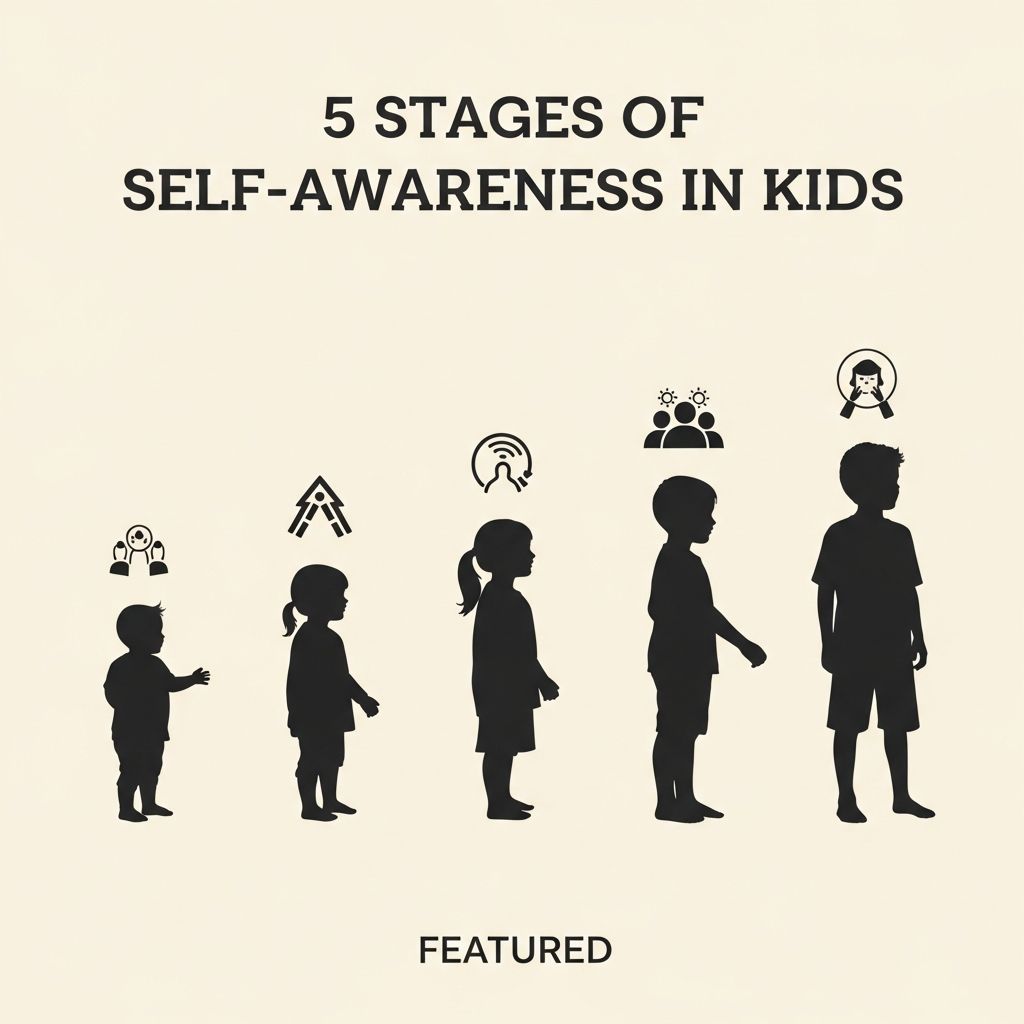
Self-awareness forms the cornerstone of emotional and social growth in young children, enabling them to navigate their world with increasing confidence and empathy. Pioneered by developmental psychologist Philippe Rochat, the five stages of self-awareness provide a roadmap from infancy to preschool years, often assessed through innovative mirror tests. These stages reveal how kids transition from basic bodily distinction to understanding their place in others’ perceptions.
Why Self-Awareness Matters for Lifelong Development
Mastering self-awareness equips children with tools for emotional regulation, social interactions, and academic success. Research indicates that early self-recognition correlates with advanced empathy and reduced behavioral issues later in life. Parents play a pivotal role by creating environments rich in reflective play and responsive feedback.
Understanding these stages helps caregivers tailor support, turning everyday moments into opportunities for growth. From peekaboo to perspective-taking discussions, intentional activities accelerate this vital progression.
Stage 1: Differentiation – The First Sense of ‘Me’ from Birth
Newborns enter the world instinctively distinguishing their bodies from the surrounding environment. This foundational stage, termed differentiation, emerges immediately after birth as infants cry, move limbs, or reach for objects, signaling an innate awareness of self as separate from caregivers and stimuli.
Visual cues amplify this: babies gaze at mirrors, noting contrasts between their image and the background. Reaching behaviors further confirm spatial awareness, as they grasp toys while coordinating body positions. Parents can nurture this by narrating actions: “Look at your hand waving!” Such verbal cues reinforce bodily boundaries.
- Key behaviors: Crying to signal needs, reflexive grasping, preferential gaze toward faces.
- Parental tip: Use high-contrast toys and mirrors during tummy time to highlight body-environment distinctions.
- Milestone age: Birth to 1-2 months.
Stage 2: Situational Awareness – Positioning Self in Context (Around 2 Months)
By two months, infants advance to situational self-awareness, grasping how their bodies fit within immediate surroundings. They mimic facial expressions during social exchanges, like smiling back at a parent’s grin or cooing in response to voice tones, demonstrating contingency between actions and reactions.
Mirror play becomes interactive; babies explore reflections with directed movements, such as tracking their hands across the glass. This stage builds coordination and social reciprocity, laying groundwork for deeper recognition. Encourage it through face-to-face games and naming body parts in mirrors.
| Age Range | Hallmarks | Support Strategies |
|---|---|---|
| 1-3 months | Mirroring smiles, coordinated reaching | Daily face games, mirror songs |
| Evidence | Social smiling onset | Responsive caregiving |
Stage 3: Identification – Mirror Recognition Breakthrough (18-24 Months)
The hallmark of identification arrives between 15-24 months, when toddlers pass the classic “rouge test.” A dot of color (often rouge) is applied to the child’s nose unnoticed; upon mirror viewing, self-aware infants touch their own nose, not the reflection, proving they link the image to themselves.
This stage coincides with personal pronoun use (“me,” “mine”) and possessive play, like claiming toys. Language blooms as kids name themselves, solidifying identity. Celebrate with labeled mirror activities: “That’s baby [name] smiling!” Studies confirm 75% of children pass by 24 months.
- Testing method: Rouge or sticker on face; self-touch indicates success.
- Real-world signs: Saying “my” during play, pointing to self in photos.
- Parent boost: Photo albums and naming games.
Stage 4: Permanence – The Enduring Self Across Time and Space (2-4 Years)
Toddlers now grasp permanence: their “self” persists beyond immediate views, enduring time and distance. Yet, a “me-but-not-me” tension arises; kids refer to mirror selves by name (“Look at [name]!”) while oscillating between first- and third-person views.
They recognize past photos as “me then” and anticipate future selves in drawings. This fosters continuity, aiding memory and narrative skills. Support via storytelling: “Remember when you were a tiny baby? That’s still you!” Challenges include separation anxiety resolution.
By age 3, most navigate this, linking identity across contexts like home versus preschool.
Stage 5: Meta-Self-Awareness – Seeing Self Through Others’ Eyes (4-5 Years)
The pinnacle, meta-self-awareness, dawns around age 4, as preschoolers realize their mirror image matches others’ views of them. This “third-person” perspective sparks self-consciousness—hiding from reflections or blushing in groups—while igniting social emotions like pride, shame, and empathy.
Kids ponder: “How do I look to friends?” Theory of mind emerges, understanding differing viewpoints. Nurture with role-play: “How might your sibling feel?” This stage paves the way for complex relationships and moral reasoning.
| Stage | Age | Key Insight | Emotional Outcome |
|---|---|---|---|
| 1: Differentiation | Birth | Body vs. world | Basic needs signaling |
| 2: Situational | 2 months | Body in space | Social reciprocity |
| 3: Identification | 18-24 mo | Mirror = self | Possessive language |
| 4: Permanence | 2-4 yrs | Self endures | Memory narratives |
| 5: Meta | 4-5 yrs | Others’ view | Empathy, shame |
Parental Strategies to Foster Each Stage
Active involvement accelerates self-awareness. For infants, prioritize skin-to-skin and mirror exposure. Toddlers benefit from labeled emotions and self-portraits. Preschoolers thrive on group play and reflection questions.
- Infancy (Stages 1-2): Peekaboo, naming routines.
- Toddlerhood (Stage 3): Rouge test at home, pronoun books.
- Preschool (Stages 4-5): Family albums, “what if” talks.
Consistency matters; responsive parenting correlates with earlier milestones per longitudinal studies.
Signs of Progress and When to Seek Guidance
Track via daily observations: self-naming by 2 years, photo recognition by 3. Delays past 24 months for identification warrant pediatric checks, potentially linking to autism spectrum indicators. Most children follow Rochat’s timeline naturally.
Variations exist culturally; some societies emphasize collectivity, subtly shifting meta-awareness onset.
Frequently Asked Questions (FAQs)
What is the mirror test for self-awareness?
The mirror test, or rouge test, marks a dot on a child’s face; self-touch upon seeing the reflection confirms identification around 18 months.
Can all children pass the mirror test at the same age?
No, typically 15-24 months, with 75% by 24 months; individual and cultural factors influence timing.
How does self-awareness link to emotions like empathy?
Post-Stage 5, children grasp others’ mental states (age 3-5), enabling sympathy and social emotions.
What if my child skips a stage?
Stages overlap fluidly; consult professionals if major delays persist beyond norms.
Are there activities to speed up development?
Yes, mirrors, naming, role-play, and responsive interactions promote progression.
Long-Term Impacts: From Self-Awareness to Resilient Adults
Early mastery predicts better peer relations, academic resilience, and mental health. Erikson’s stages align: post-self-awareness, initiative vs. guilt (3-6 years) builds on this foundation. Nurture today for tomorrow’s leaders.
Integrate into routines: bedtime reflections (“What made you happy today?”) cultivate ongoing growth. Celebrate small wins; self-awareness is a lifelong journey starting young.
References
- Development of Self – Child and Adolescent Development — Viva Pressbooks. 2023. https://viva.pressbooks.pub/topicalchilddev/chapter/development-of-self/
- Development of Self | Child Psychology — Lumen Learning. 2023. https://courses.lumenlearning.com/child/chapter/development-of-self-2/
- Nurturing the 5 Levels of Self-Awareness in Children: A Parent’s Guide — Ahead App. 2024. https://ahead-app.com/blog/mindfulness/nurturing-the-5-levels-of-self-awareness-in-children-a-parent-s-guide
- 15.8: Development of Sense of Self — Social Sci LibreTexts. 2023. https://socialsci.libretexts.org/Bookshelves/Early_Childhood_Education/Infant_and_Toddler_Care_and_Development_(Taintor_and_LaMarr)/15:_Emotional_Development/15.08:_Development_of_Sense_of_Self
- How children develop self-awareness — Busy Brains Activity Packs. 2023. https://www.busybrainsactivitypacks.co.uk/post/how-children-develop-self-awareness