Long before massive CGI battles and sprawling fantasy trilogies dominated movie screens, J.R.R. Tolkien’s beloved tale The Hobbit reached millions of viewers in an unlikely form: a modestly budgeted, hand-drawn television movie that aired in 1977. Directed by Jules Bass and Arthur Rankin Jr., this animated special shrank an epic quest into a 77–78 minute broadcast and, in the process, etched itself into the memories of a generation of children.
Today, this version can look quaint, even bizarre, beside Peter Jackson’s bombastic live-action trilogy. Yet the Rankin/Bass Hobbit remains fascinating: tonally strange, visually unsettling, musically earnest, and unexpectedly influential. It is part cozy bedtime story, part nightmare fuel, and part anti-war fable—all wrapped in a simple, colorful cartoon.
The Unlikely TV Epic
On paper, the 1977 The Hobbit sounds like an experiment that should never have worked. It was produced by Rankin/Bass Productions, best known for holiday specials like Rudolph the Red-Nosed Reindeer and Santa Claus Is Comin’ to Town, and animated by the Japanese studio Topcraft in Tokyo. Broadcast on American network television rather than released theatrically, it had to fit into a limited runtime and a family-friendly time slot.
| Aspect | 1977 Animated The Hobbit |
|---|---|
| Format | Made-for-TV animated film |
| Directors | Jules Bass, Arthur Rankin Jr. |
| Writer (adaptation) | Romeo Muller (from J.R.R. Tolkien’s novel) |
| Runtime | About 77–78 minutes |
| Medium | Hand-drawn cel animation |
Within those constraints, the filmmakers condensed Tolkien’s novel into a brisk quest: Gandalf recruits Bilbo Baggins to help a band of dwarves reclaim their mountain home and treasure from the dragon Smaug. Major episodes—the trolls, goblins, riddles with Gollum, giant spiders, and the final clash at the Lonely Mountain—appear in sequence, but everything moves at high speed to keep the story within network time limits.
Rankin/Bass Meets Middle-earth
Rankin/Bass productions have a very specific flavor: bold character designs, simple but expressive animation, and an emphasis on songs. Translating that style into Middle-earth created a version of Tolkien that feels both familiar and off-kilter.
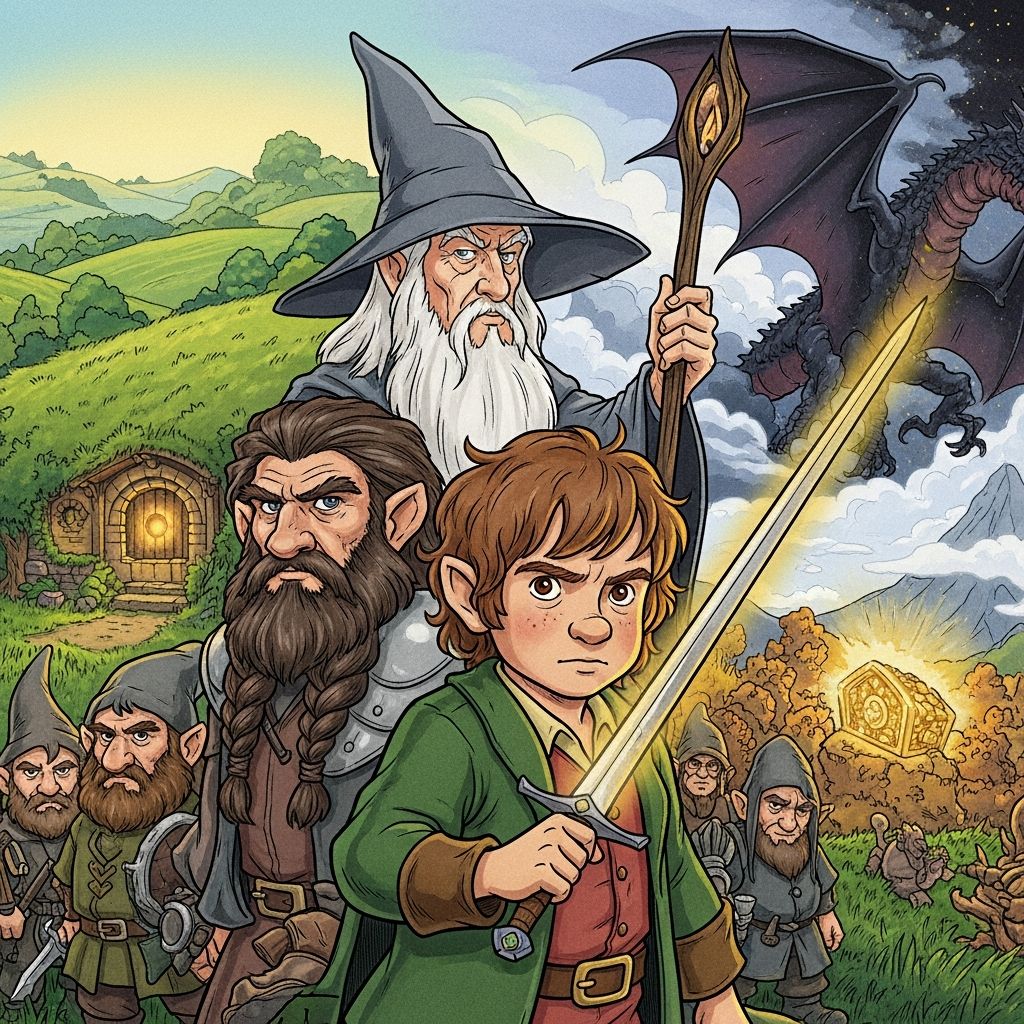
- Character design: Bilbo is round, soft, and visibly hobbit-like, with oversized feet and a constantly worried expression.
- Gandalf: Voiced by director John Huston, Gandalf appears more severe and mysterious here than in many other adaptations, his angular features and deep voice giving him a mythic severity.
- Monstrous creatures: Trolls, goblins, spiders, and even some elves look angular, gaunt, and unsettling, pushing against the cozy feel of the source material.
Most of the animation was handled at Topcraft in Japan, a studio that would later evolve into the team behind early Studio Ghibli projects. The style is not as fluid or detailed as modern animation, but it has a distinctive, hand-crafted texture that gives the film a dreamlike quality.
Voices That Haunt the Imagination
One of the enduring strengths of the 1977 film is its unexpectedly heavyweight voice cast. For a television special, the talent involved is impressive:
- Orson Bean as Bilbo Baggins – His performance captures Bilbo’s ordinary, slightly fussy nature and gradual growth into a braver, more self-assured hero.
- John Huston as Gandalf – Huston’s gravelly voice and measured delivery lend Gandalf a sense of age and authority that anchors the fantasy.
- Richard Boone as Smaug – Boone’s deep, rumbling voice turns the dragon into a sly, menacing presence rather than just a special effect.
- Brother Theodore as Gollum – His guttural, half-muttered performance pushes Gollum into full horror territory; this version of the character feels more like a lurking monster than a tragic figure.
- Otto Preminger as the Elvenking – The filmmaker-turned-actor gives the woodland ruler a sharp, imperious tone that makes even the elves faintly threatening.
These performances do much of the heavy lifting. The animation may be limited, but the voices give each key figure a strong identity, from Bilbo’s hesitant bravery to Smaug’s mocking arrogance.
Folk Ballads and Battle Cries: The Sound of the ’70s
A defining—and divisive—feature of the Rankin/Bass Hobbit is its music. Instead of grand orchestral themes, the movie leans on folk-inspired ballads and choral pieces that reflect the era in which it was produced. Many lyrics come directly from Tolkien’s songs and poems in the book, but they are set to gentle, sometimes melancholy melodies rather than rousing anthems.
The original song “The Greatest Adventure” functions as the movie’s unofficial theme, recurring in different arrangements to underline Bilbo’s journey. While some viewers find the constant musical interludes charming, others see them as intrusive. Yet the songs are central to the special’s identity: they soften the violence, reinforce its moral messages, and give even minor scenes a mythic, storybook rhythm.
How the Music Shapes the Story
- Emotional framing: Songs often signal a shift in emotion—from the cozy safety of the Shire to the dread of dark forests and caves.
- Pacing tool: Musical sequences allow the film to summarize events quickly or smooth transitions between story beats.
- Moral emphasis: Lyrics highlight themes of courage, humility, and the heavy cost of greed and war.
A Children’s Story Dipped in Nightmare
Ask adults what they remember most vividly about the 1977 Hobbit, and many will not mention Bilbo or the songs. Instead, they bring up the scares. Despite its simple animation and family audience, the film is packed with unsettling imagery and intense sequences that linger in the mind.
Memorable Frights
- Goblin tunnels: The goblins’ underground lair is cramped, shadowy, and chaotic, with jagged designs that make the creatures look diseased and insect-like.
- Gollum’s lair: This Gollum, with his bulging eyes and hunched, amphibious body, is staged more like a horror movie creature than a tragic antihero. The Riddles in the Dark sequence becomes a tense standoff where Bilbo feels genuinely trapped.
- Spiders of Mirkwood: The giant spider designs mix animal and almost human features, giving them an eerie, uncanny-valley effect that many viewers found deeply unsettling as children.
- Elves as otherworldly: Unlike the luminous, graceful elves of later adaptations, some elves here look severe and alien, blurring the line between ally and threat.
This unsettling quality was not unique to The Hobbit. Many 1970s and 1980s children’s films were willing to explore darker moods and scarier designs than modern studio blockbusters, which are often carefully calibrated to avoid traumatizing young viewers. Media scholars and child psychologists have noted that controlled exposure to safe, fictional fear can help children develop emotional resilience and coping strategies when guided by supportive adults.
Compressing Tolkien: What’s Lost and What Survives
Adapting a roughly 300-page novel into a 77-minute film inevitably means sacrifices. The Rankin/Bass version trims or simplifies several characters and subplots to keep the story moving.
- Streamlined cast: Many dwarves have limited development beyond a few lines and visual distinctions.
- Skipped episodes: Some book events and characters are compressed or removed entirely to maintain the broadcast runtime.
- Reduced political complexity: The intricate alliances and tensions between men, elves, and dwarves around the treasure are simplified.
Yet the essential arc remains:
- Bilbo begins as a comfort-loving homebody.
- He is reluctantly drawn into a dangerous quest.
- Through cleverness and courage, he saves his companions more than once.
- He returns home changed—wiser and less attached to possessions.
In this way, the 1977 film functions as a kind of illustrated outline of Tolkien’s story. Viewers who discover the book afterward often find it fleshes out details and relationships only hinted at in the cartoon.
Surprisingly Pacifist Middle-earth
One notable way the Rankin/Bass adaptation diverges from many fantasy epics is its tone toward war and heroism. Produced in the shadow of the Vietnam War and a decade of global unrest, the film places unusual emphasis on the futility and sorrow of large-scale conflict.
Instead of glorifying the Battle of the Five Armies as a triumphant climax, the film leans into its tragedy: misunderstandings and greed lead different peoples to the brink of unnecessary bloodshed, only to be interrupted by a common threat. The final cost, including the death of Thorin, underscores that victory on the battlefield rarely comes without a heavy price.
This emphasis dovetails with broader 1970s trends in children’s media that quietly promoted cooperation, empathy, and skepticism toward violence. Scholars examining postwar children’s culture have noted similar messages in television programming and educational materials of the era, as producers responded to public concern about the impact of war imagery on young audiences.
Why It Still Matters for Families
With high-definition versions of more recent adaptations readily available, why revisit a 1977 television cartoon today? For families and Tolkien fans, this version of The Hobbit still offers several unique strengths.
Gateway to Tolkien
For many adults, the Rankin/Bass film was their first exposure to Middle-earth. A short, self-contained story with clear stakes and a hopeful ending can be a gentle way to introduce children to Tolkien before tackling denser material or longer live-action films.
Opportunity for Conversation
The film’s mix of coziness and creepiness nearly demands discussion:
- Parents can pause to talk about why certain scenes feel scary, and how Bilbo copes with fear.
- The differences between this adaptation and the book can open a conversation about how stories change when retold.
- The focus on the consequences of greed and war invites questions about what truly matters: treasure or peace.
Nostalgia with a Side of Critique
Adults revisiting the special may experience a mix of affection and surprise. Some sequences that once terrified now look charmingly handmade; others may still feel surprisingly intense. Watching together with children can be a way to share a piece of personal history while also modeling critical thinking about media from previous decades.
Quick Facts for Curious Viewers
- Original release: Broadcast in the United States in late November 1977.
- Countries of origin: United States and Japan.
- Original language: English.
- Production companies: Rankin/Bass Productions, with animation by Topcraft.
- Current reputation: Often remembered fondly as a cult classic and a formative childhood viewing experience, though opinions on its tone and style remain divided.
Frequently Asked Questions About the 1977 Hobbit
Is the 1977 animated The Hobbit faithful to Tolkien’s book?
It follows the main plot—Bilbo’s recruitment, the quest with the dwarves, the confrontation with Smaug, and the final battle—but compresses or omits several episodes and side characters to fit its roughly 77–78 minute runtime. Key themes of courage, humility, and the cost of greed survive, even if the details are simplified.
Is this version too scary for young children?
That depends on the child. The film was made for television and avoids graphic violence, but the goblins, Gollum, spiders, and some elves are designed to be genuinely unsettling. Families may want to preview or watch together, using the scary moments as chances to pause, comfort, and discuss.
How does it compare to Peter Jackson’s Hobbit trilogy?
The Rankin/Bass version is much shorter, more directly aimed at children, and built around songs and narration rather than large-scale spectacle. Jackson’s films add many subplots and characters from other Tolkien works; the 1977 film sticks largely to the book’s main storyline and keeps the focus on Bilbo.
Who are the key creative figures behind the film?
The adaptation was directed by Jules Bass and Arthur Rankin Jr., with a teleplay by Romeo Muller based on Tolkien’s novel. Voice actors include Orson Bean as Bilbo, John Huston as Gandalf, Richard Boone as Smaug, and Brother Theodore as Gollum.
Why does this version look so different from other Tolkien adaptations?
The film reflects the Rankin/Bass house style and 1970s television animation techniques, with much of the work done at the Japanese studio Topcraft. Character and creature designs emphasize bold shapes and strong silhouettes, often pushing monsters into deliberately eerie territory.
References
- The Hobbit (TV Movie 1977) — IMDb. 2024-05-01 (last updated). https://www.imdb.com/title/tt0077687/
- The Hobbit Cartoon From the ’70s Is Pure Nightmare Town — Nerdist (Kyle Anderson). 2020-12-14. https://nerdist.com/article/the-hobbit-cartoon-1977-pure-nightmare-fuel-bilbo-baggins-gandalf-smaug-reflection-tolkien/
- A Cultural History of Children’s Television in the United States — Encyclopedia of Children and Childhood in History and Society (Gale). 2004-01-01. https://link.gale.com/apps/doc/CX3408900096/GVRL
- The Lord of the Rings and Children’s Literature — The Lion and the Unicorn (John Pennington). Johns Hopkins University Press. 2003-04-01. https://muse.jhu.edu/article/41667
- The Hobbit — Rotten Tomatoes. 2014-08-31 (streaming info). https://www.rottentomatoes.com/m/hobbit
- War, Peace, and the News Media — UNESCO Courier. 1979-03-01. https://unesdoc.unesco.org/ark:/48223/pf0000047842