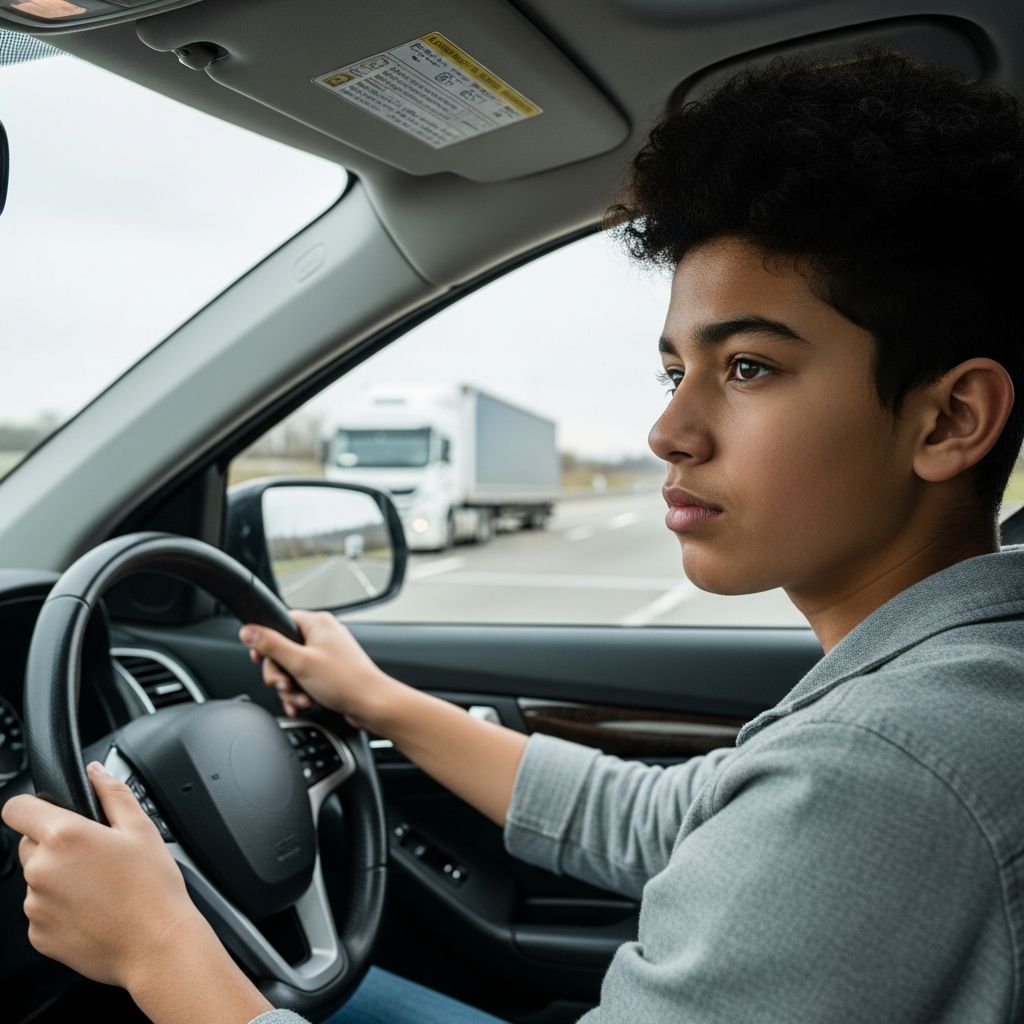
Blind spots and hidden hazards are some of the most confusing and dangerous parts of driving for teenagers, yet many new drivers only receive a quick explanation before being sent onto busy roads. As a parent or caregiver, you can turn these confusing concepts into simple, repeatable routines that your teen practices every time they drive.
Why Blind Spots Matter So Much for New Drivers
Experienced adults often forget how overwhelming driving felt in the beginning. New drivers are trying to remember pedals, signals, speed, road signs, directions, and traffic rules all at once. On top of that, they are expected to understand areas they literally cannot see: blind spots beside and behind the vehicle.
- Blind spots make it easy to miss cars, bikes, or pedestrians that are close but not visible in mirrors.
- Teens tend to over-trust mirrors and underuse quick shoulder checks and scanning habits.
- Stress and inexperience mean they may freeze or guess instead of calmly verifying what’s around them.
Teaching blind spots is not just about pointing at a diagram; it is about building a repeatable pattern of mirror use, scanning, and decision making that becomes second nature with practice.
Explaining Blind Spots in Simple, Teen-Friendly Language
Before getting into the car, clarify what a blind spot actually is and is not. Your teen needs a clear, concrete picture rather than a vague idea.
- Define the term plainly: A blind spot is any area around the car that the driver cannot see directly through the windshield, windows, or mirrors without turning their head.
- Differentiate from poor visibility: Fog, darkness, or dirty windows reduce visibility, but blind spots exist even on a sunny day with clean glass.
- Emphasize that every vehicle has them: Small cars, large SUVs, trucks, and buses all have blind spots, just in different places and sizes.
Give a few everyday examples your teen can relate to, such as a car that “appears out of nowhere” when changing lanes or a cyclist riding beside the rear passenger door where mirrors do not clearly show them.
Common Blind Spot Locations Teens Need to Know
Each vehicle model has its own quirks, but most cars share similar blind spot zones. Walking through these together will help your teen picture where risks are likely to hide.
| Blind Spot Area | Where It Is | What Often Hides There |
|---|---|---|
| Side rear blind spots | Just behind the driver’s and passenger’s shoulders, outside the side windows | Cars in adjacent lanes, motorcycles, bicycles |
| Rear center blind spot | Directly behind the vehicle’s trunk or tailgate, especially low and close | Small children, pets, low cars, short obstacles, bikes lying on the ground |
| Front corner blind spots | Near the front pillars (A-pillars) on either side of the windshield | Pedestrians about to cross, scooters, other cars in intersections |
| Large vehicle blind zones | Beside and behind trucks, buses, and vans | Entire cars, motorcycles, and bikes that the larger driver cannot see |
Use the family car as a live example. Stand in the likely blind spot areas while your teen sits in the driver’s seat and adjusts mirrors. Ask them to tell you when you disappear from view and when you become visible again.
Setting Up Mirrors Like a Pro
Most teens think mirror setup is about personal comfort, but it is really about coverage. Poorly positioned mirrors create much larger blind spots and force more drastic head movements just to see nearby vehicles.
Step-by-step mirror setup routine
- Seat first: Have your teen adjust the seat distance, height, and backrest so they can comfortably reach pedals and see clearly over the steering wheel.
- Rearview mirror: Center the mirror so the back window fills the reflection, with as little of the car’s interior showing as possible.
- Left side mirror: From the normal driving position, tilt the mirror so only a thin sliver of the car’s side is visible on the inner edge and more of the adjacent lane is visible.
- Right side mirror: Repeat the same idea on the passenger side, aiming to just barely see the car along the inner edge.
- Check the coverage: Ask your teen to watch as a parent or friend walks in a big circle around the car and notice how the person moves from mirror to mirror, then into blind spots.
Teach your teen that mirrors are not a one-time setup. They should quickly confirm mirror position each time they drive, especially if others share the car.
Teaching the Three-Part Lane Change Habit
Many new drivers treat lane changes like small turns of the steering wheel instead of careful, multi-step decisions. A simple, consistent routine helps your teen stay calm and avoid surprises.
The lane-change checklist
- Signal early: Turn on the turn signal several seconds before moving so others have time to react.
- Mirror scan: Check the rearview mirror, then the side mirror in the direction of the intended lane change.
- Quick shoulder glance: Briefly turn your head to check the blind spot over the relevant shoulder.
- Re-check ahead: Look forward again to confirm traffic and space conditions ahead have not changed.
- Move smoothly: Make a gradual, steady move into the new lane without jerky steering.
Practice this on quiet roads first, with frequent narration. Ask your teen to say each step out loud at the beginning: “Signal, mirrors, shoulder, move.” Over time, the words fall away but the sequence remains.
Parking Lots and Driveways: The Overlooked Danger Zones
Many parents focus on highways, yet some of the most heartbreaking crashes happen at low speeds in parking lots and driveways. Small children, pets, and low obstacles can easily disappear behind the rear of a vehicle.
- Teach your teen to walk around the car before backing out of a driveway, especially in neighborhoods with children or pets.
- Emphasize slow backing, frequent checks of mirrors and rear windows, and stopping if anything feels uncertain or unclear.
- Remind them that backup cameras are helpful but not perfect; they can miss small objects or be blocked by dirt or weather.
When practicing, have your teen back out of parking spaces next to taller vehicles to experience how other cars and pedestrians can be completely hidden until they move slowly backward.
Helping Teens Read Other Drivers’ Blind Spots
Understanding personal blind spots is only half the lesson. New drivers also need to recognize where other drivers cannot see them and how to avoid sitting in those risky zones.
- Teach your teen not to linger next to another car’s rear quarter panel, particularly near large trucks and buses.
- Explain that if your teen cannot see the truck driver’s mirrors, the truck driver almost certainly cannot see your teen’s car.
- Encourage either passing efficiently when safe or easing back so the other driver has clear visibility.
Make a game of spotting other vehicles driving in blind spots while you are behind the wheel. Ask your teen to point them out and suggest safer positions for those cars.
Simple At-Home Exercises to Build Spatial Awareness
Spatial awareness is the brain’s ability to judge distance, size, and relative position. For many teens, this develops with practice rather than instinct. You can build this skill in safe, low-pressure ways.
Low-risk practice ideas
- Parking lot cones: Use small traffic cones, plastic bins, or chalk lines in an empty lot to practice pulling into and backing out of parking spaces.
- Door-distance drill: Ask your teen to park next to a line or curb, then step out and see how close they actually are versus how close they thought they were.
- Slow-speed weaving: Set up a simple slalom pattern with wide spacing and have your teen weave through at walking speed to feel the car’s size.
These exercises shrink the mental gap between what your teen thinks the car is doing and what it actually does, which is crucial for navigating tight spaces and interpreting blind spots accurately.
Coaching Without Panic: How Parents Can Stay Calm
Even the most patient parent can tense up when a teen drifts toward the edge of a lane or starts to merge without checking a blind spot. Yet tension and shouting often shut teens down or make them more flustered and error-prone.
- Agree on calm cue words before driving, like “Pause” or “Check left,” instead of yelling or grabbing the wheel.
- Give feedback after the moment has passed whenever possible, not while your teen is in the middle of a maneuver.
- Praise specific safe behaviors: “You did a nice shoulder check before that lane change” is more powerful than vague compliments.
Model the exact driving behavior you expect. Your teen pays far more attention to how you drive in everyday life than to the instructions you give during a lesson.
When and How to Add More Complexity
Blind spot teaching should progress from simple to complex situations. Rushing into freeways or crowded multi-lane roads before your teen is ready can overwhelm them and lead to risky decisions.
Suggested progression
- Empty parking lots: Introduce mirror checks, backing, and slow, deliberate turns.
- Quiet residential streets: Practice lane position, parked-car awareness, and simple intersections.
- Moderate traffic roads: Add lane changes with signaling, mirror checks, and shoulder glances.
- Multi-lane roads and highways: Work on higher-speed blind spot checks, merging, and passing large vehicles.
Let your teen know that nervousness is normal, and progress is not a race. The goal is consistent safe behavior, not speed of completion.
Using Technology Wisely (Without Over-Relying)
Modern vehicles often include blind spot monitors, backup cameras, and parking sensors. These are helpful tools, but they can give a false sense of security if your teen treats them as replacements for looking and thinking.
- Explain what each feature does and does not do; for example, some alerts only trigger at certain speeds or may not detect very small objects.
- Insist on the same habits in older cars without these tools, so your teen does not become dependent on alerts.
- Frame technology as a backup to good habits, not the primary line of defense.
If your teen learns to drive competently in a basic car, they will be much safer in any future vehicle, no matter what technology it uses.
Frequently Asked Questions About Teens and Blind Spots
How soon should I start teaching my teen about blind spots?
Begin the conversation as soon as your teen starts learning to drive, even during the earliest parking lot sessions. At first, keep it simple: introduce the idea that there are areas they cannot see in mirrors and demonstrate them outside the car. As their skills improve, layer in more complex scenarios like lane changes, merging, and highway driving.
What if my teen forgets to check blind spots even after repeated reminders?
Instead of reacting with frustration, try slowing down the driving environment. Return to quieter roads and ask your teen to narrate each step out loud before and during lane changes. Sometimes the issue is not willful neglect but overload; reducing complexity gives their brain room to form a solid habit. You can also agree on a gentle verbal cue you will use when they miss a check, then review what happened once the car is stopped.
Should I avoid busy roads until they are perfect with blind spot checks?
Perfection is not realistic, but they should show consistent, conscious effort before you add heavy traffic or highway speeds. When you do step into busier environments, choose off-peak times and clearly explain the plan for the drive ahead of time. Always be ready to calmly take over if needed, while still allowing your teen to do most of the work as they become more capable.
Are backup cameras and blind spot sensors enough protection for new drivers?
These tools improve safety but are not foolproof. Weather, dirt, unusual angles, or small objects can make cameras and sensors miss important hazards. If teens learn to rely only on screens and beeps, they may not develop the deeper awareness and judgment needed to handle unexpected situations. Teaching classic skills—mirror use, turning the head, scanning, and moving slowly when uncertain—gives them protection in any car, with or without modern systems.
How long does it usually take for teens to feel comfortable with blind spot checks?
Every teen is different, but many need weeks or months of regular practice before blind spot checks feel automatic. The key is repetition in varied but manageable situations: residential streets, moderate traffic, different times of day, and different weather conditions. Over time, what once felt forced and awkward becomes a smooth routine your teen uses without needing reminders.
Helping Your Teen Become a Thoughtful, Aware Driver
Teaching blind spots is about far more than a single driving skill. It trains your teen to assume there may be something they cannot see, to slow down when unsure, and to double-check before making a move that could affect others. Those habits support every other safety lesson you give them, from speed control to distraction management.
By breaking the concept into clear explanations, hands-on demonstrations, calm coaching, and plenty of structured practice, you help your teen move from guessing to truly understanding what is happening around their vehicle. Over time, that awareness turns driving from a scary mystery into a manageable responsibility—one they are better prepared to handle safely for years to come.