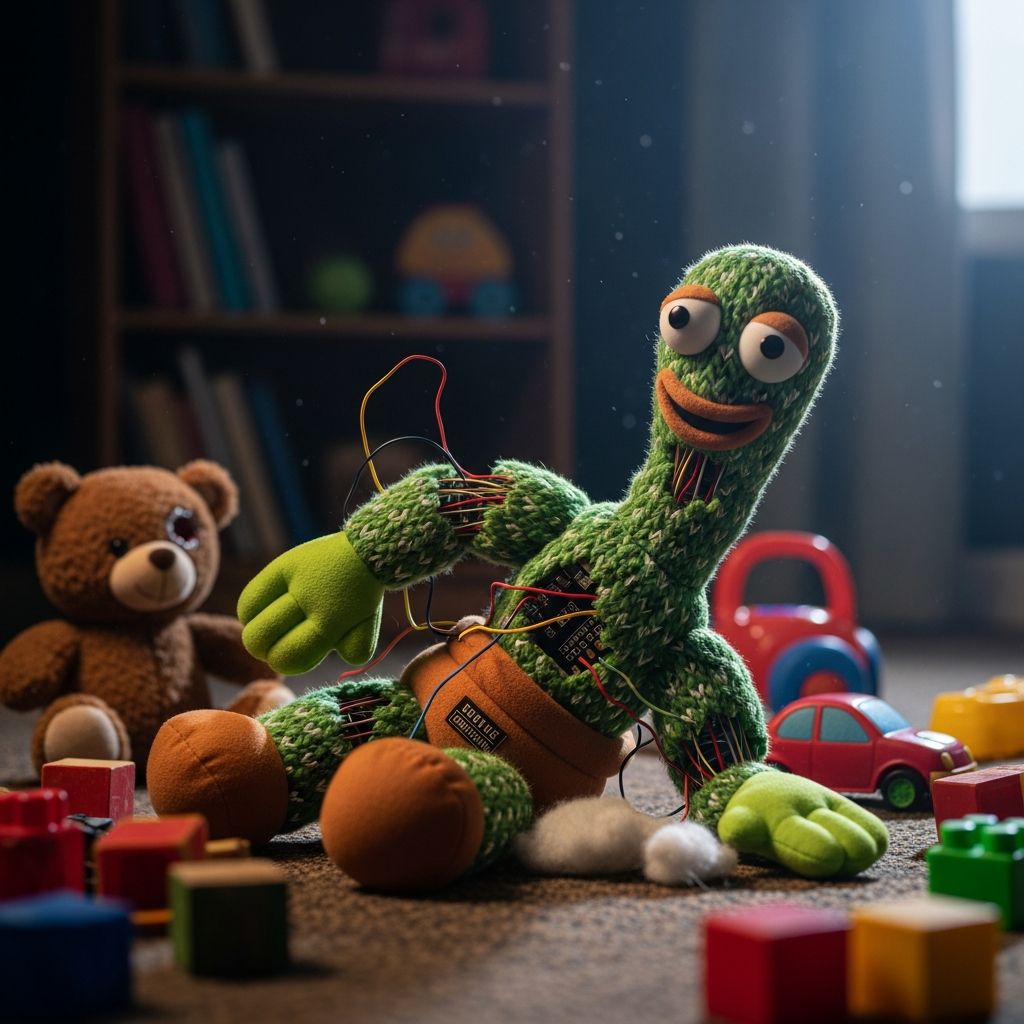
A seemingly innocent children’s toy—a dancing, singing cactus—reportedly blasting profanity and drug references in Polish is more than just a viral oddity; it is a case study in how modern toy supply chains and online marketplaces can fail families.
Although the story is unusual and even darkly comic on the surface, it exposes deeper problems in how toys are designed, translated, and sold across borders, especially when parents increasingly rely on one-click shopping for their kids’ gifts.
From Cute to Concerning: The Strange Case of the Swearing Cactus
The product at the center of this controversy was marketed as a cheerful educational cactus toy that sings and dances, an appealing combination for parents looking to engage toddlers with music and movement.
The shock came when families discovered that one of the cactus’s songs contained explicit language and references to drug use in Polish, content that clearly does not belong in a nursery or playroom.
Why This Story Resonated With Parents
- Parents trust children’s products labeled as age-appropriate, especially when they are marketed with bright colors, smiling characters, and friendly packaging.
- Many families assume that if a toy is sold on a major platform or by a big retailer, basic content checks and safety reviews have already happened.
- The idea that a toy could secretly broadcast mature content in a foreign language challenges that sense of security and raises doubts about how carefully products are vetted.
How Global Toy Supply Chains Create Gaps
Modern toys often pass through multiple companies and countries before they ever reach a child’s hands, with one firm designing the hardware, another supplying audio content, and others handling manufacturing, packaging, and distribution.
Each handoff creates an opportunity for miscommunication or inadequate review, especially around language, cultural meaning, and age-appropriateness of embedded songs or stories.
Common Breaking Points in the Process
- Content licensing without context: A manufacturer might license a catchy track simply because it fits the toy’s format, without a fluent reviewer assessing the lyrics in every language version.
- Language barriers: Teams approving products for export may not recognize problematic words in another language and may rely on incomplete translations or automated tools.
- Fragmented accountability: When multiple third-party sellers, distributors, and fulfillment providers are involved, each assumes someone else checked the content thoroughly.
What Toy Regulations Actually Cover
Toy regulations in many countries focus heavily on physical hazards such as choking risks, sharp edges, toxic materials, and electrical safety, leaving content issues like explicit language and mature themes less tightly defined.
Standards often include noise limits and labeling requirements, but detailed review of song lyrics—especially in multiple languages—is not always systematically enforced, particularly for imported low-cost electronic toys.
Physical vs. Content Safety
| Type of safety | Typical focus | How it relates to the cactus case |
|---|---|---|
| Physical safety | Choking hazards, sharp parts, toxic materials, overheating, battery access. | The cactus toy primarily raised content concerns rather than physical hazards, so it could potentially pass basic mechanical tests. |
| Content safety | Age-appropriate language, themes, and imagery in songs, voices, and visuals. | The explicit, drug-referencing lyrics in Polish demonstrate how content can slip through when regulators and retailers focus mainly on mechanical and chemical risks. |
| Labeling & marketing | Age grading, warnings, and claims such as “educational” or “for toddlers.” | Calling a product for young children “educational” while it secretly contains mature lyrics undermines the trust those labels are meant to build. |
The Role of Online Marketplaces and Big Retailers
Large retailers and online platforms sell enormous volumes of third-party goods, including toys that they do not design or manufacture themselves, relying on sellers to certify compliance while using spot checks and automated filters.
Investigations and enforcement actions in other toy cases have shown that even major companies can miss problematic items until consumers complain or regulators step in, suggesting that oversight is reactive rather than fully preventative.
Why Problematic Toys Still Slip Through
- Online catalogues may list thousands of low-cost toys, making comprehensive manual review of every audio clip or language variant impractical without targeted risk-based screening.
- Platforms and retailers sometimes prioritize listing speed and low prices over deep verification of each product’s cultural and linguistic nuances.
- Enforcement often depends on consumer complaints, media attention, or regulator inquiries, so issues only surface once the product is already in homes.
Why Language and Culture Checks Matter
Toys today circulate globally, meaning a song recorded for one audience can unexpectedly offend or alarm families in another country if lyrics contain slang, adult themes, or politically charged references.
Without native speakers or culturally informed reviewers in the approval process, companies risk building toys that function as unintentional Trojan horses for content that contradicts the values and expectations of parents.
Best Practices for Content Vetting
- Hiring native-language reviewers to assess all recorded content, not just relying on written translations of lyrics or scripts.
- Maintaining a red-flag list of themes—such as drugs, explicit violence, and sexual references—that automatically disqualify songs for children’s products.
- Documenting the origin and licensing of every audio track embedded in a toy, including language variants, so responsibility is clear if something goes wrong.
What Parents Can Do Before Buying a Toy
Even when regulators and retailers fall short, parents can take a few practical steps to reduce the risk of bringing inappropriate or unsafe toys into their homes, especially when shopping online for budget-friendly items.
These checks will not catch every problem, but they significantly improve the odds of spotting red flags before the toy appears on the doorstep.
Practical Pre-Purchase Checklist
- Read multiple reviews, not just the star rating: Look for comments mentioning strange sounds, unexpected language, or quality issues, and treat repeated warnings as serious.
- Check the seller, not only the platform: Products sold directly by a major retailer may have more rigorous checks than those shipped by small third-party sellers.
- Be cautious about very low prices: Deeply discounted electronic toys with lots of features can indicate rushed design and minimal vetting.
- Search the product name separately: A quick search can reveal news stories, recall notices, or user videos exposing problems with the toy.
What To Do If a Toy Seems Inappropriate
When parents discover that a toy includes disturbing content, the immediate priority is to remove the product from the child’s environment and explain, in age-appropriate terms, why it is going away.
Beyond protecting one family, reporting the issue helps regulators, retailers, and other parents become aware of the problem so the product can be reviewed, recalled, or removed.
Steps to Take After a Bad Discovery
- Stop using the toy immediately and store it out of children’s reach while deciding whether to return or discard it.
- Document the issue with photos or short videos that clearly show the toy, the packaging, and the concerning behavior (such as offensive audio).
- Contact the seller or retailer with a clear description of the problem and ask for a refund, even if formal recalls have not yet been announced.
- Submit a report to relevant consumer safety authorities so the issue enters official channels for investigation.
How Incidents Like This Can Change Policy
High-profile toy mishaps, even when they begin as niche online stories, can push regulators to expand definitions of safety to include content risks more explicitly, especially for electronic toys that rely on songs and recorded speech.
Retailers may respond by tightening their own internal approval systems, imposing stricter requirements on third-party sellers, and adding new checks for language and cultural appropriateness in product review pipelines.
Possible Reforms and Industry Responses
- Clearer guidance that children’s products must avoid explicit language and adult themes in any language version, backed by enforceable penalties.
- Mandatory content audits for interactive toys that play music, stories, or voice prompts before they can be listed on major platforms.
- Improved traceability of digital content in toys so regulators can quickly determine where problematic audio originated and who is accountable.
Teaching Kids Media Awareness Through Mistakes
As unsettling as it is, a toy that turns out to be inappropriate can also serve as a moment to talk with older children about media, language, and why not everything marketed to them is trustworthy.
Framing the removal of the toy as an act of care—rather than punishment—helps kids see that adults are actively protecting them and modeling how to respond when products cross important boundaries.
Conversation Starters for Parents
- “Sometimes companies make mistakes, and toys include words or ideas that are not for kids. When we find those, it is our job to keep you safe.”
- “If you ever see or hear something from a toy that feels scary, mean, or strange, you can always tell us so we can check it together.”
- “Even grown-ups have to be careful about the things they buy and listen to, and we are learning how to choose better too.”
Key Takeaways for Families
The swearing cactus toy is a vivid reminder that “kid-friendly” branding does not guarantee truly child-appropriate content, especially in a world where toys are assembled from global parts and sold at high speed online.
Parents cannot control every failure in the system, but by combining skepticism, simple investigation steps, and quick reporting when something goes wrong, families can both protect their own children and help improve the broader toy marketplace.
FAQs About Inappropriate or Unsafe Toys
How can a toy with offensive content make it onto a major retailer’s site?
Large online catalogues often depend on sellers to certify that products comply with safety and content rules, while the retailer performs limited spot checks and responds to complaints.
When multiple companies handle manufacturing, content, and distribution, each may assume others verified the audio or language, allowing problematic material to slip through until families notice it.
Are there laws against toys with explicit lyrics for kids?
Regulations typically focus on physical and chemical safety, but some jurisdictions can treat deceptive or clearly inappropriate content in children’s products as a consumer protection or labeling issue, especially when marketing claims emphasize education or suitability for toddlers.
As incidents gain attention, policymakers may consider more explicit rules requiring retailers to treat mature language and themes as a form of risk alongside choking hazards and battery access.
Should I avoid all electronic toys that play music?
Electronic toys can be engaging and educational when content is well-designed and age-appropriate, and most do not contain hidden explicit material.
Instead of avoiding them entirely, parents can preview audio, check reviews, and favor reputable brands or sellers that clearly describe the songs and languages used.
What is the best way to report a suspicious toy?
Start with the retailer or platform where the toy was purchased, providing your order information and clear documentation of the issue so they can investigate and potentially stop sales.
For serious safety or content concerns, also submit a report to the relevant consumer safety authority in your country so regulators can track patterns and issue public alerts or recalls when necessary.
Can parents rely on product recalls to catch toys like this?
Recalls are powerful tools but are usually triggered after problems are documented and verified, meaning many families encounter the product before any official action occurs.
Staying informed about safety alerts and treating unusually cheap, generic, or poorly documented toys with caution helps reduce reliance on recalls as the first line of defense.