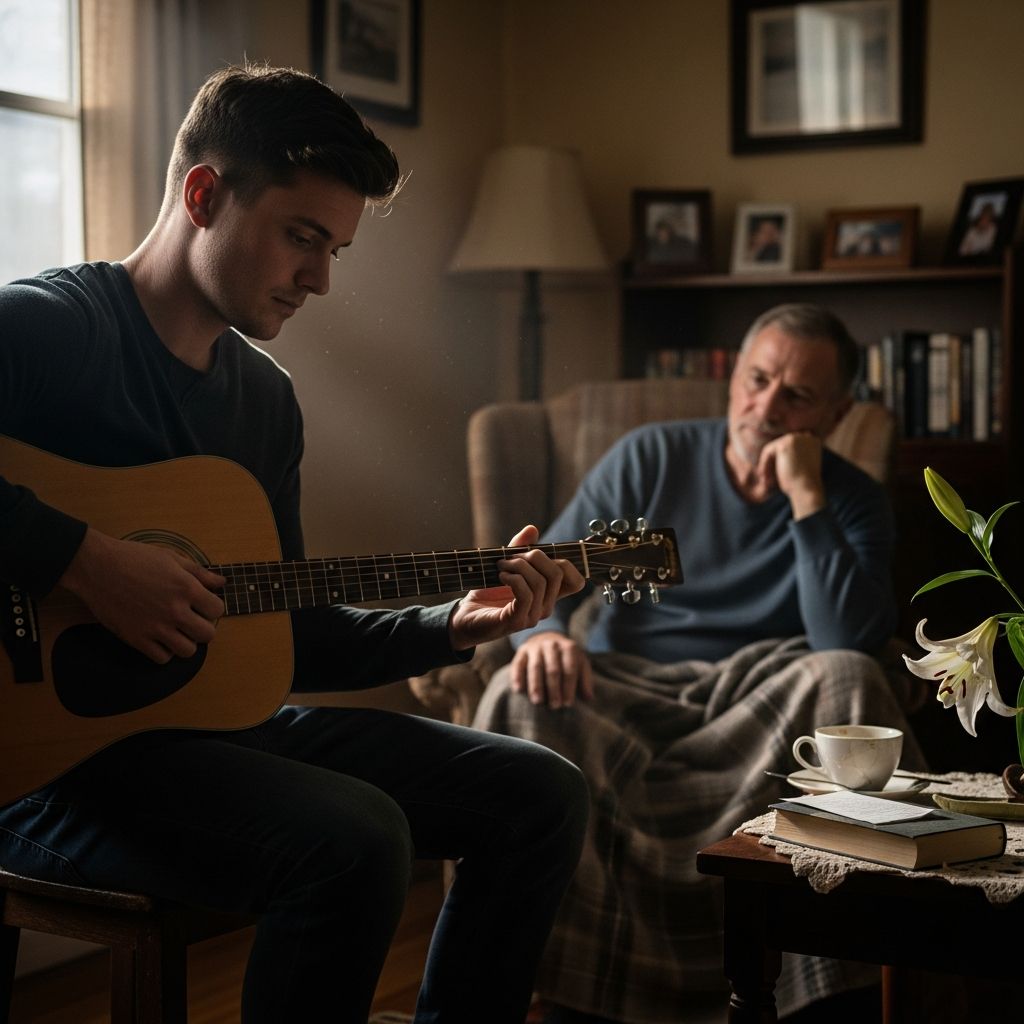
When a parent receives a cancer diagnosis, there are often no words that feel big enough to hold all the fear, love, and heartbreak that follow. For one songwriter whose dad was told he had about a year to live, those unspeakable feelings eventually turned into a song — a raw, vulnerable musical goodbye to his father that has resonated with millions of viewers online.
The Viral Video That Broke Hearts
In the now-famous clip, a young man sits with his guitar and quietly explains that his dad has cancer and has been given limited time to live. The mood is gentle but heavy; the kind of stillness that comes when everyone in the room knows life has just split into a “before” and an “after.” As he begins to sing, the camera doesn’t just stay on him — it captures his father’s face, too, allowing viewers to witness the unfiltered reaction of a dad hearing his son’s musical farewell.
The song itself is written from the perspective of a child losing a parent, mixing gratitude, regret, and the desperate wish to pause time. Listeners see a father who is both proud and devastated, clearly moved that his son has poured his heart into this tribute while also confronting the reality that this may be one of the last big memories they create together.
A Song Born From a Cancer Diagnosis
The songwriter created the piece after learning that his dad’s cancer was likely terminal, and that doctors had estimated roughly a year left. That kind of prognosis does something strange to time: every ordinary moment suddenly feels precious, and every interaction is quietly framed by the question, “Will we ever get this again?” Turning to music gave him a way to process those feelings without having to spell them out in conversation.
Instead of writing a purely sad song, he crafted lyrics that balance sorrow with gratitude. He sings about memories they’ve already made, the life lessons his dad has passed down, and the stubborn hope that love might somehow outlast the body. It’s not just a song about death; it is also a song about how deeply a child can be shaped by a parent’s presence.
Capturing Dad’s Reaction on Camera
One of the most powerful parts of the video is not actually the song itself, but the father’s reaction as he listens. Viewers see his face move through multiple emotions: surprise, pride, disbelief, and the ache of knowing his child is bracing for a future without him. He doesn’t have to say much — his eyes say everything.
Many people who watch the video recognize their own fathers in his reaction. He looks like a man who has spent years trying to be strong for his family, now forced to accept that they are being strong for him. The camera lingers on the tender, unspoken connection between them, giving the audience a rare window into a deeply private, intimate moment between parent and child.
The Emotional Themes Inside the Lyrics
Even without quoting specific lines, the themes of the song are clear from the way the son sings and the way the father responds. This is a piece about anticipatory grief — the kind of mourning that begins long before someone actually dies. It is also about the unfairness of having to say goodbye before you feel ready, and about trying to make peace with the fact that no amount of love can change a medical prognosis.
At the same time, the song highlights enduring connection. The son sings as if he is trying to build a bridge that will stretch past hospital rooms and medical scans into whatever comes next. Embedded in the performance is an unspoken promise: even if they are physically separated, the bond between them will continue to shape who he becomes.
Why This Song Resonates With So Many
The video spread quickly online because it taps into a nearly universal fear: losing a parent. Whether or not someone has personally experienced cancer in their family, most people know what it means to dread the day they have to say goodbye to a mom or dad. Watching another person live that moment in real time triggers empathy, as well as a sense of recognition.
There is also something uniquely powerful about watching men — fathers and sons in particular — openly share vulnerability. In many families, difficult conversations about death and illness are avoided. This video flips that script by showing a son choosing to lean into vulnerability, and a dad allowing himself to be visibly moved instead of hiding his emotions.
How Music Helps Families Cope With Terminal Illness
Music has long been used as a way to express emotions that feel too overwhelming or complicated to put into everyday language. In families facing a terminal diagnosis, songs can carry messages that might otherwise be impossible to say out loud: “I’m scared,” “I’m grateful,” “I don’t know how to let you go,” or simply, “I love you more than I can ever explain.”
For this songwriter and his dad, the song becomes a kind of emotional time capsule. Long after the performance ends, the father knows his son’s love has been recorded in a form that can be replayed again and again. If and when the dad is no longer physically present, the family still has a way to hear his child’s heart speaking directly to him.
Anticipatory Grief: Mourning Before the Goodbye
Anticipatory grief describes the process of grieving someone while they are still alive, often after a serious diagnosis like cancer. Instead of a single moment of loss, families live through countless small losses — the loss of normal routines, the loss of certainty about the future, and sometimes the loss of the roles people once played within the home.
The songwriter’s decision to create and share a song is one way of working through that anticipatory grief. Rather than ignoring the reality of what is happening, he looks it in the eye and tries to give it shape. For many viewers, this feels both heartbreaking and oddly comforting; it shows that honoring the pain can exist right alongside cherishing the time that remains.