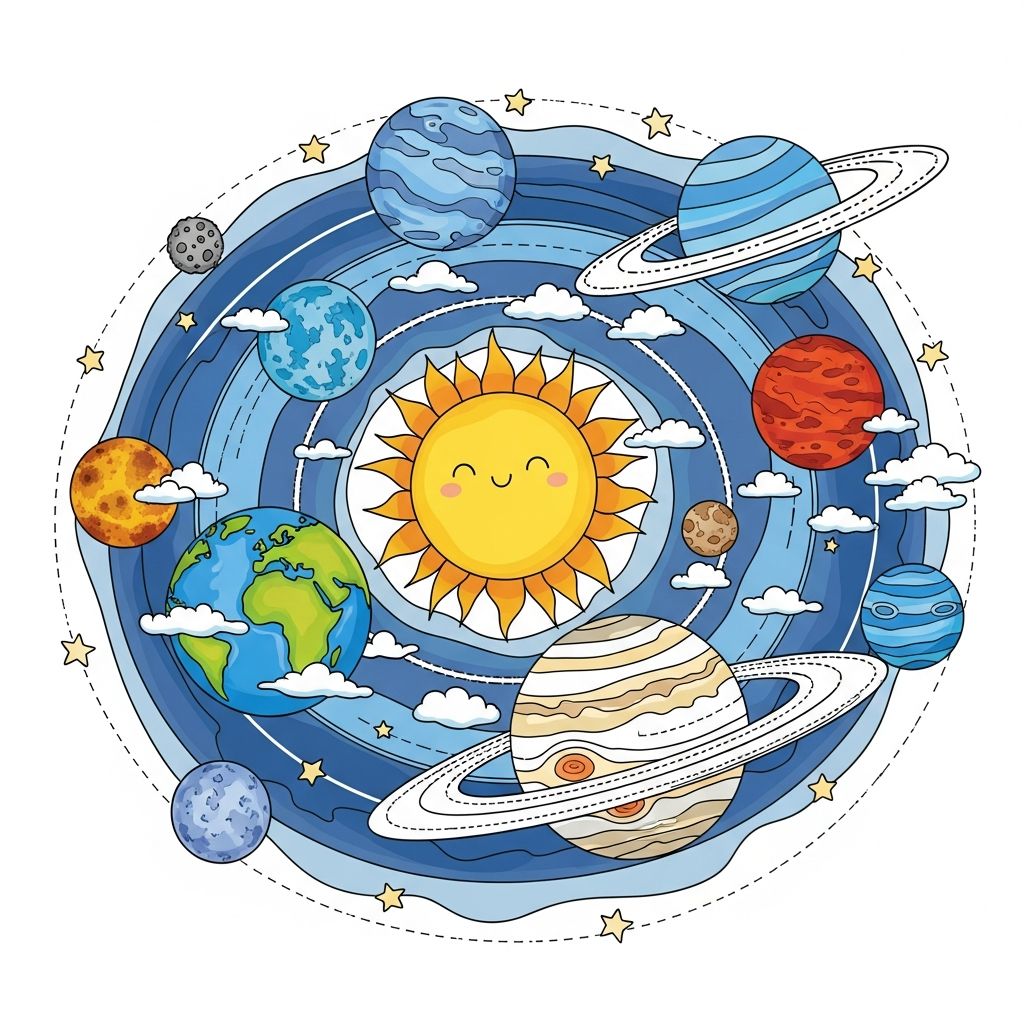
Solar system coloring pages are more than quiet-time printables – they can become the starting point for big questions, curious minds, and early science learning about planets, moons, and the Sun.
Why Space-Themed Coloring Pages Engage Young Learners
Many children are naturally fascinated by rockets, stars, and distant planets, so a space theme instantly captures attention and imagination. When kids color the solar system, they begin to see how the planets fit together like pieces of a cosmic puzzle.
Coloring also strengthens fine motor skills and attention span, while short space facts and simple explanations turn a simple art activity into an informal science lesson. This combination makes solar system coloring pages useful for both home and classroom learning.
Essential Solar System Facts to Support Coloring Time
Even a basic understanding of the solar system can help adults answer questions that come up while kids color. Keeping a handful of age-appropriate facts nearby allows you to explain what each object in the picture represents.
Here is a simple overview you can share in your own words as children color:
- The solar system is the Sun plus everything that moves around it, including planets, moons, asteroids, and comets.
- There are eight main planets that orbit the Sun in set paths called orbits.
- Earth is the only known planet that supports life, but scientists are always looking for signs of life elsewhere.
- Many planets have moons, and some have rings made of ice or rock pieces.
Suggested Colors for the Sun and Each Planet
Real planets do not match crayon boxes perfectly, but offering suggested colors can help children remember which planet is which. Treat these colors as helpful starting points, not strict rules.
| Object | Suggested Colors | Fun Detail to Mention |
|---|---|---|
| Sun | Yellow, orange, a bit of red | It is a star that gives light and heat. |
| Mercury | Gray, light brown | Small and rocky, closest planet to the Sun. |
| Venus | Pale yellow, creamy orange | Covered in thick clouds with very high temperatures. |
| Earth | Blue, green, brown, white | Our home, with oceans, land, and swirling clouds. |
| Mars | Red, rusty orange | Known as the “red planet” because of iron-rich dust. |
| Jupiter | Tan, light brown, white bands | Largest planet, with swirling clouds and big storms. |
| Saturn | Pale yellow with gray or tan rings | Famous for its wide rings made of ice and rock. |
| Uranus | Pale blue or blue-green | Tilts on its side as it orbits the Sun. |
| Neptune | Deep blue | Very far from the Sun, cold and windy. |
Allow kids creative freedom to mix colors, add patterns, or draw extra stars and comets, even if the result is not scientifically exact. The goal is to plant memorable mental images and spark curiosity.
Types of Solar System Coloring Pages You Can Use
There are many ways to present the solar system on paper, from simple outlines for preschoolers to detailed sheets for older kids. Mixing page types keeps the activity fresh and lets children explore space in different ways.
- Full solar system posters: A large image showing the Sun, all eight planets, and sometimes the asteroid belt, ideal for a big coloring project.
- Single-planet sheets: A focused page for each planet with room to add labels, facts, or imaginative details.
- Cut-and-paste sets: Individual planet circles that kids color, cut out, and glue in order onto a larger sheet or strip of paper.
- Space scenes: Rocket ships, astronauts, stars, and planets together to create storytelling opportunities.
- Labeling worksheets: Color, then connect names to the correct planets or add written labels for spelling practice.