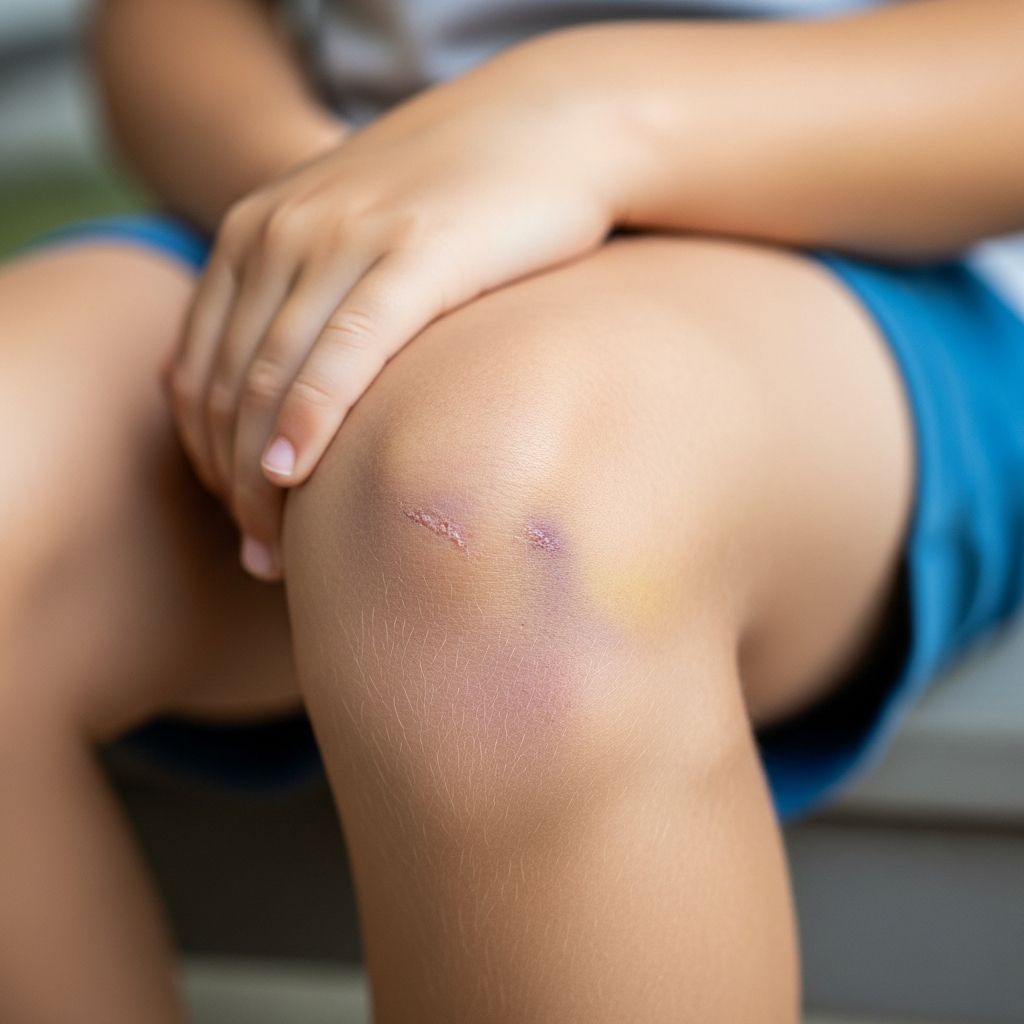
Knee injuries are very common in active children and teens. One of the most frequent minor knee injuries is a knee contusion, often called a deep bruise. Understanding what this injury is, how to care for it at home, and when to seek medical help can make recovery smoother and safer for your child.
What Is a Knee Contusion?
A knee contusion happens when a direct blow to the knee damages the small blood vessels in the soft tissues or bone, causing bleeding under the skin or inside the bone. The skin might look normal at first and then become discolored (blue, purple, green, or yellow) over several days as the bruise heals.
In children, knee contusions often occur during:
- Sports (soccer, basketball, football, gymnastics, skateboarding)
- Falls on hard surfaces (playground, driveway, gym floor)
- Collisions with furniture, equipment, or other children
Most knee contusions are mild injuries that heal with simple home care. However, a strong impact can occasionally injure deeper structures, such as the bone or cartilage, which may need medical evaluation and follow-up.
Soft Tissue vs. Bone Bruise
Not all bruises are the same. Doctors often distinguish between a surface (soft tissue) bruise and a deeper bone bruise.
| Type of Bruise | What Is Injured? | Common Symptoms | Typical Healing Time |
|---|---|---|---|
| Soft tissue contusion | Skin, fat, and muscle around the knee | Mild to moderate pain, surface discoloration, mild swelling, knee usually moves normally | Several days to 2 weeks with proper care |
| Bone bruise | Bone under the joint surface | Deeper, more persistent pain, more tenderness with weight-bearing, sometimes less visible discoloration | Several weeks to a few months, depending on severity |
Only a healthcare professional can reliably tell whether your child has a simple muscle bruise or a bone bruise, usually based on the exam and sometimes imaging such as MRI.
Typical Symptoms of a Knee Contusion
Signs and symptoms vary based on how hard the knee was hit and which tissues were affected, but common features include:
- Pain at the point of impact, especially when touched or bumped
- Swelling developing within a few hours after the injury
- Bruising or discoloration that may appear immediately or over the next 1–2 days
- Stiffness or soreness when bending or straightening the knee
- Mild difficulty with walking or running, especially right after the injury
With a straightforward contusion, your child should still be able to gently move the knee and bear at least some weight, although it may be uncomfortable. Severe pain, inability to walk, or a feeling that the knee is unstable can suggest a more serious injury.
How Doctors Diagnose a Knee Contusion
Many minor knee bruises can be managed at home without an immediate doctor visit. However, if you do see a healthcare provider, they may:
- Ask what happened (type of impact, direction of force, whether your child heard a pop or felt a snap)
- Review your child’s symptoms (pain level, swelling, locking, catching, giving way)
- Examine the knee (tender areas, swelling, bruising, range of motion, stability)
- Check for signs of ligament, tendon, or cartilage damage
Imaging tests are not always needed for a simple contusion. However, a doctor may order:
- X-rays to rule out fractures or certain growth-plate injuries in children
- MRI if a bone bruise, ligament tear, or cartilage injury is suspected
First Aid and Home Care: The PRICE / RICE Approach
Early care in the first 24–48 hours can significantly reduce pain and swelling and help your child heal faster. Many pediatric and sports medicine guidelines recommend a combination of protection, rest, ice, compression, and elevation.
1. Protect the Knee
Right after the injury:
- Take your child out of the game, practice, or vigorous play.
- Avoid running, jumping, or contact activities.
- Use crutches if walking is very painful or your doctor recommends them.
2. Rest
For the first 1–2 days:
- Limit walking to basic daily activities.
- Avoid stairs when possible.
- Do not push through pain to keep playing sports.
3. Ice
Cold therapy helps control pain and swelling.
- Apply a cold pack or a bag of crushed ice wrapped in a thin towel.
- Use for about 10–20 minutes at a time, every 2–3 hours while awake for the first 24–48 hours.
- Never place ice directly on bare skin to avoid frostbite.
4. Compression
Gentle pressure around the knee can reduce swelling and provide support.
- Use an elastic bandage or a soft compression sleeve.
- Wrap snugly but not so tight that your child feels tingling, numbness, or increasing pain.
5. Elevation
Raising the knee helps fluid drain away from the injured area.
- Have your child lie down and prop the leg on pillows.
- Try to keep the knee at or slightly above heart level, especially during the first couple of days.
Medication for Pain Relief
If your child’s healthcare provider approves, certain over-the-counter medicines can make your child more comfortable:
- Acetaminophen can help with pain.
- Non-steroidal anti-inflammatory drugs (NSAIDs), such as ibuprofen or naproxen, can reduce both pain and inflammation, if used as directed.
Important points:
- Always follow dosing instructions based on your child’s age and weight.
- Do not give two medicines containing the same ingredient at the same time.
- Check with your child’s doctor if your child has kidney problems, bleeding disorders, stomach ulcers, or takes other medications.
Healing Timeline: What to Expect
Recovery time depends on how severe the contusion is and whether deeper structures are involved.
- Mild soft tissue contusion: discomfort improves noticeably after a few days; most kids return to light activity within 1–2 weeks.
- Moderate contusion: pain and swelling may last 2–3 weeks; return to full sports may take longer, especially if the knee was very swollen.
- Bone bruise: symptoms can persist for several weeks to a few months, especially with high-impact activities.
During recovery, your child’s pain should gradually decrease, movement should improve, and swelling should slowly resolve. If the opposite happens—pain worsens or new symptoms appear—call your child’s healthcare provider.
When a Bruise May Be More Than a Bruise
Sometimes a blow that looks like a simple contusion can mask more serious problems, such as a ligament tear, cartilage injury, or fracture. Seek same-day medical evaluation or urgent care if your child has any of the following warning signs:
- Cannot put any weight on the leg or refuses to walk
- Severe pain that does not improve with rest and ice
- Very large or rapidly increasing swelling of the knee
- Knee looks deformed or is stuck in a bent position
- Feeling or hearing a “pop” at the time of injury with immediate swelling
- Knee repeatedly “gives way,” locks, or catches during movement
- Fever, redness, or warmth around the joint (possible infection or inflammatory condition)
- Numbness, tingling, or weakness in the leg or foot
Rapidly worsening pain or swelling in the thigh or lower leg after a contusion is rare but urgent; it can indicate dangerous pressure building up in the muscles that may require emergency treatment.
Rehabilitation and Safe Return to Activity
As pain and swelling improve, gentle movement and strengthening help restore normal knee function and reduce the risk of re-injury. Many children recover fully with a gradual increase in activity, while others—especially athletes—may benefit from physical therapy.
Early Motion
- Encourage gentle bending and straightening of the knee within a pain-free range.
- Avoid forcing the joint if your child resists or feels sharp pain.
Strength and Flexibility
- Once your child can walk without limping, simple exercises may include tightening the thigh muscle, mini-squats, or leg raises as advised by a professional.
- Stretching the front and back of the thigh (quadriceps and hamstrings) helps restore normal movement.
Criteria for Returning to Sports
Before full return to play, experts usually recommend that your child:
- Has no or only mild soreness at rest
- Can walk, jog, and run straight ahead without pain or limping
- Can hop on the injured leg without increased pain
- Has full or near-full range of motion compared with the other knee
A sports medicine professional or pediatrician can provide a customized plan to safely guide your child back to practice and competition.
Preventing Future Knee Contusions
Not every knee bruise can be prevented, but you can lower the risk and severity of injuries by focusing on safety and conditioning.
Protective Equipment and Environment
- Ensure your child wears sport-appropriate protective gear (such as kneepads for volleyball, skateboarding, or inline skating).
- Choose well-fitting, supportive shoes with good traction.
- Encourage play on safer surfaces when possible (grass or padded gym floors instead of concrete).
Strength, Flexibility, and Technique
- Year-round conditioning that includes leg strengthening and core stability can protect the knees.
- Teach proper landing and cutting techniques in jumping and pivoting sports.
- Encourage warm-up and stretching before practices and games.
Smart Sports Habits
- Emphasize listening to pain signals—if something hurts more than mild soreness, your child should stop and rest.
- Allow adequate recovery time after injuries to avoid returning too soon.
- Promote cross-training and varied sports instead of year-round specialization that stresses the same areas repeatedly.
Frequently Asked Questions (FAQs)
Q1: How do I know if my child’s knee bruise is serious?
A minor contusion usually causes localized pain, some swelling, and a bruise, but your child can still gently move the knee and may walk with only mild discomfort. Red flags for a more serious problem include an inability to bear weight, severe or rapidly increasing pain, major swelling, deformity, or a sense that the knee is unstable or locking. In those cases, your child should be evaluated by a healthcare professional.
Q2: Should my child get an X-ray for a knee contusion?
Not every bruise needs an X-ray. Doctors typically recommend imaging if they suspect a fracture, a growth-plate injury, or if your child has severe pain, cannot walk, or has significant tenderness over the bone. In some cases, an MRI may be used to check for a bone bruise or ligament injury.
Q3: Can my child go to school with a knee contusion?
Yes, most children with a mild bruise can attend school if they can get around safely. You may need to adjust activities—using the elevator instead of stairs, limiting playground time, or getting temporary excuses from physical education and sports until walking is comfortable and your healthcare provider clears activity.
Q4: Is it normal for the bruise color to change?
Yes. As the body breaks down and reabsorbs the blood under the skin, bruise colors typically shift from dark blue or purple to green, yellow, and then light brown before fading completely. This change in color over several days to a couple of weeks is a normal part of healing.
Q5: When should we follow up with a doctor?
You should contact your child’s doctor if pain or swelling has not improved at all after a few days of home care, if your child is still limping significantly after a week, or if new symptoms such as locking, giving way, numbness, or fever develop. Children with a bone bruise or another associated knee injury may need ongoing follow-up to monitor healing.
References
- Pediatric Knee Injuries: ACL — Children’s National Hospital. 2023-02-01. https://www.childrensnational.org/get-care/health-library/knee-injuries-acl
- Muscle Contusion — Ann & Robert H. Lurie Children’s Hospital of Chicago. 2022-06-15. https://www.luriechildrens.org/en/specialties-conditions/muscle-contusion/
- Knee Injuries — Nemours KidsHealth. 2023-05-10. https://kidshealth.org/en/parents/knee-injuries.html
- When Your Athlete Has a Strain, Sprain or Contusion — Texas Children’s Hospital. 2022-08-09. https://www.texaschildrens.org/content/conditions/when-your-athlete-has-strain-sprain-or-contusion
- Knee Pain or Injury in Children: Care Instructions — Kaiser Permanente Health Encyclopedia. 2021-11-01. https://healthy.kaiserpermanente.org/health-wellness/health-encyclopedia/he.knee-pain-or-injury-in-children-care-instructions.bo1378
- Knee Contusion: Recovery, Causes, Treatment & More — Healthline. 2018-09-24. https://www.healthline.com/health/knee-contusion
- Knee Injury — American Academy of Pediatrics, Pediatric Patient Education. 2016-01-01. https://publications.aap.org/patiented/article/doi/10.1542/ppe_schmitt_372/194333/Knee-Injury