Understanding Sensory Play and Its Role in Growing Minds
Sensory play encompasses any activity that activates one or more of a child’s senses, creating a dynamic learning environment where children explore their surroundings through touch, sight, sound, taste, and smell. This form of play represents far more than simple entertainment; it serves as a fundamental mechanism through which young children process information about their world and build the cognitive foundations necessary for future learning. From the moment infants begin grasping objects to the time preschoolers engage in complex imaginative games, sensory engagement remains at the heart of developmental progress.
The significance of sensory-based activities lies in their ability to activate multiple neural pathways simultaneously. When children engage with different textures, colors, sounds, and scents, their brains work to process and categorize this information, strengthening the connections between nerve cells. These neural pathways form the infrastructure upon which all subsequent learning depends, making early sensory experiences investments in a child’s long-term cognitive capacity.
The Neurological Foundation: Building Brain Architecture Through Exploration
At the cellular level, sensory play performs critical developmental work. Research demonstrates that when children actively utilize their senses in conjunction with one another, they establish neural connections that enable increasingly sophisticated cognitive functioning. This neurobiological process begins in infancy and continues throughout early childhood, with each sensory experience refining and expanding the brain’s capability to process complex information.
The brain’s development during the early years follows predictable patterns, with certain windows of opportunity opening and closing as children mature. Sensory play capitalizes on these critical periods by providing rich, varied experiences that stimulate developing brain regions responsible for perception, motor control, language, and emotional regulation. Children who engage in diverse sensory activities develop stronger neural networks than those with limited sensory exposure, resulting in advantages that extend well beyond the preschool years.
Consider how a child learning about temperature through play water activities engages multiple brain systems simultaneously: the sensory cortex registers the sensation of warmth or coolness, the motor cortex coordinates hand movements, the language centers search for appropriate descriptive words, and the memory systems record the experience for future reference. This multisensory engagement creates robust learning pathways that support retention and transfer of knowledge to new situations.
Language Development: Communication Emerges Through Sensory Experience
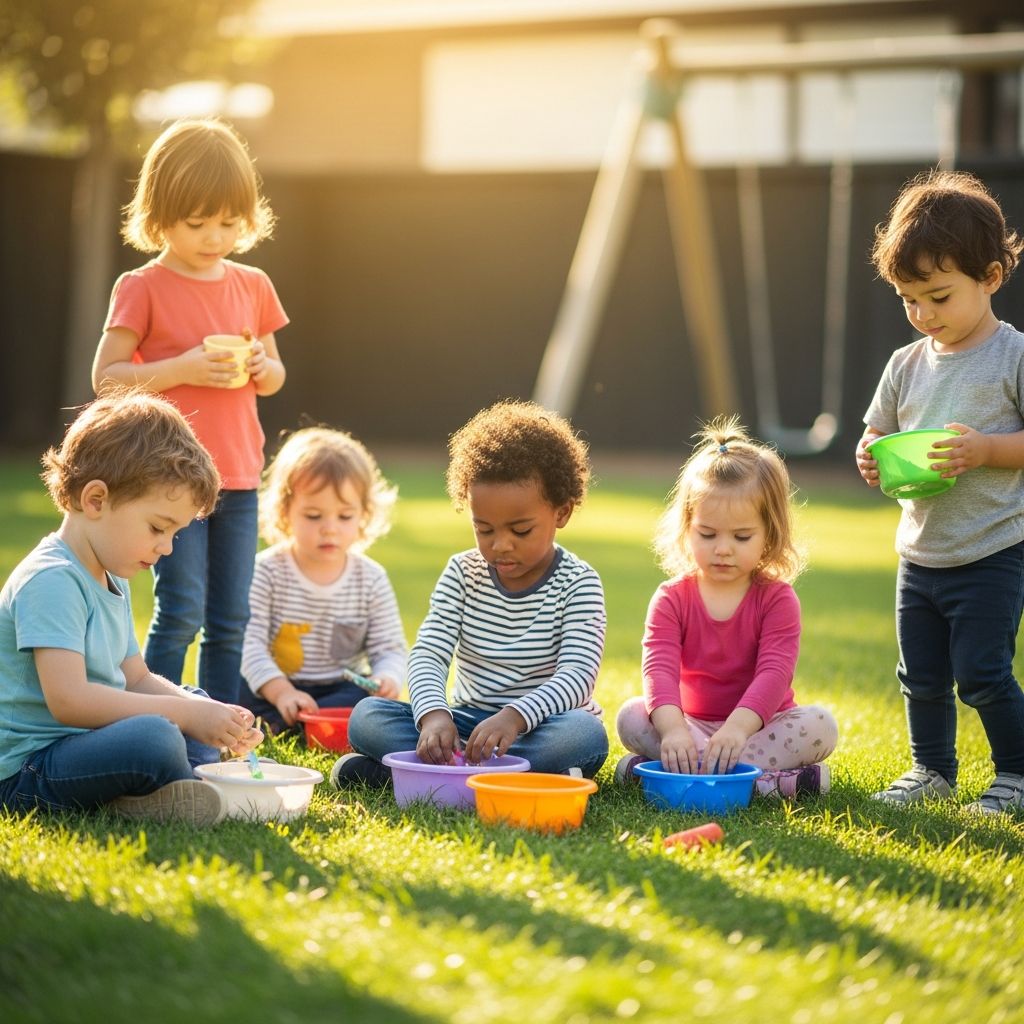
Language acquisition occurs most naturally when children have concrete sensory experiences to anchor their new vocabulary. When preschoolers play with water, they encounter liquids that flow, splash, and change shape, giving them genuine understanding of concepts like “liquid,” “flow,” and “splash” before they encounter these words in books or lessons. This experiential foundation makes vocabulary stick far more effectively than isolated word repetition could achieve.
During sensory play activities, children discover the need to communicate their observations, desires, and discoveries to others. A child building with blocks might ask for help securing a piece, describe the tower’s appearance, or explain their construction method to a friend. Each interaction provides natural opportunities to use language in meaningful contexts, strengthening both expressive and receptive language skills. When caregivers participate in sensory activities alongside children, asking open-ended questions and engaging in dialogue, they further amplify language development benefits.
The vocabulary expansion occurring during sensory play extends beyond simple object names. Children learn descriptive language—rough, smooth, slippery, grainy—and action words related to their physical interactions. This nuanced language development supports their ability to express increasingly complex thoughts and emotions as they mature.
Motor Skill Development: From Gross Movement to Fine Coordination
Sensory play activities provide the ideal context for developing both large and small muscle groups in ways that feel playful rather than demanding. Gross motor skills—involving large muscle groups—strengthen through activities like balancing on unstable surfaces, climbing through obstacle courses, or swinging from playground equipment. These whole-body movements build strength, coordination, and body awareness essential for later physical activities.
Fine motor development, the ability to control small muscles in the hands and fingers, occurs naturally through tactile play experiences. When children pour sand from one container to another, manipulate play dough, thread beads onto strings, or arrange small objects into patterns, they strengthen the precise muscle coordination necessary for writing, drawing, eating with utensils, and dressing themselves. Unlike formal exercise programs, sensory play makes these skill-building activities inherently enjoyable, increasing children’s motivation to practice and persist through challenges.
The proprioceptive system—our awareness of body position and the force needed for different movements—develops through physical sensory experiences. Children learn how hard to push, pull, or lift objects through experimentation and feedback, gradually developing better body control and spatial awareness. This foundational body knowledge supports everything from safe playground behavior to future sports participation.
Cognitive Growth: Problem-Solving and Analytical Thinking
Sensory play naturally encourages the problem-solving and critical thinking skills that characterize intelligent learning. When a child encounters a challenge during play—such as figuring out how to transfer small pasta pieces between containers without spilling, or determining how to build a structure that won’t topple—they engage in the fundamental cognitive processes of experimentation, observation, and hypothesis testing.
These playful problem-solving experiences teach children that challenges have solutions worth pursuing, building resilience and perseverance. Rather than following predetermined instructions, children in sensory play contexts discover cause-and-effect relationships independently, deepening their understanding of how the physical world operates. A child pouring water learns that tilting the container at different angles changes the flow rate, developing intuitive understanding of physics principles.
Memory enhancement occurs naturally as children engage with varied sensory materials and challenges. The act of retrieving previous experiences to inform current problem-solving strengthens memory systems, while the concentration required during complex sensory activities improves attention span and focus. Children learn to organize information by categories—grouping objects by texture, color, or size—developing the classification systems that underpin mathematical and scientific thinking.
Social and Emotional Development: Connection and Self-Expression
When children engage in sensory play alongside peers, they naturally develop critical social skills. Collaborative sensory activities require children to recognize that others have different perspectives and preferences, building empathy and flexibility. A child might discover that their friend enjoys the same water play activity but approaches it differently, or prefers different materials altogether. These discoveries teach valuable lessons about individual differences and acceptable variations in how people approach tasks.
Sensory play also provides safe contexts for emotional expression and regulation. Through play with soothing textures like kinetic sand or calming water activities, children develop awareness of their emotional states and discover self-soothing techniques. More vigorous sensory activities involving jumping, crashing, or vigorous movement provide outlets for physical energy and emotional intensity, helping children achieve better emotional balance.
When children successfully navigate challenges during sensory play—creating a desired structure, solving a puzzle, or mastering a physical skill—their confidence grows. This sense of competence developed through play experiences supports positive self-concept development and willingness to tackle new challenges in academic and social contexts.
Practical Implementation: Bringing Sensory Play Into Daily Life
Sensory play need not require expensive equipment or extensive preparation. Everyday household materials provide rich opportunities for exploration. Dried pasta, rice, beans, water, sand, and household items like plastic containers, wooden spoons, and fabric scraps all offer valuable sensory experiences. The key is creating safe environments where children can freely explore these materials with minimal restriction, limited primarily by basic safety considerations.
Effective sensory play setups share common characteristics: materials that invite manipulation, varied textures and consistencies, opportunities for both solo and collaborative play, and space for children to experiment without predetermined outcomes. Open-ended activities where children decide how to use materials typically generate more cognitive engagement than highly structured, outcome-focused tasks.
Creating Sensory-Rich Environments
- Designate dedicated spaces where sensory exploration is welcomed and mess is expected
- Rotate materials periodically to maintain novelty and sustain engagement
- Provide tools like measuring cups, funnels, and containers that extend play possibilities
- Include materials that appeal to all sensory modalities: things to see, touch, hear, and smell
- Allow adequate time for play without rushing to conclusions or cleanup
Age-Appropriate Sensory Experiences: From Infants to School-Age Children
Sensory play opportunities should evolve as children develop, matching their emerging abilities and interests. Infants benefit from safely exploring different textures, temperatures, and objects with varying weights and shapes. Their primary activities involve grasping, mouthing (under supervision), and examining objects closely—all legitimate sensory experiences.
As children reach toddlerhood and preschool years, their sensory play becomes more intentional and experimental. They begin deliberately mixing materials, building structures, and examining cause-and-effect relationships. Their growing motor skills enable more complex manipulations, while developing language allows them to describe their discoveries.
School-age children continue benefiting from sensory play, though the activities often become more sophisticated. They might engage in science experiments that emphasize sensory observation and discovery, build complex structures requiring planning and problem-solving, or explore creative projects combining sensory exploration with imaginative play.
Frequently Asked Questions About Sensory Play
Is sensory play only for young children?
While sensory play is particularly important during early childhood when neural development is most rapid, children of all ages benefit from sensory engagement. School-age children and even adolescents develop skills through sensory activities like science experiments, sports, and creative projects that engage their senses.
What if my child is sensory-sensitive or has sensory processing difficulties?
Children with sensory sensitivities still benefit from sensory play, but activities may need modification. Start with less intense sensory experiences and gradually increase intensity based on the child’s comfort. Consult with occupational therapists who specialize in sensory processing for personalized guidance.
How much time should children spend in sensory play?
There’s no magic number, but research suggests that regular daily sensory experiences support optimal development. Even 20-30 minutes of focused sensory play provides meaningful benefits, though longer periods are beneficial when children remain engaged.
Can sensory play substitute for formal educational instruction?
Sensory play builds foundational skills and should complement, not replace, intentional instruction. It works best as part of a balanced approach to learning that includes varied experiences and activities.
What safety considerations are important for sensory play?
Ensure materials are age-appropriate and free from choking hazards for young children. Supervise water play to prevent drowning risks. Use non-toxic materials and wash hands after play, especially with materials that touched the mouth.
The Long-Term Impact: Building Foundations for Lifelong Learning
The benefits of sensory play extend far beyond early childhood. Children who experience rich sensory environments during their formative years develop stronger neural foundations that support academic learning, creative thinking, and emotional resilience throughout their lives. The problem-solving skills practiced during sensory exploration transfer to academic challenges. The confidence developed through successful sensory play experiments supports willingness to tackle new learning tasks. The language skills refined through sensory experiences enable more effective communication and social connection.
As children progress through elementary and secondary education, the skills developed through early sensory play continue providing advantages. Students with stronger motor skills transition more easily into handwriting and sports. Those with well-developed language skills excel in reading and communication. Children with strong problem-solving abilities approach academic challenges with confidence and persistence.
Perhaps most importantly, early sensory play experiences cultivate curiosity and love of learning that sustain children throughout their educational journeys. When learning through exploration feels natural and enjoyable, children develop intrinsic motivation to understand their world—a quality far more valuable than any specific skill or piece of knowledge.
Conclusion: Prioritizing Sensory Exploration in Childhood
Sensory play represents one of the most powerful and accessible tools available for supporting healthy child development. By providing varied, rich opportunities for children to explore their world through touch, sight, sound, taste, and smell, caregivers create the conditions for optimal brain development, language acquisition, motor skill mastery, cognitive growth, and emotional wellbeing. The investment in sensory play during early childhood pays dividends throughout a child’s life, building neural pathways, skills, and dispositions that support success in learning and living.
References
- Benefits of Sensory Play for Preschoolers — Lillio. 2024. https://www.lillio.com/blog/sensory-play-benefits-for-preschoolers
- Why Sensory Play is Important for Your Child’s Development — PlayWell Brooklyn. 2024. https://www.playwellbrooklyn.com/blog/why-sensory-play-is-important-for-your-childs-development
- The Benefits of Sensory Play For Your Child — Cleveland Clinic. 2024. https://health.clevelandclinic.org/benefits-of-sensory-play-ideas
- What is Sensory Play and Why is It Important? — Action For Children. 2024. https://www.actionforchildren.org.uk/blog/what-is-sensory-play-and-why-is-it-important/