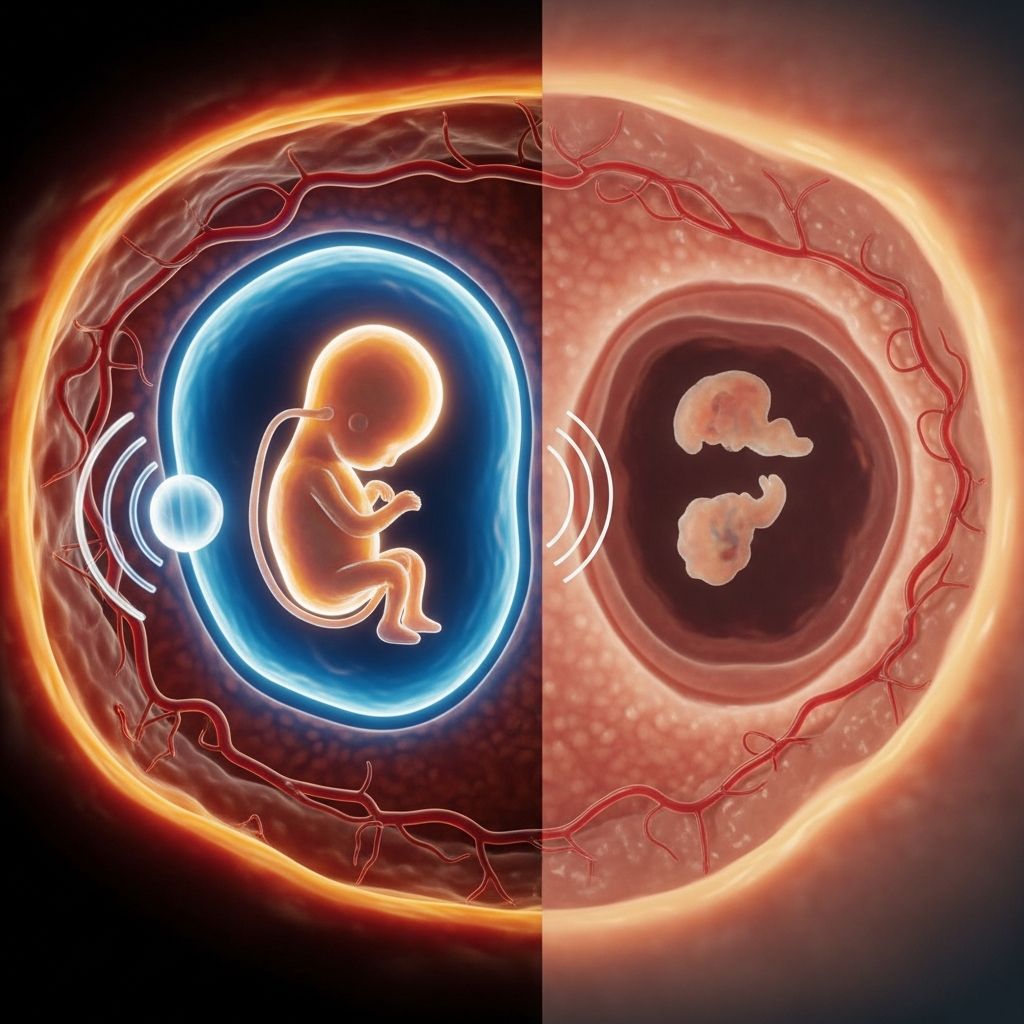
A viable pregnancy offers the potential for a live birth, while a nonviable one cannot progress to a healthy delivery. These terms guide medical decisions and emotional preparation during early gestation.
Defining Pregnancy Viability
Viability refers to a pregnancy’s ability to result in a live-born infant. In the first trimester, a **viable pregnancy** shows normal development, including a gestational sac, yolk sac, and embryonic heartbeat via ultrasound. Nonviable pregnancies lack these signs or exhibit abnormalities preventing survival.
Early assessment is crucial because distinguishing between viable, nonviable, and uncertain cases influences interventions like expectant management or procedures to address complications.
Key Diagnostic Indicators in Early Pregnancy
Ultrasound and blood tests form the backbone of viability assessments. Transvaginal ultrasound detects an intrauterine gestational sac without an embryo or heartbeat in uncertain cases.
- Gestational sac size: Mean sac diameter under 25 mm without an embryo suggests nonviability.
- Crown-rump length (CRL): CRL over 7 mm without cardiac activity indicates failure.
- Yolk sac: Enlarged yolk sac greater than 7 mm is a red flag.
- hCG levels: Serial measurements showing no rise or decline confirm nonviability.
These criteria, established by multispecialty consensus, reduce false positives that could lead to unnecessary interventions.
Understanding Nonviable Pregnancy Types
Nonviable pregnancies include early pregnancy failures like blighted ovum (empty sac) or missed miscarriage (no heartbeat). Ectopic pregnancies, where implantation occurs outside the uterus, are always nonviable and require prompt treatment to protect maternal health.
| Type | Description | Key Ultrasound Findings |
|---|---|---|
| Anembryonic Pregnancy | Gestational sac without embryo | Mean sac diameter ≥25 mm, no yolk sac or embryo |
| Embryonic Demise | Embryo with no heartbeat | CRL ≥7 mm, absent cardiac activity |
| Ectopic | Implantation outside uterus | No intrauterine sac, adnexal mass |
Such diagnoses occur in about 15-20% of early pregnancies, emphasizing the need for follow-up scans in uncertain scenarios.
Fetal Viability and Prematurity Thresholds
Beyond early gestation, **fetal viability** marks the stage where a baby has a reasonable survival chance outside the womb, typically around 23-24 weeks. At 24 weeks, intensive interventions like NICU care become standard.
Periviable births (20-25 6/7 weeks) carry high risks: survival rates hover at 60-70% at 24 weeks, but with potential for severe morbidities like respiratory distress or neurodevelopmental issues.
- Before 23 weeks: Resuscitation rare; outcomes often fatal.
- 23-24 weeks: Gray zone; decisions weigh parental wishes and prognosis.
- After 24 weeks: Survival odds improve daily, nearing 90% by 28 weeks.
ACOG defines periviability as 20 0/7 to 25 6/7 weeks, stressing shared decision-making.
Medical Management Options
For nonviable pregnancies, options include expectant management (natural passage), medication (misoprostol), or surgical evacuation (D&C). Ectopics may need methotrexate or surgery.
Viability uncertainties prompt serial monitoring: repeat ultrasounds in 7-10 days or hCG tests to avoid premature intervention. In periviable cases, antenatal steroids enhance lung maturity, boosting survival.
Emotional and Psychological Impact
Learning of a nonviable pregnancy triggers profound grief. Support resources like counseling, support groups, and follow-up care aid coping. Many experience anxiety in subsequent pregnancies, benefiting from early reassurance scans.
Families facing periviable decisions grapple with ethics: comfort care versus aggressive resuscitation. Palliative options provide dignity when survival seems improbable.
Advances in Viability Assessment
Recent progress includes refined ultrasound protocols minimizing misdiagnosis. Emerging biomarkers and AI-enhanced imaging promise earlier, accurate predictions. For extreme prematurity, neonatal therapies like surfactant therapy have pushed viability borders, with rare survivors at 21 weeks documented as of 2025.
Legal and Ethical Dimensions
Viability influences abortion laws: post-viability restrictions apply, defined variably by jurisdiction (e.g., physician judgment on survival potential). Ectopic treatment remains universally legal, distinct from elective abortion.
ACOG advocates navigating viability through clinical judgment, ultrasound, and hormones, noting no single test guarantees outcomes beyond the first trimester.
Frequently Asked Questions About Pregnancy Viability
What confirms a viable pregnancy in the first trimester?
A gestational sac with a yolk sac, embryo, and heartbeat by ultrasound, plus rising hCG levels.
Can a pregnancy be uncertain viability?
Yes, an intrauterine sac without definitive failure signs warrants follow-up imaging.
What is the age of fetal viability?
Generally 23-24 weeks, with >50% survival odds at 24 weeks under intensive care.
Is ectopic pregnancy viable?
No, it poses maternal risks and requires intervention.
How to cope after nonviable diagnosis?
Seek counseling, join support networks, and plan future monitoring with providers.
Supporting Future Pregnancies
After loss, preconception care optimizes outcomes: folic acid, lifestyle adjustments, and thrombophilia screening if recurrent. Early viability scans reassure.
Word count: 1678 (excluding metadata and references).
References
- What Is a Viable Pregnancy and a Nonviable Pregnancy? — babyMed. 2023. https://www.babymed.com/what-is-a-viable-nonviable-periviability-viability-pregnancy
- Diagnostic Criteria for Nonviable Pregnancy Early in the First Trimester — Society of Radiologists in Ultrasound (via Radiology Wiki). 2013 (authoritative consensus, remains standard). https://wiki.radiology.wisc.edu/images/7/79/OBUS_Viability_Article.pdf
- How to know if your pregnancy is viable — NaturoBest. 2023. https://naturobest.com/blogs/pregnancy-morning-sickness/how-to-know-if-your-pregnancy-is-viable
- Fetal viability — Wikipedia (informed by primary sources). 2025. https://en.wikipedia.org/wiki/Fetal_viability
- Understanding and Navigating Viability — American College of Obstetricians and Gynecologists (ACOG). 2023. https://www.acog.org/advocacy/facts-are-important/understanding-and-navigating-viability
- What is Fetal Viability? — Community Pregnancy Clinics. 2023. https://communitypregnancyclinic.com/what-is-fetal-viability/