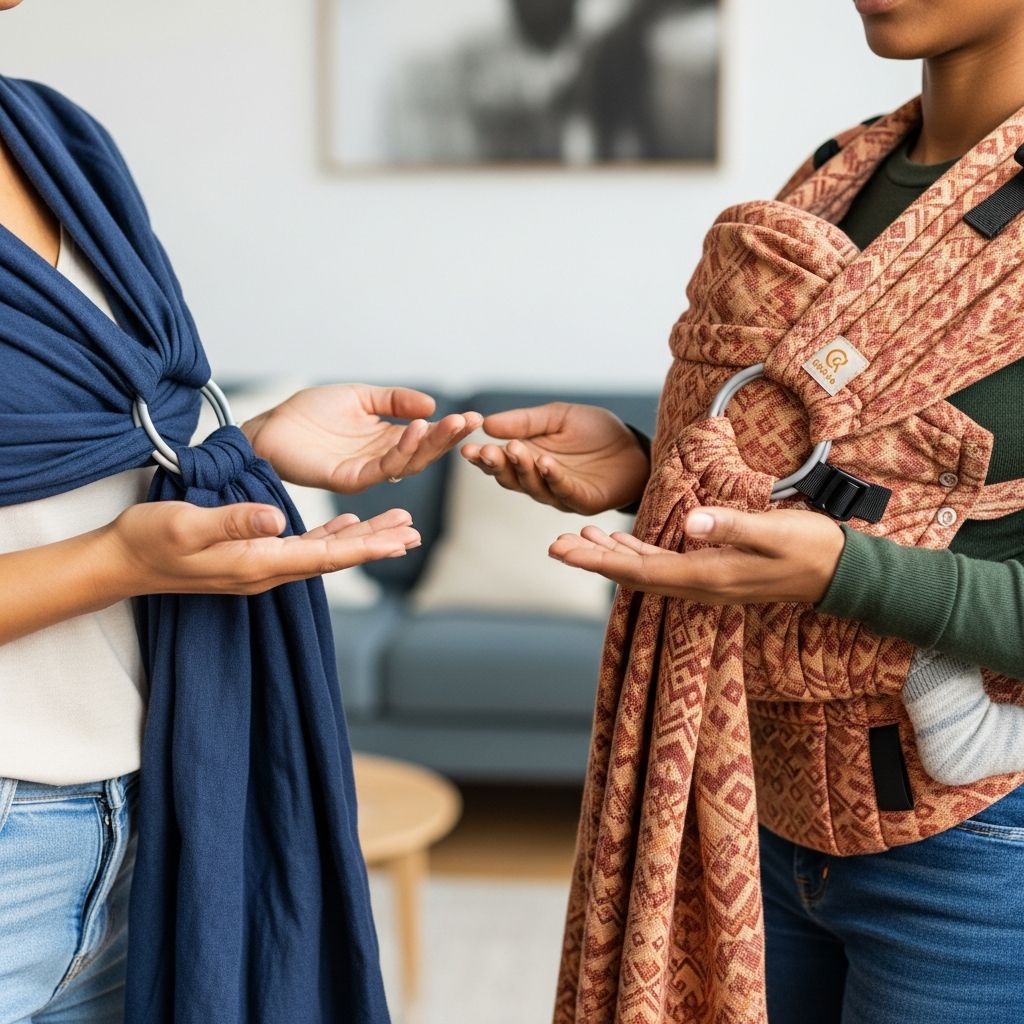
Babywearing can be a sanity saver, but the number of carrier options can quickly feel overwhelming. Two of the most popular styles among parents who want something softer and more flexible than a bulky backpack carrier are ring slings and Mei Tai carriers. This guide walks through how each one works, what they are like in everyday use, and how to decide which suits your family best.
Understanding the Two Carrier Styles
Before comparing features and comfort, it helps to understand what each carrier actually is and how it’s meant to be used. Although both are made from soft fabric, they distribute weight and adjust in very different ways.
What Is a Ring Sling?
A ring sling is a long, woven piece of fabric with two sturdy rings sewn into one end. The loose end of the fabric is threaded through the rings to create an adjustable loop that goes across your torso and over one shoulder. Baby sits in a pouch created by tightening the fabric through the rings until it hugs both you and your child securely.
- Worn over one shoulder with the fabric crossing your chest and back diagonally.
- Adjusts by gently pulling the tail of the fabric through the rings to tighten or loosen.
- Common carry positions include front tummy-to-tummy, hip carry, and sometimes a high back carry for older toddlers.
What Is a Mei Tai Carrier?
A Mei Tai (also called an Asian-style soft carrier) combines features of a wrap and a soft-structured carrier. It has a rectangular body panel that supports your baby, plus four fabric straps that tie around your waist and shoulders. Instead of buckles or clips, the straps are secured with knots, which allows a lot of adjustability without rigid hardware.
- The bottom straps wrap around your waist and tie to form a secure band.
- The top straps cross over your shoulders and back, then tie under baby’s bottom or around your waist.
- Can usually be used in front, hip, and back carries as your baby grows and gains head control.
How They Feel in Daily Life
On paper, both carriers sound simple. Real-world use is where differences really show up. Comfort, learning curve, and how forgiving a carrier is on a tired day can affect whether you actually reach for it.
Comfort for the Wearer
Ring slings concentrate weight on one shoulder, which many parents find comfortable for quick errands or short walks, but some feel strain during long wears or with heavier babies. Mei Tai carriers spread weight across both shoulders and the hips, more like a hiking backpack, and often feel better for extended use.
- Ring slings can feel light and breezy, but the single-shoulder load may become noticeable as baby approaches toddler size.
- Mei Tais distribute weight more evenly, which can be a relief if you have back or shoulder sensitivity.
Comfort for the Baby
When adjusted well, both styles can keep baby in an ergonomic, seated position with knees higher than the bottom and spine gently rounded. The main difference is how easy it is for a new wearer to get a consistently deep, supported seat.
- Ring slings can be very snuggly for newborns, but require careful tightening along the fabric to avoid baby slumping or leaning.
- Mei Tais tend to create a defined, structured seat, which many parents find simpler to reproduce the same way each time.
Quick Comparison at a Glance
The table below summarizes how ring slings and Mei Tai carriers often compare on features that matter to new parents.
| Feature | Ring Sling | Mei Tai Carrier |
|---|---|---|
| Typical learning curve | Moderate; threading and tightening take practice. | Low to moderate; tying straps is intuitive for most. |
| Where weight sits on the body | Mainly one shoulder and opposite hip. | Both shoulders and around the waist/hips. |
| Best for | Short trips, quick ups and downs, hip carries. | Long walks, naps on the go, all-day use. |
| Newborn friendliness | Very snuggly but demands precise adjustment. | Newborn-friendly with proper support and panel height. |
| Maximum age/size | Often comfortable into toddlerhood for short carries. | Frequently used from newborn through toddler for regular wear. |
| Storage and travel | Extremely compact; fits easily in a diaper bag. | Still compact but bulkier than a sling. |
| Adjustment speed once familiar | Very fast: pop baby in and pull fabric. | Quick: tie, tighten, and go. |
| Ideal for caregivers of different sizes | Highly adjustable; one size can fit many. | Also very adjustable; strap length matters more than clothing size. |
Safety Basics Every Babywearing Parent Should Know
No matter which carrier you choose, safety depends more on positioning and fit than on the brand name on the label. A few core principles can help you use any carrier more confidently.
- Keep airways clear. Baby’s face should be visible, not pressed into your chest or fabric, and the chin should not be forced down onto the chest.
- Hold baby high and snug. A good rule of thumb is that you can easily kiss the top of baby’s head without leaning down, and the fabric is tight enough that baby doesn’t slump when you relax your shoulders.
- Check leg and hip position. Baby’s knees should be higher than the bottom in an “M” shape, with weight supported by the thighs and bottom, not hanging straight down from the crotch.
- Regularly inspect your carrier. Look for frayed fabric, loose stitching, or any damage near rings, straps, or panel seams.
- Practice over soft surfaces. Especially in the early days, practice new carries over a bed or couch with another adult nearby.
When a Ring Sling Really Shines
Although ring slings are sometimes perceived as trickier at first, they offer unique advantages that many families grow to love once they get past the learning curve. Their combination of compact size and quick adjustability makes them a favorite “second carrier” even in homes that rely on another style day-to-day.
Everyday Scenarios Where Ring Slings Work Well
- Short daily errands. For quick trips into a store or from the car to a doctor’s office, it is easy to slip the sling on, seat baby, tighten, and then pop them back out a few minutes later.
- At home with active older siblings. The ability to do a fast hip carry lets you keep baby close while still having your hands more or less free to help a toddler or preschooler.
- Breastfeeding on the go. Some parents find side or semi-reclined positions easier to achieve discreetly with a ring sling once they are comfortable adjusting the fabric.
- Hot climates. The single layer of fabric and airy design can feel cooler than more structured or heavily padded carriers.
Potential Challenges with Ring Slings
The main difficulty new users report is getting the fabric evenly tightened through the rings. If the cloth bunches or twists, it can be hard to adjust one area without affecting another. This can lead to a baby who leans away from the rings or a strap that digs into the wearer’s neck if not smoothed out.
- Fine-tuning the top, middle, and bottom edges of the sling may feel fiddly at first.
- Caregivers with shoulder or neck pain might find prolonged, one-sided carrying uncomfortable.
- Very slippery or high-maintenance fabrics, such as some silks, can add to the challenge if you are still learning.
Where Mei Tai Carriers Excel
Mei Tai carriers appeal to many parents who want the softness of a wrap without committing to long lengths of fabric or complicated tying methods. Because the body panel is already shaped, it can feel more straightforward to place baby and then tighten everything with a few well-placed knots.
Everyday Scenarios Where Mei Tais Work Well
- Walks, hikes, and travel days. Distributing weight across shoulders and hips makes these carriers more comfortable for extended wear, especially as babies get heavier.
- Nap time on the move. The supportive body panel can help keep a sleeping baby’s spine and head well aligned without constant micro-adjustments.
- Caregivers sharing one carrier. Because the straps tie rather than buckle to set lengths, a wide range of body types can achieve a good fit with the same carrier.
- Transitioning to back carries. As baby becomes more mobile and curious, the move from front to back carry often feels more natural in a Mei Tai than in a narrow or heavily padded style.
Potential Drawbacks of Mei Tais
Although usually easier to learn than a full wrap, Mei Tais are not without quirks. Some parents find the long straps awkward to deal with in tight spaces or muddy environments. Others prefer carriers with buckles simply for speed, especially when frequently juggling car seats and strollers.
- Long straps can drag on the ground when you are tying, especially if you are shorter or in cramped areas.
- Thick waistbands or very wide shoulder straps may feel bulky under winter coats.
- Because they lack hard buckles, some caregivers initially question whether knots feel “secure enough,” although properly tied knots are very strong.
Fabric, Care, and Practical Details
Material choice has a big impact on how a carrier feels against your skin, how it drapes, and how much upkeep it requires. Parents often discover they care as much about how easy it is to wash a carrier as they do about color or pattern.
Common Fabric Options
- Cotton and cotton blends. Usually the easiest to wash and dry, with a soft feel that breaks in over time. A solid, medium-weight cotton is a popular everyday choice.
- Linen. Lightweight and breathable, which makes it appealing in warmer climates. It can feel crisp at first but softens with use and washing.
- Silk or silk blends. Often chosen for special-occasion slings because of their sheen and drape. They can be strong yet thin, but frequently require more delicate care or professional cleaning.
- Specialty weaves and blends. Some carriers use textured weaves or include fibers such as bamboo or hemp to create more cush or support, particularly for heavier toddlers.
Care and Maintenance Considerations
Spit-up, milk leaks, sunscreen, and everyday grime are facts of life with infants. Choosing a carrier that fits your laundering habits will make you more likely to use it regularly instead of saving it “for good.”
- Check whether your chosen carrier is machine-washable and how many extra care steps (like line-drying) it requires.
- Think honestly about whether you will manage spot-cleaning or dry-clean-only fabrics with a baby who spits up frequently.
- Consider darker or patterned fabrics if you want something that hides small stains between washes.
How to Choose the Right Carrier for Your Family
There is no single “best” carrier; the right choice depends on your body, your baby, and your daily routine. Many parents find that their preference changes as their child grows, or that one type is better for home while another shines when out and about.
Questions to Ask Yourself
- How long will you usually wear your baby at a time? Longer outings lean toward a Mei Tai, while brief in-and-out carries may be easier with a ring sling.
- Do you have any existing shoulder, neck, or back issues? If one shoulder is already sensitive, a two-shoulder carrier will likely be more comfortable.
- Who else will use the carrier? If multiple caregivers will share it, adjustability and simplicity matter more than niche features.
- What is your climate like? Hot, humid weather may push you toward lighter fabrics and more breathable designs.
- Are you comfortable learning new tying techniques? If knots and fabric adjustment don’t bother you, either style is an option; if you prefer something that “just clips,” you may want to consider buckle carriers instead.
Trying Before You Commit
When possible, visiting a local babywearing group, lending library, or parenting class where carriers are available to try can be invaluable. Being fitted in person by someone familiar with different styles often reveals comfort issues or preferences that are hard to predict online.
- Practice seating a weighted doll or a friend’s baby before your own newborn arrives, if you feel nervous about handling a tiny infant in fabric.
- Pay attention to how easy it feels to adjust the carrier alone, without someone else tugging or tightening straps for you.
FREQUENTLY ASKED QUESTIONS
Are ring slings safe for newborns?
Yes, ring slings can be safe for newborns when used correctly and when they are designed for that age range. The key points are to keep baby high enough to kiss, ensure clear airways at all times, and support the back so baby does not curl into a chin-to-chest position that can interfere with breathing.
Can Mei Tai carriers be used from birth?
Many Mei Tai carriers are suitable from birth or from a specific minimum weight, provided the body panel supports the back of baby’s head and neck and the leg openings do not spread the hips too wide. Always check the manufacturer’s age and weight guidelines, and consider using an infant-friendly carry variation if the panel seems tall or deep on a small baby.
Which is easier for someone completely new to babywearing?
Experiences vary, but a lot of new parents find the defined body panel and straightforward tying of a Mei Tai less intimidating than threading and adjusting a ring sling. That said, some people click with ring slings immediately, especially if they are comfortable working with fabric and like the idea of a quick hip carry.
Do I really need more than one carrier?
Need is a strong word, but many families do end up appreciating having at least two options. A supportive, two-shoulder carrier like a Mei Tai can handle long outings, while a compact ring sling can live in the diaper bag or car for those moments when you unexpectedly need both hands free.
What if I buy something and it does not work for us?
Carriers hold their value surprisingly well, and there is an active second-hand market for both ring slings and Mei Tais. If a particular style does not suit your body or your baby’s temperament, selling or swapping it for something different is common, and many parents go through a brief period of experimenting before settling on a favorite.