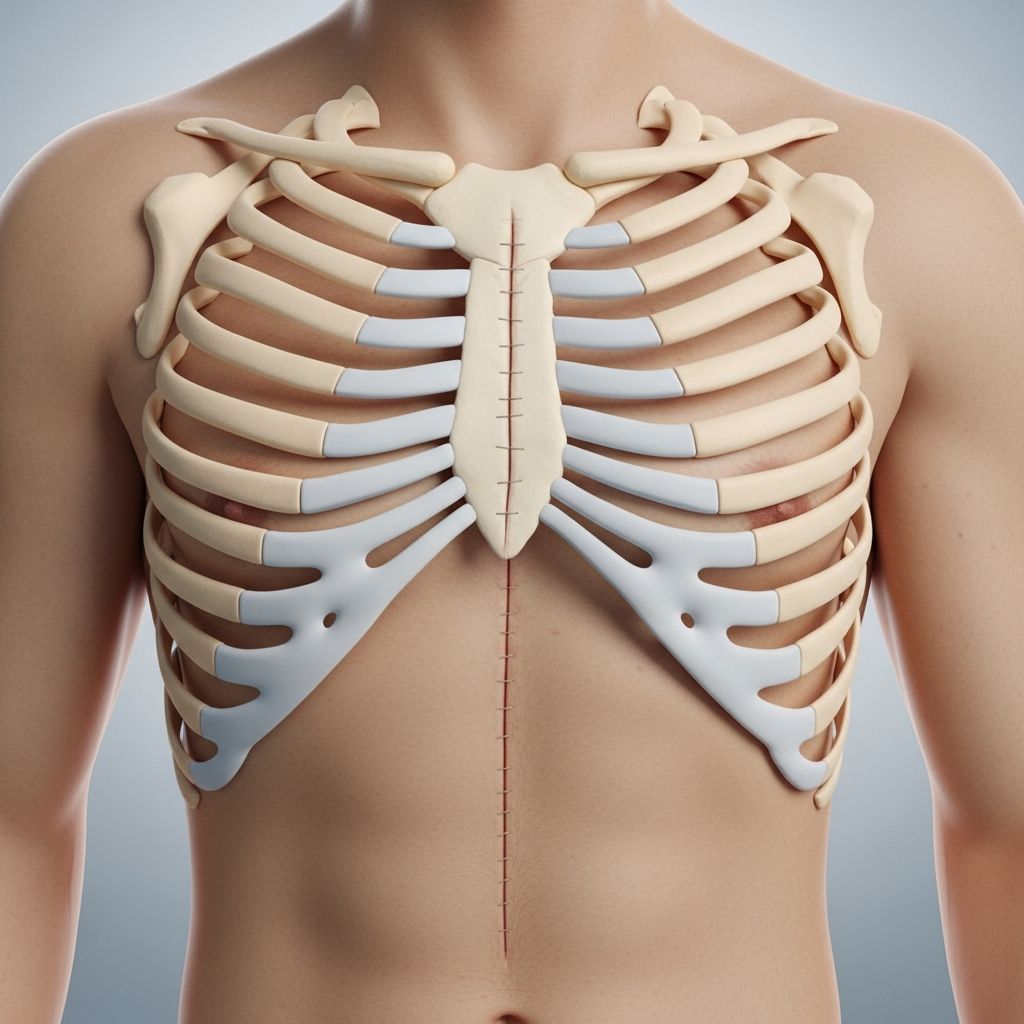
The Ravitch procedure stands as a cornerstone in treating significant chest wall abnormalities, particularly severe cases of **pectus excavatum** and **pectus carinatum**. This open surgical approach reshapes the sternum and surrounding structures to restore normal chest contour, improving both physical appearance and function.
Understanding Chest Wall Deformities
Chest wall deformities affect thousands of children worldwide, often becoming noticeable during growth spurts in puberty. **Pectus excavatum**, commonly called “funnel chest,” features a deep depression in the sternum, potentially compressing the heart and lungs. In contrast, **pectus carinatum**, or “pigeon chest,” involves a protruding sternum due to abnormal cartilage growth.
These conditions arise from uneven cartilage development connecting ribs to the sternum. While mild cases may require bracing, severe deformities—typically those with a Haller index greater than 3.25 for excavatum—demand surgical intervention to prevent complications like reduced lung capacity, cardiac strain, or psychological distress from appearance.
When is Ravitch Surgery Recommended?
Surgeons recommend the Ravitch procedure for adolescents aged 13-22 with complex or asymmetric deformities unsuitable for minimally invasive options like the Nuss technique. It’s ideal when cartilage overgrowth is pronounced or prior treatments failed.
- Severe pectus excavatum causing cardiopulmonary symptoms
- Symmetric or asymmetric pectus carinatum unresponsive to bracing
- Patients over 14 years where chest growth stabilizes
- Failed Nuss procedure or contraindications to thoracoscopy
Pre-surgical evaluation includes CT scans, echocardiograms, pulmonary function tests, and psychological assessments to confirm candidacy.
Preparing for the Ravitch Procedure
Preparation begins weeks ahead. Families receive detailed instructions on fasting, medication cessation, and home modifications. Children undergo baseline cardiac and respiratory assessments to establish safety benchmarks.
Nutritional optimization is key: high-protein diets support healing, while smoking cessation in households reduces infection risks. Mental preparation involves counseling to address body image concerns, as surgery transforms visible deformities.
| Pre-Op Checklist | Details |
|---|---|
| Medical Tests | ECG, Echo, PFTs, Chest CT |
| Lifestyle Adjustments | No aspirin 2 weeks prior, balanced diet |
| Family Prep | Plan for 5-7 day hospital stay, pain management education |
| Day Before | Clear liquids only, hospital arrival time |
Detailed Surgical Process
Performed under general anesthesia, the Ravitch procedure lasts 3-5 hours. Surgeons make a horizontal incision across the chest, 5-7 cm below the nipples in males or along the inframammary fold in females, minimizing visible scarring.
Key steps include:
- Muscle elevation: Pectoralis and rectus muscles lifted to expose sternum and ribs.
- Cartilage resection: Abnormal costal cartilages (ribs 3-7) removed while preserving perichondrium for regrowth.
- Sternal osteotomy: Sternum scored and repositioned—elevated for excavatum, depressed for carinatum.
- Stabilization: Stainless steel bar or absorbable struts placed beneath sternum; sutures anchor to ribs.
- Drain placement: Soft tissue drains prevent fluid buildup; chest tubes if needed.
- Closure: Layered suturing, often with dissolvable materials.
Cartilage regenerates over 4-6 weeks, fixing the chest permanently without bar removal in many modified versions.
Immediate Post-Operative Care
Patients wake in ICU for 24 hours, monitored for vital signs, pain, and breathing. Epidural catheters provide superior analgesia, supplemented by IV medications transitioning to orals.
Mobility starts day 1: deep breathing exercises prevent pneumonia, while assisted walking combats clots. Drains remain 3-7 days, removed when output drops below 50ml/day.
- Day 1: Bedside mobilization, incentive spirometry
- Day 2-3: Floor walking, pain control optimization
- Day 4+: Discharge planning, home drain care if needed
Recovery Timeline and Milestones
Hospital stay averages 4-7 days. Home recovery spans 6-12 weeks, with restrictions on lifting (>10lbs), sports, and driving until 8 weeks.
| Week | Activities Allowed | Restrictions |
|---|---|---|
| 1-2 | Light walking, school remote | No stairs, baths, or lifting |
| 3-6 | Gradual school return, showers | No PE, contact sports |
| 7-12 | Light exercise, bar check x-ray | Avoid heavy impact |
| 3+ Months | Full activities, bar removal if metallic | Follow-up imaging |
New cartilage growth solidifies results by 6 months; metallic bars removed outpatient after 6-12 months.
Risks, Complications, and Mitigation
While effective (95% success rate), risks include infection (2-5%), pneumothorax (1-3%), bar displacement (rare), and chronic pain.
Mitigation strategies:
- Antibiotics prophylaxis
- Intraoperative nerve protection
- Serial imaging surveillance
- Pain team involvement
Recurrence is under 5%, lower than some minimally invasive methods for severe cases.
Long-Term Outcomes and Benefits
Post-Ravitch, patients report improved exercise tolerance, lung volumes up 20-30%, and enhanced self-esteem. Scars fade to thin lines within 2 years.
Studies confirm sustained correction into adulthood, with minimal reoperation needs. Psychological benefits are profound, alleviating bullying and body dysmorphia.
Alternatives to Ravitch Surgery
Not all cases need open surgery. Options include:
- Nuss Procedure: Minimally invasive bar insertion for symmetric excavatum.
- Bracing: Custom orthoses for carinatum in younger patients.
- Reverse Nuss: For select carinatum cases.
Choice depends on age, severity, and surgeon expertise.
Frequently Asked Questions (FAQs)
Is Ravitch surgery painful?
Moderate to severe initially, managed excellently with epidurals and multimodals; most return to normal by 4 weeks.
How long does the scar take to heal?
Initial healing 2 weeks; full fading 12-18 months with silicone gels and sun protection.
Can my child play sports after recovery?
Yes, full clearance at 3-6 months; contact sports after bar removal.
What if the deformity recurs?
Rare (<5%); managed with revision surgery or bracing.
Is Ravitch covered by insurance?
Often yes, if symptomatic or Haller index >3.25; pre-authorization required.
Life After Ravitch: Patient Stories and Advice
Many patients describe life-changing confidence boosts. Tips: Stay hydrated, adhere to PT, join support groups like Pectus Awareness. Annual follow-ups ensure optimal health.
References
- Ravitch Procedure — Children’s Hospital of Philadelphia. 2023. https://www.chop.edu/treatments/ravitch-procedure
- Modified Ravitch Operation — Pectus Clinic. 2023. https://www.pectusclinic.com/treatments/surgery/modified-ravitch-operation/
- Adult Pectus Excavatum — Washington University School of Medicine. 2024. https://cardiothoracicsurgery.wustl.edu/patient-care/thoracic/pectus-excavatum/
- The Ravitch Procedure — Nemours KidsHealth. 2023. https://kidshealth.org/en/parents/ravitch-procedure.html
- Modified Ravitch Procedure — UCSF Department of Surgery. 2024. https://surgery.ucsf.edu/procedure/modified-ravitch-procedure
- Pediatric Ravitch procedure for pectus repair — Children’s Health. 2023. https://www.childrens.com/specialties-services/treatments/ravitch-procedure
- Pectoralis Muscle Transposition in Association with the Ravitch Procedure — PMC (NCBI). 2019-11-29. https://pmc.ncbi.nlm.nih.gov/articles/PMC6908393/
- Pediatric Chest Wall Defects: Nuss and Ravitch Technique — Children’s National Hospital. 2024. https://www.childrensnational.org/get-care/health-library/chest-wall-defects-treatment-nuss-and-ravitch-technique