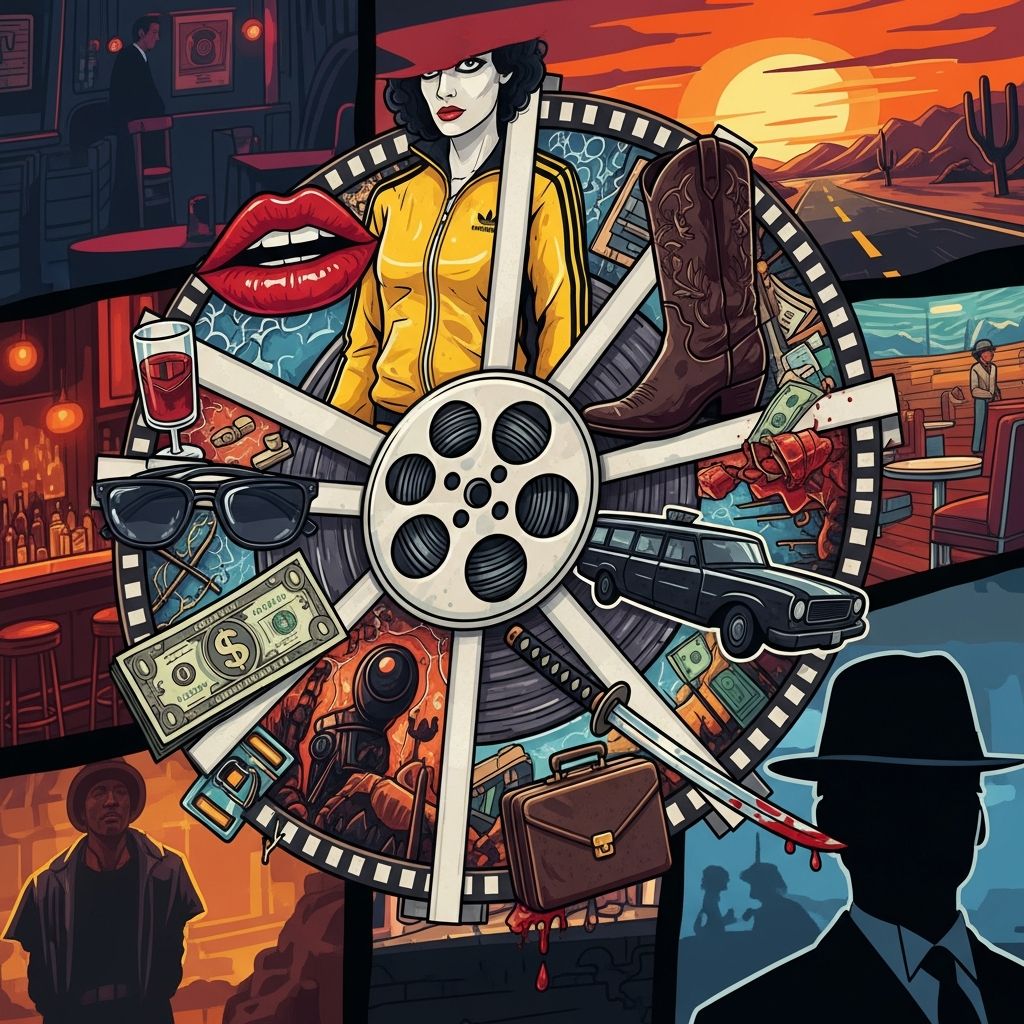
Few directors inspire the kind of passionate debate that Quentin Tarantino does. His films are violent yet funny, intensely talky yet visually stylish, and deeply in love with movie history. This guide walks through his major feature films, highlights what makes each one special, and offers an easy way to decide where to start in his filmography.
- New to Tarantino and wondering which film to watch first?
- Curious how his style evolved from indie crime capers to sprawling historical epics?
- Looking for a quick overview you can use to choose movie night picks?
You will find all of that here, in one place, written for fans rather than film scholars—but with enough detail to keep serious movie lovers happy.
Tarantino in Brief: Why His Movies Matter
Tarantino emerged in the early 1990s as part of a wave of independent American filmmakers who changed the look and feel of mainstream cinema. His films quickly became known for:
- Nonlinear storytelling (jumping around in time)
- Stylized dialogue that sounds casual but is meticulously written
- Graphic violence mixed with dark comedy
- Homages to genre cinema like kung fu films, Westerns, crime thrillers, and exploitation movies
- Soundtrack-driven moments where music defines the scene more than dialogue
By the time films like Pulp Fiction and Kill Bill arrived, he was already a defining voice of 1990s and 2000s cinema, influencing everyone from studio blockbusters to small indie projects.
Core Tarantino Feature Films (Directed by Him)
Below is a snapshot of his major directed features often considered the “core” Tarantino movies.
| Film | Year | Main Genre | Good Starting Point? |
|---|---|---|---|
| Reservoir Dogs | 1992 | Crime / Heist | For fans of gritty, talky thrillers |
| Pulp Fiction | 1994 | Crime / Dark Comedy | Yes – often the best first pick |
| Jackie Brown | 1997 | Crime / Character Drama | Great for slower, character-focused stories |
| Kill Bill: Vol. 1 | 2003 | Martial Arts / Revenge | For action and stylized violence |
| Kill Bill: Vol. 2 | 2004 | Western / Revenge | Watch immediately after Vol. 1 |
| Death Proof | 2007 | Slasher / Car Exploitation | For completists and grindhouse fans |
| Inglourious Basterds | 2009 | War / Alternate History | Excellent mid-level starting point |
| Django Unchained | 2012 | Western / Revenge | Good if you like Westerns and big emotions |
| The Hateful Eight | 2015 | Western / Chamber Thriller | Best once you’re used to his style |
| Once Upon a Time in Hollywood | 2019 | Drama / Hollywood Fairy Tale | For movie-history buffs and slower vibes |
Below, we’ll walk through these films in a roughly chronological flow, but organized by thematic arcs rather than a strict year-by-year ranking.
The Crime Years: Heists, Hitmen, and Double Crosses
Reservoir Dogs (1992): The Minimalist Explosion
Reservoir Dogs is Tarantino’s debut feature, a small-scale crime thriller about a group of thieves whose diamond heist goes violently wrong. Instead of showing the robbery itself, the film stays mostly in a warehouse as the surviving criminals try to unravel who betrayed them.
What stands out:
- Low-budget intensity – most of the film is people talking in a single location.
- Fragmented structure – character backstories are revealed in sharp flashbacks rather than a straight timeline.
- Instantly memorable dialogue – long conversations about pop music and tipping become as iconic as the violence.
If you enjoy character-driven tension and don’t mind harsh violence, this is a strong introduction to his raw early style.
Pulp Fiction (1994): The Cultural Earthquake
Pulp Fiction is the film that vaulted Tarantino into global fame, winning the Palme d’Or at Cannes and an Academy Award for Best Original Screenplay. It interweaves multiple crime stories—hitmen, a boxer, a mob boss, and his wife—into a puzzle-like narrative that loops and overlaps.
Why it’s so beloved:
- Nonlinear storytelling perfected – scenes are rearranged, but the emotional logic still flows.
- Dialogue as music – long scenes of casual talk (burgers, foot massages, TV pilots) drive the film as much as plot twists.
- Iconic set pieces – the dance sequence, the adrenaline shot, and the diner showdown are among modern cinema’s most quoted scenes.
For most viewers, this is the best first Tarantino film. It balances violence with humor and offers the widest sample of what he does well.
Jackie Brown (1997): The Warmest Tarantino Film
Jackie Brown adapts Elmore Leonard’s novel Rum Punch and centers on a middle-aged flight attendant caught smuggling money for a gun runner. Compared to the flashiness of Pulp Fiction, it is quieter, more patient, and deeply focused on character.
Key qualities:
- Emotionally grounded – the slow-burn relationship between Jackie and bail bondsman Max Cherry gives the film an unexpectedly tender core.
- A tribute to 1970s crime cinema and blaxploitation films, but with more nuance and empathy.
- Understated storytelling – fewer big stylistic tricks, more lived-in atmosphere.
If you want to see Tarantino at his most soulful and least show-offy, Jackie Brown is the one.
The Revenge Epics: From Samurai Swords to Six-Shooters
Kill Bill: Vol. 1 (2003) & Vol. 2 (2004): One Big Bloody Opera
The Kill Bill films follow a former assassin, known as The Bride, who wakes from a coma and hunts down her old comrades after they tried to kill her. Tarantino considers the two volumes a single film, and watching them together makes it clear why.
Vol. 1 leans into hyper-stylized martial arts and anime-influenced violence, including a legendary fight sequence against the Crazy 88 gang. Vol. 2 slows down, shifting closer to a Western and focusing on dialogue, backstory, and emotional payoff.
What makes them special:
- Genre mashup – Japanese samurai cinema, kung fu movies, spaghetti Westerns, and grindhouse all collide.
- Bold visual experimentation – black-and-white scenes, animated sequences, abrupt shifts in tone.
- A surprisingly heartfelt core – beneath the bloodshed lies a story about motherhood, loyalty, and identity.
If you like action and don’t mind graphic violence, these films showcase Tarantino at his most visually inventive.
Django Unchained (2012): Western Vengeance in the Deep South
Django Unchained is a revisionist Western about an enslaved man who teams up with a German bounty hunter to rescue his wife from a brutal plantation owner. It blends Western tropes with the history of slavery in the United States, generating both acclaim and controversy.
Highlights:
- Oscar-winning screenplay – Tarantino received his second Academy Award for Best Original Screenplay for this film.
- Big emotions and big performances – the story swings from absurd comedy to harrowing brutality.
- Stylized history – this is not a realistic treatment of slavery but a revenge fantasy framed through genre cinema.
For viewers comfortable with harsh subject matter and tonal whiplash, it’s a gripping, cathartic entry in his filmography.
War, Westerns, and Bottle Episodes
Inglourious Basterds (2009): Cinema vs. Fascism
Inglourious Basterds imagines an alternate World War II where a group of Jewish-American soldiers and a French cinema owner aim to assassinate Nazi leaders. The film is broken into chapters and switches between languages, creating a playful yet tense narrative.
Signature elements:
- Extended suspense sequences – especially the opening farmhouse scene and the basement tavern scene.
- Film as a weapon – the climax literally uses cinema against fascism, turning movie images into an act of resistance.
- Unpredictable story choices – Tarantino rewrites history in bold, violent fashion.
If you like war films but want something stranger and more self-aware, this is a standout.
The Hateful Eight (2015): Locked-Room Western
The Hateful Eight traps eight dangerous strangers in a snowbound Wyoming cabin after the Civil War. Shot in an ultra-wide 70mm format but mostly confined to one room, it’s a deliberate contradiction: a huge canvas used for an intimate, poisonous chamber piece.
Reasons to watch:
- Stage-play structure – most of the drama comes from sharp dialogue and shifting alliances.
- Mystery-thriller engine – the story plays like a whodunit that slowly mutates into a bloodbath.
- Morally bleak tone – it’s among Tarantino’s darkest works, with almost no purely sympathetic characters.
This one is best approached once you already know whether you enjoy his long dialogue scenes and appetite for cruelty.
Hollywood, Cars, and Grindhouse Oddities
Death Proof (2007): Stunt Cars and Scream Queens
Death Proof was originally released as part of the double feature Grindhouse, alongside Robert Rodriguez’s Planet Terror. The film follows a stuntman who uses his reinforced car as a weapon against women, only to eventually meet a group who fight back.
What to know:
- Structure in two halves – the first group of women and the second group mirror each other, but with very different outcomes.
- Practical car stunts – it’s a love letter to old-school stunt work and 1970s car movies.
- Slow burn – long conversations dominate the first hour, with payoffs arriving in the final act.
It is often ranked lower among his films, but for grindhouse and car-chase fans, it has a unique charm.
Once Upon a Time in Hollywood (2019): A Love Letter to a Lost Era
Once Upon a Time in Hollywood follows a fading TV actor and his stunt double navigating the changing landscape of late-1960s Los Angeles, set against the background of the Manson Family and shifting Hollywood culture. More than any of his earlier work, it’s about aging, nostalgia, and the fear of becoming obsolete.
Why many viewers connect with it:
- Atmospheric world-building – long stretches simply immerse you in movie sets, radio jingles, and neon-lit streets.
- Bittersweet tone – it is less cynical than many of his films, with space for genuine affection between characters.
- Alternate history again – as in Inglourious Basterds, Tarantino rewrites a dark chapter in history through fantasy.
If you value mood and character over constant plot, this is one of his richest late-career works.
How to Choose Your First (or Next) Tarantino Film
Because his movies vary widely in tone and subject matter, it helps to pick based on your tastes. Use this quick guide to choose:
- Want the definitive Tarantino experience? Start with Pulp Fiction.
- Prefer character drama over spectacle? Try Jackie Brown or Once Upon a Time in Hollywood.
- Craving stylized action and revenge? Go for Kill Bill (both volumes) or Django Unchained.
- Interested in war and alternate history? Watch Inglourious Basterds first.
- Like tight, talky thrillers? Start with Reservoir Dogs or The Hateful Eight.
- Into grindhouse and car movies? Check out Death Proof once you’re familiar with his style.
Streaming and Viewing Tips
Because licensing varies by country and over time, Tarantino’s films rotate across major streaming services and digital rental platforms. Filmographies from sites like official distributor pages, major streaming platforms, and curated databases (such as the British Film Institute’s listings) can help check current availability.
- Check large subscription platforms first, then digital rental services if it’s not included.
- Some titles have multiple cuts (for example, extended editions released on disc or as limited streaming events); cinephiles may prefer these longer versions.
- Theatrical re-releases or special event screenings sometimes present films like The Hateful Eight in formats closer to their original roadshow presentations.
Common Themes and Signatures Across His Movies
Even when Tarantino jumps between time periods and genres, several threads run through his body of work.
- Revenge as narrative engine – from Kill Bill to Django Unchained, revenge drives many major plots.
- Movie literacy – characters reference pop culture, and entire scenes echo the structure of older films.
- Chapter-based structures – many works are divided into titled chapters, emphasizing their storybook or novel-like quality.
- Morally ambiguous protagonists – few characters are simply good or evil; almost everyone exists in shades of gray.
- Soundtrack as storytelling – needle-dropped songs introduce characters, set ironic counterpoints, or anchor key scenes.
Frequently Asked Questions (FAQs)
Q: How many feature films has Quentin Tarantino directed?
A: Tarantino is commonly credited with ten major directed features, counting the two Kill Bill volumes as a single project in his personal tally, while filmographies often list them separately.
Q: Is there a single “best” Tarantino movie?
A: Critics often cite Pulp Fiction and Inglourious Basterds among his best-reviewed works, while fan favorites vary widely depending on taste for crime stories, Westerns, or historical fantasies.
Q: Are Tarantino films connected in a shared universe?
A: Tarantino has suggested that many characters are related or exist within a shared fictional universe, though this is more an informal web of references and in-jokes than a strict continuity.
Q: Why are his movies so violent?
A: Violence in his films is often heightened, stylized, or darkly comic, reflecting influences from exploitation cinema and genre films; debates over its impact are ongoing in film criticism and media studies.
Q: Has Tarantino said he will stop making movies?
A: Tarantino has repeatedly mentioned a desire to retire from directing after around ten films to preserve a strong, concise body of work, though plans can evolve over time and remain a subject of speculation.
References
- Quentin Tarantino filmography — Wikimedia Foundation (summary of directed features and career roles). 2024-05-01. https://en.wikipedia.org/wiki/Quentin_Tarantino_filmography
- Quentin Tarantino — Wikimedia Foundation (biographical overview and film list). 2024-05-01. https://en.wikipedia.org/wiki/Quentin_Tarantino
- Quentin Tarantino Movies & TV Shows List — Rotten Tomatoes. 2024-03-10. https://www.rottentomatoes.com/celebrity/quentin_tarantino
- Quentin Tarantino – IMDb — IMDb.com, Inc. 2024-03-20. https://www.imdb.com/name/nm0000233/
- Complete Filmography – The Quentin Tarantino Archives — The Quentin Tarantino Archives. 2023-11-15. https://wiki.tarantino.info/index.php/Complete_Filmography