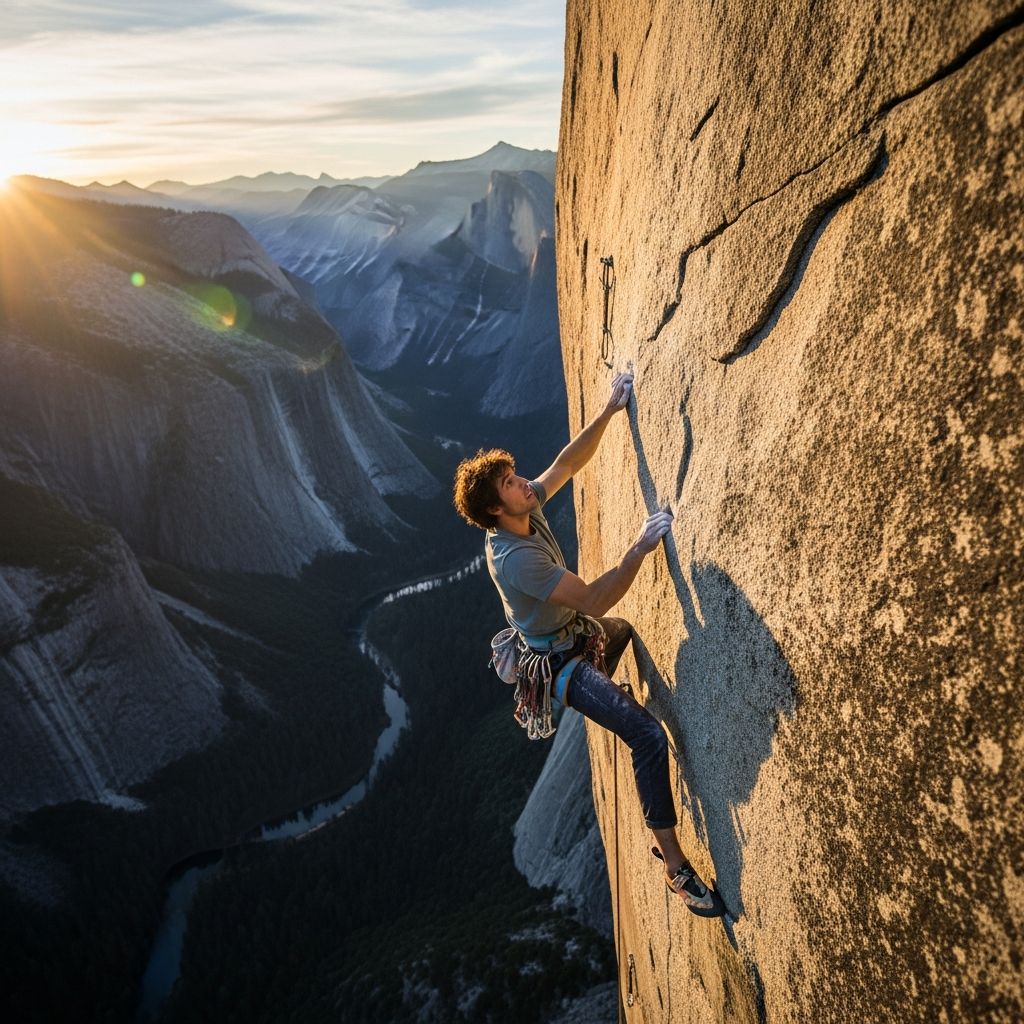
Alex Honnold has spent most of his life on the edge of a cliff, literally. Famous for free soloing El Capitan in Yosemite without a rope, he is often framed as the embodiment of calculated risk and extreme focus. Yet in recent years, another story has unfolded alongside the granite walls: his life as a partner and parent. This article explores how one of the world’s most recognized climbers is rethinking fear, responsibility, and identity as he builds a family while still chasing big objectives.
The Journey from Dirtbag Nomad to Family Man
For years, Honnold personified the classic “dirtbag climber” lifestyle—living in a van, chasing weather windows and rock faces, and organizing his entire life around performance on the wall. That existence required a narrow focus: minimal possessions, few obligations, and almost no compromises.
Transitioning from that extreme freedom to a life with a partner and child is not just a change in circumstances; it is a transformation in how he thinks about time, commitment, and risk. What once revolved around a single question—“How do I get better at climbing?”—now has to make room for new questions:
- How do you remain fully committed to your craft without neglecting your family?
- What does “acceptable risk” look like when your decisions affect a child?
- Can an identity built on pushing limits adapt to the constraints of parenthood?
Honnold’s answers are evolving, but they begin with acknowledging that family is not a hobby added onto climbing—it is a new center of gravity around which everything else must orbit.
Living with Risk: How a Climber Thinks About Fear
Honnold’s reputation has often been reduced to fearlessness, but that framing misses the core of his approach. He is not reckless; he is meticulous. His landmark solo of El Capitan’s Freerider route in 2017 came only after years of rehearsal, route memorization, and physical and mental preparation. Each move was practiced until it felt routine, reducing the objective risk to a level he found acceptable.
In family life, he applies a similar logic: not the elimination of risk, but the management of it. The stakes, however, are different. Where a fall once meant personal extinction, a serious mistake now carries emotional and practical consequences for the people who depend on him.
From Personal Tolerance to Shared Consequences
Before parenthood, the risks Honnold accepted were mostly his own to bear. Marriage and a child turn those decisions into shared burdens. This shift changes the context of every expedition, ascent, or new project.
Key changes in how he might evaluate risk as a father include:
- Time exposure: Long, committing expeditions pull him away from home for extended periods, changing the emotional cost of each trip.
- Type of objective: Routes that are highly experimental or poorly understood may be deprioritized compared to climbs with better-known conditions or protection options.
- Redundancy and backup plans: Emergency planning, communication, and logistics become non-negotiable rather than optional add-ons.
The same brain that once broke a 3,000-foot wall into rehearsed sequences now breaks life into questions of probability, consequence, and responsibility.
Partnership on the Ground: Marriage as a New Kind of Rope
Climbing partnerships are built on trust, communication, and mutual reliance. Marriage introduces a similar dynamic but with a broader emotional range and longer time horizon. Instead of sharing a rope for a day or a season, Honnold and his partner share a long-term project: building a home, raising a child, and negotiating two careers under one roof.
Communication Under Pressure
Good climbing partners must communicate clearly about goals, risk tolerance, and conditions; the same skills are crucial at home. When trips, expeditions, or new objectives come up, the conversation is no longer just about grades and weather—it’s about timing with family events, childcare, and emotional bandwidth.
Common themes in those conversations likely include:
- Scheduling: How long will he be away? What support does his partner need while he is gone?
- Transparency: How risky is the objective compared to his baseline climbing?
- Reciprocity: How can the partnership ensure both people pursue meaningful goals, not just one?
Comparing Climbing Partnerships and Marriage
| Aspect | Climbing Partnership | Marriage & Family |
|---|---|---|
| Time Horizon | Days to seasons | Years to decades |
| Primary Goal | Complete objectives safely | Build a stable, meaningful life |
| Decision Impact | Mainly affects two partners | Affects children, extended family, careers |
| Type of Trust | Technical competence and risk judgment | Emotional reliability, shared values, long-term support |
Parenthood: The Hardest Route He Cannot Rehearse
Unlike a massive line on granite, parenting offers no rehearsal laps and no exact topo. There are guidebooks and advice, but no fixed route. For someone like Honnold, who thrives on preparation and repetition, this introduces an entirely different kind of challenge.
From Singular Focus to Split Attention
Elite athletes often rely on singular focus to reach world-class levels. Parenthood disrupts that by design. Nights might be interrupted. Training sessions must fit around naps, appointments, and mealtimes. The mental bandwidth once reserved almost exclusively for climbing now has to accommodate:
- Monitoring a baby’s development and health
- Shared household tasks and logistics
- Being emotionally present, not just physically home
Instead of seeing this only as a limitation, Honnold’s approach suggests reframing parenthood as a new, multi-year project that demands creativity, patience, and resilience—the same traits that served him on multi-day routes in Patagonia or Antarctica.
Recalibrating Priorities Without Losing Identity
Becoming a parent can trigger a profound identity shift, especially for people whose self-worth is closely tied to performance. Research on elite athletes shows that major life events, including parenthood, can reshape both training patterns and competitive focus, sometimes improving long-term well-being even if short-term performance dips.
For Honnold, this may mean:
- Choosing objectives that fit better within family time frames
- Adjusting the volume or intensity of travel-heavy projects
- Deriving fulfillment from mentorship, storytelling, or environmental work, not just personal records
Legacy Beyond Grades: The Honnold Foundation and Climate Work
As his public profile grew after the Oscar-winning documentary Free Solo, Honnold expanded his focus beyond personal achievement. Through the Honnold Foundation, he supports solar energy projects in underserved communities, aiming to increase access to clean, affordable power. This work resonates strongly with concerns about climate change and long-term planetary health.
In the context of parenthood, this environmental work takes on new meaning. Concerns about the future habitability of the planet intersect with the immediate reality of raising a child. Questions about risk shift from individual survival on a wall to collective survival on Earth.
Key themes in his legacy-building include:
- Environmental responsibility: Supporting low-carbon solutions like solar aligns climbing, travel, and advocacy with broader planetary concerns.
- Role modeling: Showing his child—and a global audience—that high performance and social responsibility can coexist.
- Redefining success: Adding impact, not just difficulty ratings, to his personal definition of a life well lived.
How a Pro Climber’s Brain Handles Fear and Uncertainty
Neuroscientific research on risk and fear suggests that experience and training can shape how the brain responds to threatening situations, although claims about “fearless brains” are often oversimplified. In Honnold’s case, extensive exposure to high-stakes climbing, combined with careful progression, has conditioned both his mind and body to handle intense stress.
Parenthood, however, introduces new forms of uncertainty he cannot control: illness, accidents, social challenges, and the long arc of a child’s development. The tools he developed on the wall—breath control, visualization, methodical planning—remain useful, but the outcomes are far less predictable.
Transferable Skills From the Wall to the Nursery
- Patience: Just as he waits for perfect conditions on a route, he must wait out tantrums, sickness, and difficult phases.
- Calm under pressure: Staying composed when a move feels insecure is not unlike staying calm when a child is hurt or distressed.
- Long-term thinking: Planning multi-year projects translates into thinking about schooling, values, and environmental conditions that will shape his child’s future.
Balancing Training, Travel, and Bedtime Stories
Maintaining elite performance while being an engaged parent is a logistical puzzle. While specific schedules vary, the underlying challenge is universal: limited hours and expanded responsibilities.
Typical tensions in this balancing act include:
- Early-morning or late-night training versus the need for sleep
- Extended expeditions versus being present for milestones like first steps or first words
- Media, speaking obligations, and business commitments versus downtime with family
There is no perfect solution, only ongoing negotiation. The same adaptability that lets Honnold change tactics mid-route now has to operate in a living room filled with toys and in calendars filled with pediatric appointments.
What His Story Says About Modern Fatherhood
Honnold’s transition from solitary climber to public figure, partner, and parent reflects broader shifts in cultural expectations around fatherhood. Many men today navigate a tension between traditional provider roles and newer ideals emphasizing emotional presence, shared domestic labor, and active caregiving.
By openly discussing relationships, risk, and family, high-profile athletes can help normalize a more expansive vision of masculinity—one in which being a devoted parent is fully compatible with ambition and high performance.
Frequently Asked Questions (FAQs)
Q: Who is Alex Honnold and why is he famous?
A: Alex Honnold is an American rock climber best known for his 2017 free solo ascent of the Freerider route on El Capitan in Yosemite, a 3,000-foot wall he climbed without ropes or protective gear. The ascent was widely described as one of the greatest feats in the history of climbing and was documented in the film Free Solo.
Q: How has becoming a parent influenced his approach to risk?
A: Parenthood adds emotional and practical consequences to his choices. While he still climbs at a very high level, he places greater emphasis on preparation, choosing objectives more carefully, and communicating with his partner about the risks and time commitments involved.
Q: Does Alex Honnold still take on dangerous climbs?
A: He continues to pursue ambitious projects, including new routes, speed records, and big-wall climbs around the world, but does so within a framework that increasingly weighs family, environmental work, and long-term health alongside performance.
Q: What is the Honnold Foundation?
A: The Honnold Foundation is a nonprofit organization founded by Alex Honnold that supports solar energy projects to improve access to clean, affordable power for communities around the world, aligning his public platform with environmental and social impact.
Q: What can parents learn from Honnold’s story, even if they never climb?
A: His journey illustrates how skills like preparation, honest risk assessment, clear communication, and long-term thinking can help parents balance personal passions with responsibilities to their families, whatever their field or lifestyle.
References
- Special Mention – Alex Honnold — Piolets d’Or. 2018-04-20. https://www.pioletsdor.net/index.php/en/archives/home-3/2018-honoured-ascents/98-special-mention-alex-honnold
- Alex Honnold — Encyclopaedia Britannica. 2024-02-05. https://www.britannica.com/biography/Alex-Honnold
- Alex Honnold – The North Face Climbing Athlete — The North Face. 2023-06-01. https://www.thenorthface.com/en-us/about-us/athletes/alex-honnold
- Is Alex Honnold’s El Cap Free-Solo the Greatest Individual Sports Achievement Ever? — Evening Sends. 2017-06-05. https://eveningsends.com/is-alex-honnolds-el-cap-free-solo-the-greatest-individual-sports-achievementever/
- Alex Honnold interview: Life after climbing Free Solo — Red Bull. 2019-06-03. https://www.redbull.com/us-en/alex-honnold-life-after-free-solo