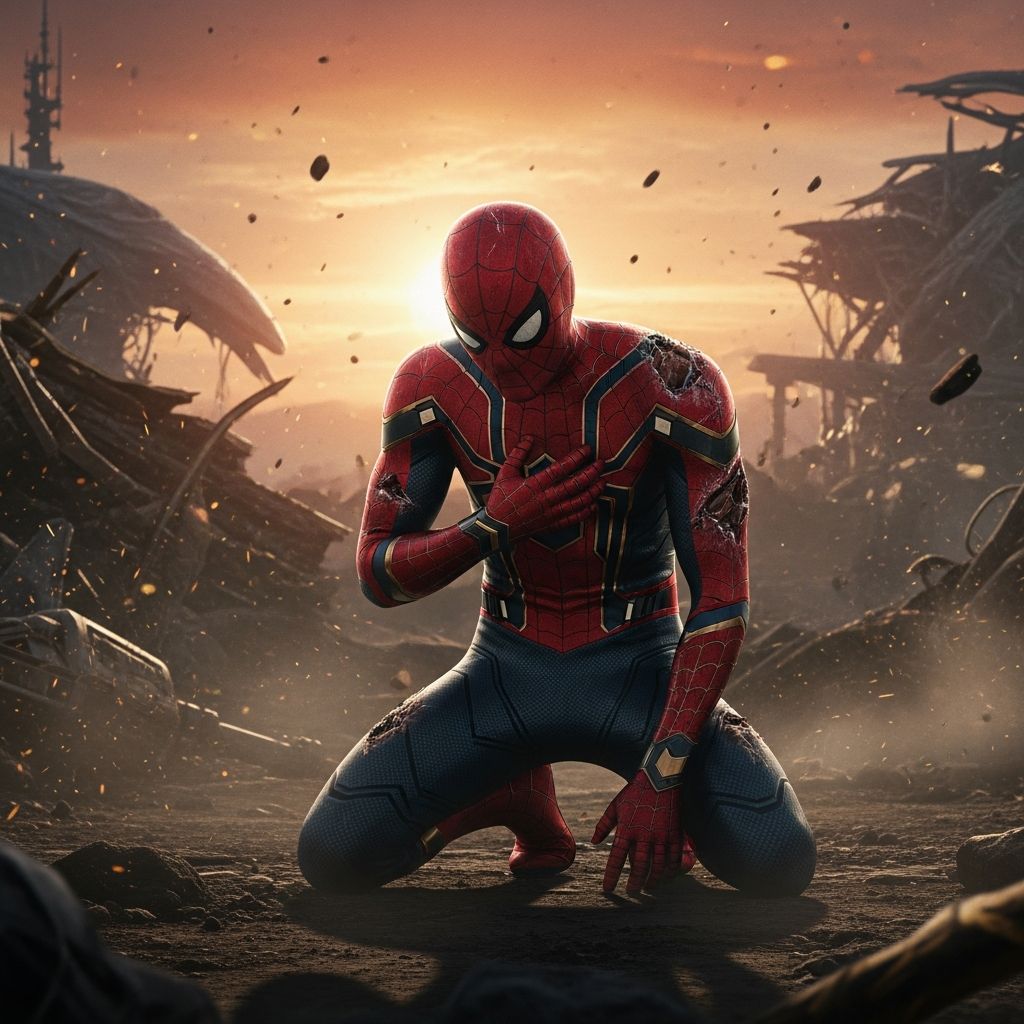
Spider-Man has been a pop culture icon for decades, but in Avengers: Infinity War, Peter Parker stops feeling like just another superhero and starts feeling like someone you might actually know: a bright, anxious, well-meaning teenager trying to stand tall in a world that keeps getting scarier.
This article takes a fresh look at Peter’s place in the movie, not to recap the plot, but to understand why his journey hits so many nerves for parents, kids, and anyone who has ever felt small in the face of impossible stakes.
From Queens Kid to Cosmic Soldier
Peter Parker enters Infinity War as a neighborhood defender who is still figuring out his homework schedule, yet within minutes he is dragged into an intergalactic crisis. That shift is not just spectacle; it is the movie’s sharpest illustration of how quickly a teenager can be pushed into adult territory before feeling ready.
By taking Peter out of familiar streets and into deep space, the film reframes his classic “friendly neighborhood Spider-Man” identity as something far more vulnerable: a child standing in the middle of a war he barely understands. The costume gets bigger, but his inexperience is always right under the surface.
- He is still riding the school bus when the threat arrives.
- He is improvising as he goes, relying more on instinct than training.
- He chases the danger instead of turning away, revealing ambition and naivety in equal measure.
Tony Stark as Mentor, Parent, and Cautionary Tale
The heart of Peter’s story in the film is not a single punch or gadget; it is his evolving relationship with Tony Stark. Tony has money, experience, and power, but what Peter keeps bringing out of him is something far more uncomfortable: responsibility.
Where previous movies let Tony dodge the full weight of his choices behind sarcasm and tech, his connection to Peter forces him to confront what it means to put a teenager in harm’s way. The dynamic looks less like a boss and intern, and more like a reluctant father trying to pretend he is only a supervisor.
How Their Dynamic Shapes the Story
- Tony tries to define boundaries with rules and upgraded suits, but he keeps rewarding Peter’s risk-taking.
- Peter reads Tony’s approval as permission to push further, assuming that being \”needed\” outweighs being safe.
- Every major decision Peter makes in space quietly reflects this tension between wanting to impress and needing protection.
The result is a relationship that feels painfully familiar: an adult who cannot quite admit that they are scared, and a teenager who cannot quite admit that they are scared too.
Why Peter’s Fear Feels So Real
Most superheroes face danger with steely calm or quippy bravado, but Peter’s strongest scenes in Infinity War hinge on moments when his composure cracks. The camera lingers on his confusion, his breathlessness, his inability to process what is happening around him.
That visible fear is not a weakness; it is the point. It reminds viewers that under the nanotech and the acrobatics is a teenager whose biggest problem, very recently, was a school trip or a crush. The scale of the threat collides with his age in a way the film refuses to smooth over.
Emotions That Anchor the Spectacle
- Uncertainty: He hesitates more than older heroes, asking questions that reveal how out of his depth he feels.
- Dependence: He keeps checking Tony’s reactions, almost like a kid looking at a parent during turbulence.
- Self-blame: Even as the threat overwhelms everyone, Peter instinctively wonders what more he should have done.
This emotional transparency gives the audience someone to latch onto amid planets, portals, and armies. In Peter’s eyes, the cosmic disaster stops being abstract and becomes terrifyingly human.
Growing Up at the End of the World
Peter’s arc doubles as a warped version of a classic coming-of-age story. Instead of learning to drive or applying to college, he is learning how it feels to make adult choices when the consequences are fatal, permanent, and massively public.
Every step he takes away from Earth, and away from his normal life, is a step further into a version of adulthood that many teenagers recognize in their own smaller ways: deadlines, expectations, and fears that do not wait until they are ready.
| Teenager Reality | Peter in Infinity War |
|---|---|
| Balancing homework and hobbies | Balancing school with planet-level threats |
| Seeking approval from teachers or parents | Seeking validation from Tony Stark and veteran heroes |
| Fear of failing a test or team tryout | Fear of failing to stop a villain who can erase half the universe |
| Experimenting with identity through clothes, music, or friends | Experimenting with what kind of hero he wants to be on a literal battlefield |
By turning these familiar adolescent struggles into cosmic metaphors, the film gives younger viewers a reflection of their anxiety, and older viewers a haunting reminder of how fragile teenage confidence can be.
The Power of a Kid Among Legends
One reason Peter’s presence stands out in a cast packed with gods, sorcerers, and super-soldiers is that he wears his youth like a spotlight. Surrounded by heroes who have led armies or ruled worlds, he is the one openly improvising, geeking out, and second-guessing himself.
This contrast does more than provide comic relief. It recasts the entire battle, reminding the audience that the consequences of galactic war are not just measured in statistics, but in the terror of a single scared teenager who never imagined becoming a soldier.
- His pop-culture references are funny on the surface, but they emphasize how recently he was just a fan, not a colleague.
- His awe around other heroes underscores how surreal it is for him to be part of the main fight.
- His physical smallness compared to armored giants and hulking warriors visualizes how much he is outmatched.
The movie does not erase that imbalance. Instead, it leans into it, using Peter as a kind of emotional measuring stick for just how bad things have become.
What Parents See When They Watch Peter
For many adults, especially parents, Peter’s storyline can be difficult to sit through, even in a fictional universe. It taps into a specific dread: the helplessness of watching a young person walk into risks that cannot simply be taken away or fixed after the fact.
The film never has Tony sit down and deliver a speech about fatherhood, yet almost every interaction with Peter is loaded with that kind of subtext. His concern is coded in tech upgrades and stern warnings, the way many real adults express fear through rules, gadgets, or half-jokes.
Layers of Relatability for Adults
- Seeing a childlike figure insist on taking on burdens that belong to older shoulders.
- Recognizing the gap between what a teenager thinks they understand and what an adult knows is coming.
- Feeling guilt over encouraging talent and bravery, only to realize that encouragement also increases exposure to harm.
In this light, Peter’s scenes are less about superheroics and more about the universal friction between protecting kids and letting them grow.
Why That Final Moment Stays With You
Without retelling the entire climax, it is enough to say that Peter’s final moments in the film remain some of the most discussed scenes in modern blockbuster cinema. What makes that sequence so piercing is not just what happens, but how much he seems to understand it in real time.
Unlike heroes who meet the end with stoic resignation, Peter reacts like a teenager who knows something is very wrong and is desperate to make it stop. The scene unfolds not as a grand farewell, but as a panic attack that the adults around him are powerless to calm.
- His instinct is to cling to his mentor, not to deliver a speech.
- His words are fragmented, reflecting fear more than philosophy.
- The camera stays close, treating his experience as the emotional center of the catastrophe.
That intimacy turns a massive special-effects sequence into something painfully small and personal, and that is why viewers have such a hard time shaking it off once the credits roll.
Lessons About Vulnerability in a Superhero World
Peter’s journey in Infinity War cuts against the grain of the invincibility fantasy that often surrounds superheroes. His greatest contribution to the film is not sheer power, but vulnerability. He shows that courage does not erase fear; it works alongside it.
For kids and teens, that message can be quietly liberating. For adults, it can act as a reminder that strength is not only about shielding the next generation, but also about acknowledging the situations where shielding is no longer possible.
Key Takeaways From Peter’s Arc
- Bravery and fear can coexist in the same moment.
- Mentorship carries emotional responsibility, not just training duties.
- Young people often step into adult crises without fully grasping the risks.
- Stories about loss and risk can deepen, not cheapen, the superhero genre.
In centering a scared, hopeful teenager at the heart of an apocalyptic story, the film quietly argues that emotional honesty is as essential to heroism as any armor or superpower.
FAQs About Peter Parker in Infinity War
Why does Peter follow Tony into space?
Peter follows Tony not only because he feels a duty to help, but also because he desperately wants to matter in the bigger picture. For a teenager who suddenly has extraordinary abilities, sitting on the sidelines feels worse than the danger itself, even if that calculation is shortsighted.
Is Peter really ready to be an Avenger in this movie?
On a technical level, Peter handles himself impressively in combat, but emotionally he is still in transition. The film uses that tension to raise questions about what \”ready\” even means when the stakes involve entire planets rather than local neighborhoods.
How does Peter change Tony Stark?
Peter forces Tony to confront a version of himself that has not yet been hardened by years of trauma and compromise. Through their bond, Tony is dragged out of his usual self-centered orbit and into a more parental mindset, where someone else’s safety suddenly matters more than his own comfort.
Why does Peter’s fate feel more devastating than some adult heroes?
Peter’s youth magnifies the tragedy because it represents potential more than completion. Losing him, even temporarily, feels like watching a life paused before it fully started, and that unrealized future weighs more heavily than the losses of characters who have already had long arcs.
What can families talk about after watching his scenes?
Families can use Peter’s storyline to discuss risk, responsibility, and emotional honesty. His fear and courage open doors to conversations about pressure at school, mental health, and what it means to ask for help when life feels too big.
Peter Parker’s role in Avengers: Infinity War proves that the most powerful moments in a superhero epic are not always the biggest explosions, but the quiet seconds when a scared kid reaches for someone’s hand and hopes it will be enough.