Hearing the word amputation can sound scary, especially if you or someone you care about is going through it. This guide is here to explain what it means in simple words, why doctors sometimes need to do it, and how kids can still run, play, learn, and enjoy their lives afterward.
What Does Amputation Mean?
Amputation is when a doctor removes a part of the body, usually all or part of an arm, leg, hand, or foot. The part that stays is called the residual limb or stump. Doctors only do this when there is no better way to keep a child safe and healthy.
- Upper limb amputation: affects the shoulder, arm, elbow, forearm, wrist, or hand.
- Lower limb amputation: affects the hip, thigh, knee, lower leg, ankle, or foot.
Even though it is a big surgery, many kids learn to move in new ways and can still do almost everything they enjoy.
Why Would a Child Need an Amputation?
Doctors think very carefully before deciding that an amputation is needed. For kids, the most common reasons include medical problems, injuries, or serious infections.
Health Problems That Affect the Bones or Blood Vessels
Sometimes a disease makes part of the body too damaged to heal. In these cases, removing part of the limb can protect the rest of the child’s body.
- Bone tumors (bone cancers) – Some cancers start in the bones of the leg or arm. If other treatments cannot safely remove all the tumor, amputation can help stop the cancer from spreading.
- Serious blood vessel problems – Rarely, a child’s blood flow is so badly damaged that part of the limb does not get enough oxygen and tissue starts to die.
- Severe bone infection – A very strong infection (called osteomyelitis) can destroy bone. If medicines and other treatments do not work, amputation may be the safest option.
Injuries and Accidents
Serious accidents can badly damage an arm or leg. Doctors sometimes cannot safely repair everything that has been hurt.
- Traumatic injury – Crashes, machinery, fireworks, or lawn equipment can tear or crush a limb.
- Mangled limb – When bone, skin, muscles, and blood vessels are all very damaged, doctors must decide whether trying to save the limb or doing an amputation is safer.
- Partial amputation – Sometimes only part of the limb is hanging on by skin or tissue; surgeons decide if it can be fixed or needs to be removed.
Serious Infections
Certain infections spread quickly and can make a child very sick if they move through the bloodstream.
- Bad infections of the skin and tissue (like necrotizing infections).
- Blood infections that damage blood vessels and cause tissue to die.
In these cases, removing the infected part of the limb can save a child’s life.
Being Born With Limb Differences
Some kids are born with a limb that did not fully form, or that grew in an unusual way. This is called a limb difference or congenital limb deficiency.
- The limb may be very short or missing parts.
- Bones may be shaped differently or be out of place.
Sometimes, doing an amputation and fitting a prosthetic (artificial) limb can help the child move and play more easily.
How Do Doctors Decide If Amputation Is Needed?
Doctors and surgeons look at many things before they suggest amputation. They often work as a team that can include:
- Orthopedic or plastic surgeons (bone and soft tissue doctors).
- Cancer doctors (oncologists) if there is a tumor.
- Infection specialists if there is a serious infection.
- Rehabilitation doctors and therapists who plan life after surgery.
They ask questions such as:
- Can the limb be safely saved and still work well?
- Will the child be in pain or have many surgeries if we try to save the limb?
- Is the limb getting enough blood and oxygen to heal?
- Will saving the limb make it harder to fit a prosthetic later?
For some very serious injuries, doctors use scoring systems to help decide whether to try to save the limb or to amputate, but they also think about the child’s age, long-term comfort, and future activities.
What Happens During Amputation Surgery?
Amputation is a planned surgery done in the operating room. The child is fully asleep under general anesthesia, so they do not feel anything during the operation.
Steps of the Surgery (In Simple Terms)
- Cleaning and checking the limb – Surgeons remove damaged or infected tissue and decide exactly where the cut should go.
- Shaping the bone – They carefully cut and smooth the bone to the right length so a prosthesis can fit later.
- Protecting nerves and blood vessels – Nerves are cut high up so they can pull back into soft tissue, helping reduce painful nerve endings. Important blood vessels are tied off to stop bleeding.
- Covering the bone with muscle and skin – Muscles are attached in a way that keeps the limb strong and stable. The skin is closed gently over the end of the limb.
- Bandaging and support – The new residual limb is wrapped and sometimes placed in a splint or cast to protect it while it heals.
Because kids are still growing, surgeons also think about how long the limb should be so that, when the child is older, the limb will fit a prosthesis as well as possible.
Healing After an Amputation
After surgery, the main goals are healing, pain control, and helping the child learn new ways to move and do daily activities.
Right After Surgery
- Pain medicine – Doctors and nurses check pain often and give medicine to keep the child comfortable.
- Wound care – The incision is cleaned, checked, and re-bandaged to prevent infection.
- Positioning and protection – The residual limb is protected from bumps and kept in positions that help joints stay flexible.
Learning to Move Again
Physical and occupational therapists play a big role in recovery.
- Exercises to keep muscles strong and joints from getting stiff.
- Balance and walking practice (for leg amputations).
- Using hands and arms in new ways (for arm amputations).
- Daily skills like dressing, bathing, and using school supplies in different ways.
Emotions and Feelings
Amputation does not just affect the body; it affects feelings too.
- Kids may feel sad, scared, angry, or worried about how they look.
- Parents and brothers or sisters may feel stressed or anxious.
- Talking with psychologists, social workers, or support groups can help everyone cope.
Many families find it helpful to meet or hear from other children who have had an amputation and are living active lives.
What Is a Prosthetic Limb?
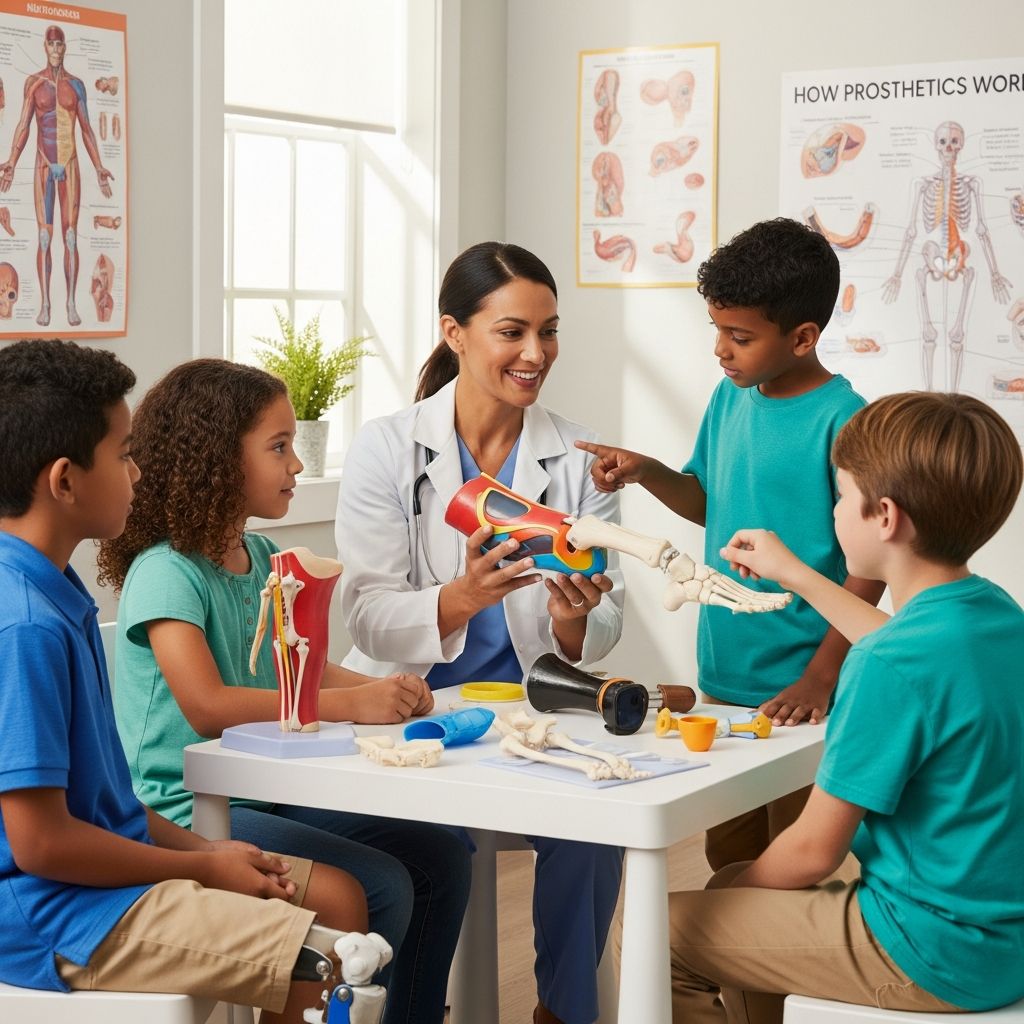
A prosthetic limb is an artificial arm or leg that takes the place of the part that was removed. Not every child will use a prosthesis, but many do, especially for leg amputations.
Parts of a Prosthesis
- Socket – The part that fits over the residual limb.
- Joints – Special parts that act like elbows, wrists, knees, or ankles.
- Foot or hand – May be simple or designed for special activities like sports.
- Padding and liners – Soft materials that help the prosthesis feel more comfortable.
Prostheses for Growing Kids
Because children grow quickly, their prosthetic limbs often need to be adjusted or replaced regularly.
- New sockets or parts are made as the limb changes shape or size.
- Kids may get different prostheses for different activities (for example, one for walking and one for sports).
| Type of Amputation | Common Prosthetic Goal | Examples of Activities |
|---|---|---|
| Below-the-knee (lower leg) | Walking and running with good balance | Playing tag, climbing stairs, running in gym class |
| Above-the-knee (thigh) | Stable standing and safe walking | Walking at school, moving around the house, sports with practice |
| Below-the-elbow (forearm) | Gripping and holding objects | Writing, eating, carrying books, playing some musical instruments |
| Above-the-elbow (upper arm) | Helping with positioning and some grasp | Helping stabilize objects, reaching, certain adapted sports |
Special Challenges for Children
Children are not just “small adults.” Their bodies and lives are different, so their amputation care is different too.
Growth and Bone Changes
Because kids keep growing, the bones in the residual limb can change over time.
- Bony overgrowth – Sometimes the cut end of the bone grows too much and forms a sharp tip that can poke into soft tissues and cause pain.
- This may require another surgery to smooth or shorten the bone so the child can keep using a prosthesis comfortably.
Multiple Surgeries Over Time
As a child grows taller and stronger, they might need:
- Adjustment surgeries to keep the limb comfortable inside the prosthesis.
- New prosthetic fittings many times during childhood.
School, Sports, and Friends
Amputation can raise questions at school and with friends, but most children return to their regular activities.
- Many kids go back to their usual classes and sports with some changes or adaptive equipment.
- Teachers and coaches can learn how to support the child’s needs.
- Friends may be curious; simple, honest explanations often help.
Living a Full Life After Amputation
Even though amputation is a big change, children can still grow up to have busy, active, and exciting lives.
- They can play sports, including wheelchair sports or sports with special prosthetic legs.
- They can swim, dance, hike, and do martial arts with the right training and support.
- They can use technology, musical instruments, and tools with creative adaptations.
- They can become students, workers, artists, scientists, and anything else they dream of.
What matters most is safety, good medical care, practice, and support from family, friends, and health professionals.
Frequently Asked Questions About Amputation
Does amputation hurt?
During the surgery you are asleep and do not feel it. After surgery, there can be soreness, but doctors and nurses give medicine and use other methods to help control pain. Over time, most kids say the area feels much better than it did when it was badly injured or sick.
Will I ever be able to walk or run again?
Many kids who have leg amputations walk, run, and play using a prosthetic limb or a wheelchair, or sometimes both. With practice, physical therapy, and the right equipment, you can be active in many different ways.
What is phantom limb feeling?
Some people feel like the missing part of the limb is still there. This is called phantom limb sensation. Sometimes it is just a feeling, and sometimes it can be uncomfortable. Doctors have treatments to help if it bothers you.
Will my friends treat me differently?
At first, friends may be curious or unsure what to say. Explaining in simple words what happened and showing them what you can do often helps. Real friends care about who you are, not just how your body looks.
How often will I need a new prosthetic limb?
Because kids grow, prosthetic limbs need to be adjusted or replaced regularly. Some children need a new or re-fitted prosthesis every year or two while they are growing quickly.
Can I still play sports?
Yes. Many children and adults with amputations play team sports, run races, swim, and do other activities. Your medical and therapy team can help you choose activities that are safe and fun for you and show you any special equipment you might need.
References
- Lower-Limb Amputation in Children and Adolescents—A Rare but Challenging Situation — Hoellwarth JS, et al. 2022-07-06. https://pmc.ncbi.nlm.nih.gov/articles/PMC9320991/
- Pediatric Traumatic Limb Amputation: The Principles of Management — Griffiths JC, et al. 2015-07-01. https://pmc.ncbi.nlm.nih.gov/articles/PMC4904133/
- Pediatric Acquired Upper and Lower Limb Deficiency — American Academy of Physical Medicine and Rehabilitation. 2021-03-01. https://now.aapmr.org/pediatric-acquired-upper-and-lower-limb-deficiency/
- Pediatric Limb Loss and Limb Difference: An Introduction for Parents — Amputee Coalition. 2020-01-01. https://amputee-coalition.org/resources/pediatric-limb-loss-and-limb-difference-an-introduction-for-parents/
- Amputations — Shriners Children’s. 2023-01-01. https://www.shrinerschildrens.org/en/pediatric-care/amputations
- Conditions We Treat – Prosthetics Clinic — Phoenix Children’s Hospital. 2023-01-01. https://phoenixchildrens.org/specialties-conditions/prosthetics-clinic/conditions-we-treat