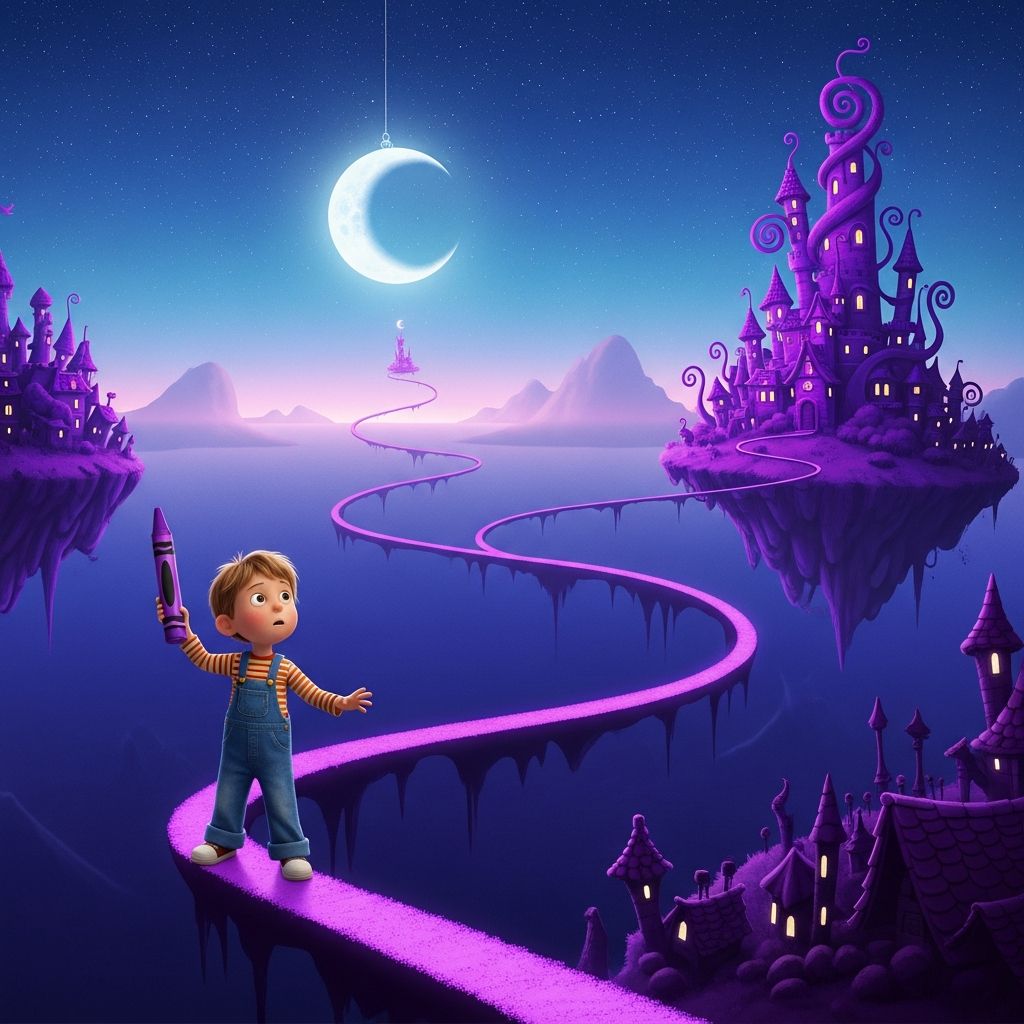
Crockett Johnson’s Harold and the Purple Crayon appears, at first glance, to be a simple bedtime story: a little boy with a purple crayon draws his way through a moonlit night, inventing mountains, oceans, and picnics as he goes. But beneath its spare lines and quiet tone lies a surprisingly rich meditation on imagination, fear, and the quiet courage it takes to be oneself in a world that often demands conformity.
More Than Just a Make-Believe Adventure
On the surface, Harold’s journey is pure play: he draws a landscape, walks through it, and solves problems with his crayon. Yet this simple act of drawing is far more than child’s play; it’s a radical assertion of agency. Harold doesn’t wait for permission, a map, or an adult to tell him where to go; he creates his own world, his own rules, and his own way home.
What makes the book so enduring is that it doesn’t just celebrate imagination as a fun escape; it shows imagination as a tool for survival and self-definition. When Harold finds himself lost, hungry, or afraid, he doesn’t cry out for rescue. Instead, he draws a balloon to catch his fall, a boat to cross the ocean, and a window to lead him back to bed. In doing so, he models a kind of resilience that’s deeply relevant to both children and adults: the ability to keep going by inventing a way forward, even when the path isn’t clear.
The World as a Blank Page
Harold begins his night on a blank white page, with nothing but a purple crayon in his hand. There’s no ground, no sky, no moon—just darkness and possibility. He draws the moon first, then the ground, then trees, a dragon, a picnic, and an ocean. Each stroke of the crayon brings something into being, and each new creation becomes part of the reality he must now live in.
This blank-page beginning is more than a clever visual device; it’s a metaphor for the human condition. Like Harold, we all start with a kind of emptiness—a life that isn’t fully written yet. We don’t choose our starting point, but we do choose, moment by moment, what to draw into existence: our relationships, our values, our responses to fear and failure.
For children, this idea is especially powerful. They are constantly learning what is real and what is pretend, what they can control and what they cannot. Harold’s world blurs that line in a way that invites children to ask: If Harold can draw a moon, is that moon real? If he draws a dragon, is it dangerous? And if he draws a window to his bedroom, is that his real room or a made-up one?
Imagination as a Tool for Resilience
Harold’s story is structured around a series of crises: he falls from a mountain, he’s over his head in the ocean, he’s lost in a city of windows. Each time, he doesn’t panic or give up; he uses his crayon to invent a solution. He draws a balloon to catch him, a boat to sail home, and finally a window and a bed to end his journey.
This pattern reveals a deeper lesson about resilience: it’s not just about enduring hardship, but about creatively reshaping one’s circumstances. Harold doesn’t wait for someone else to fix things; he takes responsibility for his own safety and well-being, using the only tool he has—his imagination.
For parents and educators, this offers a powerful model for how to talk with children about fear and failure. Instead of framing problems as things to avoid or escape, Harold shows that they can be opportunities to invent, adapt, and grow. A child who feels lost or overwhelmed can learn to ask: What can I draw? What can I create? How can I make a way forward, even if it’s not the way I expected?
The Hidden Cost of Creating Reality
What makes Harold’s journey so compelling is that it’s not all triumph and wonder. There are moments of real fear and disorientation: the dragon he draws becomes frightening, the ocean threatens to swallow him, and the city of windows makes him feel truly lost.
These moments reveal a subtle but important truth: when we create our own reality, we also create our own dangers. The dragon isn’t real in the ordinary sense, but it feels real to Harold; the ocean he draws is just lines on a page, but it still threatens to drown him. This mirrors the adult experience of anxiety and self-doubt: our fears may be “only in our heads,” but they still have real power over us.
Harold’s response is not to deny his fear, but to face it with his crayon. He doesn’t erase the dragon or the ocean; he draws a way around them. In doing so, he models a mature kind of courage: not the absence of fear, but the willingness to keep going despite it, using creativity as a lifeline.
Being Alone in a World of One’s Own
One of the most striking aspects of Harold’s story is how alone he is. There are no parents, no friends, no adults to guide him; just Harold and his purple crayon in a world of his own making. This solitude is both a source of freedom and a source of vulnerability.
On one hand, Harold’s isolation allows him to be completely himself, without worrying about rules, expectations, or what others might think. He can draw a nine-pie picnic, a dragon, and a city of windows, all because he wants to, not because anyone told him to. On the other hand, that same isolation means he has no one to turn to when things go wrong; he must rely entirely on himself.
This tension reflects a deeper philosophical question: what does it mean to be an individual in a world that often pressures us to conform? Harold’s crayon becomes a symbol of his unique self—the “one-of-a-kind soul” that he both protects and expresses through his drawings. In a culture that often values fitting in over standing out, Harold’s story quietly celebrates the courage to be different, to think for oneself, and to create a life that feels true.
What Harold Teaches About Dignity and Self-Reliance
At its core, Harold and the Purple Crayon is a story about dignity. Harold’s dignity doesn’t come from being perfect, fearless, or always in control; it comes from his willingness to keep going, to keep drawing, even when he’s lost or afraid.
He holds sacred his own intuitions, impulses, and choices, and he uses his crayon to protect that inner self from being erased by fear or conformity. In this sense, the purple crayon is not just a drawing tool; it’s a symbol of self-reliance, creativity, and the refusal to let external forces define who he is.
For adults, this offers a timely reminder: in a world of constant change, uncertainty, and pressure to conform, the ability to “draw one’s own world” is a form of resistance. It’s the courage to say, “This is what I value, this is what I create, this is how I want to live,” even when the path is unclear and the risks are real.
Why This Story Still Matters Today
More than seventy years after it was first published, Harold and the Purple Crayon remains deeply relevant. In an age of screens, algorithms, and curated online identities, Harold’s simple act of drawing on a blank page feels like a quiet rebellion.
Children today are often surrounded by pre-made worlds—video games, apps, and endless streams of content—where the rules are already written and the outcomes are often predictable. Harold’s story reminds them that they, too, can be the authors of their own experiences, that they can invent their own rules, their own adventures, and their own ways of being.
For parents, the book offers a model of how to support a child’s imagination without taking over. It’s not about giving children more toys or more structured activities; it’s about trusting them to explore, to make mistakes, and to find their own way home, crayon in hand.
How to Talk About Harold with Kids
Reading Harold and the Purple Crayon with a child is a chance to open up rich conversations about imagination, fear, and problem-solving. Here are a few ways to deepen the experience:
- Ask: “What would you draw if you had a purple crayon and a blank page?” This invites children to imagine their own world and think about what matters to them.
- Discuss: “Was Harold really in danger when he fell or when he was in the ocean?” This helps children explore the difference between real and pretend, and how feelings can be real even when the situation is made up.
- Wonder: “Why do you think Harold was so determined to find his window?” This can lead to conversations about safety, home, and the comfort of returning to something familiar.
- Reflect: “Have you ever felt lost or scared, and then figured out a way to feel better?” This connects Harold’s journey to the child’s own experiences of resilience.
FAQs About Harold and the Purple Crayon
- What age is Harold and the Purple Crayon best for?
- The book is typically recommended for children ages 3–8, but its themes of imagination and resilience can resonate with older children and even adults.
- Is Harold and the Purple Crayon a dream or real?
- The story is deliberately ambiguous; it can be read as a dream, a game of make-believe, or a metaphor for the creative mind. This open-endedness is part of what makes it so rich for discussion.
- What does the purple crayon symbolize?
- The purple crayon often symbolizes imagination, creativity, and the power to shape one’s own reality. It can also represent a child’s inner voice or unique self.
- Why is Harold alone in the story?
- Harold’s solitude emphasizes his independence and self-reliance. It allows him to be fully in charge of his world, but it also highlights the challenges of facing fear and uncertainty without help.
- What can parents learn from Harold’s story?
- Parents can learn to value a child’s imagination as a serious tool for resilience and self-expression. The story encourages trusting children to solve their own problems and to see creativity as a form of strength, not just entertainment.
Key Takeaways for Parents and Educators
| Aspect of the Story | What It Teaches | How to Apply It |
|---|---|---|
| Harold drawing his world | Children can shape their own experiences through imagination and choice. | Encourage open-ended play and creative projects; ask “What would you create?” |
| Harold facing fear (dragon, ocean) | Resilience comes from creative problem-solving, not just avoiding danger. | When a child is scared, help them brainstorm solutions instead of rushing to fix things. |
| Harold being alone | Independence and self-reliance are valuable, but so is knowing when to ask for help. | Balance freedom with safety; teach that it’s okay to be alone in play, but also okay to seek support. |
| Harold finding his window | Even in a world of one’s own making, there’s comfort in returning to something familiar and safe. | Reinforce routines and safe spaces; help children know they can always “draw their window” back to calm. |