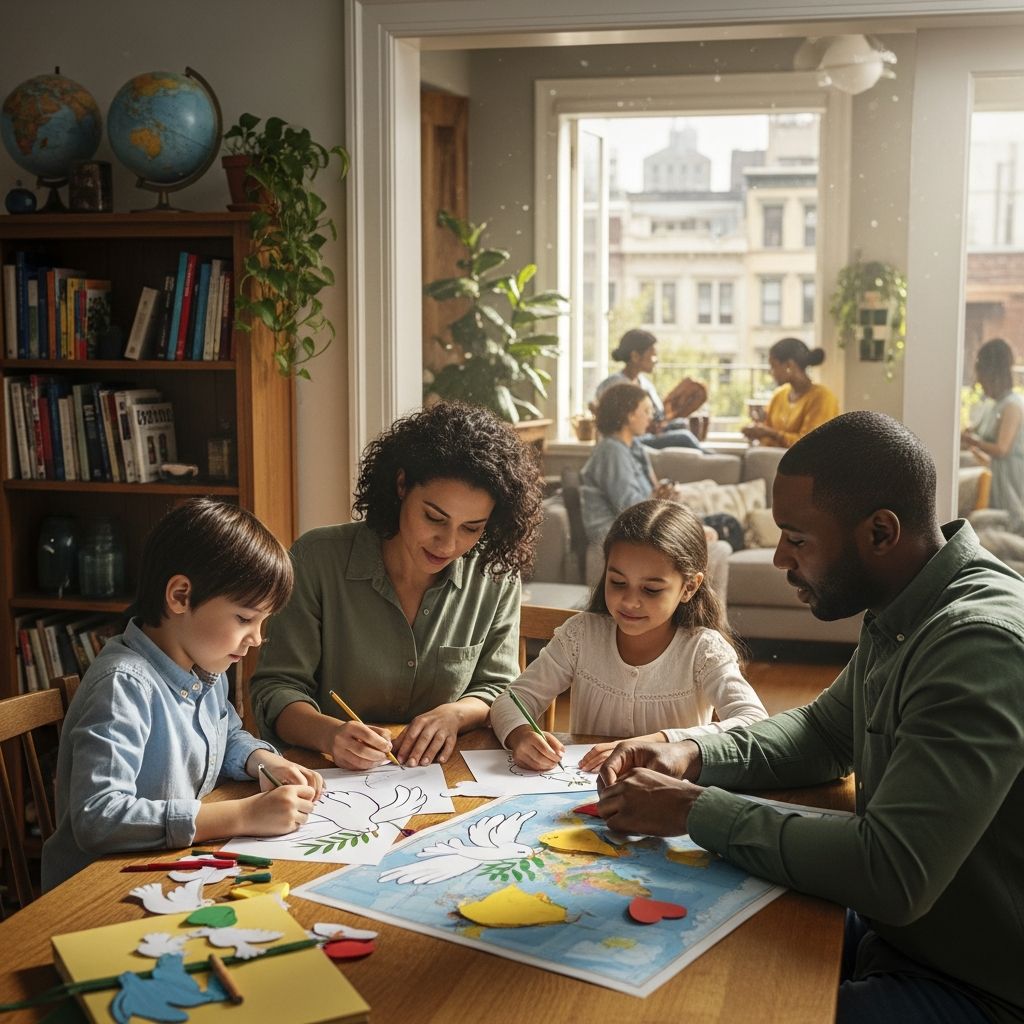
The world children inherit is shaped not only by politics and institutions, but by what happens in living rooms, kitchens, and school runs. When families choose connection over control and understanding over punishment, they are quietly training the next generation to solve conflict with empathy instead of aggression.
This article explores how parents and caregivers can make daily family life a training ground for peace. You will find practical ideas, mindset shifts, and concrete examples you can adapt to your own culture, values, and circumstances.
Why Peace Begins at Home
Children learn how the world works primarily by watching the adults around them. When they consistently see calm problem-solving, respectful disagreement, and emotional honesty, they begin to believe that these are normal and effective ways to live.
- Harsh criticism and frequent yelling teach that power wins and vulnerability is dangerous.
- Curiosity, boundaries, and empathy teach that needs matter, problems can be talked through, and people are more important than being right.
- Small, repeated experiences of being seen and heard add up to a deep internal sense of safety that children will carry into friendships, workplaces, and eventually their own families.
The Inner Work of a Peaceful Parent
Most parents know what they wish they could do in hard moments; the challenge is staying calm enough to do it. Peaceful parenting starts with self-leadership: learning to regulate your own emotions so you can guide rather than react.
Building Your Emotional Toolkit
Before changing how you respond to your child, notice how you respond to yourself. Instead of silently scolding yourself for losing your temper, treat your own mistakes as chances to learn.
- Pause rituals: Take three slow breaths, step into another room for 30 seconds, or briefly drink a glass of water before addressing a conflict.
- Self-check questions: Ask, “What am I feeling right now?” and “What does my child need in this moment?” before you speak.
- Repair as a practice: When you yell or overreact, model accountability: “I spoke too harshly. You didn’t deserve that. I’m working on calmer ways to talk when I’m frustrated.”
Letting Go of the Myth of Perfect Parenting
A peaceful family is not a conflict-free family. It is a home where mistakes are expected, emotions are allowed, and people work together to clean up the mess.
- Expect bad days, tired evenings, and miscommunications.
- Measure success not by how rarely you struggle, but by how quickly you reconnect after a rupture.
- See every conflict as a chance to show your child how to repair, forgive, and try again.
Connection as Your Main Parenting Strategy
Children cooperate more willingly when they feel emotionally connected. Connection does not mean giving in to every demand; it means tending to the relationship so guidance can actually land.
Daily Micro-Connections
You do not need hours of uninterrupted time to build closeness. A handful of intentional moments each day can change the emotional tone of your entire household.
- Greeting rituals: When your child wakes up or returns home, pause what you are doing, make eye contact, and offer a hug or brief chat.
- Transition check-ins: Use car rides, walks, or dishwashing time to ask open questions like “What was the funniest thing that happened today?”
- Playful attention: Spend even 10–15 distraction-free minutes following your child’s lead in play, without correcting or directing.
When Connection Comes Before Correction
In heated moments, many children cannot hear logic until they feel understood. A simple pattern is: connect, then guide.
- First, acknowledge the feeling: “You’re really disappointed that screen time is over.”
- Next, hold the boundary: “It’s time to turn it off now.”
- Then, offer support: “Do you want a hug, or should we pick a song to listen to together while we tidy up?”
This approach does not magically erase protests, but it lowers the emotional temperature, preserves dignity, and teaches that limits can coexist with care.
Gentle Discipline That Still Holds Firm
Peaceful parenting is sometimes misunderstood as permissive. In reality, children feel safest when adults set clear, consistent boundaries and enforce them with calm, confident leadership.
From Punishment to Teaching
Discipline shares a root with the word “disciple,” meaning to teach. Instead of focusing on making children suffer for misbehavior, shift the focus to helping them learn better skills for next time.
| Old Pattern | Hidden Message | Peaceful Alternative | What the Child Learns |
|---|---|---|---|
| Yelling or shaming after a mistake | “When you mess up, you are bad.” | Describe the impact, brainstorm solutions, and practice the new behavior together. | “Mistakes are fixable and I can take responsibility.” |
| Automatic punishment (loss of privilege) | “Power decides outcomes, not understanding.” | Use natural or logical consequences linked to the behavior (e.g., cleaning up a mess made in anger). | “My actions have effects, and I can repair them.” |
| Embarrassing the child in front of others | “Your dignity is less important than my authority.” | Speak privately, focusing on specific behaviors, not character. | “I am respected even when I am corrected.” |
Setting Limits With Respect
Clear limits help children feel safe, especially in a chaotic world. The key is enforcing limits without humiliation or threats.
- State expectations in positive, concrete terms: “Hands stay on your own body,” instead of “Don’t hit.”
- Offer limited choices within the boundary: “You can hop or walk to the car. Which do you choose?”
- Follow through calmly; if you shout the limit from another room but never act on it, the boundary becomes unclear.
Raising Emotionally Intelligent Children
Conflict in the world often escalates because people lack basic emotional skills: naming feelings, tolerating discomfort, and listening when upset. Families can nurture these abilities from early childhood.
Helping Children Name and Navigate Feelings
Emotions are not problems to fix but signals to understand. When children learn that all feelings are acceptable, but not all actions are, they become less afraid of their inner life.
- Use everyday moments to label feelings: “You look proud of that drawing,” or “You seem frustrated that it isn’t working yet.”
- Describe your own feelings in age-appropriate ways: “I’m feeling overwhelmed, so I’m going to take a quick breather and then I’ll help you.”
- Normalize emotional waves: “Anger comes and goes, like a storm. We can ride it out together.”
Teaching Peaceful Problem-Solving
Instead of always stepping in as judge and jury between siblings or peers, guide children to participate in solutions. This prepares them for later disagreements in classrooms, communities, and workplaces.
- Help each child state their perspective without interruption.
- Reflect what you hear: “You wanted the toy, and you had it first. You’re upset it was grabbed.”
- Ask, “What ideas do you both have to solve this?” and support them in finding a plan that feels fair.
Over time, children internalize the idea that listening, compromising, and creativity are normal parts of resolving conflict.
Home as a Practice Ground for Kindness
A peaceful world is built on everyday acts of consideration: holding doors, checking on a lonely classmate, speaking up when someone is teased. Families can weave these habits into ordinary routines.
Making Cooperation a Family Value
When children contribute to the life of the household, they learn responsibility and experience being needed. Chores become more meaningful when framed as care for the community, not punishment.
- Create simple, age-appropriate jobs: matching socks, feeding pets, watering plants, or stirring ingredients.
- Explain the “why”: “When you help set the table, everyone gets to eat sooner and we can enjoy dinner together.”
- Use encouragement focused on effort and impact: “You worked hard to tidy that space; it makes the room feel calm for all of us.”
Practicing Empathy in Everyday Life
Empathy grows when children regularly imagine other people’s experiences. No special curriculum is required—only curiosity.
- During stories or shows, ask, “How do you think that character feels right now? Why?”
- Invite small acts of kindness: making a card for a sick relative, saving part of a snack for a sibling, or greeting a shy neighbor.
- Model thinking aloud: “The cashier looks tired. Let’s smile and thank them for helping us.”
Extending Peace Beyond Your Front Door
As children grow, they begin to notice unfairness in the wider world: bullying at school, news about violence, or conflicts between groups. Rather than shielding them entirely, parents can gently frame these realities while offering ways to contribute to change.
Talking About a Not-So-Peaceful World
Honest but grounded conversations help children feel informed without being overwhelmed. The goal is not to provide all the answers but to sit with hard questions.
- Use simple, clear language: describe what happened, avoid graphic details, and emphasize helpers who are responding.
- Invite feelings and questions: “How does hearing about that make you feel?”
- Reassure them about the safety measures in their daily life, like trusted adults and community rules.
Family Actions That Ripple Outward
Children feel more hopeful when they see that even small actions matter. Your family can choose one or two simple ways to contribute to a kinder community.
- Join neighborhood clean-ups or community events and explain how caring for shared spaces shows respect for others.
- Support local charities through donations of time, items, or money, involving children in choosing causes.
- Practice inclusive hospitality, such as inviting classmates from different backgrounds to playdates or celebrations.
Adapting Peaceful Parenting to Your Reality
Every family faces real constraints: limited time, financial pressure, caregiving responsibilities, or health challenges. Peaceful parenting is not an all-or-nothing identity but a direction you gently lean toward.
Starting Small and Staying Flexible
Trying to change everything at once usually leads to burnout. Focus on small, repeatable shifts that fit your current season of life.
- Pick one routine (mornings, bedtime, or mealtimes) and experiment with adding more connection and less rushing.
- Choose a single personal growth goal, such as pausing before reacting or lowering your voice during discipline.
- Review once a week: ask yourself what went well, what felt hard, and what tiny tweak might help.
Honoring Cultural and Personal Values
Peaceful parenting does not require abandoning your culture, faith, or family traditions. It invites you to express those values in ways that protect dignity and nurture relationship.
- Keep important rituals—meals, holidays, spiritual practices—but approach them without fear-based control.
- Adapt language and expectations to what is realistic and meaningful where you live.
- Seek community with other caregivers who are also exploring kinder ways to set limits and solve problems.
Frequently Asked Questions
Is peaceful parenting the same as letting my child do whatever they want?
No. Peaceful parenting combines warmth with clear, consistent boundaries. Children still hear “no,” experience consequences, and are expected to respect others, but they are guided rather than shamed.
What if I grew up with harsh discipline and lose my temper easily?
Many adults are breaking patterns they never chose. Awareness is already a powerful step; from there, small practices like pausing, apologizing, and seeking support can gradually rewire your default reactions.
Will my child be able to handle the “real world” if I am gentle at home?
A caring home does not make children fragile; it gives them a strong base from which to face challenges. When children are secure and emotionally skilled, they are often better prepared to navigate conflict, stand up for themselves, and show leadership.
What should I do in the moment when my child is melting down?
First, focus on safety—move objects or people out of harm’s way. Then simplify: stay nearby, use few words, offer physical comfort if welcomed, and wait until the emotional storm passes before discussing what happened.
How can both caregivers stay on the same page?
Perfect agreement is unrealistic, but shared principles help. Have regular, calm conversations about what each of you believes children need, where you can align, and how you will handle differences in front of the kids.
Planting Seeds of Peace, One Day at a Time
Choosing peaceful parenting does not guarantee an easy life, obedient children, or a conflict-free world. It does, however, steadily grow humans who know how to feel deeply, think clearly, and act with courage and compassion.
Each time you listen instead of dismiss, set a boundary without humiliation, or repair after a hard moment, you are teaching your child how to use power differently. These small, often invisible decisions in ordinary homes are among the most powerful investments anyone can make in a more peaceful future.