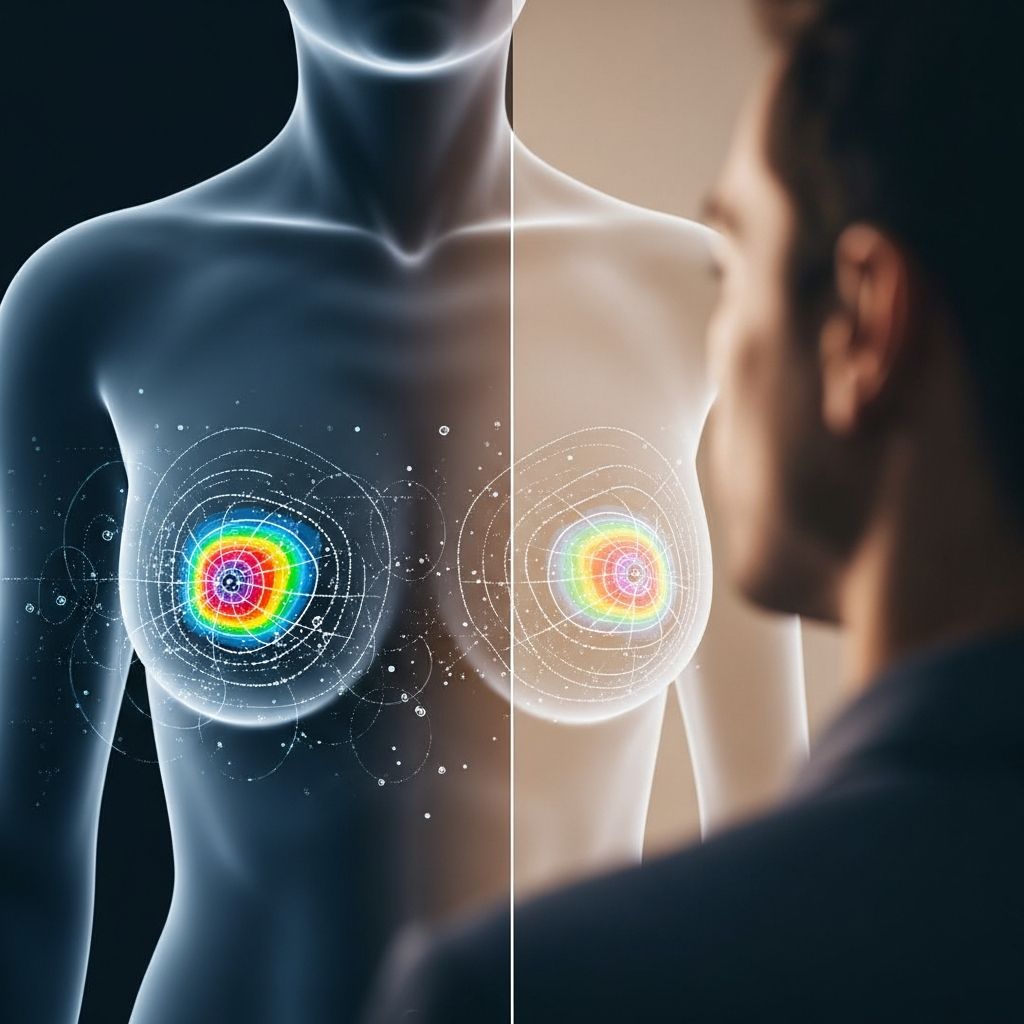
Men’s visual attention to women’s breasts is not random but guided by evolutionary and perceptual mechanisms, as demonstrated by eye-tracking studies. These investigations reveal that men prioritize specific regions, such as the breasts and waist-to-hip ratio (WHR), associating them with fertility and attractiveness.
The Role of Eye-Tracking in Understanding Visual Attraction
Eye-tracking technology provides objective data on where individuals direct their gaze, measuring fixation duration and frequency. In studies involving images of female bodies, participants’ eye movements are recorded to map attention patterns. This method bypasses self-reported biases, offering insights into subconscious preferences.
For instance, when men view front-posed images of women varying in WHR (0.7 or 0.9) and breast size (small, medium, large), initial fixations within 200 milliseconds target the breasts or waist. These rapid assessments suggest an evolved ‘first-pass filter’ for evaluating potential mates.
Both men and women exhibit similar gaze patterns, with about 75% of observation time focused on the lower breast and nipple-areola complex (NAC). This convergence indicates shared aesthetic evaluation criteria, though men allocate slightly more time to upper breast regions.
Key Areas of Focus: Breasts, Waist, and Beyond
- Breasts receive the most prolonged attention: Men spend significantly more time fixating on breasts compared to the face, midriff, or legs, regardless of size variations.
- Nipple-areola complex (NAC) dominates: The NAC and lower breast pole account for 52-58% of total fixation time in attractiveness assessments.
- Waist-to-hip ratio (WHR) as a rapid cue: Lower WHR (e.g., 0.7) images attract more overall attention and higher attractiveness ratings, with initial gazes scanning waist areas.
- Midriff scrutiny for higher WHR: Images with higher WHR (0.8-0.9) draw more fixations to the midriff, possibly as a fertility discrepancy signal.
These patterns align with evolutionary theories: breasts signal secondary sexual characteristics linked to estrogen levels and nulliparity, while low WHR indicates reproductive health.
Sex Differences and Similarities in Perception
Although men focus more on reproductively relevant areas like breasts and hips, women show comparable attention to NAC and lower breasts during aesthetic and symmetry evaluations. Men rated lower WHR figures highest, spending longer on these images overall.
| Aspect | Men | Women |
|---|---|---|
| Fixation on NAC/Lower Breast | 57% of time | 58% of time |
| Upper Breast Attention | Higher | Lower |
| Total Time on Breasts | Longer overall | Similar patterns |
| WHR Preference Influence | Strong (low WHR preferred) | Less pronounced |
The table summarizes gaze data from key studies, highlighting minimal sex differences in core focus areas.
Evolutionary Underpinnings of Breast Preferences
Human breasts are unique among primates for their permanence post-weaning, hypothesized as a fertility signal. Larger breasts correlate with higher estradiol levels, peaking mid-cycle, enhancing perceived fecundity. Eye-tracking confirms men prioritize these traits rapidly, with breast fixations outlasting waist scans.
In one experiment, men viewed images divided into regions of interest (ROIs): upper trunk (breasts), midriff-to-waist, and hips-to-feet. Breasts garnered the most fixations, supporting mate selection strategies.
Areolar pigmentation also influences judgments; darker pigmentation around the NAC affects attractiveness ratings alongside size. This fine-grained attention does not always linearly correlate with overall ratings, suggesting complex integration of cues.
Implications for Aesthetics and Symmetry Assessment
Beyond attraction, eye-tracking informs plastic surgery by identifying perceptually salient features. The NAC’s prominence as the initial fixation point (most common first gaze) underscores its role in holistic breast evaluation.
Observers assessed eight breast types in frontal, lateral, and oblique views. Symmetry judgments mirrored aesthetics, with lower pole and NAC fixations persisting across tasks. This data serves as reference for patient perceptions post-reconstruction.
Breast Size vs. Shape: What Draws the Eye?
Contrary to stereotypes, breast size alone does not dictate attention; men fixate equally on small, medium, and large breasts but prefer hourglass figures (low WHR) overall. Small-breasted images prompted relatively longer breast gazes than head scans, indicating compensatory scrutiny.
Upper body regions (face, breasts, midriff) receive more attention than lower body, with breasts leading. This upper-body bias peaks in the first second of viewing.
Broader Contexts: Culture, Wealth, and Perception
While evolutionary bases are consistent, socio-economic factors modulate preferences. Higher-status men may prioritize breast size over buttocks, linking to resource signaling. Cross-cultural eye-tracking could test universality, though current data from Western samples dominate.
Women’s self-perception aligns with male gazes, focusing similarly on NAC, suggesting internalized standards.
Frequently Asked Questions
What do men notice first about women’s breasts?
Men first fixate on breasts or waist within 200 ms, followed by prolonged NAC and lower breast attention.
Do women and men perceive breast attractiveness differently?
Key patterns are similar, with both prioritizing NAC (52-58% fixation time), though men emphasize upper breasts more.
Why is low waist-to-hip ratio important?
Low WHR (0.7) signals fertility, drawing more gaze and higher ratings; higher WHR shifts focus to midriff.
Does breast size affect male attention duration?
Men spend comparable time on all sizes but rate low WHR figures highest, irrespective of size.
How does eye-tracking benefit breast aesthetics research?
It provides objective gaze data for symmetry and attractiveness, aiding surgical outcomes and reference values.
Conclusion: Insights from Objective Science
Eye-tracking demystifies the male gaze, revealing instinctual priorities rooted in evolution. Breasts, especially NAC and lower poles, command attention across sexes, intertwined with WHR for attraction judgments. These findings enhance understanding of human mate choice and perceptual psychology.
References
- Male and Female Perception of Physical Attractiveness — Evolutionary Psychology Journal. 2016-02-29. https://journals.sagepub.com/doi/10.1177/1474704916631614
- Analysis of the Visual Perception of Female Breast Aesthetics and Symmetry — PubMed/Plastic and Reconstructive Surgery. 2019-11-20. https://pubmed.ncbi.nlm.nih.gov/31764626/
- Building a better breast with eye-tracking technology — EurekAlert!/Piotr Pietruski et al. 2019-11-20. https://www.eurekalert.org/news-releases/775323
- Eye-Tracking of Men’s Preferences for Waist-to-Hip Ratio and Breast Size — Dixson et al., Archives of Sexual Behavior. 2011-05-01. https://canlabvuw.wordpress.com/wp-content/uploads/2015/05/eye-tracking-of-men_s-preferences-for-waist-to-hip-ratio-and-breast-size-of-women.pdf
- Eye Tracking of Men’s Preferences for Female Breast Size and Areolar Pigmentation — Dixson & Grimshaw, Semantics Scholar. 2011. https://www.semanticscholar.org/paper/Eye-Tracking-of-Men%E2%80%99s-Preferences-for-Female-Breast-Dixson-Grimshaw/375f1080ee08d346a2bc11a39b17533a4c0f783b