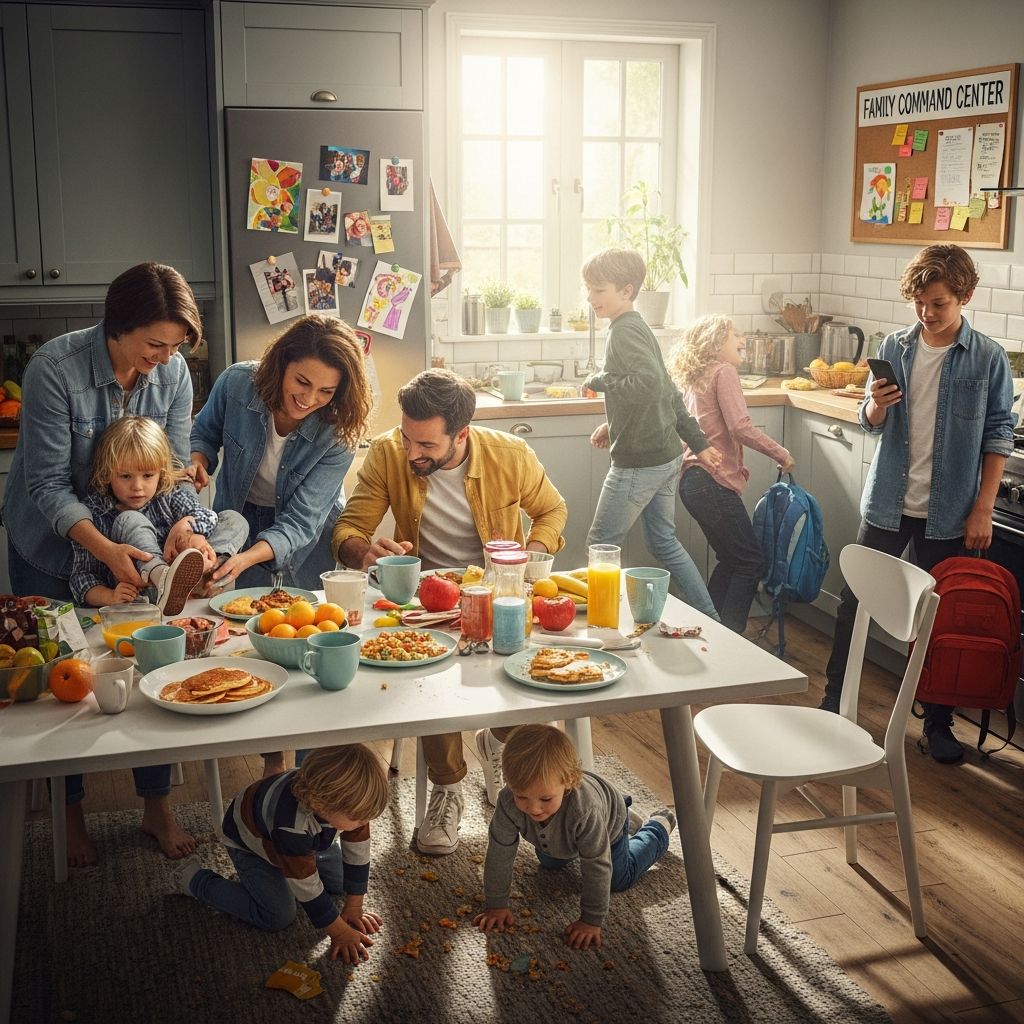
Raising a large family can feel like running a small organization out of your living room. There is noise, movement, competing needs, and constant decision-making, often before breakfast is even over. Yet there can also be deep connection, rich relationships, and a sense of team that is hard to find anywhere else.
This guide explores the unique pressures of parenting many children at once and offers practical, realistic strategies for building a home that feels loving and manageable instead of chaotic and draining.
The Hidden Realities Of Parenting A Big Family
From the outside, people see matching holiday outfits, cute stair-step kids, and full dinner tables. On the inside, parents of large families are juggling emotional needs, schedules, budgets, and laundry in ways that are hard to explain to anyone who has never lived it.
- The household can shift from calm to chaos in seconds, often over something as small as a missing shoe.
- Parents are constantly triaging: whose need is urgent, whose can wait, and what can be delayed without everything falling apart.
- Simple tasks like going to the dentist or buying shoes require project-level planning and coordination.
Understanding that these stressors are normal in big families is the first step toward designing systems that work for your particular crew.
Time: The Most Precious And Scarce Resource
No matter how many children there are, parents only have the same 24 hours a day. What changes with a large family is the number of people drawing on those hours. Time becomes the most valuable currency in the house, and everyone wants a slice.
- Daily routines often blend into one another: meals, school, activities, bedtime, and chores can feel like one long conveyor belt.
- Parents may feel guilty that each child only gets small pockets of one-on-one attention.
- Moments of quiet are rare and can feel like emergencies in their own right: when it is quiet, you may assume something is going wrong.
The goal is not to magically create more hours, but to be deliberate about how they are used and to lower the pressure to do everything perfectly for everyone at once.
Strategies For Managing Time Without Losing Your Mind
While every family is different, some time-management patterns are especially helpful in big households. The key is to trade perfection for consistency and to design rhythms that are sustainable on a typical day, not an ideal day.
- Anchor your day with 2–3 non-negotiable routines. For example: a predictable wake-up routine, a mealtime rhythm, and a bedtime sequence. Everything else can flex around these anchors.
- Batch similar tasks. Answer messages at one or two set times, prep snacks for the whole day in one go, and wash laundry by category (like towels together, uniforms together) to avoid constantly switching gears.
- Create small pockets of connection. A five-minute check-in before lights out or a shared joke in the car on the way to practice is often worth more than a grand, rare “special day.”
- Use visual schedules. A simple dry-erase board or printed chart in the kitchen helps everyone know what is happening next without parents repeating instructions all day.
Money, Meals, And The Math Of A Full House
Big families multiply almost every cost: food, clothing, shoes, school supplies, sports fees, transportation, and healthcare. Financial stress can quietly shape decisions about activities, vacations, and even how much parents feel they can relax.
- Grocery bills often rival a small restaurant’s weekly order.
- Outings that seem simple with one or two children become significant expenditures with many kids.
- Parents may feel pressure to say yes to every opportunity, even when the budget says otherwise.
| Area | Why It Scales Quickly | Practical Ideas |
|---|---|---|
| Food | Three daily meals plus snacks multiply with each child. | Plan simple rotating menus, buy staples in bulk, and favor recipes that stretch easily. |
| Clothing | Growth spurts, seasons, and school dress codes add up fast. | Use hand-me-down systems, shop secondhand, and keep a small “next size” bin. |
| Activities | Each sport or lesson fee multiplies by the number of children involved. | Set a yearly activity budget and cap, rotate turns for expensive activities, favor community programs. |
| Transportation | Larger vehicles and more frequent trips raise costs. | Combine errands, carpool when possible, schedule appointments on the same day. |
Making The Budget Work For More Than A Month
Financial peace in a large family does not come from never spending, but from knowing where your money is going and matching that to your values. The goal is to avoid surprise expenses that could have been predicted and to involve older children in age-appropriate ways.
- Create a written or digital budget that includes categories specific to big families: birthdays, field trips, school photos, activity fees, and seasonal clothing.
- Decide in advance what you will almost never buy new (for example, casual clothes or toys) and what you will usually buy new (like car seats or shoes that affect health).
- Teach children about trade-offs: joining one travel team might mean fewer restaurant meals, or new gadgets may require saving birthday money.
- Keep one small, flexible line in the budget for spontaneous fun so that saying yes sometimes feels possible.
Noise, Clutter, And Limited Space
When many people share a home, space and noise are constant issues. Even when everyone is getting along, there is almost always motion: footsteps, doors, running commentary, and a steady stream of belongings migrating through the house.
- Shared bedrooms can lead to both strong sibling bonds and frequent conflict over light, noise, and privacy.
- Common areas can feel crowded, especially during homework time or early mornings.
- Clutter multiplies quickly because every child generates paper, art, laundry, and treasures that matter deeply to them.
Creating Calm Inside Limited Space
The solution is not necessarily more square footage, but more intentional use of whatever space exists. A small home can still feel spacious if it is organized for real life instead of an idealized version of it.
- Designate zones by activity, not by person. Have a reading corner, a homework table, a toy area, and a quiet corner rather than trying to give each person an entire room.
- Use vertical storage. Shelves, hooks, over-the-door organizers, and wall-mounted bins reclaim space and keep the floor clearer.
- Limit how many items can live in a category. For example, each child might have a set number of everyday outfits, a single bin for memorabilia, or a specific hook for frequently used bags.
- Schedule brief reset times. Two or three 10-minute family tidy sessions a day often work better than one overwhelming marathon clean-up.
Emotional Needs And Sibling Relationships
One of the richest parts of a large family is the network of relationships between siblings. It is also one of the most complex parts. Rivalry, alliances, intense friendships, and sudden conflicts can all appear before lunchtime.
- Children may compete for parental attention, even when parents are doing their best to be fair.
- Quieter children can easily be overshadowed by more vocal siblings.
- Older children may feel pressure to act like a second parent, while younger ones may feel overlooked in the crowd.
Fostering Connection With Each Child
In big families, connection often comes from many small interactions rather than a few dramatic gestures. Consistency matters more than size. Intentionally weaving micro-moments of attention into the day helps each child feel seen.
- Create simple one-on-one rituals: a short walk after dinner with rotating kids, a shared weekly breakfast, or a private handshake and check-in at bedtime.
- Use children’s names, eye contact, and gentle touch when speaking to them to cut through the background noise.
- Notice and name specific strengths: “You’re so patient with the toddler” or “You’re great at entertaining your little brother,” rather than only commenting on behavior.
- Rotate small responsibilities (like helping with dinner prep or reading to a younger sibling) so each child has chances to feel important.
Balancing Fairness And Individuality
One of the hardest tensions in a big family is balancing what feels fair with what each child actually needs. Treating everyone the same is not always equitable, but children often measure fairness visually: who gets what, when, and how much.
- Explain that “fair” means everyone gets what they need, not that everyone gets the same thing at the same time.
- Give older kids privileges that match their responsibilities and stage of life, while still reserving special experiences for younger children.
- Allow each child to have one or two areas where they can make individual choices, such as hairstyle, a hobby, or how to decorate a small personal space.
- Notice signs of resentment and name them gently so they can be discussed rather than left to grow quietly.
Parent Burnout: When Love And Exhaustion Collide
Parents of large families may carry a quiet sense of guilt: loving their children deeply while also feeling profoundly tired and occasionally fantasizing about disappearing to a hotel for a night of silence. This mix of emotions is normal, but if left unaddressed, it can turn into burnout.
- Constant decision fatigue and noise can leave parents feeling numb or irritable.
- Sleep may be fragmented for years, especially when babies, toddlers, or teens with late-night schedules overlap.
- Parents may feel as if they have no identity outside of managing the family’s needs.
Realistic Self-Care For Parents Of Many
Self-care in a big family is not about long spa days or elaborate vacations; it is about weaving small, sustainable habits into daily life so that parents can keep functioning with a full heart instead of running on fumes.
- Protect a minimum sleep window. Even if bedtimes and wake-ups shift somewhat, guard a core number of sleep hours as fiercely as possible.
- Schedule small, regular breaks. A 15-minute walk alone, a quiet cup of tea with a book, or a weekly hobby hour can make a significant difference.
- Ask for and accept help. That may mean trading childcare with another family, leaning on relatives, or hiring help for specific tasks when possible.
- Stay connected to other adults. Short conversations with friends, a support group, or an online community can relieve the sense of isolation.
Systems That Help Big Families Run Smoothly
Every large family eventually develops its own culture and systems. The most effective ones are flexible, easy to remember, and built around the particular personalities and needs in the home. They are not rigid rules; they are tools that reduce mental load.
- Assign age-appropriate daily chores so that everyone contributes to the household in visible ways.
- Use simple labels (words or pictures) on drawers, bins, and shelves to reduce repeated questions and lost items.
- Create a central communication hub: one place for the calendar, to-do lists, permission slips, and reminders.
- Review the week together briefly every weekend so older children know what to expect and can help younger ones prepare.
Frequently Asked Questions About Large-Family Parenting
How many children count as a large family?
There is no universal definition, but many people consider a family with four or more children to be a large family. What truly defines a large family, though, is less the specific number and more the experience of managing many overlapping needs, schedules, and personalities at once.
Can children in big families still get enough individual attention?
Yes, but attention may look different than it does in smaller families. Instead of long, daily one-on-one outings, children often receive many shorter but consistent moments of connection woven into everyday life. Intentional micro-moments of presence, eye contact, and conversation can meet emotional needs surprisingly well when they happen frequently.
Do older kids always have to help raise younger siblings?
Healthy responsibility is different from parentification. Older children can reasonably help in age-appropriate ways—reading to younger siblings, helping with simple tasks, or watching them briefly—without being made responsible for their siblings’ overall care or emotional well-being. Clear limits and appreciation help this feel like teamwork instead of a burden.
How can parents keep discipline consistent with so many children?
Consistency starts with a small set of clear family rules and predictable consequences, not a long list of detailed regulations. When rules are simple and repeated often, both parents and children can remember and apply them more easily. Discussing expectations during calm moments, rather than only during conflict, helps everyone stay on the same page.
Is it possible to enjoy the chaos instead of fighting it?
While no household feels joyful all the time, many parents of large families find that accepting a certain level of noise and imperfection makes life easier. Shifting the goal from “controlling every moment” to “guiding the general direction and staying connected” lowers stress and opens space to notice the funny, tender, and beautiful parts of big-family life.
Embracing The Big-Family Adventure
Living with many children under one roof is undeniably challenging, but it is also an opportunity to build a tight-knit, resilient team. With simple systems, realistic expectations, and intentional connection, your large family can become a place where everyone—parents included—feels seen, valued, and deeply at home.