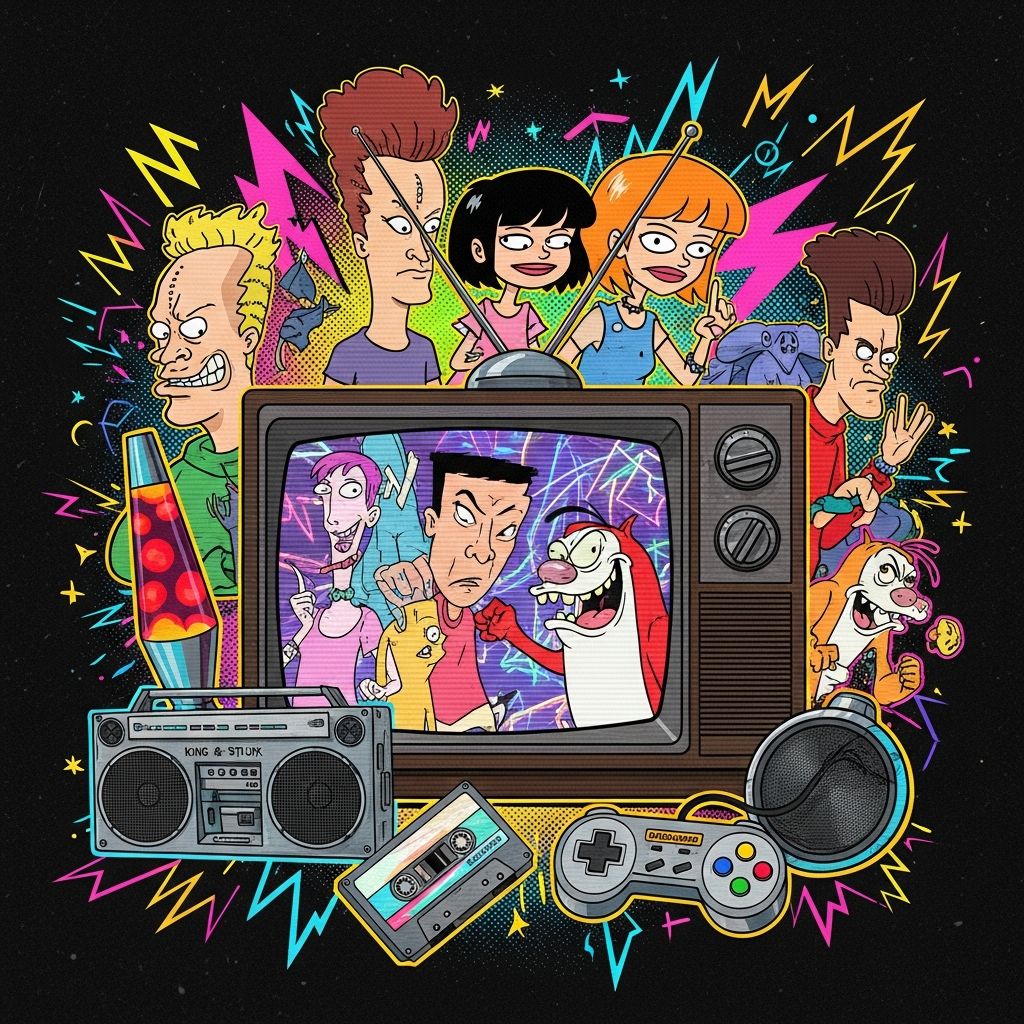
In the 1990s, MTV quietly built one of the most influential animation lineups on television. What began as a music video channel expanded into an experimental playground where strange, edgy, and deeply personal cartoons could live alongside rock videos and pop culture commentary. MTV’s animated shows didn’t just entertain teenagers; they helped redefine what television animation could be, inspiring later adult-focused blocks and streaming-era experimentation.
The Birth of MTV Animation: From Bumpers to Full Series
Before it became a home for full-length cartoon series, MTV used short, stylish animated IDs and bumpers to glue its programming together. These tiny pieces of animation, often created by independent artists, showed executives there was an appetite for unusual, highly designed visuals on the channel.
Key early steps that led to MTV’s 90s cartoon boom included:
- Artist-driven IDs: Short animated station IDs commissioned from indie animators made the MTV logo itself a constantly changing character.
- Influence of short-form pioneers: Producers have cited the rapid-fire, experiment-friendly style of Sesame Street as an inspiration for mixing educational and avant-garde techniques in short animated pieces.
- Independent animation on TV: Giving festival-circuit animators a commercial outlet helped prove that unconventional styles and darker tones could attract audiences, not scare them away.
By the early 1990s, the channel was ready to move from stylish fragments to full shows.
Liquid Television: The Strange Laboratory
Liquid Television, which debuted in 1991, is widely considered the true starting point for the MTV animation wave. It functioned less like a single show and more like an anthology magazine of animation, pulling in shorts from around the world and spotlighting wildly different visual approaches.
Core characteristics of Liquid Television included:
- Anthology format: Each episode stitched together multiple animated shorts with no requirement for a unified look or tone.
- Adult-oriented themes: Storylines often explored violence, sexuality, and surreal horror, aimed at older teens and adults rather than kids.
- Launchpad for series: It introduced characters and concepts that would become full series, including Beavis and Butt-Head and Æon Flux.
Liquid Television helped normalize the idea that television animation could be as diverse and experimental as anything in underground film festivals, while still living on a mainstream cable channel.
Building a Studio: MTV Animation Goes In-House
In 1993, MTV created its own internal animation studio to support the growing success of its cartoons. This move gave the network more control over production schedules, visual consistency, and the ability to spin off successful shorts into series.
| Year | Milestone | Impact on MTV Cartoons |
|---|---|---|
| 1991 | Launch of Liquid Television | Proved there was a late-night audience for experimental adult animation. |
| 1993 | MTV Animation studio established | Allowed the network to produce ongoing series in-house and scale up. |
| Mid-1990s | Multiple hit shows and a feature film | MTV became a serious rival to Cartoon Network and Nickelodeon for animated content. |
With infrastructure in place, MTV could transform standout shorts into flagship properties.
Beavis and Butt-Head: Lowbrow, High Impact
Beavis and Butt-Head is often cited as MTV’s breakout animated phenomenon. Spawned from a short on Liquid Television, it followed two clueless metal-loving teenagers riffing on music videos and causing havoc.
Why this show mattered so much:
- Voice of a specific subculture: The series leaned into heavy metal fandom, slacker humor, and a very 90s form of anti-authoritarianism.
- Controversy as marketing: Media panic over the show’s crude humor and alleged influence on teen behavior only heightened its visibility and cultural power.
- Multimedia success: Its popularity led to a theatrical film, merchandise, and ongoing revivals, showing that adult animation could succeed beyond niche late-night blocks.
The show’s mix of commentary on real music videos and scripted segments also underscored MTV’s dual identity as both a music network and a comedy venue.
Æon Flux and the Rise of Stylized Adult Sci-Fi
Where Beavis and Butt-Head embraced juvenile jokes, Æon Flux embraced dense, nearly wordless science fiction. Originating as a Liquid Television serial, it evolved into a full series known for its fluid animation, harsh violence, and cryptic storytelling.
Defining traits included:
- Experimental narrative: Early segments often killed the protagonist repeatedly, challenging conventional continuity and viewer expectations.
- Visual innovation: The show used exaggerated anatomy, dynamic camera angles, and detailed backgrounds to create a uniquely unsettling world.
- Adult genre storytelling: It showed that animated sci-fi on TV could handle themes of espionage, bioengineering, and dystopian politics without softening for children.
Æon Flux helped expand the idea of what “adult animation” could look like—stylistically daring, morally ambiguous, and narratively complex.
Daria: Deadpan Intelligence in a Hyper-Loud Era
Daria, which premiered in 1997 as a spin-off from Beavis and Butt-Head, took a very different approach to teen life. Instead of celebrating chaos, it gave viewers a smart, observant outsider who dissected suburban high school culture with dry wit.
What set Daria apart:
- Character-driven storytelling: Episodes focused on relationships, identity, and social pressure rather than shock value.
- Emotional realism: Beneath the sarcasm, the show tackled issues like self-worth, academic stress, and family dynamics.
- Representation of “too smart” teens: Many viewers who felt out of sync with their peers saw themselves in Daria’s skepticism and intelligence.
In contrast to MTV’s louder, edgier shows, Daria proved that quietly critical, dialogue-heavy animation could be just as captivating for older teens.
Filling the Space Adult Swim Would Later Own
During the 1990s, MTV occupied a niche that would later be strongly associated with Adult Swim on Cartoon Network: late-night, offbeat animation designed for teens and young adults rather than children.
Common traits across many MTV cartoons from this period included:
- Dark humor and graphic content: Violence, sexual jokes, and bleak scenarios were common, making clear these shows were not Saturday-morning fare.
- Pop culture density: Episodic plots were packed with references to music, fashion, and 90s celebrity culture.
- Irreverent tone: Authority figures—from parents to politicians—were often portrayed as clueless or hypocritical, echoing broader youth skepticism in that era.
This programming helped normalize the idea that animation could be a standard vehicle for late-night comedy and commentary—a concept that other networks would push even further in the 2000s.
How MTV’s 90s Cartoons Changed the Animation Industry
MTV’s work with independent animators and its willingness to take creative risks had ripple effects well beyond its own schedule.
Industry-level influences included:
- New jobs for independent artists: The channel became an important employer for animators who previously relied on festivals and commercials, helping keep the craft alive during lean years.
- Proof that diverse styles can sell: Once MTV showed that audiences would watch unconventional, adult-targeted animation, other networks began commissioning more varied projects.
- Feature-film opportunities: The success of properties like Beavis and Butt-Head Do America demonstrated that TV-born adult cartoons could justify theatrical releases.
- Broader design culture impact: MTV’s short-form IDs and animated segments influenced motion graphics, advertising, and broadcast design, setting visual trends that outlived individual shows.
Scholars and media historians note that, by the 1990s, MTV had become deeply woven into youth identity formation, with its animation arm playing a key role in shaping how a generation saw itself and its culture.
Watching with Your Kids Today: Nostalgia and Caution
For many parents, 90s MTV cartoons are now nostalgic artifacts. But revisiting them with today’s kids requires a bit of context and care, because they were always designed with older teens and young adults in mind.
Points to consider if you are thinking about rewatching with a younger audience:
- Content maturity: Expect strong language, sexual humor, and graphic or stylized violence in many series.
- Cultural references: Jokes tied to 90s music, politics, and celebrity scandals may need explanation for younger viewers.
- Conversation opportunities: Shows like Daria can open up discussions about peer pressure, cynicism, and critical thinking, if handled thoughtfully.
Compared with contemporary youth media, these series can feel both ahead of their time and clearly anchored in the anxieties of the 1990s.
Frequently Asked Questions (FAQs)
Why were 90s MTV cartoons considered groundbreaking?
They were among the first widely seen TV cartoons in North America to consistently target older teens and adults with experimental visuals, dark humor, and mature themes, proving that animation could succeed outside children’s time slots.
How did MTV animation differ from Nickelodeon or Saturday-morning cartoons?
While Nickelodeon and traditional networks mainly focused on kids and family-friendly humor, MTV programmed late-night shows with violence, sexuality, and satire aimed at young adults, often using more unconventional visual styles.
Did MTV’s animated shows influence later adult animation?
Yes. Media historians and industry writers credit MTV’s 90s output with helping clear a path for later adult-focused blocks and shows by demonstrating that cable audiences would embrace edgy, auteur-driven animation.
Are 90s MTV cartoons appropriate for children today?
Most of them were originally intended for older teens and adults, featuring mature content. Parents who feel nostalgic should preview episodes and consider their child’s age and sensitivity before watching together.
What is the best way to explain their historical importance to younger viewers?
You can frame them as early experiments that helped prove cartoons were not just for kids, combining music culture, indie art, and social commentary at a time when most TV animation was still tightly controlled and child-focused.
References
- MTV and the Creation of a Generation Identity — Strange Digital. 2021-03-10. https://www.strangedigital.org/mtv-and-a-generation-identity/
- MTV Animation — Wikipedia (summary of history; underlying primary sources cited therein). n.d. https://en.wikipedia.org/wiki/MTV_Animation
- CTW and MTV: Shorts of Influence — Animation World Network. 1997-09-01. https://www.awn.com/mag/issue2.6/2.6pages/2.6robinsonshorts.html
- A Brief History of MTV IDs and the Impact They’ve Had on the Creative World — It’s Nice That. 2021-12-14. https://www.itsnicethat.com/features/mtv-ids-animation-film-141221
- MTV and 90s Cartoons Overview — 90s Cartoons Wiki (fan-compiled reference summarizing channel history). n.d. https://90scartoons.fandom.com/wiki/MTV