Montessori parenting has gone from niche to mainstream, and Monti Kids is one of the most talked-about ways to bring Montessori toys into your living room without needing a teaching credential. This guide walks through what Monti Kids is, how it works, what you actually get, and how to decide if it fits your family’s budget, lifestyle, and values.
What Is Monti Kids and Who Is It For?
Monti Kids is a subscription-based program that delivers age-specific Montessori-inspired toys and learning materials for children from birth to about age three. Each shipment focuses on a particular developmental window and pairs physical toys with guidance for parents on how to present and rotate the activities.
This kind of service is designed for caregivers who want a Montessori environment at home but do not have the time, training, or energy to research and curate every single toy on their own. If you are juggling work, sleep deprivation, and the steep learning curve of early parenthood, Monti Kids attempts to act like a built-in curriculum and coach wrapped into a box.
- Age range: roughly 0–36 months.
- Focus: fine motor skills, gross motor skills, language, concentration, and problem-solving.
- Format: physical toys plus digital support (videos, guides, and community access may vary by plan and era).
Core Montessori Principles Behind Monti Kids
To understand Monti Kids, it helps to know what makes a toy or activity “Montessori-aligned” rather than just “cute and wooden.” While every program interprets Montessori a bit differently, several key principles tend to show up again and again.
Child-Led, Hands-On Learning
Montessori emphasizes learning through active exploration instead of passive entertainment. Toys are typically designed so that the child manipulates real objects—fitting shapes, transferring items, stacking, opening and closing—rather than just pushing buttons for lights and sounds.
- Materials invite movement and problem-solving instead of scripted play.
- There is usually a clear, built-in purpose to each toy (pouring, stacking, matching, etc.).
One Skill at a Time
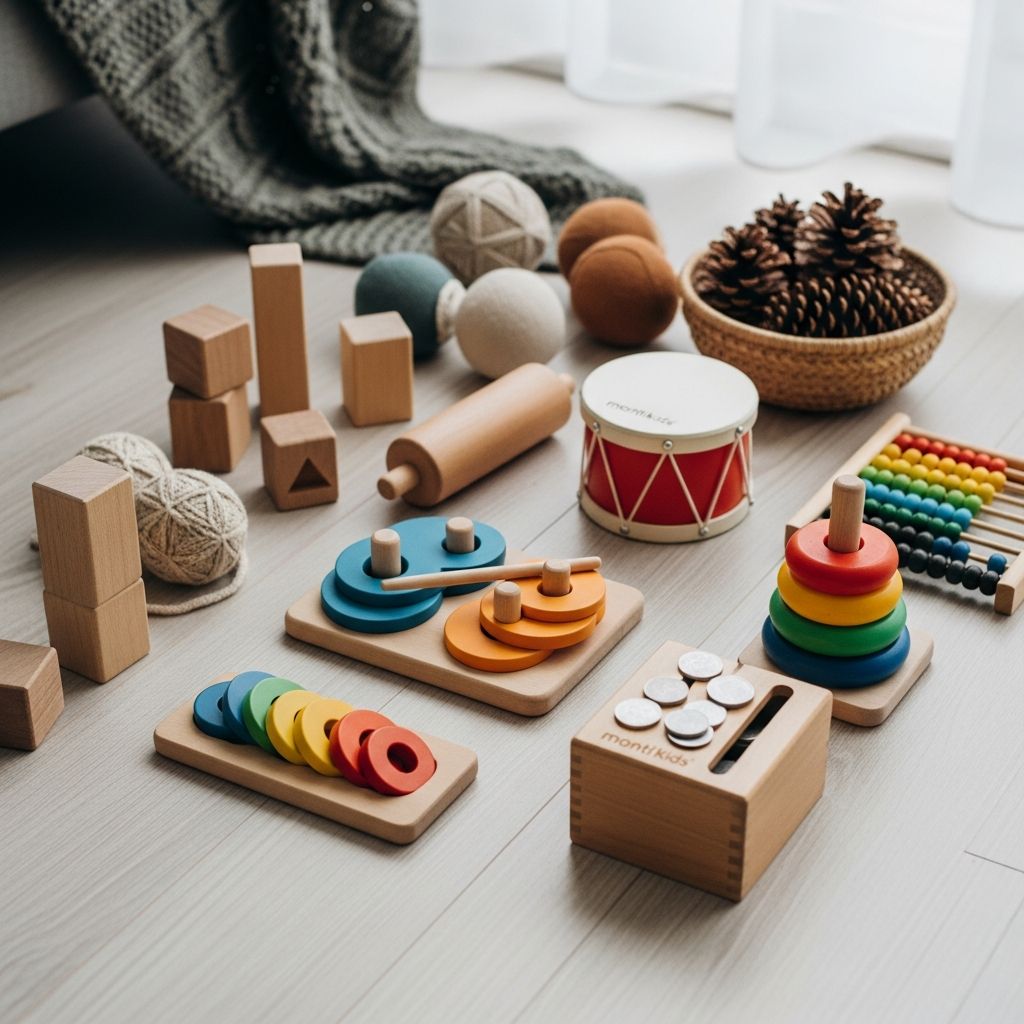
Montessori materials tend to isolate a single challenge. Instead of a toy that sings the alphabet, counts to ten, flashes colors, and spins, you might see a simple set of rings on a dowel, or a puzzle with just one new motor pattern to practice.
- Fewer distractions can support deeper concentration.
- Success or “self-correction” is often built into the item, so the child can see if something fits or does not without constant adult correction.
Real Materials and Aesthetics
Wood, metal, glass, and natural fibers are common in Montessori spaces. Monti Kids toys often aim for a clean, neutral aesthetic, which tends to blend more easily into adult living spaces than bright plastic toys. The idea is to communicate respect for the child by offering tools that feel real and substantial.
- Neutral colors and natural materials can make the play area calmer and more inviting.
- Toys are intended to look like “miniature real things” rather than fantasy gadgets.
How the Monti Kids Subscription Works
While details can change over time, the general structure follows a predictable rhythm. You sign up based on your child’s age, receive a themed box every few months, and use included guides to introduce the materials gradually.
Stage-Based Boxes
Instead of sending random assortments, Monti Kids organizes its program into levels that correspond to specific age ranges. Each level contains a curated set of toys meant to support emerging skills in that window—visual tracking for young infants, two-handed coordination for older babies, and early problem-solving and pre-math concepts for toddlers.
- Boxes are typically timed every three months.
- Families can usually join at any stage; you do not have to start at birth.
What Comes in a Typical Box
Although exact contents change, you can generally expect:
- Several wooden toys or activity sets tailored to your child’s age.
- Printed or digital cards describing each toy, why it matters developmentally, and how to introduce it.
- Access to video demonstrations showing the material in use.
- Occasionally, access to a moderated online community or coaching resources.
Monti Kids Box Snapshot (Illustrative)
| Level (Age Range) | Primary Focus Areas | Examples of Activities |
|---|---|---|
| Early Infant (0–3 months) | Visual tracking, grasp reflex, tummy time | High-contrast cards, simple mobiles, soft grasping toys |
| Older Infant (4–8 months) | Reaching, hand transfer, cause and effect | Rolling cylinders, rattles, object permanence activities |
| Young Toddler (9–18 months) | Two-handed coordination, early problem-solving | Posting boxes, simple shape puzzles, stacking toys |
| Older Toddler (19–36 months) | Refined motor skills, sequencing, early math and language | More complex puzzles, matching games, early counting activities |
This progression is designed so that each new level revisits and extends earlier skills. Parents can gradually rotate out toys that are too simple and reintroduce them later for new kinds of play.
Benefits of Monti Kids for Busy Families
The appeal of Monti Kids is not just the toys themselves; it is the combination of curation, education, and convenience. For many parents, those benefits are worth as much as the materials in the box.
Time-Saving Curation
Researching developmental milestones, comparing toys, and reading reviews can take hours. Monti Kids streamlines this by sending a ready-made set that has already been filtered for age appropriateness and Montessori alignment. For exhausted parents, removing that decision fatigue can feel like a gift.
- No need to guess which toys match your child’s current stage.
- Built-in rotation plan so you are not overwhelmed by clutter.
Parent Education and Confidence
One underrated feature of structured programs is how they teach caregivers what to look for in their child’s behavior. The guides and videos often explain why a simple toy matters and how it links to cognitive or motor development, which can make everyday play feel more meaningful and less random.
- Clear demonstrations reduce the pressure to “perform” as a teacher.
- Parents gain a language for describing and observing their child’s growth.
Quality and Longevity
High-quality wooden toys can feel like an investment rather than a short-term purchase. Many Monti Kids materials are sturdy enough to be used by multiple children or passed along to friends. Their classic designs also mean they do not quickly feel dated or out of style.
- Neutral colors suit shared living spaces without feeling like visual clutter.
- Durable materials hold up better under daily toddler testing.
Drawbacks and Limitations to Consider
Monti Kids is not a one-size-fits-all solution. Before committing, it helps to weigh potential disadvantages in the context of your own budget and preferences.
Higher Upfront Cost
Montessori subscription boxes tend to cost more per box than picking up a few generic toys online, particularly because of the use of wood and the inclusion of educational support. For some families, this fits well within the budget; for others, it is a significant stretch.
- The cost per box can rival or exceed a month of local classes or playgroups.
- Budget-conscious parents may prefer to buy a few key Montessori-style pieces individually.
Fixed Curation vs. Personal Taste
Because boxes are pre-planned, they may not always align perfectly with your child’s strongest interests or your home aesthetic. Some parents love the surprises; others prefer to hand-pick every item. If you enjoy browsing second-hand stores or curating your own shelves, a subscription might feel limiting.
- There is less flexibility to swap out toys before a box ships.
- Families with limited storage space may find the volume of toys challenging.
Screen-Based Guidance
Monti Kids leans on video lessons and digital resources to support parents, which can be a pro or con. If you appreciate visual demos, this is a plus; if you are trying to reduce screen time for the whole family, you may find yourself skimming instead of truly using these resources.
- Some caregivers prefer printed manuals over logging into a platform.
- Others find videos essential to understanding how to present a material.
Is Monti Kids Worth the Price?
Value is subjective, but a structured way to think about the question is to compare Monti Kids to alternative ways of building a Montessori-inspired environment. The table below outlines several paths families commonly take.
Approach Comparison
| Approach | Upfront Effort | Cost Level | Customization | Educational Support |
|---|---|---|---|---|
| Monti Kids subscription | Low | High | Moderate | High (videos, guides, community) |
| DIY Montessori toy curation | High | Variable (can be budget or premium) | High | Low to moderate (books, blogs, courses) |
| General toy subscription (non-Montessori) | Low | Low to moderate | Low | Low (less developmental focus) |
| Montessori school only | Moderate | High (tuition) | Low at home, high at school | High, but limited to classroom hours |
For some, the subscription’s cost is justified by the reduction in research time, the clarity of the curriculum, and the feeling of having expert eyes on their child’s early years. For others who enjoy the hunt for bargains, second-hand finds, or crafting DIY activities, the same money might stretch further when spent piece by piece.
How to Set Up a Simple Montessori Play Space with Monti Kids
Regardless of whether you commit to multiple levels or just try one box, the way you set up the environment matters. A few small tweaks can transform a cluttered corner into a calm, purposeful space that invites independent exploration.
Step-by-Step Setup Guide
- Choose a dedicated area. A low shelf or a small section of your living room is enough. The key is consistency: this is the spot where your child knows to find engaging materials.
- Limit the number of toys on display. Start with four to eight activities at your child’s level instead of crowding every shelf. Store extras in a closet and rotate them weekly or bi-weekly.
- Present materials clearly. Use small baskets or trays so each toy or set of objects is complete and ready for use. Avoid mixing multiple activities in one bin.
- Make everything accessible. Ensure your child can reach all items on the lowest shelves without help. Accessibility encourages independence.
- Model, then step back. Slowly demonstrate how a material is used once or twice, then allow your child to experiment without correction unless safety is a concern.
Tips for Rotating Monti Kids Toys
- Notice which toys your child ignores; remove them for a while and reintroduce later.
- Pair new materials with familiar ones so the shelf does not feel overwhelming.
- When attention spans shorten, a small rotation can feel as exciting as a brand-new box.
Montessori at Home Without a Subscription
Loving Montessori does not obligate you to sign up for any specific program. Whether you use Monti Kids or not, the same underlying principles can guide your choices at home. The main difference is whether you prefer a packaged roadmap or enjoy building your own path.
- Look for toys that encourage active use rather than passive watching.
- Favor simple designs that isolate one skill.
- Use low shelves and limited options to support focus.
If Monti Kids is not in your budget, you can still borrow its structure by making your own “levels.” Every few months, reassess your child’s skills, add a few new challenges, and retire activities that are either too easy or too frustrating.
Frequently Asked Questions About Monti Kids
Is Monti Kids a replacement for preschool?
No. Monti Kids supports learning at home during the first three years, which are often spent outside of formal schooling. It can complement, but not fully replace, the social experiences and group routines of a preschool classroom. Think of it as an early foundation, not a substitute for later schooling.
What if my child seems ahead or behind the suggested age range?
Development is not perfectly tied to the calendar. If a toy is too easy, your child may breeze through it and move on; if it is too hard, you can store it away and try again later. The age labels are guidelines, not strict rules. Parents who observe their child closely often find creative ways to adapt materials for different levels.
Do I need every level for the program to be effective?
Not necessarily. Some families use Monti Kids for just one or two seasons, perhaps focusing on the infant period or key toddler stages. Others commit across multiple levels to maintain consistency. Your decision can be shaped by budget, storage space, and how much you appreciate the included parent education.
How does Monti Kids compare to buying toys second-hand?
Second-hand shopping is often more affordable and sustainable, but it requires time and knowledge to ensure the items are age-appropriate, complete, and safe. Monti Kids charges a premium for doing that research, coordinating the progression, and offering guidance. If you enjoy thrifting and reading up on Montessori, DIY might be more satisfying; if you prefer to outsource, a subscription can be more appealing.
Will my child get bored of the toys quickly?
Many Montessori-style materials are deceptively simple and deepen with repetition. That said, interest always fluctuates. Rotating materials, adjusting the challenge (for example, increasing the number of puzzle pieces), and modeling new variations can keep the same toys engaging over time.
Final Thoughts: Choosing What Works for Your Family
Monti Kids offers a polished, convenient way to bring Montessori principles into the earliest years, especially for parents who want expert-backed guidance and do not have the time to curate everything themselves. The higher price tag and fixed curation will be perfect for some families and unnecessary for others.
If the idea of an organized, developmentally aligned toy library appearing at your door every few months sounds relieving rather than stressful, Monti Kids may be a practical fit. If instead you love the process of hunting for bargains, crafting your own activities, or mixing multiple educational philosophies, you may choose to borrow ideas from Montessori and from Monti Kids while building a unique path that reflects your family’s personality.