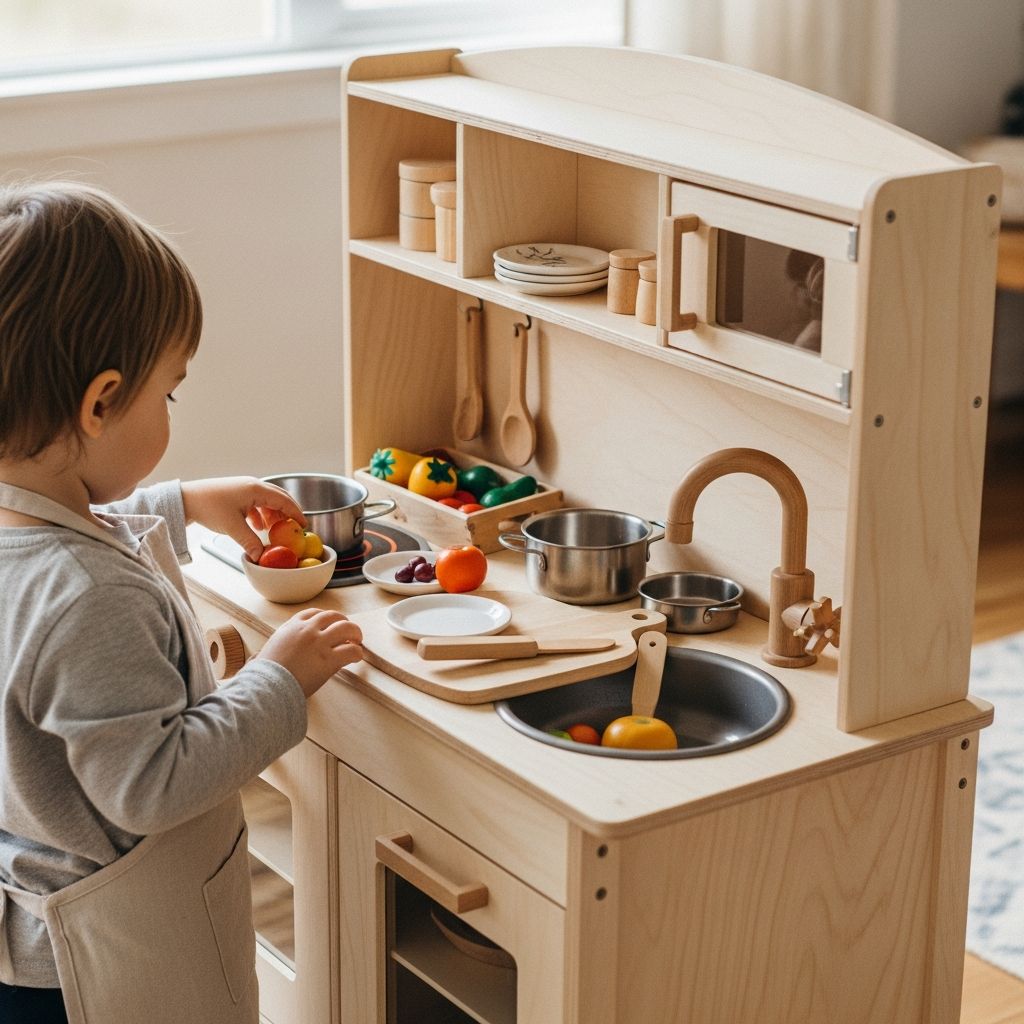
Understanding Montessori-Inspired Play Kitchens
Montessori-inspired play kitchens represent a transformative approach to early childhood learning, moving beyond traditional toy kitchens to create functional spaces where children engage in authentic, meaningful activities. Unlike conventional play kitchens that emphasize imaginative role-play through plastic features and pretend elements, Montessori-style kitchens prioritize real-world functionality and child-centered design. These specially designed spaces incorporate principles developed by Maria Montessori, who believed that children learn best through hands-on exploration and practical life activities. The philosophy behind these kitchens centers on the concept “Help me do it by myself,” empowering children to take ownership of their learning journey while developing essential life competencies.
Core Design Principles That Set Montessori Kitchens Apart
The distinctive characteristics of Montessori play kitchens stem from thoughtful pedagogical design rather than commercial toy aesthetics. These kitchens are engineered with specific developmental goals in mind, incorporating features that facilitate independence and meaningful engagement.
Child-Centered Accessibility
One of the most fundamental design principles involves creating spaces proportioned specifically for young learners. Child-sized countertops, appropriately weighted utensils, and accessible storage ensure that children can engage independently without constant adult assistance or modification. This accessibility removes barriers to participation, allowing children to initiate activities on their own terms and maintain focus on the task at hand rather than struggling with adult-sized equipment.
Quality Materials and Authentic Construction
Montessori play kitchens emphasize natural, durable materials such as wood and metal rather than plastic alternatives. This material selection serves multiple developmental purposes: it provides realistic sensory feedback, teaches children to handle objects with appropriate care, and creates a learning environment that mirrors actual kitchen spaces. By working with authentic materials, children develop respect for quality craftsmanship and learn how everyday objects function in real-world contexts.
Minimalist Aesthetic Philosophy
The visual design of Montessori kitchens embraces simplicity and intentionality. Rather than overwhelming shelves filled with numerous colorful toys, these spaces feature curated collections of purposeful items. This minimalist approach reduces cognitive overload and helps children focus their attention on meaningful activities rather than becoming distracted by excessive clutter. The calming environment supports deeper concentration and more productive engagement.
Developing Independence and Confidence
Perhaps the most significant benefit of Montessori play kitchens lies in their capacity to foster authentic independence in young learners. Through structured opportunities to complete real-world tasks, children develop confidence in their abilities and cultivate a genuine sense of autonomy.
Tasks such as washing fruits, arranging utensils, pouring liquids, or preparing simple snacks transform ordinary kitchen activities into confidence-building experiences. When children successfully complete these tasks independently, they internalize the message that they are capable and competent. This internal confidence extends beyond the kitchen, positively influencing how children approach challenges in other areas of their lives.
The independence fostered through these activities operates differently from traditional toy play. Rather than engaging in pretend scenarios that may or may not develop practical skills, children in Montessori settings experience the satisfaction of accomplishing genuine tasks. This authentic achievement creates deeper psychological benefits than imaginative play alone can provide.
Motor Skills Development and Coordination
Montessori play kitchens provide exceptional opportunities for developing both fine and gross motor skills through purposeful activity. The various movements and manipulations required in kitchen-based tasks strengthen children’s physical capabilities while building hand-eye coordination.
Fine Motor Skill Refinement
Activities such as pouring, stirring, gripping utensils, cutting soft vegetables, and manipulating objects of varying sizes and textures engage the small muscle groups essential for later academic skills like writing. These repetitive, purposeful movements refine dexterity and control in ways that random toy play cannot replicate. Children develop the precise hand movements and finger strength necessary for holding writing instruments and performing detailed tasks.
Gross Motor Development
Beyond fine motor skills, kitchen-based Montessori activities support the development of larger muscle groups. Using kitchen towers or step stools allows children to practice balance, coordination, and body awareness as they move through three-dimensional space. The climbing and positioning required to reach countertops safely develops the core strength and spatial awareness essential for physical development.
Cognitive Growth Through Practical Learning
The cognitive benefits of Montessori kitchen activities extend well beyond simple entertainment. Research demonstrates that practical life skills activities significantly enhance children’s executive functioning, problem-solving abilities, and understanding of cause and effect.
Executive Functioning and Sequential Learning
Cooking and food preparation involve multiple sequential steps that must be executed in the correct order. As children engage in these activities, they develop planning skills, time management abilities, and the capacity to remember and execute multi-step processes. Following a recipe, gathering ingredients, preparing food, and cleaning up afterward all require organizational thinking and the ability to anticipate future steps based on current actions.
Problem-Solving and Critical Thinking
When children encounter challenges in the kitchen—such as determining appropriate ingredient quantities, finding solutions when materials are unavailable, or adapting processes when obstacles arise—they engage in authentic problem-solving. Rather than being told the “correct” answer, children in Montessori environments are encouraged to explore solutions independently, which builds resilience and strengthens their ability to approach obstacles creatively.
Understanding Cause and Effect
Kitchen activities naturally demonstrate cause and effect relationships. Observing how ingredients transform through mixing, heating, or combining teaches children that their actions have direct, observable consequences. This foundational understanding supports cognitive development across multiple domains and builds the child’s comprehension of how systems work.
Building Responsibility and Environmental Stewardship
Montessori philosophy emphasizes care for the environment and community. Play kitchens designed according to these principles create natural opportunities for children to develop responsibility through meaningful contributions to household activities.
When children participate in food preparation and cleanup, they learn that their actions directly impact their living environment. Washing dishes, organizing utensils, and maintaining a clean workspace teach children to care for shared spaces and develop habits of environmental stewardship. These activities instill an understanding that everyone bears responsibility for maintaining order and cleanliness—a foundational lesson that extends to broader environmental consciousness.
By allowing children to contribute meaningfully to family activities, adults communicate that their participation matters and that they are valued members of the household. This sense of contribution builds self-worth and motivates continued engagement in responsible behavior.
Fostering Creativity Within Purposeful Boundaries
While Montessori philosophy emphasizes practical, real-world learning, it simultaneously recognizes the crucial importance of creativity in child development. Montessori play kitchens create a unique intersection where creativity flourishes within a framework of meaningful purpose.
Children using these kitchens engage in creative role-playing that reinforces practical skills. They might imagine hosting a family dinner, running a café, or preparing meals for imaginary guests. These scenarios spark imagination while remaining grounded in real kitchen functionality. Research by developmental psychologists has demonstrated that children in Montessori settings display notably higher levels of creative thinking, which often correlates with improved academic outcomes.
The creativity developed through kitchen activities encompasses both convergent thinking (finding solutions to specific problems) and divergent thinking (imagining multiple possibilities). When a child realizes they can use a wooden spoon as a stirring tool or a small bowl, they exercise creative problem-solving in a concrete, meaningful context.
Social Skills and Family Connection
Montessori kitchens facilitate rich social learning opportunities and strengthen family bonds through shared meaningful activity. These spaces naturally encourage cooperation, communication, and the development of social skills.
Collaborative Learning Experiences
When parents and children engage together in kitchen activities, they create opportunities for genuine collaboration. Taking turns, following instructions, communicating about tasks, and working toward shared goals all develop essential social competencies. Children learn to navigate social interactions in a context free from high pressure or evaluation, allowing them to practice skills in a supportive environment.
Family Bonding and Shared Memory Creation
Cooking together creates lasting family memories while simultaneously strengthening relationships. The informal conversation that occurs during food preparation, the shared experience of creating something tangible, and the celebration of completed tasks all contribute to family cohesion. Research on family dynamics demonstrates that shared meaningful activities strengthen emotional bonds and create positive relationship patterns.
Comparison: Montessori Kitchens Versus Traditional Play Kitchens
| Aspect | Montessori Kitchens | Traditional Play Kitchens |
|---|---|---|
| Functionality | Real cooking and food preparation possible | Non-functional pretend play features |
| Materials | Natural wood, metal, authentic materials | Plastic, battery-operated components |
| Learning Approach | Practical life skills and real tasks | Imaginative role-play and pretend scenarios |
| Child Role | Active participant in meaningful work | Passive observer in pretend scenarios |
| Skill Development | Independence, motor skills, responsibility | Social skills, imagination, role-playing |
| Design Philosophy | Child-centered, minimal aesthetic | Commercial appeal, colorful, multiple features |
Implementing Montessori Kitchen Principles at Home
Families interested in incorporating Montessori principles into their kitchens need not purchase specialized furniture. The underlying philosophy can be adapted to existing spaces through thoughtful organization and intentional activity selection.
- Create accessible storage: Arrange child-friendly items on low shelves where children can independently retrieve and return them
- Provide appropriately sized tools: Invest in child-scaled utensils, lightweight pitchers, and manageable equipment
- Establish clear activity stations: Designate specific areas for different tasks such as food preparation, cleaning, or organizing
- Offer genuine choices: Allow children to select from available options rather than directing every activity
- Minimize distractions: Keep only necessary items visible, storing excess materials elsewhere
- Provide real materials: Use actual cooking equipment, wooden utensils, and authentic ingredients rather than plastic alternatives
Frequently Asked Questions About Montessori Play Kitchens
At what age can children begin using a Montessori kitchen?
Children as young as 18 months can begin engaging in simple Montessori kitchen activities with close supervision. However, most children benefit most significantly from ages 2-6 when they are developing independence and practical skills more rapidly.
Are Montessori play kitchens expensive?
Dedicated Montessori kitchen furniture can be a significant investment, but Montessori principles can be implemented in existing kitchens through organizational changes and thoughtful material selection at various price points.
How much supervision do children need in a Montessori kitchen?A: Adult supervision depends on the child’s age and experience level. Young toddlers require close oversight, while older children can work more independently once they have demonstrated understanding of safety rules and appropriate technique.
Q: What foods are appropriate for children to prepare in a Montessori kitchen?
Age-appropriate activities include washing produce, tearing soft vegetables, stirring, pouring, and spreading soft foods. More advanced tasks like cutting with child-safe knives can be introduced as children demonstrate readiness and fine motor control.
How does a Montessori kitchen approach differ from simply letting children cook with parents?
While cooking with parents is beneficial, true Montessori kitchens emphasize child-initiated activity, independence, and purposeful work. Children select activities based on their interests and abilities rather than simply assisting with parent-directed tasks.
Can Montessori kitchen activities support academic learning?
Yes. Kitchen activities develop executive functioning, mathematical thinking (measuring, counting, sequencing), literacy (reading recipes), and scientific understanding (cause and effect, observation).
References
- What Makes a Montessori Play Kitchen Unique — Robud. Accessed 2026-02-02. https://www.robud.com/blogs/tips-ideas/what-makes-a-montessori-play-kitchen-unique
- Why Montessori Kitchen Towers Are a Game-Changer for Your Toddlers Independence — Petite Kingdom. Accessed 2026-02-02. https://petitekingdom.com/lifestyle/inspiration/why-montessori-kitchen-towers-are-a-game-changer-for-your-toddlers-independence/
- Montessori In The Kitchen — Boston Parents Paper. Accessed 2026-02-02. https://bostonparentspaper.com/montessori-in-the-kitchen/
- Benefits of Using Montessori Kitchens — CMS Preschool. Accessed 2026-02-02. https://cmpreschool.com/benefits-of-using-montessori-kitchens/
- Benefits of Kitchen & Cooking Play for Preschoolers, Toddlers and Babies — My Happy Helpers. Accessed 2026-02-02. https://myhappyhelpers.com.au/blogs/my-happy-helpers/benefits-of-kitchen-cooking-play-for-preschoolers-toddlers-and-babies