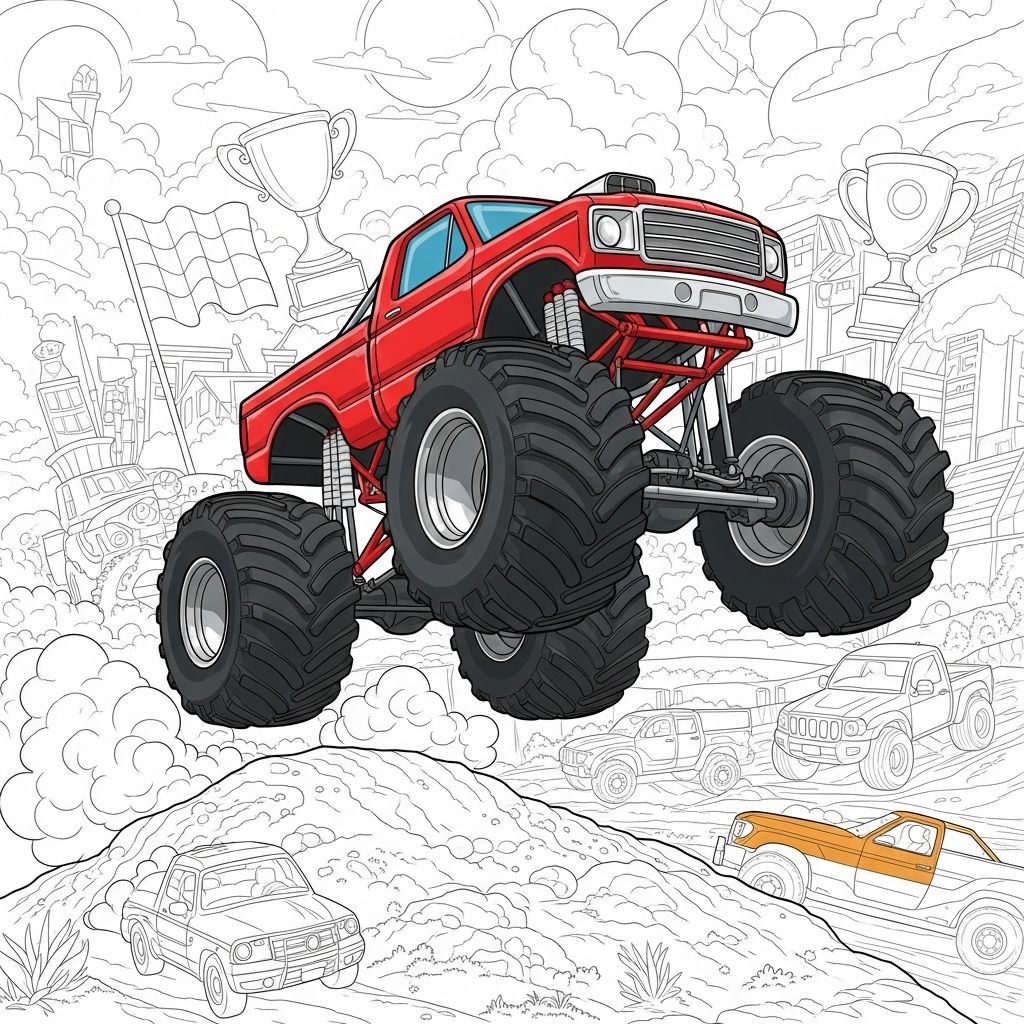
Monster truck coloring pages combine roaring engines and giant wheels with a calm, focused activity that keeps kids happily engaged. These bold designs appeal to children who love action, vehicles, and big, powerful machines, while quietly supporting important developmental skills such as focus, coordination, and creativity.
Why Kids Love Monster Truck Coloring Pages
Monster trucks sit right at the intersection of imagination and excitement: they jump, race, crush cars, and look larger than life. Coloring pages based on these trucks give children a safe, screen-free way to enjoy all that action while expressing themselves with markers, crayons, or colored pencils.
For many kids, especially vehicle-obsessed preschoolers and early elementary students, trucks feel familiar and exciting. When that interest appears on paper in a simple outline, kids are more motivated to sit, color, and complete a page than they might be with more generic pictures.
- Big wheels and dramatic shapes are visually striking and fun to color.
- Action scenes let kids imagine races, jumps, and stunts.
- Truck themes feel “cool” and often appeal to reluctant colorers.
Hidden Learning Benefits of Truck Coloring
While kids think they are just coloring enormous tires and clouds of dust, they are actually practicing a surprising number of school-ready skills. Repeated use of coloring pages can support academic readiness, emotional regulation, and even early STEM curiosity.
Consider how many small muscles are engaged when a child carefully traces the curve of a tire or fills in the body of a truck. Those micro-movements connect directly to handwriting readiness and better pencil control later on.
Key Skills Built Through Coloring
- Fine motor skills: Holding crayons, changing pressure, and staying within lines strengthen fingers and hands.
- Hand-eye coordination: Eyes guide the hand as children color narrow areas like exhaust pipes or flames.
- Attention and patience: Completing a detailed truck design encourages kids to stick with a task.
- Color recognition and planning: Choosing color schemes and repeating patterns builds early design sense.
- Visual-spatial awareness: Understanding where parts of the truck begin and end supports spatial reasoning.
Choosing the Right Monster Truck Pages by Age
Not every monster truck coloring page is right for every child. Very detailed images may frustrate toddlers, while older kids may lose interest in simple outlines with little to fill in. Matching the design to your child’s age makes coloring more enjoyable and successful.
| Age Group | Recommended Page Style | Main Focus |
|---|---|---|
| Toddlers (2–3) | Large trucks, thick outlines, minimal tiny details | Grip practice, color exploration, fun scribbling |
| Preschool (3–5) | Simple trucks with a few features (big tires, windows, road) | Hand control, naming colors, beginning to stay in the lines |
| Early Elementary (5–8) | More detailed designs with flames, patterns, ramps, or arenas | Precision, focus, pattern creation, story-building |
| Tweens & Teens | Complex trucks, shading areas, backgrounds with crowds or cities | Relaxation, stress relief, advanced coloring techniques |
Creative Ways to Use Monster Truck Coloring Pages
Monster truck pages can be much more than quiet-time fillers. With a little imagination, they can become party decorations, classroom tools, or starting points for storytelling and early writing. Think of each printed truck as a flexible canvas you can build activities around.
Below are ideas that work well at home, in preschool and elementary classrooms, or in after-school programs.
At Home
- Weekly “Truck Time” routine: Set aside one afternoon a week where kids pick a new truck sheet, color it, and display it on the fridge.
- Color-and-talk sessions: Ask open-ended questions while you both color, such as, “Where is your truck going?” or “What is it jumping over?”
- Family coloring races: Race to finish a page, then compare colors, patterns, and invented truck names.
In the Classroom
- Center activity: Add monster truck pages to a fine motor or art center alongside crayons, markers, and stickers.
- Writing prompts: After coloring, have students write a sentence or short story about their truck’s big competition.
- Math integration: Use the trucks to practice counting wheels, windows, or stars on the vehicle’s body.
Party and Event Ideas
- Monster truck coloring station: At a birthday party, set up a small table with different truck pages, coloring tools, and clipboards.
- DIY party favors: Roll a few printed pages with a small pack of crayons and tie with a ribbon as take-home gifts.
- Decorations: Have guests color trucks and tape them to a banner string to create a unique party garland.
Incorporating Learning: Trucks as Teaching Tools
Monster truck coloring pages can quietly introduce early science, math, and literacy concepts. You do not need special worksheets or formal lessons; a few intentional questions and prompts are often enough.
Children naturally wonder how giant vehicles can jump ramps, crush cars, and land safely. Use that curiosity as a springboard to simple age-appropriate explanations and rich vocabulary practice.
Early STEM Connections
- Talk about size and weight: Compare a monster truck to a regular car using phrases like “heavier,” “taller,” and “longer.”
- Introduce motion words: jump, race, crash, bounce, roll, turn, accelerate, and stop.
- Discuss wheels and traction: Ask why big tires help trucks drive over rough ground or crushed cars.
Language and Storytelling
- Give each truck a unique name and personality, such as “Thunder Crusher” or “Lightning Roller.”
- Help children describe the scene: Is the truck in a stadium, in the desert, or on a muddy course?
- Encourage short oral stories while coloring, then write down what children say so they see their words become text.
Materials and Setup Tips
A bit of preparation can turn monster truck coloring into a smooth, low-mess activity that kids can enjoy independently. Gather a small kit of materials and store it where children can easily reach it (with supervision as needed).
Offering different coloring tools also lets kids experiment with textures, line width, and blending techniques as they grow more confident.
Recommended Supplies
- Crayons for younger kids who need sturdy, forgiving tools.
- Washable markers for bright, bold colors that make trucks pop.
- Colored pencils for older kids who like shading and small details.
- Thicker paper or cardstock if children plan to cut out trucks for crafts.
- Clipboards or a hard surface if coloring away from a table, such as on the floor or outside.
Comfortable Coloring Environment
- Provide child-sized chairs or a low table so arms and hands are relaxed.
- Use natural light or a bright lamp so kids can clearly see outlines and colors.
- Keep a small trash container nearby for paper scraps and crayon wrappers.
From Coloring Sheet to Craft Project
Finished pages do not have to end up in a stack on the counter. Turn completed monster trucks into simple crafts that kids can proudly display or play with. This extends the life of each printable and adds a second layer of creativity.
Cutting, gluing, and assembling crafts also adds extra fine motor practice and helps children follow multistep directions.
Craft Ideas Using Monster Truck Pages
- Monster truck collage: Cut out colored trucks and glue them onto a large paper background with drawn ramps, crushed cars, and cheering crowds.
- Puppet trucks: Tape or glue colored trucks onto craft sticks to create simple puppets for storytelling.
- Room decor: Laminate favorite pages and use them as wall art or placemats.
- Truck trading cards: Reduce the size of pages when printing, color, cut into rectangles, and create a set of “monster truck cards” with names written underneath.
Supporting Different Learning Styles
Children approach coloring in different ways. Some focus on neatness and detail; others rush to finish and move on. Monster truck pages can accommodate all of these preferences while still offering learning opportunities.
Parents and educators can gently guide children without insisting on perfection. Praising effort and creativity encourages kids who might be hesitant about art activities.
- For visual learners, hang examples of finished trucks and color combinations for inspiration.
- For kinesthetic learners, combine coloring with movement: ask kids to act out what their truck does after they finish the page.
- For verbal learners, focus on storytelling and descriptive language while they color.
Screen-Free Fun and Calming Routines
Coloring offers a calming counterbalance to active play and screen time. Monster truck themes can convince even high-energy kids to sit and focus for stretches of time, especially when the pages feature their favorite style of vehicle.
Many families use coloring as part of a wind-down routine before bed or as a transition from energetic activities to quieter ones. Truck pages give children something familiar and exciting to look forward to while still slowing their bodies and minds.
Simple Monster Truck Coloring Prompts
If you want to stretch a single printable into a longer activity, try giving kids playful prompts before or during coloring. These prompts help kids think about the picture in new ways and often spark more complex designs and stories.
- “Color this truck as if it is racing through mud. What colors will show that?”
- “Design a truck for a night show. How will you make it look bright and glowing?”
- “Imagine this truck is from outer space. What patterns and colors make it look alien?”
- “Your truck is on a snowy mountain. How can you show cold weather with color?”
Frequently Asked Questions About Monster Truck Coloring Pages
Are monster truck coloring pages appropriate for very young children?
Yes, as long as you choose simple designs with large shapes and thick outlines. Avoid very detailed pages for toddlers and young preschoolers, and always supervise if children still put crayons or paper in their mouths.
How can I keep my child interested in coloring over time?
Vary the difficulty of the pages, offer different coloring tools, and occasionally add challenges such as “only cool colors” or “create your own logo on the side of the truck.” Showing off finished artwork in frames or on the fridge also helps kids feel proud and motivated.
Can coloring really help with school skills?
Coloring supports fine motor development, attention span, and visual tracking, all of which are important for writing, reading, and classroom work. It is not a complete curriculum, but it is a beneficial piece of a balanced set of activities.
What if my child colors “incorrectly” or goes outside the lines?
For younger children, staying inside the lines is not the goal; experimentation is. As kids mature, you can gently encourage more precision, but creativity and enjoyment should remain the priority.
How often should I print new monster truck pages?
There is no strict rule. Some kids enjoy coloring the same design multiple times in different ways, while others prefer fresh pages each session. Watch your child’s reactions and adjust the variety and frequency to keep coloring fun, not overwhelming.
Making Monster Truck Coloring Part of Everyday Life
Monster truck coloring pages are simple, inexpensive, and versatile. With just a few sheets of paper and basic coloring tools, you can offer your child a fun activity that supports learning, creativity, and calm focus.
Whether you use them on rainy afternoons, in classrooms, or as part of a high-energy birthday party, these big-wheeled trucks are ready to roll right into your child’s imagination and daily routine.