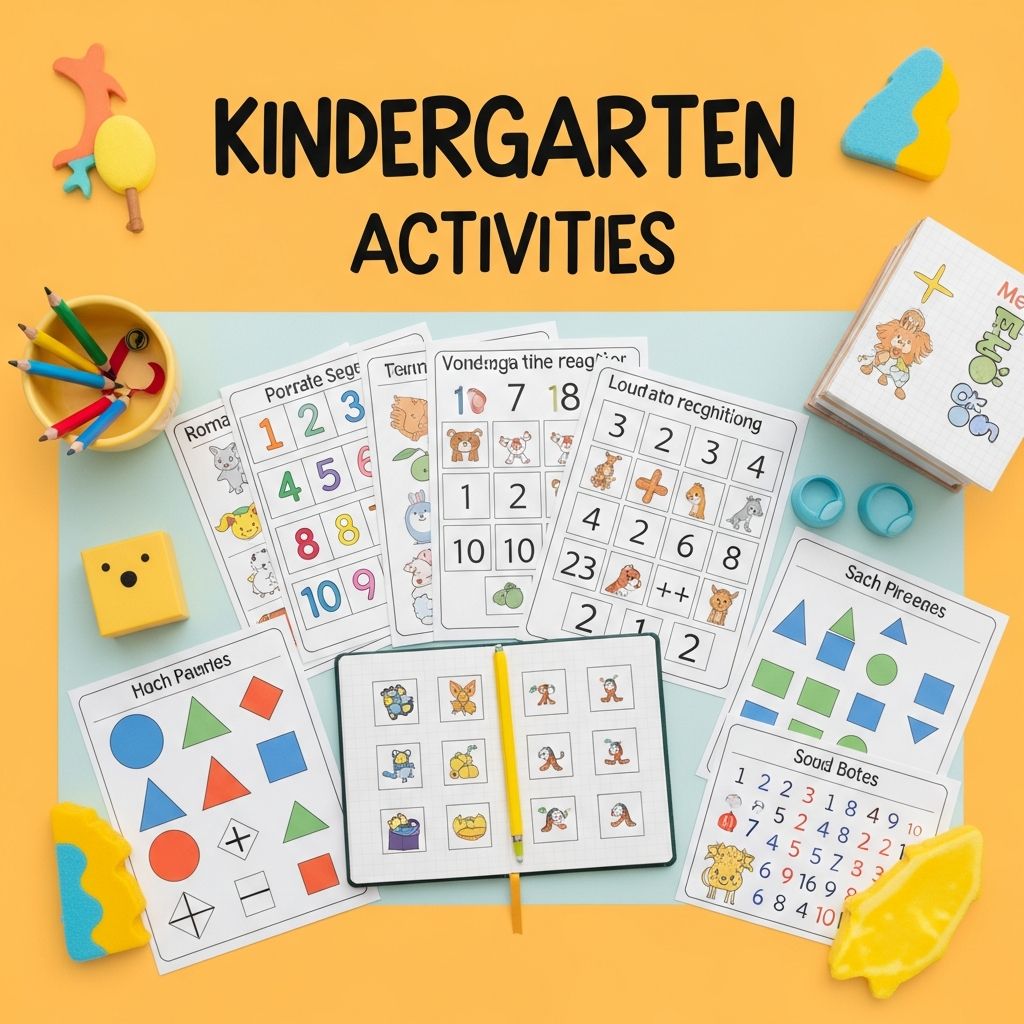
Kindergarten marks the beginning of formal math education, where children develop critical foundational skills that pave the way for future academic success. At this stage, focus on building number sense, understanding basic operations, recognizing shapes, and comparing quantities through hands-on, engaging activities. Printable worksheets offer a flexible, cost-effective way for parents to reinforce these concepts at home, aligning with established educational standards across states like California, Utah, and Arizona. These resources promote perseverance in problem-solving and abstract reasoning, key mathematical practices emphasized in kindergarten curricula.
Building Strong Foundations: Why Kindergarten Math Matters
Early math education emphasizes two primary areas: representing and operating on whole numbers using objects or numerals, and describing shapes and space. More instructional time should prioritize numbers over other topics to ensure children can count objects, compare sets, and model simple addition or subtraction scenarios. Research-backed standards, such as the Common Core, stress real-world problem-solving and habits of mind like reasoning quantitatively. Home-based printables extend classroom learning, allowing repeated practice that boosts retention and confidence.
Worksheets should incorporate manipulatives like counters, drawings, or claps to represent problems, helping children visualize concepts before transitioning to equations. This approach fosters fluency within 5 and eventually within 10 for addition and subtraction. Parents play a vital role by creating a supportive environment, celebrating small victories, and integrating math into daily routines like counting snacks or sorting toys.
Mastering Counting and Number Recognition
Counting forms the bedrock of kindergarten math. Children learn to count to 100 by ones and tens, count forward from any number in the sequence, and write numerals from 0 to 20, representing quantities accurately—even zero as no objects.
- Count-and-Color Sheets: Children count items in each section (e.g., apples, stars) and color based on the number, reinforcing one-to-one correspondence.
- Number Tracing Mazes: Trace numerals while navigating paths with embedded counts, combining fine motor skills with recognition.
- Sequence Fill-Ins: Fill missing numbers in sequences starting from various points, like 15, 16, __, 18.
These activities align with standards requiring children to know number names and count sequences. Practice daily for 10-15 minutes to build automaticity.
Introduction to Addition and Subtraction Basics
Kindergarteners grasp addition as ‘putting together’ and subtraction as ‘taking apart,’ solving problems within 10 using objects, drawings, or equations. They decompose numbers ≤10 into pairs (e.g., 5=2+3 or 4+1) and find complements to 10.
- Story Problem Visuals: Read simple tales like ‘Three birds fly in, two fly away’ and draw or use fingers to solve.
- Make-10 Cards: Match pairs that sum to 10, such as 6 and 4, with pictorial support.
- Domino Decompositions: Draw lines on dominoes to show number pairs, recording as equations.
Fluency within 5 comes through repeated games, transitioning to 10 by year’s end. Encourage verbal explanations to deepen understanding.
Exploring Measurement and Data Skills
Children describe attributes like length or weight, compare objects (e.g., ‘taller than’), and classify items into categories, counting and sorting by quantity.
| Attribute | Activity Idea | Standard Alignment |
|---|---|---|
| Length | Line up pencils and crayons; compare which is longer. | K.MD.1, K.MD.2 |
| Weight | Sort toys into ‘heavy’ or ‘light’ bins; count each. | K.MD.1 |
| Capacity | Fill cups with beans; decide which holds more. | K.MD.2 |
- Graphing Favorites: Tally family votes on ice cream flavors, create bar graphs.
- Sorting Mats: Categorize buttons by color/size, count totals.
These build data literacy, essential for comparing numbers.
Geometry: Shapes and Spatial Awareness
Kindergarten geometry involves identifying, describing, and composing shapes (2D: circle, square; 3D: cube, sphere), understanding their defining attributes.
- Shape Hunts: Circle shapes in a picture scene, label attributes like ‘four sides.’
- Build with Shapes: Cutouts to compose larger figures, like a house from rectangles and triangles.
- Pattern Blocks: Extend color/shape sequences.
Positional words (above, below) enhance spatial reasoning.
Fun Ways to Differentiate and Extend Learning
Tailor activities: Advanced learners tackle problems within 20; beginners use more visuals. Integrate tech like counting apps or games for variety. Track progress with stickers on a chart.
Frequently Asked Questions
What age group are these worksheets best for?
Ideal for 5-6-year-olds in kindergarten, but adaptable for advanced preschoolers or early first-graders.
How often should we do math worksheets?
15-20 minutes daily, 4-5 days a week, to avoid burnout while building habits.
Do I need special supplies?
Crayons, counters (beans/buttons), scissors; most are no-prep.
How do these align with school standards?
Directly support Common Core and state standards like those in California and Utah for counting, operations, and geometry.
What if my child struggles with numbers?
Start with manipulatives, play counting songs, and praise effort to build perseverance.
Creating a Math-Rich Home Environment
Beyond worksheets, label household items with numbers, cook together measuring ingredients, or play board games. Consistency turns practice into joy. As standards note, kindergarten math prepares for place value and strategies in grade 1.
Expand with seasonal themes: count pumpkins in fall, snowflakes in winter. Parental involvement correlates with stronger outcomes, per educational research embedded in standards development.
Advanced Tips for Parental Involvement
Discuss strategies: ‘How did you know 3+2=5?’ Model equations on paper. Group activities with siblings foster peer learning. Monitor for gaps, like confusing 13/31, addressed in number writing standards.
Assess readiness for next steps, like addition within 20, ensuring solid K.OA fluency. Resources from state education sites provide free extras.
References
- Mathematics Kindergarten Core — Utah Education Network. Accessed 2026. https://www.uen.org/core/core.do?courseNum=5100
- California Common Core State Standards: Mathematics — California Department of Education. 2013-08-01. https://www.cde.ca.gov/be/st/ss/documents/ccssmathstandardaug2013.pdf
- Kindergarten Math Common Core State Standards — Education.com. Accessed 2026. https://www.education.com/common-core/kindergarten/math/
- Arizona Mathematics Standards Kindergarten — Arizona Department of Education. 2018-05-01. https://www.azed.gov/sites/default/files/2016/12/Math%20Final%2000Kindergarten%20Standards%204_2_2018.pdf
- North Carolina Standard Course of Study Kindergarten Mathematics — NC Department of Public Instruction. Accessed 2026. https://www.dpi.nc.gov/documents/cte/curriculum/languagearts/scos/current/ncscos-k-2-mathematics/open