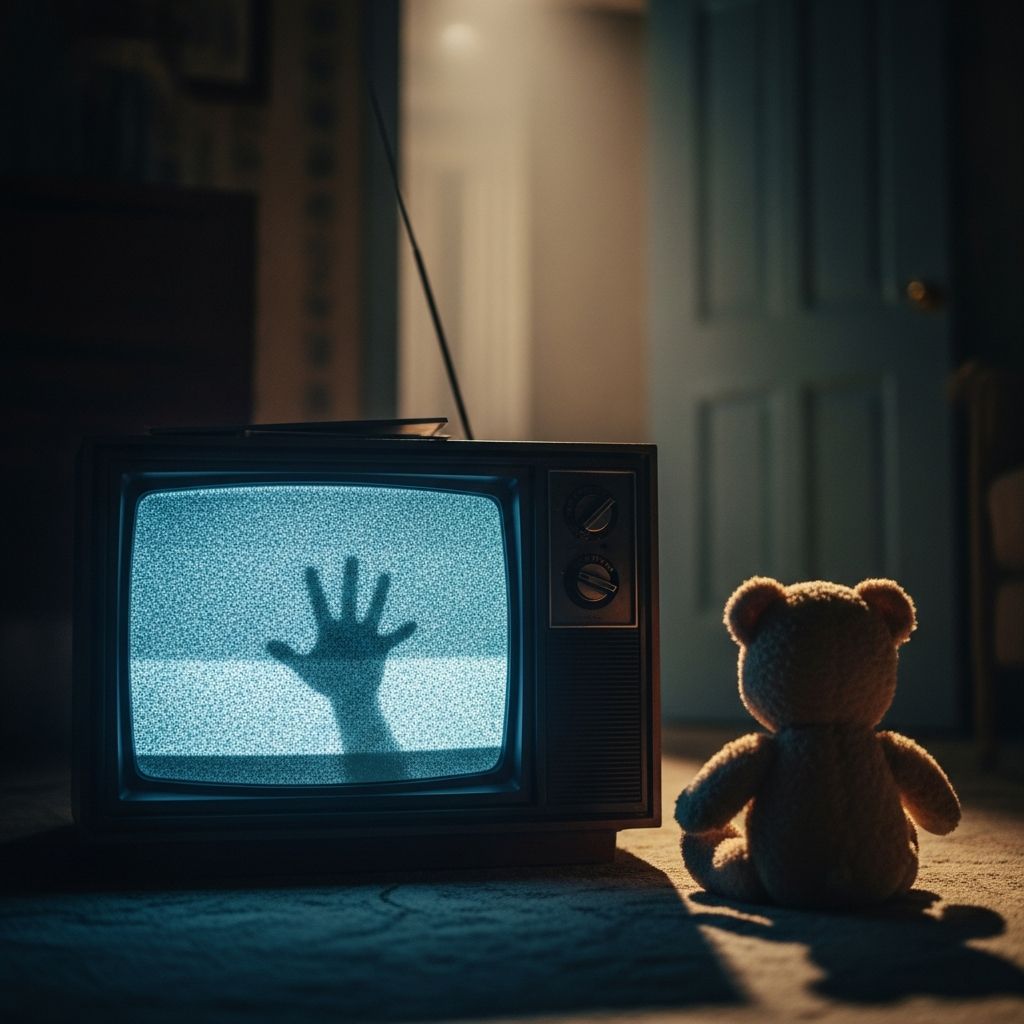
Parents who grew up in the 1980s often remember Poltergeist as their first real horror movie—terrifying, yes, but also oddly fun and magical. Now that you’re the one planning movie night, the question becomes: is Poltergeist still a good first scary movie for kids today?
This guide looks at what makes Poltergeist such a powerful gateway horror film, how to judge whether your child is ready, and how to turn a potentially spooky watch into a safe, shared family experience.
Why Parents Still Talk About Poltergeist
Poltergeist (1982) sits at a sweet spot between genuine horror and mainstream family entertainment. Produced by Steven Spielberg and directed by Tobe Hooper, it tells the story of a suburban family whose home is invaded by supernatural forces focused on their young daughter.
- Suburban setting: The film takes place in a normal neighborhood that looks like anywhere in North America, which makes the scares feel close-to-home for adults, but visually familiar and easy to follow for kids.
- Focus on family: The emotional core is not gore or body horror; it is a family trying desperately to protect and rescue their child.
- Mix of wonder and terror: Floating toys, glowing portals, and spectacular effects sit alongside the film’s more intense moments, giving kids moments of awe as well as fear.
Family context strongly shapes how children respond to media. Research on parental mediation of media suggests that when adults watch and discuss content with their children, it can significantly reduce distress and help kids process what they see.
What Age Is Poltergeist Appropriate For?
Every child is different, but there are some practical guidelines parents often use when considering Poltergeist as a first scary movie.
| Age Range | General Recommendation | Key Considerations |
|---|---|---|
| Under 8 | Usually too intense | Strong images, themes of a child in danger, potential nightmares. |
| 8–10 | Maybe, with caution | Works for horror-curious kids who already like spooky stories and handle tension well. |
| 11–13 | Often a solid gateway horror | Developmentally better able to distinguish fantasy from reality and manage suspense. |
| 14+ | Generally appropriate | Likely to find it thrilling rather than overwhelming; may notice dated effects. |
Psychologists note that older children and early adolescents are more capable of understanding complex narratives, metaphor, and the difference between fictional threats and real-world dangers. Younger children, especially under 8, are more sensitive to vivid images, loud sounds, and direct threats to parents or children.
Types of Scares in Poltergeist
Knowing what kind of fear a movie uses can be more important than knowing the overall label “scary.” Poltergeist layers several distinct scare types that may affect kids differently.
1. Supernatural and Paranormal Fear
The core of the movie is a haunting: invisible forces move objects, voices come from the television, and a doorway appears to another realm. This can be thrilling for kids who enjoy ghost stories, but deeply unsettling for those wary of the unseen.
- Emphasis on ghostly presence rather than monsters.
- Household items—especially the TV—become sources of dread.
- Some scenes build slowly, letting tension grow before anything overtly frightening happens.
2. Threats to a Child
One of the film’s most intense elements is that the supernatural danger centers on the youngest daughter. Media research shows that children are more affected when onscreen victims are similar in age to them or are family members.
- Kids may imagine themselves in the child’s place.
- Scenes of separation from parents can be especially upsetting.
- At the same time, many children find comfort in seeing the parents relentlessly fight to save their child.
3. Visual and Sound Design Shocks
Though tame by modern standards, Poltergeist still includes sudden loud noises, visual transformations, flashes of light, and a few brief but intense images.
- Jump scares intensified by music stings.
- Special effects that briefly venture into body horror.
- Prolonged sequences of chaos when the haunting escalates.
Children are particularly reactive to sound; loud or discordant audio can make scenes feel scarier than the imagery alone. Watching with appropriate volume and lights on can soften this effect.
The Emotional Core: Family, Safety, and Resilience
Although it is remembered as a horror film, Poltergeist spends substantial time portraying everyday family life: shared meals, sibling teasing, parents juggling work and home. This normalcy is a big reason it can work as a first scary movie.
- Parents as protectors: The adults do not dismiss the children’s experiences; they listen, act, and ultimately lead the charge to save their daughter.
- Unity under stress: Rather than turning against each other, the family pulls together, offering a model of resilience in the face of fear.
- Clear resolution: By the end, the threat is confronted and the family escapes; the story closes the door rather than leaving children with an unresolved sense of dread.
Developmental psychologists highlight that stories in which problems are ultimately solved can help children manage anxiety; they learn that frightening experiences can be overcome and do not last forever.
How to Tell If Your Child Is Ready
Instead of relying purely on age, combine age guidelines with what you know about your child’s temperament and history with media.
Questions to Ask Yourself
- Does my child enjoy spooky stories in books, cartoons, or games?
- Have they handled milder scary movies (like animated spooky films) without lingering fear?
- Do they have a history of nightmares or bedtime anxiety?
- Are they curious and asking for something “really scary,” or are they hesitant but agreeable?
- How do they typically react to loud sounds and suspense?
If your child already watches mild horror-comedy or Halloween specials comfortably, Poltergeist may be a natural next step. If they are easily frightened by dark rooms, strange noises, or the idea of ghosts, consider waiting or starting with something gentler.
Preparing Kids Before You Press Play
Parents can dramatically shape how children interpret scary media by preparing them beforehand. Media psychologists call this “proactive mediation”—talking with kids before and during viewing to help them understand and cope with what they see.
Practical Preparation Tips
- Set expectations: Explain that it is a story about a regular family whose house is haunted, but that it all gets resolved by the end.
- Differentiate fantasy and reality: For younger viewers, remind them that the special effects are created by artists, actors, and computers, and that houses do not behave like this in real life.
- Choose the right time: Avoid late-night first viewings. Early evening gives time to decompress before bed.
- Control the environment: Watching with a small lamp on, snacks, and blankets can make the experience feel cozy rather than overwhelming.
- Offer an exit strategy: Let your child know it is okay to pause, ask questions, or even stop if it gets too intense.
Watching Together: Turning Fear Into Fun
The most important factor in a child’s experience of a scary movie is often not the movie itself, but who they watch it with and how those people react.
During the Movie
- Sit close: Physical proximity and casual touch (like a hand on the shoulder) provide subconscious reassurance.
- Model calm reactions: If you jump and scream at every scare, your child will read the situation as unsafe. Laughing nervously or saying “That got me!” can normalize the experience.
- Validate, don’t dismiss: If your child says, “That was scary,” respond with “Yeah, that part is meant to be really spooky. Remember, it’s just the movie trying to surprise us.”
- Use brief commentary: Quietly pointing out effects—“See how the toys move? That’s a camera trick”—can reduce fear without breaking immersion.
After the Movie
- Talk about favorite and least favorite parts: This helps kids process what they saw and separate excitement from fear.
- Ask what they’d do: Imagining themselves as problem-solvers in the story can increase feelings of control.
- Debrief scary images: For any specific scene that stuck with them, you can reframe it as a special effect or compare it to a behind-the-scenes idea (“Someone off camera is pulling that rope”).
- End with something light: A short cartoon, a board game, or reading together helps transition from high arousal back to calm.
Pros and Cons of Using Poltergeist as a Gateway Horror Movie
| Pros | Cons |
|---|---|
|
|
Alternatives If Poltergeist Feels Too Intense
If, after thinking it through, you decide Poltergeist is not the right first step, you can still nurture a love for spooky stories with milder options sometimes recommended for younger viewers.
- Animated ghost and monster comedies that balance gentle frights with humor.
- Classic, older monster films with implied rather than explicit horror and slower pacing.
- Halloween specials and TV episodes that introduce haunted houses or friendly monsters in short, contained stories.
Once your child has some positive experiences with this kind of content, you can revisit the idea of something as intense as Poltergeist.
Frequently Asked Questions (FAQs)
Is Poltergeist too scary for an 8-year-old?
For many 8-year-olds, Poltergeist may be too intense, especially if they are sensitive to loud noises, ghosts, or threats to children. Some mature, horror-curious kids might handle it with a parent present, lights on, and clear reassurance that it is all make-believe. When in doubt, start with something milder and work up.
Will watching Poltergeist give my child nightmares?
Nightmares are more likely if a child is already anxious, watches late at night, or has difficulty separating fiction from reality. Watching earlier in the evening, staying nearby at bedtime, and talking about the movie as a story with special effects can reduce—but not completely eliminate—the risk.
How can I help my child if they stay scared after the movie?
Acknowledge their fear (“It makes sense that you feel scared after that”), remind them that the events are fictional, and bring attention back to the story’s resolution—the family escaped and the danger ended. Keeping a small light on, offering a comforting bedtime routine, and encouraging them to talk about specific scenes can all help fears fade more quickly.
Should I preview Poltergeist before showing it to my kid?
Previewing is highly recommended. Watching alone first lets you identify the moments that might be most upsetting for your child, so you can plan pauses, explanations, or even decide it is better to wait a year or two.
What if my child ends up loving it?
If your child has a great time, treat it as a shared milestone. You can talk about what made it exciting, introduce them gradually to other well-chosen horror or suspense movies, and keep emphasizing co-viewing and conversation so that scares stay fun instead of overwhelming.
References
- Parents, Media, and Panic: What Worries Parents About Their Children’s Use of Media and Technology — Common Sense Media. 2016-11-02. https://www.commonsensemedia.org/research/parents-media-and-panic
- The Common Sense Census: Media Use by Tweens and Teens, 2021 — Rideout, V. & Robb, M. B., Common Sense Media. 2021-03-09. https://www.commonsensemedia.org/research/the-common-sense-census-media-use-by-tweens-and-teens-2021
- Media and Young Minds — Council on Communications and Media, American Academy of Pediatrics. Pediatrics, 2016-11-01. https://doi.org/10.1542/peds.2016-2591
- The Effects of Video and Television on Young Children: Research and Reflection — Anderson, D. R. & Pempek, T. A., American Behavioral Scientist. 2005-10-01. https://doi.org/10.1177/0002764204271506
- Best Scary Movies for Kids — Rotten Tomatoes Editorial. 2023-10-01. https://editorial.rottentomatoes.com/guide/best-scary-movies-for-kids/
- 40 Kid-Friendly Scary Movies and Horror Films — Good Housekeeping. 2023-10-10. https://www.goodhousekeeping.com/entertainment/movies/g28038087/best-scary-movies-for-kids/