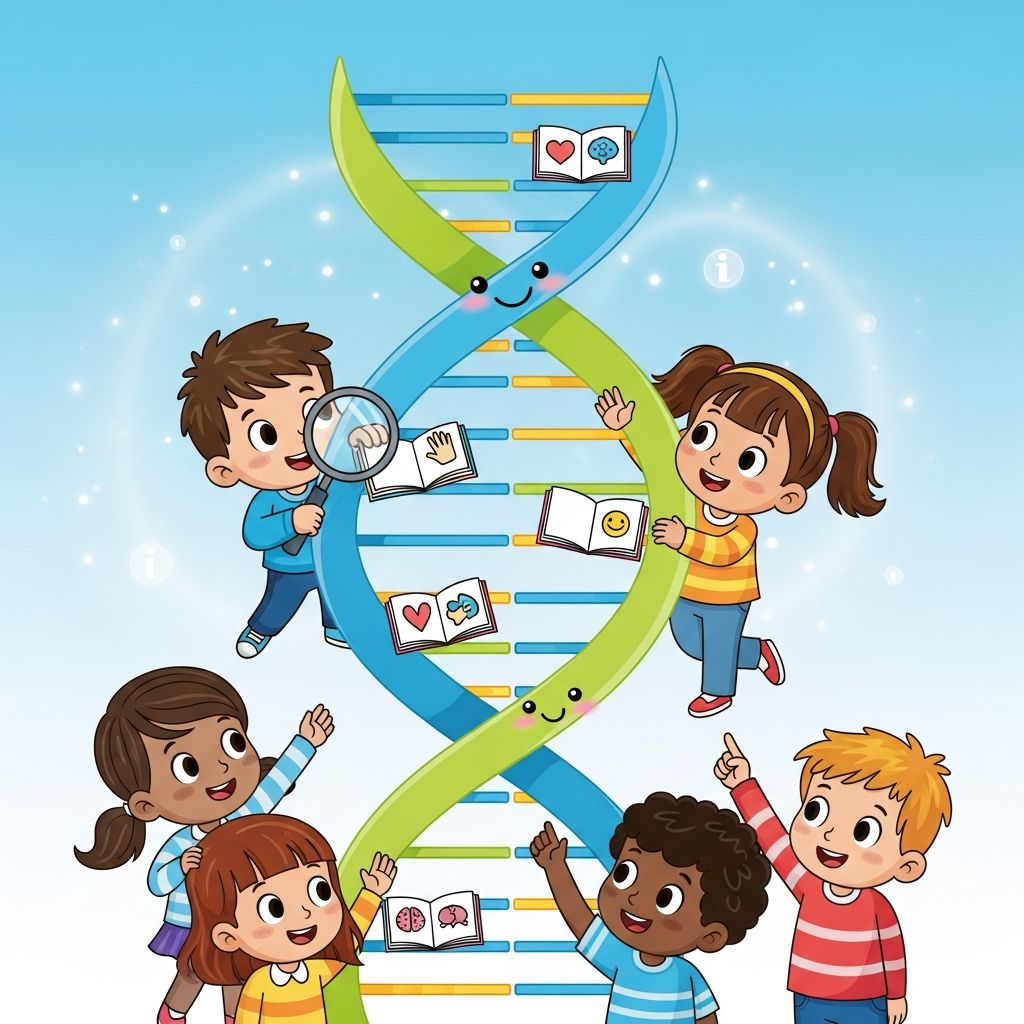
Every person on Earth has a secret set of tiny instructions inside their body that helps decide how they look and how their body works. Those hidden instructions are called genes, and they are one of the coolest science topics you can explore.
This article explains what genes are, where they live, how they help build your body, and why they make you different from everyone else. It is written in simple language so that curious kids, parents, and teachers can all learn together.
What Exactly Is a Gene?
A gene is a small section of a long molecule called DNA. DNA carries information, and each gene stores a specific set of instructions that helps your body make something it needs, usually a protein. You can think of a gene as one sentence in a giant instruction book that describes how to build and run a living body.
Genes are responsible for many of your traits. A trait is any feature that can be described, such as eye color, hair type, blood type, or even how tall you grow. Some traits are easy to see on the outside, while others are hidden inside your body, like how well your blood carries oxygen or how your body digests food.
Genes as Tiny Recipes
Imagine a huge cookbook sitting in a kitchen. Each recipe in the book tells you how to make one specific dish. In a similar way, each gene tells your cells how to make one specific protein or group of proteins. When your body “reads” a gene, it is a bit like following a recipe step by step to bake a cake or cook a meal.
- Genes are like recipes or instructions.
- DNA is the whole cookbook that holds all the recipes.
- Your body “reads” these recipes to build and repair itself.
Where Do Genes Live?
Your body is made of trillions of tiny building blocks called cells. Inside most cells is a control center called the nucleus. The nucleus is where your DNA is stored, and your genes are part of that DNA. If you could shrink down and travel inside a cell, you would find long, thin strands of DNA carefully packed and folded inside this nucleus.
Because DNA is so long, it is organized into bundles called chromosomes. Each chromosome is made of tightly coiled DNA, like a long thread wrapped around spools. Genes are short sections along this thread, each holding instructions for a different job.
Chromosomes and Address Labels
You can think of chromosomes as shelves in a library and genes as books sitting on those shelves. Each book contains one story, and each gene contains instructions for one job in your body. The position of a gene on a chromosome is like the book’s spot on the shelf, so your cells always know where to find it when they need it.
| Part | What It Is | Easy Way to Imagine It |
|---|---|---|
| Gene | A segment of DNA that holds instructions for one job, usually making a protein. | One recipe in a cookbook. |
| DNA | The long molecule made of many genes lined up in a row. | The entire cookbook full of recipes. |
| Chromosome | A tightly packed bundle of DNA stored in a cell’s nucleus. | A bookshelf holding the cookbooks. |
| Cell nucleus | The center of the cell where chromosomes are kept safe. | The library building that stores the shelves and books. |
How Many Genes Do Humans Have?
Scientists have discovered that humans carry many thousands of genes. They are spread out across 23 pairs of chromosomes in the nucleus of most cells. Each pair means there are two copies of each chromosome, one from each parent, and that also means there are two copies of most genes.
Even though every cell with a nucleus has basically the same collection of genes, the way those genes are used can be different from one cell type to another. For example, a nerve cell in the brain and a skin cell on your arm both have the same genes, but different sets of genes are active, or “switched on,” in each type of cell.
How Genes Help Build You
Most genes carry instructions for building proteins. Proteins are large molecules that do many jobs in your body, from building strong muscles to helping carry messages in your brain. Without proteins, your body could not grow, heal, or stay alive.
Here are just a few ways proteins made from genes help you every day:
- Building structures such as muscles, bones, skin, hair, and nails.
- Carrying oxygen in your blood so your cells can breathe and work.
- Breaking down food during digestion so you can get energy.
- Helping your immune system fight germs and keep you healthy.
The Gene-to-Protein Process
When a cell needs a certain protein, it “reads” the matching gene. The information in the gene is copied and then used as a template to build a chain of smaller pieces called amino acids. The amino acids fold and twist into a special shape, and that shape is what allows the protein to do its job.
If the gene is changed or damaged, the protein it makes may not work correctly. This is one of the reasons why some people are born with medical conditions that affect how their body works.
Why You Resemble Your Family
One of the most exciting things about genes is that they are passed from parents to children. When a baby begins to grow, it receives DNA from each parent. Half of the chromosomes come from the mother, and the other half come from the father. That means each parent shares one copy of most of their genes with the child.
Because of this sharing, you may have the same hair color, eye color, or dimples as family members. Sometimes a trait skips a generation, so a child might look a bit more like a grandparent or an aunt or uncle. The mix of genes you receive is unique, which is why even brothers and sisters can look quite different from each other.
Traits You Can See and Traits You Cannot See
Some traits are obvious, like curly hair or straight hair. Others are hidden inside your body. For example, certain genes influence how fast you can run, how your body handles certain foods, or how your immune system fights infections. You cannot see these traits just by looking in a mirror, but they are still controlled by genes.
- Visible traits: eye color, hair type, height, skin tone.
- Hidden traits: blood type, how your body processes vitamins, certain health risks.
Not All Differences Are from Genes
Genes are very powerful, but they do not control everything. The environment around you and your daily choices can also change how your body develops. Things like the food you eat, how much you move and exercise, how well you sleep, and even the air you breathe can all affect your health and growth.
For example, you might have genes that would allow you to grow tall, but if you do not get enough healthy food as you grow, you might not reach your full height. In another example, you might have a body that is naturally strong, but if you never use your muscles, they will not stay strong. Genes and the environment work together all the time.
When Genes Change
Genes usually copy themselves very carefully when cells divide, but sometimes small changes, called mutations, can happen. A mutation is a change in the DNA sequence inside a gene. These changes can be harmless, helpful, or harmful, depending on what the gene does and how the change affects it.
Some gene changes are passed from parents to children, while others happen only in certain cells during a person’s lifetime. In some cases, a change in a gene can lead to a medical condition, such as a blood disorder or a problem with how the body uses sugar. Doctors and scientists study these conditions to learn how to treat or prevent them.
How Doctors Learn About Genes
Today, scientists can read the order of the building blocks in DNA, much like reading letters in a long word. By comparing healthy genes with changed ones, they can often figure out which changes cause certain conditions. This type of research helps doctors give better advice and develop new medicines.
Families sometimes meet with special doctors called genetic counselors when they have questions about conditions that run in the family. These experts explain how genes are inherited and what choices families might have for testing or treatment.
Genes in All Living Things
Genes are not just a human feature. Every plant, animal, and tiny organism like bacteria has genes. This is one reason why people can study animals or plants to learn more about how genes work in humans. Some genes are surprisingly similar in many living things, which shows that life on Earth is deeply connected.
Here are a few fun facts to show how common genes are:
- Fruit flies, which are tiny insects, have been used for many years to study how traits are passed down.
- Plants have genes that control things like flower color, leaf shape, and the taste of fruits.
- Even simple bacteria have genes that help them survive in hot springs, salty oceans, or inside other creatures.
Keeping Genetic Information Private
As scientists learn more about genes, they can test a small sample of blood or saliva to learn about a person’s DNA. This can help doctors understand certain health conditions better. At the same time, information about someone’s genes is very personal, so it needs to be protected and handled carefully.
Many countries have rules to keep genetic information private and to make sure it is used fairly. When families choose to have genetic testing, they often talk with health professionals about who can see the results and how those results might affect health decisions.
Fun Ways to Explore Genetics
Even without a laboratory, there are simple ways for kids to start thinking like genetic scientists. You can look for patterns in your family or among your friends to see how traits show up in different people.
- Draw a family tree and mark who has straight hair, curly hair, or wavy hair.
- Make a chart of eye colors for your classmates or relatives and see which colors are most common.
- Notice which plants in a garden are tall or short, or which flowers share similar colors and shapes.
These small activities help you see how traits are shared within groups, just like scientists studying genes in larger populations.
Quick Reference Table: Gene Vocabulary for Kids
| Word | Simple Meaning |
|---|---|
| Gene | A piece of DNA that gives the body instructions for one job. |
| DNA | The long molecule that holds all your genetic information. |
| Chromosome | A bundle of tightly packed DNA found in the cell nucleus. |
| Trait | A feature you can describe, such as eye color or height. |
| Protein | A molecule made using gene instructions that helps build and run your body. |
| Mutation | A change in a gene’s DNA sequence. |
| Heredity | The passing of traits from parents to children. |
Frequently Asked Questions About Genes
Can I change my genes?
People cannot simply decide to change their genes by wishing or by changing their mood. The genes you are born with stay with you throughout your life. However, how those genes affect you can be influenced by your choices, such as eating healthy foods, staying active, and avoiding harmful habits. Scientists are also studying medical treatments that might fix certain gene problems in the future, but those methods are carefully tested to make sure they are safe.
Do brothers and sisters have the same genes?
Brothers and sisters receive their genes from the same parents, but they usually get different combinations of those genes. This is why siblings may share some features, like similar noses or smiles, but still look and act very different from one another. Identical twins are a special case because they come from a single fertilized egg that split, so they start out with almost exactly the same genes.
Why do some diseases “run in families”?
Some health conditions are influenced by specific genes. If a parent has a changed gene that affects health, there is a chance they may pass that gene to their children. When the same condition appears in several family members across generations, people sometimes say it “runs in the family.” Even for these conditions, lifestyle and environment can still play an important role.
Are genes the only reason people are different?
Genes are a big part of what makes each person unique, but they are not the whole story. Experiences, culture, friends, family, and personal choices all help shape who someone becomes. Two people could share similar genes and still grow into very different individuals because of the different paths they take in life.
How can kids learn more about genes?
Kids can learn more by reading age-appropriate science books, watching educational videos, and doing simple experiments or activities suggested by teachers and science museums. Asking questions in class, visiting libraries, and talking with adults who enjoy science are also great ways to keep exploring the world of genetics in a fun and safe way.
Bringing It All Together
Genes are tiny but powerful parts of DNA that help build and guide every living thing. They carry instructions that shape your body, influence your health, and connect you to your family. Even though you cannot see them, genes are working every second to help keep you alive and growing.
By learning about genes, you begin to understand not just how your own body works, but also how all life on Earth is related. The more you explore this invisible world, the better prepared you are to make smart choices about your health and to appreciate the amazing science inside every cell.