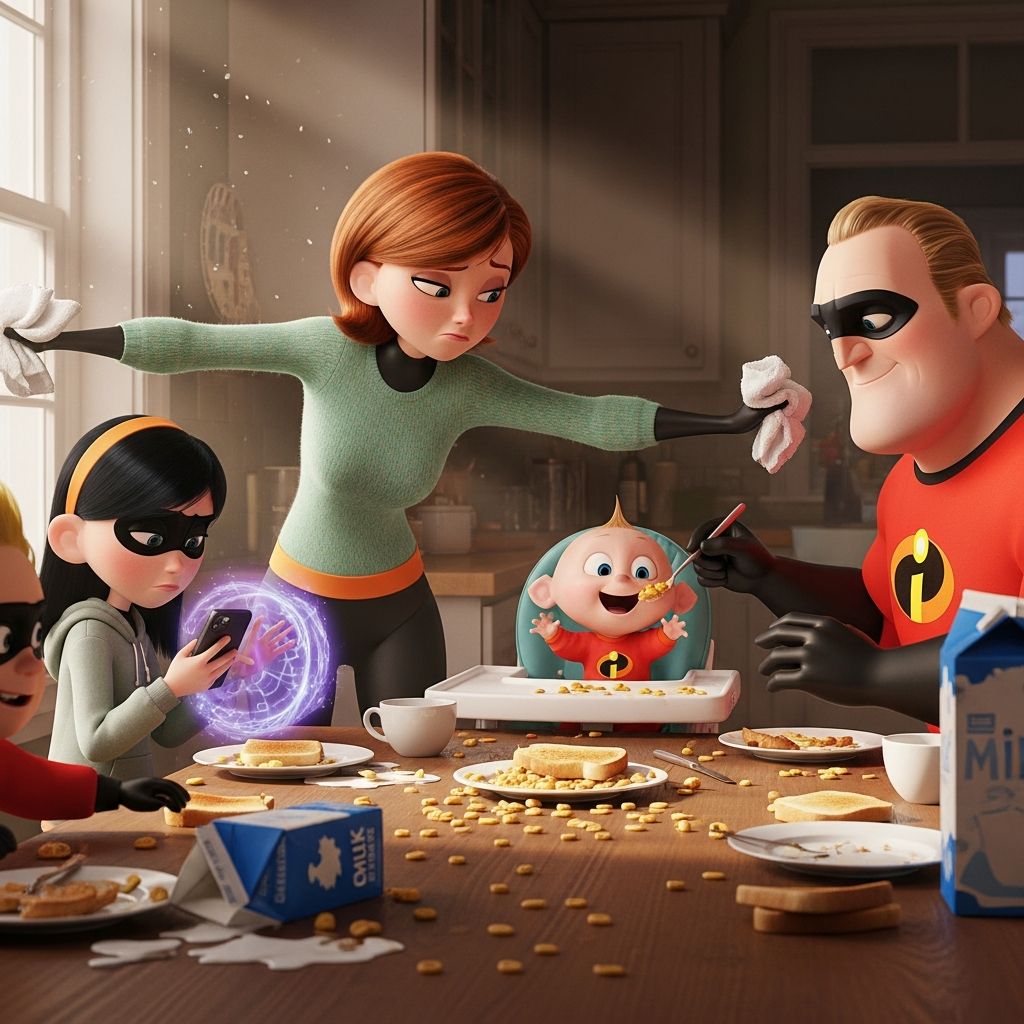
Pixar has built its reputation on telling emotionally rich stories that resonate with audiences of all ages, often by using fantasy to illuminate everyday life. Among its films about toys, monsters, and talking fish, Incredibles 2 stands out as one of the studio’s most grounded portraits of what it feels like to be a family under pressure. While the movie is packed with kinetic action and dazzling set pieces, its real power lies in the way it captures domestic chaos, shifting gender roles, and the emotional labor that holds families together.
The Superhero Family as a Relatable Household
The Parr family might have extraordinary abilities, but their core struggles are strikingly ordinary. Pixar frequently uses heightened premises to explore universal themes like identity, family, and belonging. Incredibles 2 continues that tradition by treating superpowers as metaphors for the everyday roles and tensions within a household.
- Bob (Mr. Incredible) embodies the overwhelmed stay-at-home parent desperate not to fail his kids.
- Helen (Elastigirl) represents the working parent pulled between professional purpose and emotional responsibility at home.
- Violet personifies teenage invisibility and the desire to create emotional boundaries.
- Dash reflects hyperactive childhood energy and the struggle to channel it constructively.
- Jack-Jack is the unpredictable toddler stage taken to an extreme, with powers breaking out in every direction.
By framing its story through these roles, the film turns superhero spectacle into a lens for understanding the stresses and joys of everyday parenting and partnership, echoing the broader way Pixar uses family structures to help young viewers understand real-life relationships.
Reversing Roles: When Mom Becomes the Frontline Hero
One of the most significant choices in Incredibles 2 is placing Elastigirl at the center of the public hero narrative while Bob stays home. This inversion of the previous film’s dynamic isn’t played as a gimmick; it becomes the engine for exploring modern families where both parents work, and traditional expectations are under negotiation.
Elastigirl’s Career Reboot
Helen’s storyline parallels the real experiences of parents who return to the workforce or step into new leadership roles. She grapples with questions familiar to many working caregivers:
- Can I be fully present at work and still be the emotional anchor at home?
- Will success outside the house come at a cost to my relationships?
- How much risk is acceptable if the rewards could transform my family’s future?
These tensions echo broader social conversations about women’s labor—both paid and unpaid—and the expectation that mothers should somehow excel at both simultaneously.
Bob’s Trial by Fire at Home
Bob, who once thrived on saving the world, is thrust into saving math grades, emotional breakdowns, and a baby with erratic superpowers. The film treats his learning curve with humor but also surprising tenderness. Rather than portraying him as incompetent, the story depicts a parent confronting three major realities:
- The invisible difficulty of domestic work and childcare.
- The emotional demand of being a support system rather than the public hero.
- The humbling realization that love does not automatically translate into skill or patience.
This aligns with how many analyses of Pixar note their emphasis on characters growing through relationships rather than solitary achievement.
Each Parr Child as a Different Stage of Growing Up
Pixar films frequently center on coming-of-age journeys, using fantasy to dramatize milestones like independence, responsibility, and self-discovery. In Incredibles 2, these themes are distributed across the Parr children, each representing a different developmental stage.
| Character | Life Stage | Core Conflict | Symbolic Power |
|---|---|---|---|
| Violet | Teenager | Identity, boundaries, first love | Invisibility and force fields as emotional walls |
| Dash | Middle childhood | Impulse control, boredom, need for validation | Super-speed as restless energy |
| Jack-Jack | Toddler | Unpredictability, discovery, lack of control | Many powers as raw, unshaped potential |
By interweaving these arcs, the movie mirrors the way real families often juggle multiple developmental crises at once: one child needs space, another needs structure, and the youngest demands constant attention.
Domestic Chaos as an Emotional Battlefield
Superhero films often reserve complex choreography for their action sequences. Incredibles 2 applies that same energy to its domestic scenes, treating homework, bedtime, and sibling conflicts as battles requiring strategy and emotional resilience. This approach resonates with broader commentary that Pixar’s family stories are not simply moral lessons, but explorations of how relationships shape identity and growth.
Homework, Heartbreak, and Exhaustion
One of the film’s central pleasures is watching Bob attempt to solve problems he cannot simply punch away:
- Helping Dash with confusing math approaches that differ from what he learned.
- Supporting Violet through social embarrassment and romantic disappointment.
- Managing Jack-Jack’s escalating powers that defy explanation and control.
These conflicts embody the core parenting challenge: learning to navigate issues that are emotional, not just logistical. Research on family films points out that depictions of such struggles can help young viewers process their own fears and frustrations within a safe narrative space.
Jack-Jack and the Comic Reality of Toddlers
Jack-Jack’s powers are played for comedy, but they are rooted in a recognizable reality: toddlers shift from calm to chaos in an instant. His unpredictable transformations—phasing, multiplying, bursting into flames—work as an exaggerated metaphor for rapid emotional swings and developmental leaps that parents race to keep up with.
These sequences underscore a key theme across Pixar’s work: even the smallest character can reshape the entire emotional landscape of a family, not through villainy but through sheer unfiltered existence.
The Screenslaver and the Anxiety of Modern Media
Beyond the family story, Incredibles 2 introduces the Screenslaver, a villain who manipulates people through screens and entertainment. While framed as a conspiracy within the narrative, the character also reflects wider cultural concerns about media consumption and passivity.
- Control and distraction: The Screenslaver’s methods mirror fears that constant screen time can dull critical thinking and lead to manipulation.
- Hero worship and dependence: The story questions what happens when people outsource their safety—and even their moral decisions—to public figures or institutions.
- Media skepticism: The villain’s monologues tap into a broader distrust of curated images and the narratives sold through mass entertainment and news.
These ideas echo real-world discussions about how children and families engage with media, and how storytelling—whether through news, film, or social networks—can both inform and distort our sense of reality.
Marriage, Partnership, and Shared Responsibility
At its core, Incredibles 2 is as much about marriage as it is about parenting. The Parrs’ relationship reflects a common Pixar pattern: characters grow not in isolation but in response to those closest to them.
Negotiating Ego and Support
Bob’s initial jealousy of Helen’s success is not treated as heroically justified, but as a hurdle he must overcome. The film allows him to feel sidelined and insecure while still holding him accountable for those feelings. His eventual pride in her achievements signals a shift from ego-driven to relationship-driven fulfillment.
Helen, for her part, wrestles with guilt about leaving Bob to manage the household, even though the opportunity she’s pursuing is critical for their family’s legal and financial future. This duality reflects a reality many couples face: supporting a partner’s career often requires both logistical sacrifice and emotional adjustment.
The Family as a Team, Not a Hierarchy
By the climax, the Parrs only succeed when they coordinate their strengths, including the children’s contributions. This mirrors analyses of Pixar films that emphasize group resilience and shared purpose as key ingredients in overcoming conflict. No one character saves the day alone; victory is a collaborative effort that acknowledges the value of each family member.
How Incredibles 2 Fits Into Pixar’s Larger Family Tradition
Pixar has long used family narratives to examine love, separation, and reconciliation—from the underwater search for a lost son to intergenerational memory in stories like Coco. Incredibles 2 builds on this tradition but narrows its focus to the daily grind of a nuclear family trying to function under legal, financial, and emotional stress.
- Like Finding Nemo: It confronts overprotection and the difficulty of letting children face danger and disappointment.
- Like Up and Coco: It shows how family obligations can feel constraining yet become the source of deepest meaning.
- Like many Pixar films: It uses high-concept fantasy to explore universal questions of identity, purpose, and belonging.
What sets Incredibles 2 apart is its commitment to staying grounded in the practical realities of family life—even as trains crash and buildings explode around the Parrs. The emotional stakes are not abstract; they center on whether this family can remain connected and functional amid constant external and internal pressure.
Why Families Connect So Strongly With This Sequel
Many family-oriented films aim to teach straightforward lessons about kindness, bravery, or honesty. Commentators on Pixar’s work have noted that their themes often go deeper, touching on complex issues like grief, identity, and interdependence. Incredibles 2 sits firmly in this category: instead of offering a single moral, it presents a messy portrait of family life where everyone is learning and failing in real time.
Key Reasons the Film Resonates With Parents and Kids
- It normalizes parental imperfection. Bob and Helen love their children but make mistakes, lose patience, and misjudge situations—just like real caregivers.
- It validates kids’ perspectives. Violet and Dash are not treated as side characters; their feelings and frustrations matter to the story’s resolution.
- It treats domestic labor as real work. The film gives narrative weight to chores, caregiving, and emotional support, not just superheroics.
- It acknowledges systemic stress. Legal bans on superheroes and economic insecurity mirror how outside forces can strain even strong families.
In presenting all of this through humor and spectacle, the movie offers families a shared language for talking about responsibility, equality, and emotional honesty after the credits roll—an effect often highlighted as one of the strengths of Pixar’s approach to storytelling for families.
Frequently Asked Questions (FAQs)
Is Incredibles 2 appropriate for young children?
Yes, the film is rated PG and is generally suitable for school-age children, though very young viewers may find some action scenes intense. Like many Pixar films, it balances excitement with emotionally grounded storytelling that can be discussed together as a family afterward.
What makes Incredibles 2 different from the first Incredibles?
While the first film focuses heavily on Bob’s midlife crisis and the rediscovery of purpose, Incredibles 2 shifts attention to Helen’s professional arc and Bob’s role at home. The sequel dives deeper into modern parenting, media influence, and the emotional labor of maintaining a household under stress.
How can parents use Incredibles 2 to start conversations with kids?
Parents can use scenes about homework frustration, Violet’s embarrassment, or Jack-Jack’s chaos to discuss topics like managing emotions, respecting boundaries, and appreciating each family member’s contributions. Media commentators often note that Pixar films are especially effective tools for prompting such conversations in age-appropriate ways.
Does the movie have a clear moral?
Instead of a single lesson, the film presents several intertwined ideas: families work best when responsibility is shared; both paid work and caregiving are valuable; and everyone—from toddlers to parents—needs space to grow, fail, and try again. This complexity is consistent with broader analyses of Pixar’s storytelling philosophy.
How does Incredibles 2 compare to other Pixar family stories?
Compared with films like Finding Nemo or Coco, which center on separation and reunion across distance or generations, Incredibles 2 focuses more tightly on day-to-day coexistence within a single household. Its depiction of domestic stress, shifting gender roles, and teamwork makes it one of Pixar’s most detailed examinations of how modern families function.
References
- How Disney Pixar Runs Their Films for Families? — IvyPanda (summary of academic discussions on Pixar and family themes). 2020-06-26. https://ivypanda.com/essays/how-disney-pixar-runs-their-films-for-families/
- Life Lessons We Can Learn From Pixar Films — Inside the Magic. 2024-04-18. https://insidethemagic.net/2024/04/disney-pixar-movie-morals-a-complete-breakdown-mmbcm1/
- A Celebration of Family and Culture: Disney/Pixar’s Coco — Gen Z Critics. 2018-02-08. https://genzcritics.com/2018/02/a-celebration-of-family-and-culture-disney-pixars-coco/
- “Universal themes” in Pixar movies — Scott Myers, Go Into The Story (The Black List). 2018-07-09. https://gointothestory.blcklst.com/universal-themes-in-pixar-movies-49115090d9c2
- The Secret Screenwriting Themes Behind All Pixar Movies — Ken Miyamoto, ScreenCraft. 2019-04-08. https://screencraft.org/blog/pixar-screenwriting-themes/