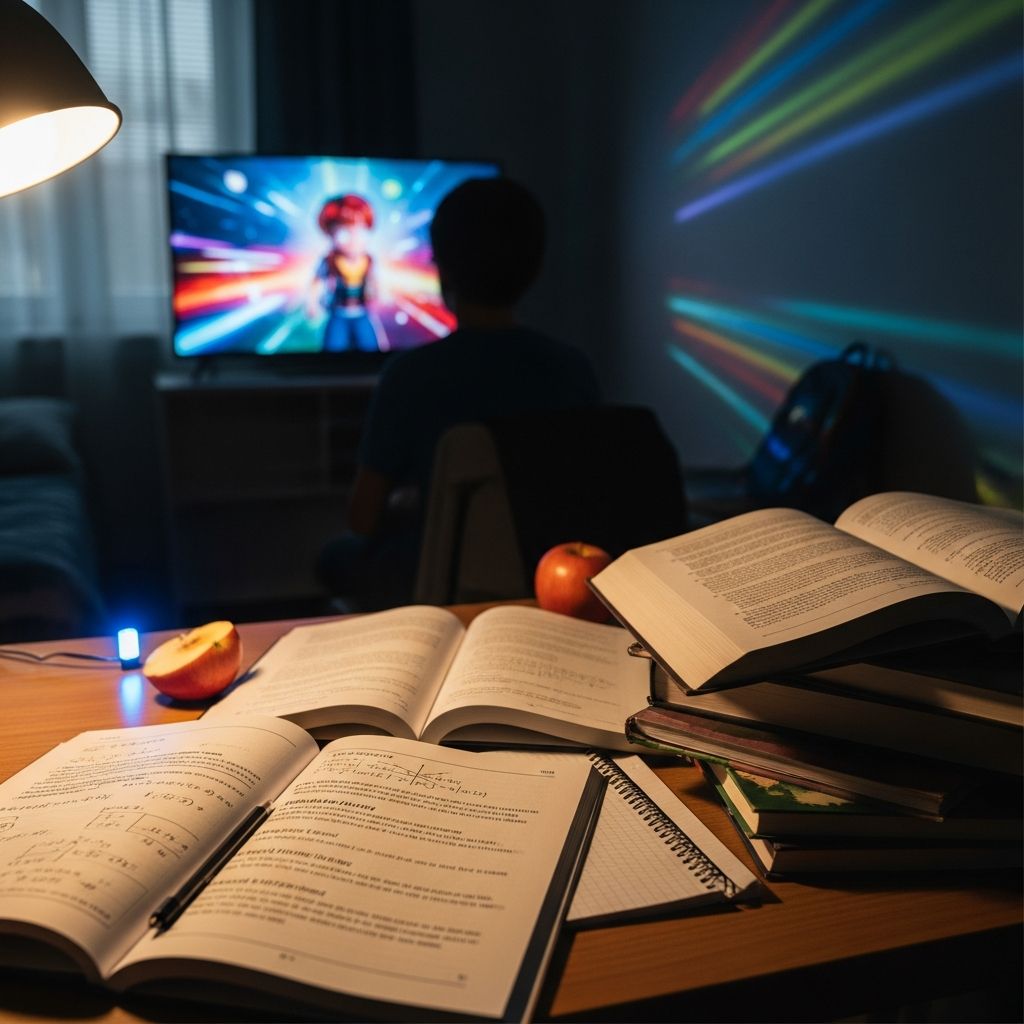
Television and streaming are woven into daily life, but the way children use screens can quietly chip away at attention, memory, and school success. Used intentionally, media can inform and inspire; used mindlessly, it competes directly with reading, sleep, and real-world exploration that brains need to grow.
This article explains how TV and other screens influence learning, why some children are more vulnerable than others, and how parents can design a calmer, more focused home environment without power struggles or guilt.
Why Screens Compete With Learning
Children’s brains develop through repetition, practice, and real-world feedback. Every hour spent passively consuming fast-paced entertainment is an hour not spent reading, solving problems, moving their bodies, or talking with caregivers—activities that directly build academic skills. The issue is less about one show and more about the steady displacement of higher-value experiences over months and years.
Television is designed to hold attention effortlessly, which can make classroom tasks feel slow and unrewarding by comparison. When a child grows used to constant novelty, it becomes harder to stay with a math problem, a dense paragraph, or a long-term project that does not offer instant payoff.
The Hidden Cost of Background TV
Many families assume that “having the TV on in the background” is harmless because no one is really watching. In reality, ambient TV fragments both adult and child attention, reduces the number and quality of parent–child interactions, and can interrupt a child’s play just when deep concentration is forming.
For young children especially, overheard dialogue and frequent scene changes disrupt focused play and language-rich back-and-forth conversation. Over time, this can dull curiosity, shorten attention spans, and subtly undermine early literacy skills that depend on sustained engagement.
How TV Affects Key Learning Skills
To understand why heavy screen use can derail academics, it helps to look at specific mental abilities that schoolwork demands. These “executive functions” act like the brain’s air-traffic control system and are heavily shaped by everyday habits and environment.
| Skill | What It Does | How Excess TV Interferes |
|---|---|---|
| Attention control | Staying focused on a task long enough to finish it. | Fast-paced scenes condition the brain to expect constant novelty, making slow, effortful tasks feel intolerable. |
| Working memory | Holding information in mind while using it (for example, remembering a multi-step instruction). | Passive watching provides few chances to rehearse or manipulate information, so this “mental workspace” is under-exercised. |
| Inhibition | Resisting impulses and delaying gratification. | On-demand entertainment offers instant pleasure, weakening the habit of waiting, persisting, and saying “not yet.” |
| Planning and organization | Breaking larger tasks into steps and following through. | Time spent consuming content leaves less practice time for planning activities, games, and projects in the real world. |
School rewards children who can sit with mild boredom, juggle information, resist distractions, and plan ahead. Habits built around constant screen stimulation cultivate the opposite profile.
Age Matters: Screens From Toddlerhood To Teens
In the early years (0–5)
In infancy and preschool, brains are wiring language, movement, and emotional regulation at breathtaking speed. Human faces, hands-on play, and real-world sounds are the raw material for that wiring. When television fills large portions of the day, it displaces exactly the kind of rich, three-dimensional input that small brains need most.
Short educational programs watched together with an engaged adult can be neutral or modestly beneficial, but frequent solo viewing—especially of fast, noisy content—has been associated with weaker language growth, more behavior problems, and later learning challenges.
School-age children (6–12)
Once school begins, the competition between screens and academics becomes more visible. Homework, reading, sports, and free play all fight for after-school hours. Even “a little TV after school” can quickly turn into hours when shows auto-play and devices are always within reach.
Heavier television use in this age group tends to correlate with lower reading time, poorer homework completion, and less sleep. Children who have screens in their bedrooms are especially vulnerable because their habits are harder for adults to see and guide.
Teens (13–18)
By adolescence, school demands ramp up just as social media, gaming, and streaming platforms become more compelling. The risk shifts from simple quantity of TV to multitasking: teens often try to study while shows run in the background or while constantly checking messages, fragmenting focus.
This chronic partial attention makes it difficult to encode information deeply, which can translate into lower test scores even when total “study time” looks acceptable on paper. It also leaves less time for sleep, exercise, and in-person friendships that buffer stress and support academic resilience.
Content Quality vs. Screen Quantity
Not all screen time is equal. Slow-paced, age-appropriate educational programs watched together with a caregiver can spark discussion, feed interests, and even support specific academic skills such as vocabulary or science knowledge. The trouble is that this kind of intentional use is often the exception rather than the rule.
Most children gravitate to high-intensity entertainment with rapid cuts, exaggerated conflict, or endless scrolling. This style of content trains the brain to seek stimulation rather than understanding. The more a child relies on screens to manage boredom, the more ordinary school tasks feel dull and effortful.
Sleep: The Silent Academic Superpower
Sleep is where the brain consolidates memories, prunes unnecessary connections, and prepares for next-day learning. Light from screens—especially close to bedtime—suppresses melatonin, shifts the body’s internal clock later, and makes it harder to fall and stay asleep.
Children who stay up watching TV or scrolling under the covers often show irritability, fogginess, and reduced motivation the next day. Even a small, chronic sleep debt can lower attention, working memory, and problem-solving skills, all of which show up directly in classroom performance and grades.
Signs That Screen Time Is Hurting School
Every family’s baseline looks different, but certain patterns are red flags that television and other screens may be undermining learning rather than supporting it. Paying attention to these cues can help parents intervene before habits become entrenched.
- Homework is routinely delayed or rushed because of shows, games, or videos.
- Your child insists they can “work with the TV on,” but forgets instructions, misses problems, or takes far longer than expected to finish tasks.
- Teachers report daydreaming, incomplete assignments, or trouble following multi-step directions.
- Bedtime battles erupt around turning off screens, and your child seems tired or cranky in the morning.
- Reading for pleasure has all but disappeared, and most free time gravitates toward passive viewing.
Seeing some of these signs does not mean screens must be banned. It does signal that the balance needs to shift toward habits that build focus, not erode it.
Creating a Home Where Learning Can Win
The goal is not a screen-free house but a home where technology serves your family’s values instead of silently steering them. Rather than relying on willpower in the moment, design the environment so that the easiest choice is usually the one that supports learning and connection.
Step 1: Get clear on your priorities
Before changing rules, decide what matters most. Perhaps your top priorities are adequate sleep, daily reading, time outdoors, and unrushed family meals. When you know what you are protecting, limits on TV feel purposeful rather than arbitrary.
Parents often find it helpful to briefly write these priorities down and share them at a family meeting. Framing changes as “protecting what we care about” reduces resistance and helps children understand the why behind new routines.
Step 2: Set simple, predictable screen rules
Overly complex rules invite negotiation and conflict. Instead, create clear, easy-to-remember guidelines tied to daily rhythms. For example, you might decide that homework and chores come before any entertainment screens, or that there are no TVs on school mornings at all.
- Anchor screen use to specific, limited windows of time (for example, a short block after homework and before dinner).
- Keep at least one or two days each week as “light screen” or “no streaming” days focused on other activities.
- Establish a family-wide “screens off” time in the evening to protect wind-down and sleep.
Step 3: Make bedrooms screen-free
Removing televisions from children’s bedrooms is one of the most powerful, low-conflict steps parents can take. It reduces unsupervised late-night viewing, protects sleep, and sends a clear message that bedrooms are for rest, not constant entertainment.
If removing a TV feels daunting, start by unplugging it on school nights, or moving streaming devices out while leaving the set temporarily. Combine this change with new bedtime routines—reading aloud, audiobooks, or quiet games—to fill the gap.
Step 4: Protect homework from distraction
Multitasking is the enemy of deep learning. Designate a quiet homework spot where televisions are off and devices used only for schoolwork. If siblings want to watch a show, encourage them to use a different room and headphones once homework is finished.
- Use website blockers or app timers for older children who do homework on connected devices.
- Break homework into short, focused blocks separated by brief movement or snack breaks instead of letting screens fill every pause.
- Model focused work yourself: when your child is studying, avoid scrolling or channel-surfing nearby.
Replacing Screens With Something Better
Simply taking away television without offering attractive alternatives tends to breed resentment and boredom. The most sustainable changes come when families add richer experiences that satisfy the same needs screens were meeting: comfort, connection, stimulation, or escape.
- For relaxation: Encourage drawing, building, music, or simple crafts that are soothing but mentally active.
- For connection: Build short rituals—card games after dinner, family walks, or shared read-aloud time—into the week.
- For excitement: Plan occasional family movie nights or sports viewing as special events, rather than leaving the TV on by default.
- For boredom: Create a “boredom box” with puzzles, comics, art supplies, and building materials that children can reach independently.
When life feels full of satisfying activities, television returns to its rightful place as occasional entertainment instead of the primary way the family passes time.
Talking With Children About TV and School
Children are more likely to cooperate with changes when they feel heard and respected. Rather than lecturing about “too much TV,” invite your child’s perspective and work toward collaborative solutions that still honor adult leadership.
You might start by asking open-ended questions: “How do you feel in the morning after staying up late with shows?” or “Have you noticed whether homework is easier when the TV is off?” When children connect their own experience of tiredness, stress, or slipping grades with screen habits, motivation to change begins to come from within.
Special Considerations: Attention and Learning Differences
Children who already struggle with attention, organization, or learning differences can be especially sensitive to heavy screen exposure. Fast-paced shows and constant novelty may temporarily hold their focus, but can also make it harder to build the slower, sustained attention that schoolwork demands.
For these children, it is often helpful to be even more intentional: prioritize sleep and exercise, use visual schedules, keep entertainment screens out of bedrooms, and choose calmer, predictable content watched in short, scheduled blocks rather than long binges.
Frequently Asked Questions
Does all TV hurt academic performance?
No. The impact depends on how much your child watches, what they watch, when they watch, and what it replaces. Occasional, age-appropriate programs—especially when co-viewed and discussed—are unlikely to harm learning and may even provide useful knowledge or vocabulary. Problems typically appear when entertainment screens crowd out sleep, reading, and real-world play.
How many hours of TV per day is too much?
There is no single number that fits every child, but a practical guideline is that entertainment screen time should not interfere with school responsibilities, active play, face-to-face interaction, or sleep. If grades, mood, or energy suffer, or if homework and reading are consistently squeezed by TV, it is a sign that the current amount is more than your child can handle well.
What if my child insists they “need” TV to unwind?
Television can feel like an easy way to relax because it demands so little effort, but over-reliance can weaken other coping skills. Validate your child’s need to decompress, then experiment together with alternative wind-down habits—music, drawing, stretching, or gentle conversation—while still allowing a modest amount of planned screen time.
Is educational programming always a safe choice?
Educational labels do not guarantee that content is slow-paced, age-appropriate, or aligned with your family’s values. Check programs yourself, keep viewing sessions short, and use them as a springboard for real-life activities—for example, cooking a simple recipe after a food show or trying a science experiment inspired by a documentary.
How can busy working parents realistically cut back on screens?
Perfection is not required. Focus on a few high-impact shifts: no screens during meals, no TVs in bedrooms, a consistent “off” time before bed, and protected homework blocks without background media. Filling the resulting space with simple, predictable routines can make the home feel calmer without demanding elaborate planning.
Bringing It All Together
Television and digital media are not going away, and they need not be enemies of learning. The key is recognizing that screens are powerful competitors for children’s time, attention, and sleep—the same resources that academics depend on. When families set thoughtful boundaries, prioritize richer experiences, and communicate openly, screens can take their place as one small part of a much bigger, more satisfying childhood.