Teaching a child to read at home in 30 days is ambitious, but a focused routine, the right strategies, and realistic expectations can build a strong foundation for lifelong literacy. This guide breaks the month into simple steps, using phonics, daily practice, and playful activities that fit into family life.
Understanding Reading Readiness
Before starting a 30-day reading plan, it helps to know whether your child is ready for formal instruction. Reading readiness is less about age and more about a combination of language, attention, and print awareness.
- Shows interest in books and enjoys being read to.
- Recognizes some letters or familiar words (like name or common signs).
- Can focus on a short activity for 5–10 minutes.
- Understands simple instructions and can speak in short sentences.
If your child is not yet showing most of these signs, focus first on building language and love of books rather than rushing into decoding words.
Core Principles of the 30-Day Plan
Every successful early reading program rests on a few core principles. Keeping these in mind will help you adapt the plan to your child’s pace and personality.
- Consistency over intensity: Short daily sessions (10–20 minutes) are more effective than occasional marathons.
- Phonics first: Teach how letters represent sounds rather than having your child memorize whole words.
- Progressive difficulty: Start with simple, consistent letter-sound relationships and gradually add complexity.
- Meaning matters: Always connect decoding with understanding; reading is about making sense, not just saying sounds.
- Playful practice: Use games, movement, and creativity to keep motivation high.
Suggested 30-Day Structure
The following is a sample structure you can adapt. Each phase focuses on a key set of skills; the specific days are flexible.
| Period | Focus | Main Goals |
|---|---|---|
| Days 1–5 | Letter–sound basics | Link several consonants and short vowels to their sounds; build phonemic awareness. |
| Days 6–10 | Blending simple words | Blend CVC (consonant-vowel-consonant) words like “cat” and “dog.” |
| Days 11–15 | High-frequency words | Introduce a small set of common sight words within simple sentences. |
| Days 16–20 | Short sentences and mini-books | Have your child read decodable sentences and very short books. |
| Days 21–25 | Fluency and expression | Build speed, accuracy, and basic expression with familiar texts. |
| Days 26–30 | Confidence and comprehension | Focus on understanding, retelling, and enjoying reading independently. |
Days 1–5: Letter–Sound Foundations
Begin by introducing a small, manageable set of letters and their sounds. Aim for 3–5 new letter-sound relationships over the first few days, revisiting them often.
- Choose high-utility consonants (like m, s, t, p, n) and one or two short vowels (such as a, i).
- Use multi-sensory techniques: trace letters in sand, air-write large letters, or shape them with clay while saying the sound.
- Play quick games like “Find the sound” where your child points to objects or pictures that start with a target sound.
Keep sessions upbeat and stop while your child is still engaged; early success builds confidence and curiosity for the next step.
Days 6–10: Blending Simple Words
Once your child can reliably link a few letters to their sounds, start showing how these sounds blend together to make words. This is the bridge from isolated sounds to real reading.
- Explain that reading a word means saying the sounds in order, then pushing them together (for example, /c/–/a/–/t/ becomes “cat”).
- Use letter cards or tiles to build CVC words like “sat,” “map,” “pin,” and “dog,” changing one letter at a time.
- Practice both directions: you build a word for your child to read, then say a word and have your child build it.
Expect blending to feel slow at first; with repetition, your child will start recognizing patterns and reading some words more automatically.
Days 11–15: Introducing High-Frequency Words
As decoding improves, introduce a small set of high-frequency words that appear often in simple texts. Some of these words follow regular patterns, and some do not.
- Start with 5–10 common words such as “I,” “a,” “the,” “to,” and “and.”
- Teach them in context, using short phrases and simple sentences like “I am Sam” or “The cat sat.”
- Create flashcards and play fast-recognition games for a minute or two each day.
The goal is to help your child recognize these words quickly so early reading feels smoother and less effortful.
Days 16–20: Reading Short Sentences and Mini-Books
By the middle of the month, your child is ready for very short, decodable texts that combine phonics patterns and high-frequency words. These can be printable mini-books, simple readers, or homemade sentence strips.
- Choose books where most words follow patterns your child has already learned, with just one or two new words per page.
- Before reading, preview tricky words together and practice them in isolation.
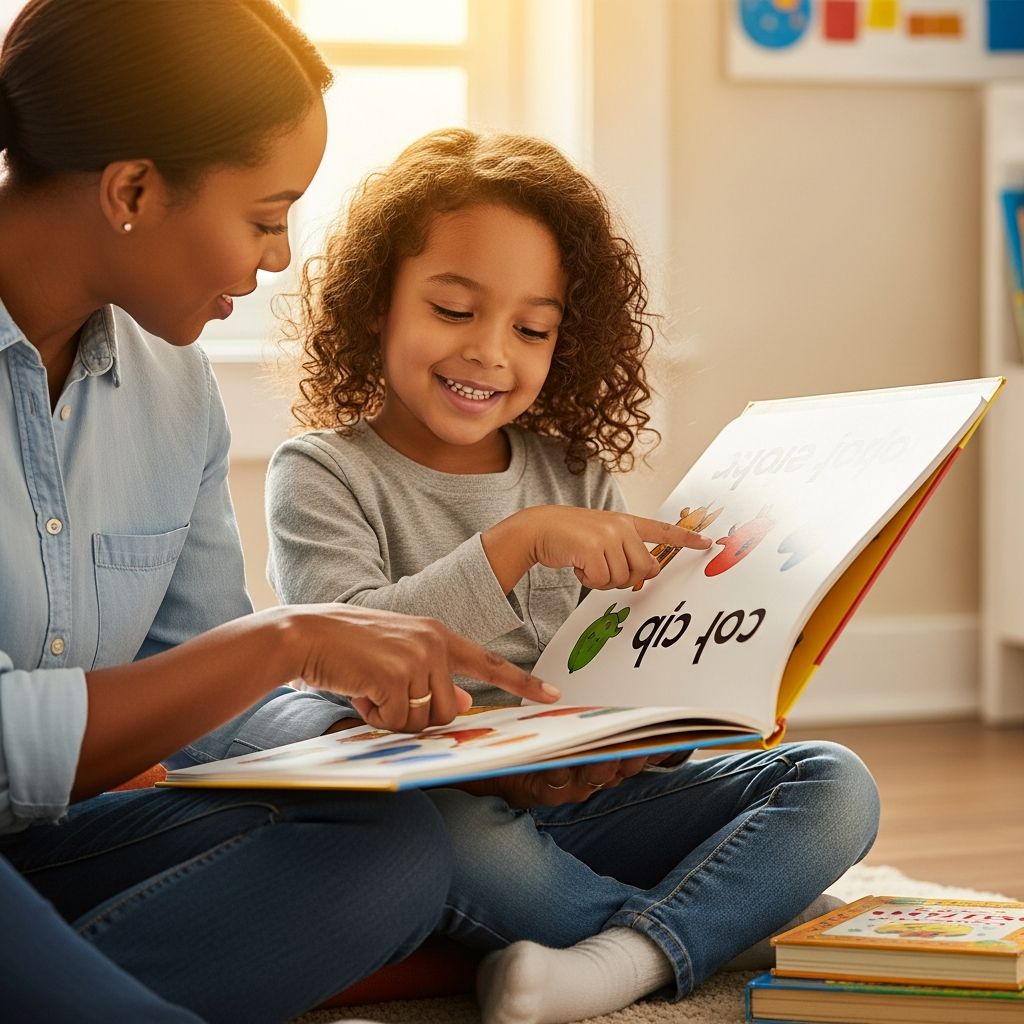
- Encourage your child to point under each word while reading to support accurate tracking.
Celebrate every completed page, and revisit favorite books over multiple days to build fluency and confidence.
Days 21–25: Building Fluency and Expression
Fluency means reading accurately, smoothly, and with some expression. At this stage, focus on rereading familiar materials rather than pushing into harder texts too quickly.
- Have your child reread favorite mini-books or sentence strips from earlier weeks.
- Model expressive reading first, then invite your child to “read it like you do” with natural pauses and intonation.
- Use simple timed readings to show progress, emphasizing improvement rather than speed competition.
As fluency grows, your child will spend less mental energy on decoding and more on understanding and enjoying what they read.
Days 26–30: Confidence, Choice, and Comprehension
In the final days, shift the focus from just “getting the words right” to enjoying stories and thinking about what they mean. This is also a good time to give your child more say in what to read.
- Offer a small selection of appropriate books and let your child choose which one to read each session.
- Pause occasionally to ask simple questions: “What happened?” “Why do you think the character did that?” “What do you think will happen next?”
- Encourage retelling by having your child explain the story in their own words, using the pictures as prompts.
The goal is for your child to see reading as meaningful and enjoyable, not just a task to finish.
Daily Session Template
Each day, aim for a consistent routine of 10–20 minutes. You can adjust the segments based on your child’s age and attention span.
- Warm-up (3–5 minutes): Quick review of known letter-sounds and high-frequency words.
- New learning (5–10 minutes): Introduce a new sound pattern, letter, or small set of words.
- Guided reading (5–10 minutes): Read a sentence, page, or short book together, offering help as needed.
- Cool-down (2–3 minutes): Celebrate success, choose tomorrow’s book, and perhaps end with you reading a slightly harder story aloud.
Choosing the Right Books and Materials
The materials you choose will shape how successful and enjoyable the 30-day journey feels. You do not need a large library, but you do need texts that match your child’s level.
- Look for decodable readers that emphasize specific phonics patterns your child is learning.
- Include a few predictable books with repeating phrases to support early confidence.
- Keep a mix of fiction and simple nonfiction so your child sees reading as a gateway to stories and real-world facts.
If you cannot access specialized readers, create your own mini-books by hand or on a computer using short, simple sentences and clear pictures.
Motivation, Praise, and Mindset
Children learn to read faster when they feel successful and supported. The emotional tone you set during lessons can matter as much as the content.
- Use specific praise: instead of saying “Good job,” say “You worked hard to sound out that tricky word.”
- Normalize mistakes by framing them as chances to learn: “Let’s try that one again together.”
- Set small goals (“Let’s read this page”) and celebrate each achievement, not just the final outcome.
A positive mindset helps your child see themselves as a reader in training, rather than someone who is “good” or “bad” at reading.
Troubleshooting Common Challenges
Every child progresses at a different pace, and it is normal to encounter obstacles. The key is to adjust the plan rather than forcing a rigid schedule.
- Struggling to remember sounds: Slow down, review fewer letters more often, and add movement or songs.
- Guessing words from pictures: Gently cover some of the picture and prompt your child to look at the first letter and move through the word.
- Resistance or frustration: Shorten the session, mix in more games, or shift focus to being read aloud to for a day or two.
If your child continues to struggle significantly over time, consider discussing concerns with a teacher or reading specialist for personalized guidance.
Beyond 30 Days: Building a Reading Life
The 30-day plan is a starting point, not a finish line. Once basic decoding skills are in place, the goal is to keep reading a natural, daily part of home life.
- Maintain a daily read-aloud habit, even as your child begins to read independently.
- Visit libraries or swap books with friends and family to keep fresh material available.
- Encourage reading signs, menus, labels, and other environmental print in everyday situations.
Over time, these habits turn early skills into lasting confidence and curiosity as your child moves on to longer and richer texts.
Frequently Asked Questions
Can every child learn to read in exactly 30 days?
No fixed timetable fits every child. Some children may progress to reading simple sentences within a month, while others need more time and repetition, especially younger or less experienced learners.
What is a reasonable goal for 30 days?
A realistic outcome is that your child understands several letter-sounds, can blend some simple words, recognizes a few common words by sight, and feels more comfortable around books and print.
How young is too young to start?
Very young children can enjoy being read to and exploring books long before they are ready to decode words. Formal phonics instruction usually works best when a child can focus for short periods and follow simple directions.
Do I need special programs or workbooks?
Structured programs can be helpful, but they are not mandatory. With basic phonics knowledge, simple homemade materials, and consistent practice, families can build strong early reading skills at home.
What if my child already knows the basics?
If your child already knows many letter-sounds and can read simple words, use the 30 days to deepen fluency, expand vocabulary, and explore more interesting texts, rather than repeating only the easiest material.
Final Thoughts
Teaching a child to read is one of the most powerful gifts a parent can offer. By approaching the process with patience, structure, and warmth, the 30-day plan becomes less about a deadline and more about starting a lifelong relationship with books and learning.