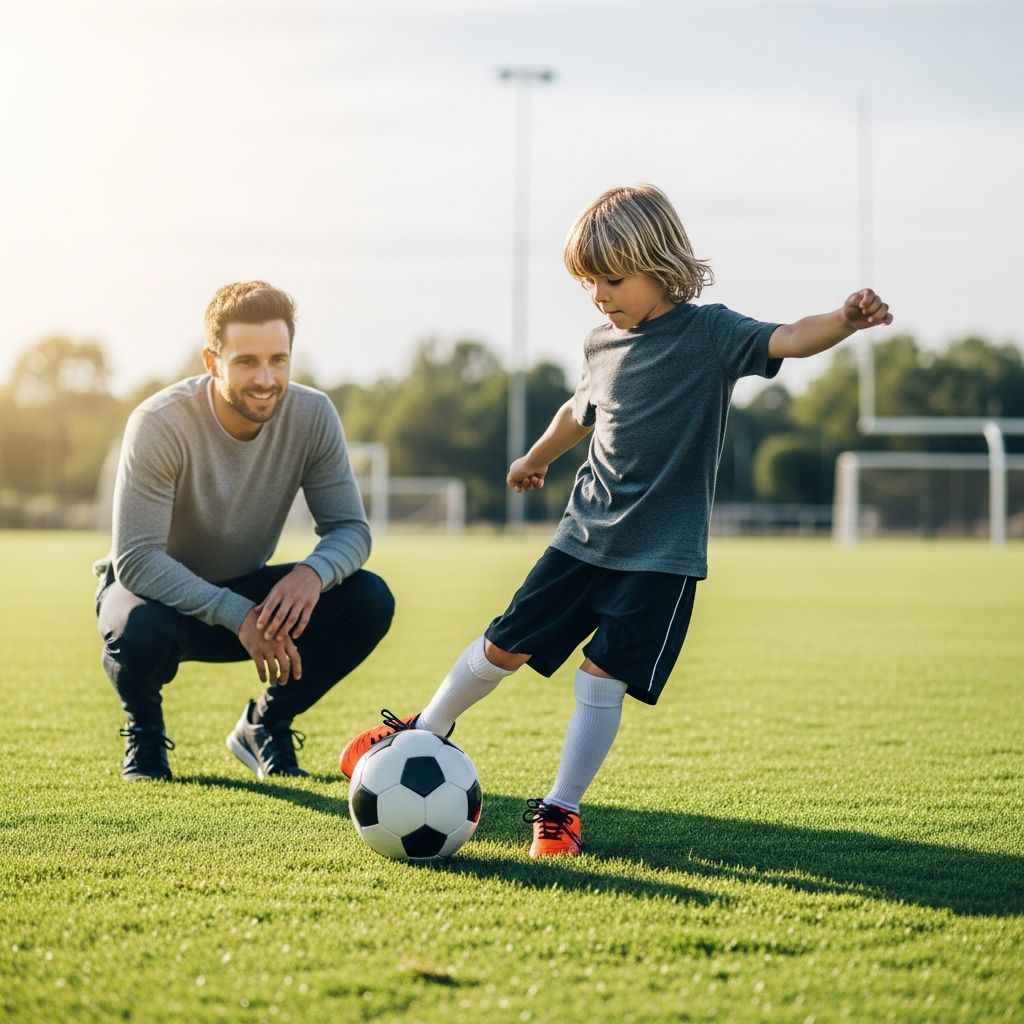
Helping a young child learn to kick a soccer ball is about much more than power. When kids understand how to balance, where to place their feet, and what part of the ball to hit, they develop safer, more effective technique that supports long-term enjoyment of the game.
This guide walks parents and caregivers through a complete, kid-friendly approach to teaching a proper soccer kick, from basic body control to fun drills and games.
Why Proper Kicking Technique Matters for Kids
Children naturally want to swing as hard as they can at the ball, often using their toes and throwing their bodies off balance. While this feels powerful, it can create bad habits and raise the risk of minor injuries like stubbed toes and awkward landings.
- Safety: Using the laces instead of the toe and maintaining balance lowers the risk of toe and ankle injuries.
- Skill growth: Good form makes it easier to learn passing, shooting, and ball control later on.
- Confidence: When the ball goes where they intend, kids feel proud and more eager to practice.
- Enjoyment: Kids who feel successful early are more likely to stick with the sport and stay active.
Foundation First: Balance, Strength, and Coordination
Before worrying about power, help your child build the physical basics that make a good kick possible. Research on motor development in children shows that balance, coordination, and single-leg stance are key building blocks for ball skills.
Balance on One Leg
During a kick, kids briefly stand on one leg while the other swings through the ball. Practice balancing without the ball first.
- Have your child stand on one leg for 5–10 seconds and then switch.
- Make it playful: see if they can balance while you gently tap their shoulders.
- Progress to balancing with eyes looking forward at a “pretend goal.”
Whole-Body Coordination
Effective kicking uses the entire body—arms, trunk, and legs—moving together. Activities that cross the body’s midline help this coordination develop.
- Marching in place, touching opposite elbow to knee.
- Simple clapping games that cross hands over the center of the body.
- Gentle skipping or high-knee marching in a straight line.
Comfort Moving Around the Ball
Some children are hesitant to move close to the ball or step around it. Build familiarity without pressure.
- Ask your child to walk in a circle around the ball.
- Have them step over the ball with one leg, then the other.
- Roll the ball back and forth with the sole of the foot while holding your hand.
The Core Mechanics of a Good Soccer Kick
Once your child can stand on one foot and move comfortably around the ball, introduce the main technical elements of a kick. Keep your language simple and repeat the same cues each time.
| Element | What to Look For | Kid-Friendly Cue |
|---|---|---|
| Non-kicking foot | Placed slightly beside and a bit behind the ball, pointing toward the target | “Place your helper foot next to the ball, pointing to the goal.” |
| Body posture | Leaning slightly forward, eyes on the ball | “Nose over your toes and look at the ball.” |
| Contact surface | Laces (top of the foot) for strong kicks; inside of the foot for accurate passes | “Kick with your shoelaces or the inside of your foot, not your toe.” |
| Ankle position | Firm ankle, toes pointed down for laces kick | “Lock your ankle and point your toes to the ground like a ballerina.” |
| Follow-through | Leg continues forward after contact, toward the target | “Swing your leg through and finish toward the goal.” |
Step-by-Step: Teaching the Basic Laces Kick
Working in slow motion helps children feel each part of the movement before they try full power.
1. Approach the Ball
Start with the ball completely still and your child standing just behind it.
- Ask them to take a small step toward the ball with their non-kicking foot.
- That non-kicking foot should end up beside the ball, about a fist’s width away.
- The toes of the non-kicking foot should point in the direction they want the ball to go.
2. Prepare the Kicking Leg
Show your child how to swing the kicking leg back in preparation.
- Hold your own leg behind you and show a gentle backward swing.
- Explain that the knee stays slightly bent, not stiff.
- Make sure the toes of the kicking foot point down so the laces will meet the ball.
3. Make Contact with the Ball
This is where many kids instinctively use their toes. Gently redirect their focus to the laces.
- Have them tap the ball very softly using only the laces area, with almost no swing.
- Encourage them to keep looking at the spot they want to hit on the ball until after contact.
- Remind them to keep the ankle firm, not floppy, as the foot strikes the ball.
4. Follow Through Toward the Target
A complete follow-through helps with both power and accuracy.
- Ask your child to swing their leg through the ball and finish with their kicking foot pointing where the ball should go.
- Let their arms move naturally for balance; they do not need to be stiff.
- Have them land gently back on two feet after the kick.
Common Mistakes and How to Fix Them
Learning to kick correctly takes time. It is normal for kids to revert to old habits, especially during games or when they are excited.
Kicking with the Toe
Problem: The child uses the very tip of the shoe to strike the ball, often leading to pain or wild, unpredictable kicks.
How to correct:
- Ask them to slow down and kick very gently for a few tries.
- Mark a small dot or sticker on the laces and tell them, “Hit the ball with the sticker.”
- Practice from close range at a wall or soft target so power is not tempting.
Standing Too Far from the Ball
Problem: The non-kicking foot is too far away, so the child reaches with their toe.
How to correct:
- Draw or imagine a small “parking spot” next to the ball where the helper foot should go.
- Ask them to step closer each time until the side of their shoe is roughly one small step from the ball.
No Follow-Through
Problem: The child stops the leg as soon as it hits the ball, which reduces power and control.
How to correct:
- Have them pretend to “kick through a door,” finishing on the other side.
- Place a cone or small object a short distance beyond the ball and ask them to swing their leg toward that object.
Simple Drills Parents Can Use at Home
Short, frequent practice sessions are more effective than one long, exhausting session. Many youth-coaching resources emphasize 10–15 minute blocks for young children to keep focus and fun high.
Stationary Target Kicks
Build accuracy and confidence at low power.
- Place a cone, bucket, or taped target on a wall a few feet away.
- Invite your child to use their laces to hit the middle of the target three times.
- Celebrate contact with the target even if the ball is slow.
Short-Range Passing Game
Passing with the inside of the foot emphasizes accuracy and control.
- Stand a few steps away from your child.
- Ask them to turn their foot sideways and use the inside to roll the ball to you.
- Keep the distance small at first; gradually move back as they succeed.
Line of Balls Drill
This keeps kids moving and gives many repetitions in a short time.
- Place 3–5 balls in a line, each about one step apart from the next.
- Have your child walk down the line, kicking each ball once with the same foot.
- Repeat using the other foot to build two-sided skill.
Creating a Safe and Supportive Practice Environment
Where and how you practice affects your child’s comfort and safety.
Choose a Suitable Space
- Use a grassy area or other soft surface to reduce impact if your child falls.
- A small, contained space like a yard or quiet park corner helps keep the ball close.
- If using a wall, stand close to reduce ball speed and avoid fear of the rebound.
Use Age-Appropriate Equipment
Sports medicine guidelines recommend appropriately sized balls for children to decrease strain and improve control.
- Size 3 balls for most kids under 8 years old.
- Lightweight balls for very young children just starting out.
- Properly fitting shoes that support the ankle and allow clear lace contact.
Emphasize Effort Over Power
- Praise specific behaviors: “I like how you used your laces” rather than only goals scored.
- Allow many slow-motion kicks before encouraging harder shots.
- Remind your child that strong kicks come naturally once the technique feels easy.
Frequently Asked Questions (FAQs)
At what age can kids start learning to kick a soccer ball properly?
Most children begin experimenting with kicking between ages 2 and 3, but more coordinated instruction on form usually works best from about age 4 and up, when balance and attention have developed a bit more.
How long does it take for proper technique to become automatic?
It can take several months of consistent, gentle practice for a new kicking motion to become natural. Some coaching resources suggest a window of 6–12 months for children to replace old habits with new ones, depending on age and frequency of practice.
Should my child practice with both feet?
Yes. While most kids prefer one foot, using both helps with coordination and makes them more versatile players later. Include at least a few repetitions with the non-dominant foot in every practice.
Is it okay if my child still uses their toe sometimes?
Toe contact will happen occasionally, especially when kids get excited. Instead of scolding, pause for a brief reset: slow the movement down, remind them of the laces, and give them another chance to try the same kick with better form.
How often should we practice?
Short, fun practices 2–3 times per week—around 10–20 minutes each—are usually enough for steady improvement without burnout. Focus on varied games and positive feedback rather than long, repetitive sessions.
References
- How to Teach Kicking and Shooting a Soccer Ball — SoccerHelp Coaching Article. 2024-03-01. https://www.soccerhelp.com/kick-shoot-soccer-ball.shtml
- How to Stop Children Kicking a Soccer Ball with their Toe — Footy 4 Kids. 2022-06-15. https://www.footy4kids.co.uk/soccer-drills/ball_control/how-to-stop-children-kicking-a-soccer-ball-with-their-toe/
- How to Kick a Soccer Ball for Kids — Kindysport Coaching Video (YouTube). 2021-05-05. https://www.youtube.com/watch?v=ICbt65ZwKjs
- Teaching Kids How to Kick a Ball — The Inspired Treehouse. 2020-04-10. https://theinspiredtreehouse.com/teaching-kids-how-to-kick-a-ball/
- Youth Soccer Position Statements — American Academy of Pediatrics, Council on Sports Medicine and Fitness. 2019-08-01. https://publications.aap.org/pediatrics/article/144/5/e20192721/38422/
- How to Kick a Soccer Ball the Right Way — Soccer Training Video (YouTube). 2022-09-18. https://www.youtube.com/watch?v=859umlqnjqw
- Shooting/Striking: Key Teaching Points — Soccer Skills in PE (Grade K–6). 2023-02-01. https://www.youtube.com/watch?v=7qoHvp0XFX4