At around seven months, your baby is likely more alert, mobile, and eager to join in on everything you do. This stage is filled with rolling, sitting, babbling, grabbing, and endless curiosity. Thoughtful play during this time is not about doing more; it is about weaving simple, responsive activities into your everyday life.
This guide offers practical, developmentally informed ways to play with your 7-month-old using items you already have at home. Each idea supports core areas of development: motor skills, communication, thinking, and emotional bonding.
What Your 7-Month-Old Is Typically Working On
Every baby grows at a unique pace, but many 7-month-olds are experimenting with some of the abilities below. These are not checklists or requirements; they are simply clues that can inspire the types of play you offer.
- Motor abilities
- Rolling in both directions
- Sitting with or without brief support
- Leaning forward to reach toys and sometimes toppling over
- Beginning to pivot on their tummy or scoot toward objects
- Hand and finger skills
- Reaching with both hands
- Transferring objects from one hand to the other
- Exploring by banging, dropping, and mouthing toys
- Thinking and problem-solving
- Noticing when an object disappears and searching for it (early object permanence)
- Watching your face closely to read your expressions
- Studying cause-and-effect: “If I drop this, what happens?”
- Communication and social skills
- Babbling with strings of sounds
- Responding to their name
- Smiling and laughing to get your attention
- Showing preferences for familiar people
Responsive play that follows your baby’s cues supports healthy brain connections and emotional security. Sensitive, back-and-forth interactions in the first year are key foundations for later learning and mental health.
Simple Sensory Play Using Everyday Items
At this age, your baby learns by exploring with their whole body. Sensory play does not have to be elaborate. Focus on safe experiences with different textures, sounds, light, and movement.
1. Texture Exploration on a Blanket
Create a sensory spot on the floor using a large blanket as the base. Place a few safe, clean household objects with different surfaces within reach:
- A soft washcloth or small towel
- A smooth wooden spoon
- A crinkly paper (inside a zip bag for safety)
- A silicone kitchen spatula
Lay your baby on their tummy or in sitting (with support if needed). Offer one item at a time. Name what they are feeling: “Soft cloth,” “Smooth spoon,” “Crinkly paper.” This supports language exposure and sensory discrimination.
2. Light and Shadow Discovery
In a dim room, use a small flashlight or the soft light from a window to create slow, gentle movements of light. Guide the light across the wall, then across your open hand. Let your baby see your hand make shapes in the beam.
- Keep the light away from your baby’s eyes.
- Move slowly and pause often so they can track and focus.
- Talk quietly about what you are doing: “The light moved up… now it’s low.”
Tracking moving objects helps develop visual attention and early eye-hand coordination, skills that underpin later reading and motor tasks.
3. Gentle Water Play
When your baby is awake and calm, you can offer supervised water exploration. Research supports the value of safe sensory experiences, including water, for early learning and engagement.
- Use a shallow basin or tray with a thin layer of warm water.
- Support your baby in sitting or place them on your lap.
- Offer a washcloth, a plastic cup, or your own hands for splashing.
Focus more on the feel of water on their hands than on big splashes. Never leave your baby unattended around water, even for a moment.
Supporting Gross Motor Skills Through Play
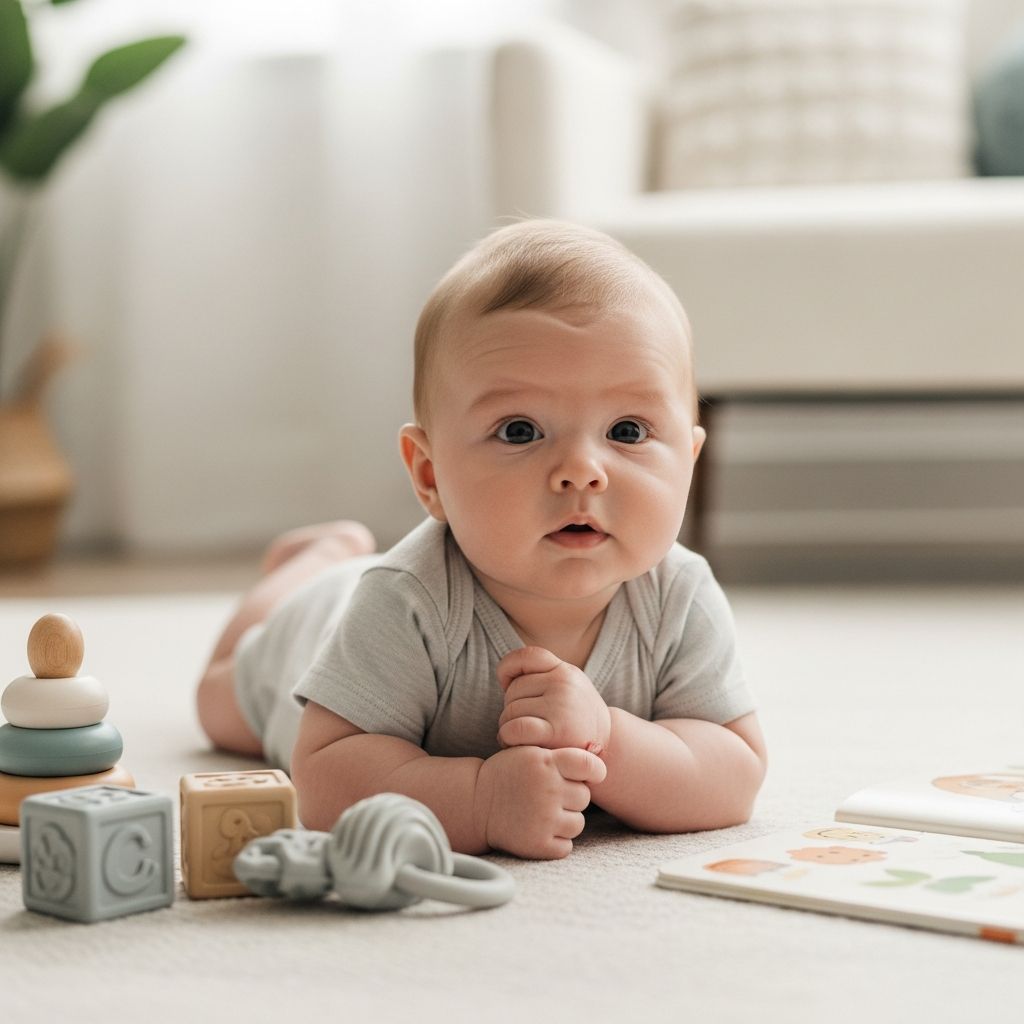
Movement experiences help babies build strength, balance, and body awareness. Tummy time and floor play are still very important around seven months.
4. Rolling Races (At Baby’s Pace)
Place your baby on their back on the floor. Set a toy just to the side of their shoulder, where they can see it but need to turn their body to reach it.
- Encourage them warmly: “Can you get the rattle?”
- Use your voice or gentle clapping to cheer on any attempt to roll or pivot.
- Help only as much as needed if they get frustrated.
This simple setup invites rolling and reaching without forcing positions your baby is not ready for.
5. Cushion “Hills” for Tummy Adventurers
Create small, stable “hills” on the floor using firm pillows or folded blankets. Lay your baby on their tummy with their upper body facing up one of the “hills.” Place a toy at the top so they are encouraged to push up and reach.
- Stay close and keep your hands nearby for support.
- Make the surfaces low and steady so they do not slide.
- Limit the time if your baby shows signs of fatigue or frustration.
Activities like this strengthen the shoulders, trunk, and hips, which are foundations for later crawling and sitting balance.
6. Supported Sitting Playtime
If your baby can sit with minimal help, you can build their balance during play.
- Sit on the floor with your legs in a V shape and your baby seated between your thighs for gentle support.
- Place a few toys in front of them so they can reach, lean, and return upright.
- Let them occasionally tip and right themselves while you keep them safe from falling backward.
This strengthens core muscles and teaches your baby how to adjust their body to stay balanced.
Fine Motor and Hand-Eye Coordination Ideas
Your baby is now especially interested in grabbing and manipulating objects. Offering chances to practice these skills lays the groundwork for later self-feeding and play.
7. Bowl and Toy “Fishing”
Place a few easy-to-grasp toys in a wide, shallow bowl or baking dish.
- Encourage your baby to reach in and lift toys out.
- Say, “Out!” when they remove a toy and “In!” when you put it back.
- Allow time for them to figure out how to grasp objects from different angles.
This activity nurtures hand-eye coordination and emerging problem-solving as your baby experiments with how to get each toy.
8. Crinkle & Tap Band
Offer your baby two safe items: one that makes a soft rustling sound and one that produces a gentle tapping noise (for example, a crinkly fabric packet and a wooden spoon on a soft surface).
- Demonstrate slow, soft tapping and shaking.
- Pause to let your baby copy your actions.
- Alternate between the two sounds so they notice the difference.
Experiences with varied sounds, combined with your calm voice, support early auditory processing and attention.
9. Early Container Play
Container play—putting objects into and taking them out of a box or cup—is an early stepping stone toward more complex problem-solving. Around this age, many babies enjoy taking things out more than putting them in.
- Give your baby a lightweight box and a few chunky toys.
- Show how you drop a toy in the box and then tip it out.
- Let your baby repeat the “dumping” part and celebrate their efforts.
This builds coordination and introduces basic concepts like in/out and full/empty.
Language, Music, and Social Interaction
By seven months, babies are tuned in to the rhythm and melody of language. Talking, singing, and reading with your baby are powerful ways to support brain development and bonding.
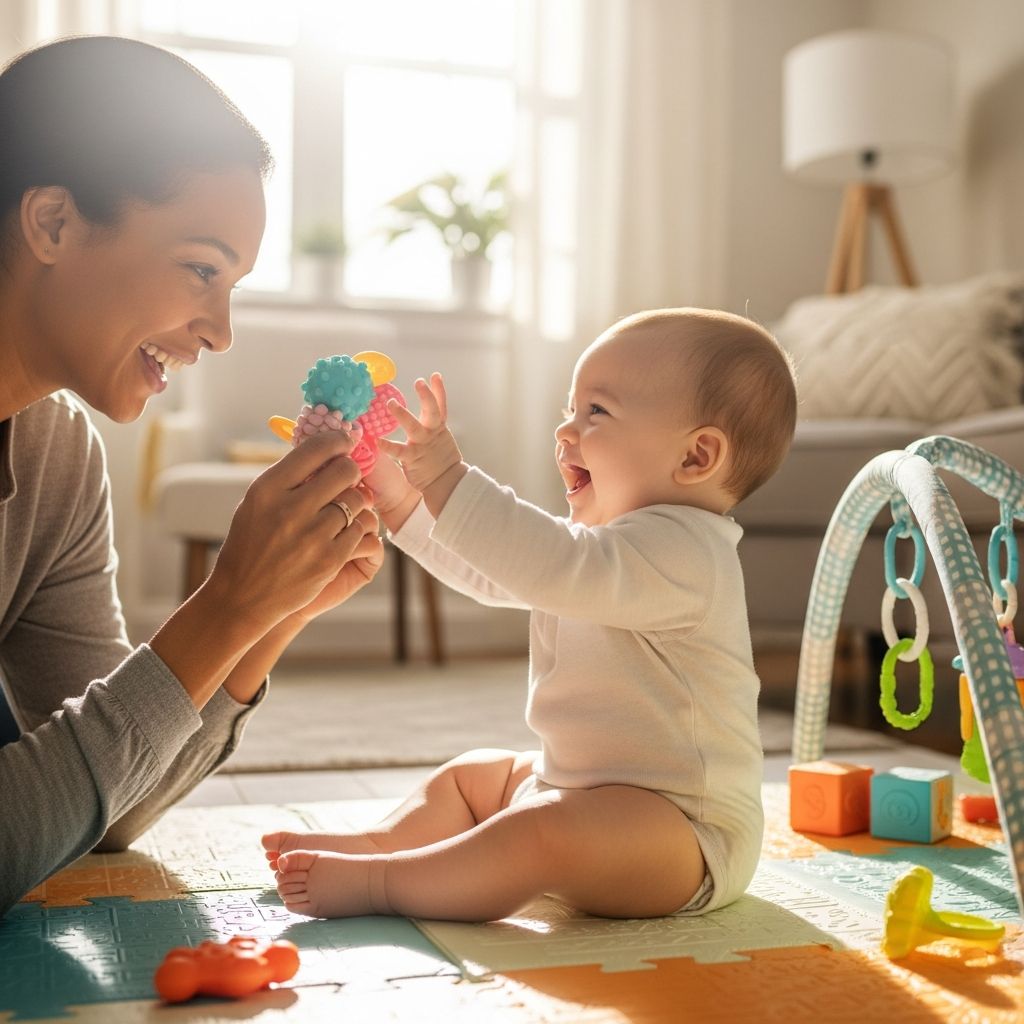
10. Face-to-Face Chat Sessions
Sit so your face is close to your baby’s and talk as though you are in a conversation, even if they only babble back.
- Pause after you speak to give them time to respond.
- Imitate some of their sounds and wait for their next “turn.”
- Describe what they seem to be looking at or doing.
Back-and-forth exchanges like this are sometimes called “serve and return” interactions. They support language growth and emotional security by showing your baby that their signals matter.
11. Action Songs and Gentle Movement
Choose a few simple songs and pair them with consistent motions, such as clapping, gentle bouncing, or moving your baby’s arms in time with the music.
- Keep the motions slow and predictable.
- Watch your baby’s face and stop if they seem overstimulated.
- Repeat favorite songs often so your baby can anticipate what comes next.
Music and rhythm experiences support early language, attention, and self-regulation skills.
12. Everyday Narration
You do not need special toys to encourage language development. Simply describing daily routines—changing a diaper, washing hands, preparing a snack—gives your baby rich language exposure.
- Use clear, simple sentences: “I am putting on your sock. One sock, two socks.”
- Name body parts, objects, and actions.
- Follow your baby’s gaze and label what they seem interested in.
Hearing many spoken words in responsive interactions is linked with stronger language outcomes later in childhood.
Object Permanence and Early Problem-Solving
Around this age, babies begin to understand that people and things still exist even when they are out of sight. Simple hiding and finding games nurture this new thinking skill.
13. “Where Did It Go?” Cloth Game
While your baby watches, place a small cloth over a favorite toy so that part of it remains visible at first.
- Ask, “Where did the toy go?” in a playful voice.
- Encourage them to pull the cloth away.
- Over time, hide more of the toy and pause longer before helping.
This early version of a hiding game helps strengthen object permanence and simple problem-solving.
14. Surprise Basket Reveal
Gather a few safe household items with different sizes, shapes, and textures. Place them in a shallow basket or box within your baby’s reach.
- Let your baby pull items out at their own pace.
- Comment on their discoveries: “You found the spoon. It’s shiny.”
- Rotate items every few days to maintain interest.
Exploring a small selection of real-world objects can support curiosity and flexible thinking without overwhelming your baby.
Bonding Through Everyday Routines
Some of the most important developmental experiences come from routines you already do. Consistent, nurturing care promotes secure attachment, which is associated with better social and emotional outcomes later in life.
15. Slow, Connected Diaper Changes
Instead of hurrying through every diaper change, occasionally treat it as a mini playtime.
- Make eye contact and talk through each step: “Off goes your diaper. Now I’m wiping.”
- Offer a special diaper-time toy they only see during this routine.
- Pause for a brief song or a few silly faces.
Turning caregiving into connection time helps your baby associate touch and routine with safety and warmth.
16. Wind-Down Ritual Before Sleep
Simple, predictable wind-down activities before naps and bedtime support your baby’s ability to settle and feel secure.
- Dim the lights slightly and lower your voice.
- Hold your baby and quietly sing or hum the same tune each time.
- Offer a brief book or a gentle back rub.
Consistent routines in the first year help babies start to recognize patterns in their day and may support more settled sleep over time.
Quick Comparison: Play Themes and Benefits
| Play Theme | Example Activity | Main Skills Supported |
|---|---|---|
| Sensory exploration | Texture items on a blanket | Touch processing, attention, early language |
| Gross motor | Cushion “hills” & rolling games | Strength, balance, body awareness |
| Fine motor | Bowl and toy “fishing” | Hand grasp, hand-eye coordination |
| Language & social | Face-to-face chats, songs | Communication, bonding, emotional regulation |
| Cognitive/problem-solving | Hidden toy under cloth | Object permanence, curiosity |
Frequently Asked Questions (FAQs)
How long should I play with my 7-month-old each day?
Instead of aiming for a specific number of hours, think about offering short, frequent moments of connection throughout the day. Babies this age benefit from several brief play periods broken up by naps, feeds, and quiet time. Watching your baby’s cues—turning away, rubbing eyes, fussing—will help you know when they need a break.
Do I need special toys for my baby to learn?
No. While some toys can be helpful, everyday household items, your face, your voice, and time on the floor together provide rich learning experiences. Realistic, safe objects and simple social games are often more beneficial than complex gadgets.
My 7-month-old is not crawling yet. Should I worry?
Babies vary widely in when they start to crawl, and some skip crawling altogether and move straight to other forms of mobility. If your baby is making progress in other motor skills, seems interested in moving, and your healthcare provider is not concerned, this is often within typical variation. If you notice that your baby is very stiff or very floppy, uses one side much more than the other, or seems to lose skills they once had, consult your pediatrician.
How can I tell if my baby is overstimulated during play?
Signs of overstimulation can include turning the head away, arching the back, rubbing eyes, crying suddenly, or becoming very fussy. If you see these signs, pause the activity, hold your baby close, lower the noise and light levels, and offer calm, predictable input such as quiet humming or gentle rocking.
What if my baby seems uninterested in an activity?
It is normal for interest to come and go quickly at this age. You can try simplifying the setup, moving closer to your baby’s eye level, or demonstrating the play yourself first. If they still seem uninterested, that is fine—follow their lead and offer a different activity, or simply enjoy quiet time together.
References
- Important Milestones: Your Baby By Seven Months — Centers for Disease Control and Prevention (CDC). 2022-03-31. https://www.cdc.gov/ncbddd/actearly/milestones/milestones-7mo.html
- Serve and Return — Center on the Developing Child at Harvard University. 2021-06-01. https://developingchild.harvard.edu/guide/a-guide-to-serve-and-return
- Zero to Three: Play — ZERO TO THREE. 2023-04-10. https://www.zerotothree.org/resource/topic/play
- How Babies Learn to Talk — National Institute on Deafness and Other Communication Disorders (NIDCD), NIH. 2022-07-14. https://www.nidcd.nih.gov/health/how-do-we-learn-speak