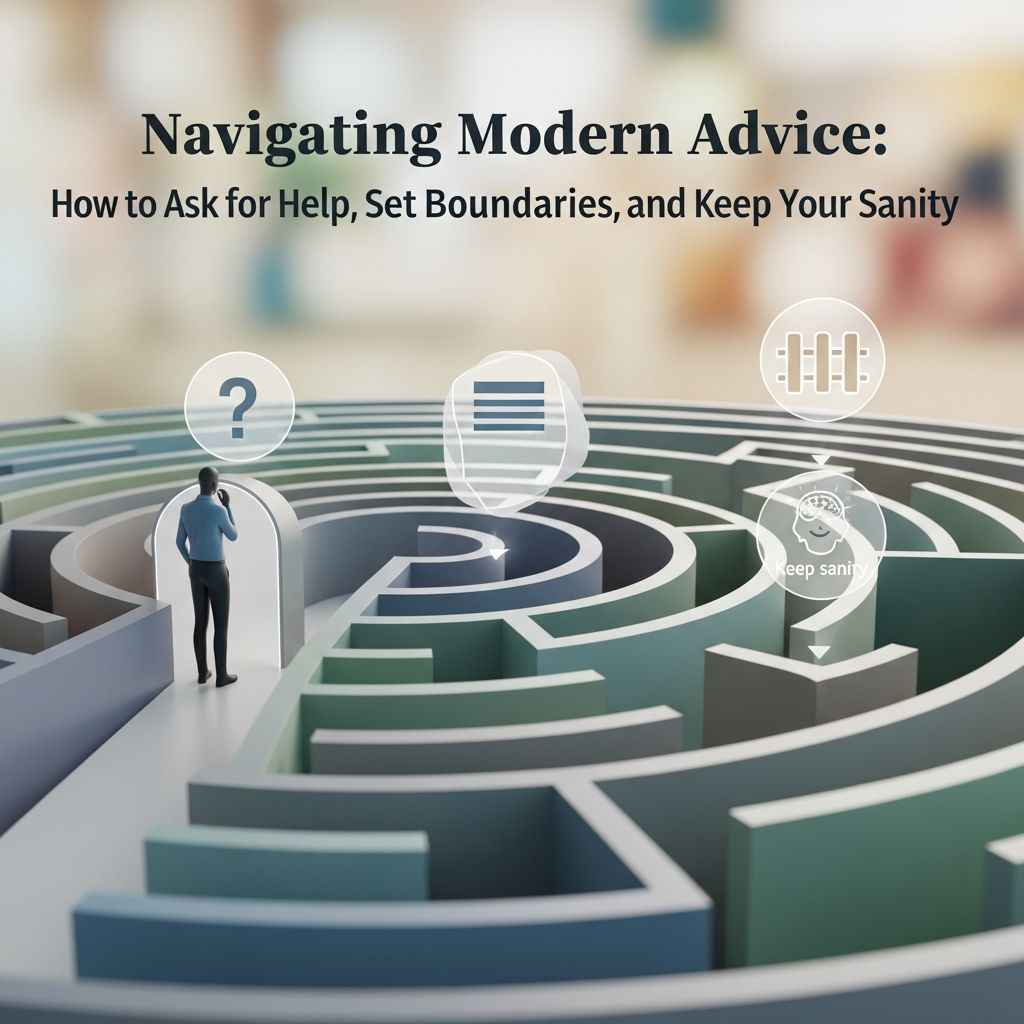
Everywhere you turn, someone has an opinion about your choices: your relationship, your job, your parenting, your friendships, even what you ate for lunch. Advice can be supportive and life-changing, or it can be overwhelming, shaming, and completely off-base. Learning how to ask for help, filter responses, and protect your emotional space is an essential skill in a world that never stops talking.
Why We Keep Asking for Advice (Even When It Hurts)
Most people do not ask for advice because they believe they are incapable; they ask because they want companionship while making a hard decision. Advice, at its best, is less about being told what to do and more about feeling less alone while you figure it out. When a topic is emotionally loaded—like love, marriage, breakups, or family drama—the urge to crowdsource comfort and clarity becomes even stronger.
The problem is that public or semi-public advice invites an audience that may not understand the nuance of your situation. Some responders will treat your life like a puzzle to be solved in three moves, ignoring context and complexity. Others will project their own fears, regrets, or frustrations onto you, which can make you feel judged instead of supported. Recognizing these dynamics helps you approach advice as raw material to sift through, not as a verdict on your life.
Building a Healthy Mindset Before You Ask
Before you post in a forum, text a group chat, or sit down with a trusted friend, it helps to get clear on what you are really looking for. Are you seeking emotional validation, practical ideas, a reality check, or all three? The more specific you are with yourself, the less power random opinions will have over your mood.
Go into the advice-seeking process with the assumption that not everything you hear will be accurate, kind, or relevant. This is not cynicism; it is protection. If you remind yourself in advance that you are allowed to discard guidance that does not fit, you lower the risk of feeling crushed by a single harsh or careless response.
Questions to Ask Yourself First
- What decision am I actually trying to make?
- Do I want an opinion, or do I mainly want someone to listen?
- Am I in a mental state where I can handle disagreement or criticism?
- What would I do if I received no advice at all—what does my gut already say?
Choosing the Right Place to Ask for Help
Not every space is built for vulnerable questions. Online comment sections, large social media groups, and anonymous forums can be useful for brainstorming options, but they are also magnets for extreme opinions and snap judgments. The more public the platform, the less control you have over tone, empathy, and context.
Smaller, curated spaces—like a private group with clear rules, a support community, or a trusted circle of friends—tend to offer more nuanced feedback. They may not be perfect, but the shared norms and relationships usually encourage more responsibility for how advice is delivered.
| Advice Source | Best For | Risks |
|---|---|---|
| Public forums & large social media groups | Collecting diverse perspectives and experiences | Harsh tone, misinterpretation, advice based on limited context |
| Close friends or family | Emotional support and practical help from people who know you | Bias, overinvestment in your choices, difficulty staying neutral |
| Professional helpers (therapists, coaches, counselors) | Structured guidance, tools, and long-term growth | Cost, availability, and the need to find a good fit |
| Specialized support groups | Insights from people facing similar challenges | Group norms may not align with your values or needs |
How to Frame Your Question So You Get Better Advice
The way you word your question often shapes the kind of answers you receive. Vague prompts like “What should I do?” invite equally vague responses, while emotionally loaded language can trigger polarized reactions. Giving just enough context—without oversharing every detail—helps others respond to your actual problem instead of to their assumptions.
It is also helpful to state your constraints up front. If you are not open to a certain option (for example, breaking up, moving across the country, cutting off a family member), make that clear. You are not being closed-minded; you are simply narrowing the field to options you can genuinely consider right now.
Examples of Clarity-Boosting Phrases
- “I’m not asking whether I should stay or go; I’ve already decided to stay. I’m looking for ways to make this choice healthier for me.”
- “I can’t change this person’s behavior; I can only change my response. What are some options I might not have considered?”
- “I want support and perspective, not insults or name-calling toward anyone involved.”
Sorting Helpful Guidance from Harmful Noise
Once you open the door to advice, you quickly realize that not all responses deserve equal weight. Some contain empathy and insight, while others are little more than venting, moralizing, or thinly disguised superiority. Your job is not to argue with every unhelpful comment; your job is to separate out the rare, useful pieces from the pile.
A helpful response does not have to flatter you, and it may not even agree with your instincts. What matters is whether it respects your humanity, acknowledges nuance, and offers something concrete you can consider. Harmful advice often feels absolute, contemptuous, or oddly eager for you to suffer in the name of “tough love.”
Signs Advice Is Worth Keeping
- It acknowledges that your situation is complicated, not black and white.
- It focuses on your safety, well-being, and agency rather than on punishing anyone.
- It offers specific ideas or questions to think about, not just labels or judgments.
- It allows for multiple possible paths instead of insisting there is only one correct move.
Signs Advice Is Better Ignored
- It mocks your feelings or calls you names.
- It confidently prescribes extreme actions based on very little context.
- It assumes bad motives for everyone involved, including you.
- It leaves you feeling smaller, scared, or ashamed without offering any path forward.
Setting Emotional Boundaries with Advice-Givers
Boundaries are not only for romantic partners or family members; they are also for anyone who insists on telling you how to live. Saying “no” to a certain type of guidance is not rude; it is an act of self-respect. The people who love you do not own your life, and strangers on the internet certainly do.
Emotional boundaries can be practical and subtle. You might choose to skim comments instead of reading every word, mute or block people who cross your lines, or restrict your sharing to only one or two safe places. Offline, boundaries might look like changing the subject, declining to provide updates, or explicitly stating that a topic is off-limits.
Boundary Statements You Can Use
- “I appreciate your concern, but I’m not asking for more advice on this right now.”
- “I’ve heard your perspective; I’m going to take some time to decide what feels right for me.”
- “This conversation is making me feel judged, so I’d like to change the subject.”
- “I know you mean well, but your comments are not helping me think clearly.”
When Advice Turns into Shaming or Piling On
Sometimes you will encounter a wave of responses that fixate less on the situation and more on condemning one person—often you. What started as a request for perspective can quickly become a performance of outrage, where commenters compete to be the most disapproving. This kind of piling on rarely leads to insight; it mainly serves to intensify your sense of guilt and confusion.
There is a difference between someone calmly challenging your choices and an angry crowd trying to make you feel as awful as possible. Healthy accountability leaves room for your growth; shaming simply tries to crush you into submission. When you can tell the difference, you are more likely to walk away from unhealthy dynamics instead of staying to absorb more hurt.
What to Do When You Feel Attacked
- Step away from the screen or conversation and ground yourself before responding.
- Remind yourself that intensity does not equal accuracy; people can be loudly wrong.
- Seek out one or two trusted voices who can help you process what happened.
- Resist the urge to defend every detail; you are allowed to disengage completely.
Honoring Your Own Judgment
Advice is a tool, not a commandment. No one else has to live with the full consequences of your decision the way you do, which means your own judgment must stay at the center of the process. Even expert guidance is meant to inform your choice, not replace it.
Instead of asking, “Whose advice should I obey?”, try asking, “Which perspectives help me see more clearly, and which cloud my thinking?” Over time, you build internal reference points: values, boundaries, and patterns that tell you when you are moving toward or away from the life you want. The more you strengthen that inner compass, the less desperate you feel for a definitive external answer.
Questions to Reclaim Your Agency
- What outcome feels most aligned with my values, even if it is hard?
- What decision keeps me safest—emotionally, physically, and financially?
- If a close friend were in my exact situation, what would I hope they would choose?
- Which piece of advice keeps echoing in my mind, and why? Does it reflect my truth or someone else’s fear?
Becoming a Better Advice-Giver Yourself
Everyone eventually ends up on the other side of the equation, responding to someone else’s vulnerable question. The way you offer guidance can either reinforce harmful patterns or help create a culture of thoughtful, compassionate problem-solving. Few things are more powerful than being the person who can tell the truth without cruelty.
A helpful advisor listens more than they lecture, asks clarifying questions, and resists the urge to make the conversation about their own drama. When you accept that you do not and cannot know every detail, you approach the situation with humility instead of authority. This makes your suggestions easier to hear, even when they are challenging.
Principles of Respectful Advice
- Lead with curiosity: ask what the person has already tried and what they are hoping for.
- Flag your biases: acknowledge when your experiences might be coloring your perspective.
- Offer options, not ultimatums: frame your ideas as possibilities, not commands.
- Leave room for disagreement: explicitly state that they know their life better than you do.
Frequently Asked Questions About Advice, Boundaries, and Tough Decisions
Is it wrong to ignore advice I specifically asked for?
No. Asking for advice is a way of gathering data, not signing a contract. You are not obligated to implement every suggestion just because you requested input. Respecting the time and intention behind someone’s response does not require you to follow their recommendations if they do not fit your values, circumstances, or safety needs.
How do I know if I am just looking for validation instead of real help?
Wanting validation does not automatically mean you are avoiding the truth. Most people need reassurance that their feelings make sense before they can calmly consider next steps. If you find yourself rejecting every piece of feedback that challenges you, it may be useful to pause and ask whether you are trying to protect yourself from necessary discomfort.
What if the majority disagrees with my decision?
Majority opinion can highlight blind spots, but it is not automatically correct for you. People commenting on your life do not carry your history, your trauma, your cultural context, or your daily reality. If you have honestly weighed their concerns and still choose a different path, that is an exercise of autonomy, not recklessness.
How can I stay open to hard truths without getting crushed?
One approach is to separate tone from content. A message may be delivered harshly but contain a useful shard of truth; likewise, gentle words can still be deeply misguided. You can quietly ask yourself, “Is there anything in this that could help me grow?” and keep only that small piece while discarding the rest.
When should I stop asking for more opinions?
If you find yourself looping through the same stories, gathering the same responses, and feeling more paralyzed than before, it is probably time to pause. At some point, additional perspectives stop adding clarity and start eroding your confidence. That is your cue to step back, check in with your own values and instincts, and move from collecting advice to making a decision.
Learning to Live with Imperfect Choices
No amount of advice can guarantee a painless outcome. Decisions about relationships, careers, or major life transitions are inherently risky because they involve other people, changing circumstances, and your own evolving needs. The goal is not to find a path with zero regret, but to choose with as much compassion, clarity, and courage as possible.
When you treat advice as a resource rather than a verdict, you create space for your own wisdom to show up. You can listen, sort, question, and even thank someone for their passionate opinion—then still choose what feels right for you. That is not selfish or stubborn; it is what adulthood looks like in a world overflowing with voices.