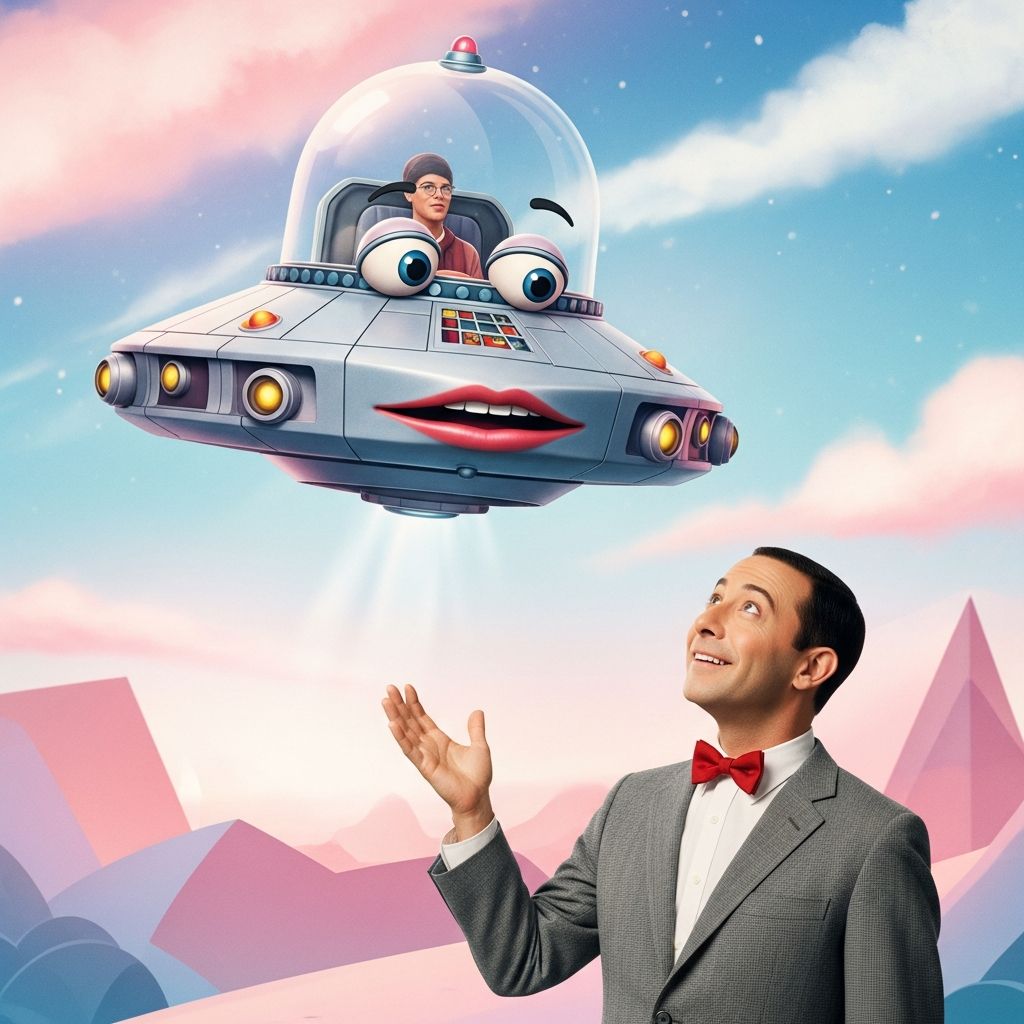
In the mid-1980s, Flight of the Navigator landed in theaters with the promise of time travel, alien technology, and cutting-edge visual effects, but its secret weapon was an offbeat voice tucked inside a silver spaceship: Paul Reubens as Max, the Trimaxion Drone Ship. Without ever appearing on screen, Reubens reshaped the film’s personality, turning what could have been a straight-laced space adventure into something stranger, funnier, and unexpectedly warm.
Reubens, best known for creating and playing Pee-wee Herman, brought a mischievous, elastic energy to Max that still feels singular decades later. His performance offers a blueprint for how voice acting can redefine a story, especially in family films that try to balance wonder, danger, and comedy.
The Movie That Needed a Personality
Flight of the Navigator follows a 12-year-old boy who disappears in the woods in 1978 and reappears eight years later without having aged a day, only to discover he has a mysterious connection to a sleek alien spacecraft. At its core, the plot is a straightforward blend of kid-centric sci-fi and government conspiracy, with scientists and military officials eager to understand the boy and the ship he’s drawn to.
On paper, the story leans heavily on familiar beats: a lonely kid, secret experiments, and a high-tech escape. What brightens that formula is Max, the A.I. pilot of the ship, who begins as a clinical, computerized presence and gradually morphs into a goofball co-conspirator. That tonal shift is where Reubens’ vocal performance takes over the movie and gives it a personality it otherwise lacks.
Max: From Machine to Mischief-Maker
Max is introduced as a cold, rule-bound navigator tasked with collecting life-forms for study, treating humans and creatures as data points in a galactic experiment. He speaks in a precise, detached way, emphasizing logic and mission parameters, which reinforces the unsettling idea that the boy hero is just another specimen.
As Max starts downloading human information, his tone twists into something far more chaotic, picking up slang, jokes, and pop-culture rhythms that reflect Reubens’ trademark comedic style. The ship’s A.I. essentially becomes corrupted by Earth humor, and the stiff robot voice melts into a manic, giggly presence that sounds suspiciously like Pee-wee Herman without ever fully becoming him.
Key ways Reubens transforms Max
- Shifts from monotone to hyperactive, giving the ship a clear emotional arc.
- Uses timing and pauses to make even short lines feel like punchlines.
- Blends irritation, curiosity, fear, and delight in rapid succession.
- Creates a relationship with the child protagonist that feels like a weird mix of babysitter, big brother, and prank partner.
Why Casting Paul Reubens Was So Unusual
When the film was made, Reubens was on the rise thanks to his stage work and the early success of Pee-wee Herman, a character that lived somewhere between children’s clown and surreal performance art. Rather than simply hiring a traditional voice actor with a neutral delivery, the filmmakers tapped into Reubens’ offbeat appeal, even crediting him under a variation of his stage persona to keep the focus on the character rather than the star.
This choice stands out in a period when many family movies still treated voice work as anonymous labor rather than a featured performance. Reubens’ presence signaled that Max was not just a talking computer but a fully realized comedic figure, one whose quirks could anchor entire scenes.
Blending Pee-wee Energy with Sci-Fi Stakes
Reubens doesn’t simply drop Pee-wee Herman into a spaceship; instead, he borrows the character’s hyperactive vocal range and filters it through an alien intelligence trying to understand human behavior. That gives Max a slightly off-kilter rhythm: he is delighted by human silliness but also baffled by it, like a stand-up comic who just discovered emotions.
This hybrid energy lets the film juggle real tension with absurd humor. Moments that could feel ominous—government chases, experiments, and near crashes—are disarmed by Max’s reactions, which swing from gleeful to panicked in seconds. The result is a film that feels safe enough for kids yet strange enough to stick in memory.
How Voice Rewrote the Movie’s Tone
One of the most striking aspects of Reubens’ performance is how completely it reorients the film once Max becomes a central figure. The early part of the story leans into mystery and melancholy as the boy grapples with lost time, missing family years, and a world that moved on without him. When Max fully enters the picture, the mood pivots into a road-trip comedy in the sky.
This is not just a shift in dialogue style; it changes the emotional stakes. Instead of dwelling on trauma and dislocation, the film reframes the boy’s ordeal as an adventure guided by a chaotic friend who never quite understands why humans are so fragile and sentimental. Voice becomes the mechanism that moves the story from grief to play.
Before Max vs. After Max
| Story phase | Tone | Emotional focus |
|---|---|---|
| Before Max dominates the screen | Somber, eerie, and slow-burn mysterious | Loss of time, family separation, and fear of the unknown |
| After Max becomes the co-lead | Fast, comedic, and mischievous | Friendship, rebellion, and the thrill of breaking rules with a powerful ally |
Max as the Kid Fantasy Made Real
Part of the enduring appeal of Max is that he embodies a fantasy many children have: a powerful friend who can break every rule and still get you home in time. The ship can outfly helicopters, outsmart adults, and bend physics, yet it behaves like a prankster older sibling rather than a stern guardian.
Reubens leans hard into that fantasy by making Max impulsive and occasionally irresponsible, but ultimately loyal. When he apologizes, panics, or hesitates, the performance suggests genuine concern, which makes the character feel less like a tool and more like a partner in crime.
Working in the Shadow of Live-Action Effects
Flight of the Navigator gained attention for its then-innovative combination of practical ship models and early CGI surface morphing, giving the craft a liquid metal sheen and shape-shifting abilities. Against that visual spectacle, a lesser voice performance could easily have been overshadowed by the novelty of the technology.
Instead, Reubens treats the effects as a playground. When the ship swoops, skids, or reconfigures itself, his vocal reactions add a human layer that turns sequences into emotional beats, not just technical showcases. The audience doesn’t just watch the ship maneuver; they experience Max’s joy, terror, or confusion along with it.
Why Parents Still Remember Max
For many adults who grew up in the ’80s and ’90s, Max is less a character and more a feeling: that mix of late-night cable reruns, synth soundtracks, and weird jokes that didn’t sound like anything else on television. Reubens’ voice ties directly into that nostalgia, especially for viewers who also knew him as Pee-wee Herman from TV and film.
Hearing the same vocal DNA in two radically different contexts—one a neon-colored kids’ show, the other a moody sci-fi adventure—gives Max a mythic quality in memory. To parents sharing the film with their own kids now, his banter becomes a bridge between generations, even if younger viewers have never seen Pee-wee at all.
Reasons Max still resonates with adults
- He captures the chaotic energy of ’80s kids’ media without the cynicism of later eras.
- His jokes and mood swings feel more anarchic than modern, tightly focus-grouped family films.
- The performance is strongly tied to a specific time yet remains emotionally legible today.
Lessons for Modern Voice Actors and Creators
Reubens’ work as Max demonstrates that a voice role in a family movie can be as layered and influential as any live-action performance. He builds an arc entirely through sound: from robotic detachment to gleeful chaos to something like empathy, all without costume, gesture, or facial expression.
For modern actors and creators, several takeaways stand out:
- Commit to a strong point of view: Max does not sound generic; he sounds like a specific personality with his own logic.
- Let humor shift the stakes, not erase them: Jokes lighten the film without undercutting the boy’s fear and confusion.
- Use contrast: The jump from monotone A.I. to jokey prankster makes the character feel like he has grown.
- Embrace weirdness: Memorable voices often come from choices that initially feel too big, too strange, or too niche.
Paul Reubens Beyond the Navigator
Although Max is just one entry in Reubens’ long list of roles, it sits at a crossroads in his career, arriving as his Pee-wee persona was gaining mainstream traction and before later character and voice roles diversified his résumé. Over the years, he continued to lend his voice to animation, games, and genre projects, building a reputation for characters that were eccentric, nervous, or gleefully unhinged.
Seen in that context, Max represents an early, polished example of what Reubens would keep doing: sneaking emotional specificity into parts that could have been played as flat caricatures. The navigator is silly, but he is never empty.
Sharing Flight of the Navigator With a New Generation
For parents considering whether to introduce the film to their kids, it helps to understand that the movie straddles a tone modern audiences might not be used to. The first act leans into fear and displacement, while the later sequences become a high-energy comedy with a chatty alien ship at the center.
That unevenness is also part of its charm. Children often respond strongly to Max’s fast-talking weirdness, while adults feel the ache of lost time and the unease of government control. Reubens connects those layers, helping the film function both as a bizarre kids’ adventure and a melancholy time-slip story.
Tips for family viewing
- Watch with kids old enough to handle mild suspense and themes of separation.
- Talk afterward about how Max changes over the course of the movie.
- Use the film as a springboard to discuss how stories mix humor and fear to explore big emotions.
FAQs
Was Paul Reubens credited under his real name?
Reubens has used both his birth name and his Pee-wee persona in credits across different projects, and in some cases, he adjusted how he was listed to keep attention on the character rather than the performer. This flexible crediting helped preserve the illusion of distinct identities for his various creations.
Is Max supposed to be Pee-wee Herman in space?
Max is not literally Pee-wee Herman, but elements of Reubens’ signature comedic style clearly echo through the performance, including rapid-fire delivery, sudden pitchchanges, and a playful attitude toward authority. That overlap makes the ship feel familiar to anyone who has encountered Pee-wee, even as Max remains a separate, alien character within the story.
How important is voice acting to the film’s success?
Without a memorable voice for Max, Flight of the Navigator would likely play as a more conventional genre piece centered on visual effects and plot mechanics. Reubens’ work turns the ship into a co-lead rather than a prop, giving the movie a sense of personality that helps explain its enduring cult status.
Did Paul Reubens continue doing voice work after this film?
Yes, Reubens remained active in voice roles for decades, contributing to animated series, films, and video games while also revisiting Pee-wee Herman on stage and in new projects. His ongoing voice career shows how a performer known for one iconic character can continually reinvent that same toolbox of sounds and expressions.
Why does Max’s transformation feel so dramatic?
The contrast between the ship’s early, robotic voice and its later, manic persona makes the change feel like a full character arc, even though nothing about the physical design of the craft alters. That transformation happens entirely in sound, illustrating how a skilled voice actor can make an audience believe a machine has developed a sense of humor—and maybe even a heart.