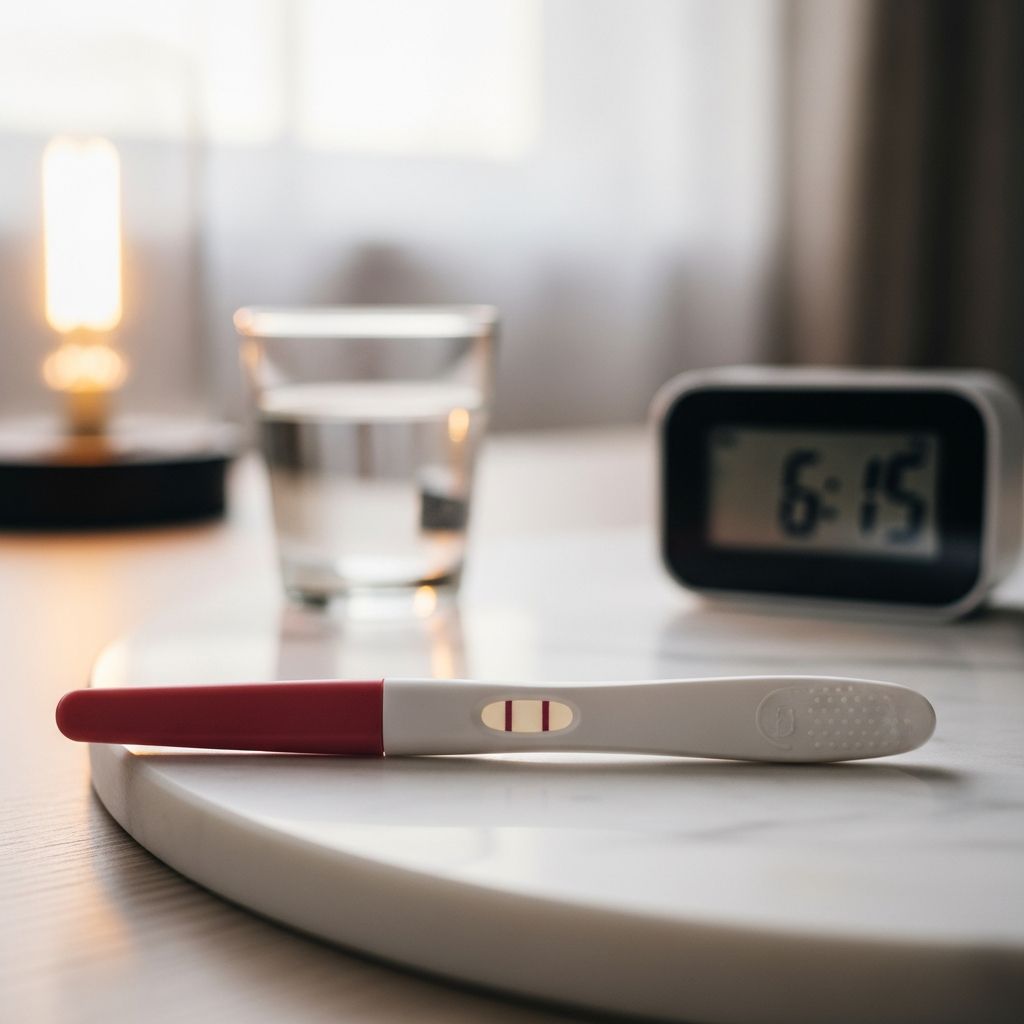
Home pregnancy tests offer a private, convenient way to detect pregnancy by measuring human chorionic gonadotropin (hCG), a hormone produced after implantation. These tests achieve up to 99% accuracy when used correctly after a missed period, revolutionizing early family planning.
The Science of hCG and Pregnancy Confirmation
hCG production begins shortly after a fertilized egg implants in the uterus, typically 6-12 days post-conception. Levels double every 48-72 hours in early pregnancy, making them a reliable marker for detection. Urine tests mimic lab methods by using monoclonal antibodies that bind to hCG, producing a visible line or digital readout.
Understanding hCG rise is crucial: studies show uniformity when referenced to ovulation, outperforming last menstrual period (LMP) estimates, which align within one week for only 78% of cases. This precision aids in early gestational dating, correlating over 90% with ultrasound measurements.
Timing Your Test for Maximum Reliability
The key to accurate results lies in timing. Most tests recommend waiting until the first day of a missed period, when hCG reaches detectable levels (around 25 mIU/mL) in 99% of pregnancies. Testing earlier reduces sensitivity due to lower hormone concentrations.
- Day of expected period: Over 99% accuracy for sensitive tests detecting 25 mIU/mL hCG.
- 4 days before: Detection in about 86% of cases with advanced tests.
- 5 days before: Around 60% detection rate, higher false negatives possible.
For irregular cycles, wait 21 days post-unprotected sex. First morning urine concentrates hCG, boosting reliability.
Types of Home Pregnancy Tests Explained
Modern tests vary in format and sensitivity:
| Type | Sensitivity | Early Detection | Pros | Cons |
|---|---|---|---|---|
| Standard Strip | 25-50 mIU/mL | Day of missed period | Affordable, simple | Line interpretation needed |
| Early Detection | 10-25 mIU/mL | 4-6 days early | Faster results | Higher cost, more false negatives early |
| Digital | 25 mIU/mL | Day of missed period | Clear “Pregnant/Not” readout | Batteries required |
Sensitive tests (e.g., claiming 10-25 mIU/mL) must reliably detect at these thresholds to match claims; otherwise, expect discrepancies, especially pre-period.
Factors Influencing Test Accuracy
Several variables impact outcomes:
- Diluted urine: Midday samples lower hCG concentration; use first morning void.
- Medications: Fertility drugs with hCG can cause false positives; most others (e.g., birth control) do not interfere.
- Medical conditions: Rare cysts or menopause elevate hCG naturally.
- User error: Reading too soon/ late or improper storage leads to invalid results.
Lab studies confirm 97-99% accuracy post-missed period with proper use, but early testing drops to 70-80% due to implantation variability.
Decoding Results: Lines, Symbols, and What They Mean
A positive shows a control and test line (or “Pregnant”); even faint lines indicate hCG presence—retest in 48 hours to confirm rising levels. No test line means negative, but early negatives warrant retesting.
Evaporation lines (gray, post-timer) mimic positives—check within specified time. Digital tests eliminate interpretation errors.
Navigating False Results and Retesting Strategies
False negatives outnumber positives (1-2% vs. rare). Causes include testing too early (hCG below threshold) or low implantation hCG. False positives stem from chemical pregnancies or reading errors.
Retest protocol:
- Wait 2-3 days for hCG doubling.
- Use first morning urine.
- Follow instructions precisely—timer essential.
If persistent negatives but symptoms (nausea, fatigue), consult a provider for blood tests, 99% accurate at 5 mIU/mL.
Comparing Popular Test Brands: Performance Insights
Independent analyses reveal variances:
- Brands with FDA review (e.g., those claiming 25 mIU/mL) achieve >99% accuracy on expected period day.
- High-sensitivity claims (10 mIU/mL, 8 days early) often fail, with error rates up to 40%.
- Digital formats reduce user error via clear displays.
Choose tests validated against clinical hCG rises for reliability.
Beyond Home Tests: When to Seek Professional Confirmation
Positive home results? Schedule prenatal care promptly. Blood tests quantify hCG precisely; ultrasounds verify viability around 5-6 weeks. Negatives with symptoms or irregular bleeding need evaluation for ectopic risks.
Lifestyle Tips While Awaiting Confirmation
Assume pregnancy: avoid alcohol, smoking; start prenatal vitamins (folic acid 400-800 mcg daily). Hydrate, eat balanced, manage stress.
Frequently Asked Questions About Early Pregnancy Tests
Can I test before my missed period?
Yes, sensitive tests detect 60-96% of pregnancies 5-2 days early, but false negatives are common—retest later.
What if the line is faint?
Faint positives are valid; hCG rises quickly. Retest in 48 hours.
Do diluted urine affect results?
Yes—use concentrated morning urine for best accuracy.
How accurate are digital tests?
Comparable to manual (99% post-miss), with clearer interpretation.
What causes false positives?
Rare: recent miscarriage, hCG meds, certain cancers.
Irregular cycle—when to test?
21 days after intercourse or 3 weeks post-ovulation.
This comprehensive guide empowers informed testing. Always pair results with healthcare advice for health decisions.
References
- Accuracy of Home Pregnancy Tests and New Developments — Laurence A. Cole. 2014-05-28. https://pmc.ncbi.nlm.nih.gov/articles/PMC4119102/
- Understanding the Accuracy of Pregnancy Tests — First Response. Recent (accessed 2026). https://www.firstresponse.com/en/articles-listings/accuracy-and-knowing-sooner
- How to get the most accurate pregnancy test results — Penn Medicine. Recent (accessed 2026). https://www.pennmedicine.org/news/how-to-get-the-most-accurate-pregnancy-test-results
- How early can home pregnancy tests show positive results? — UT Southwestern Medical Center. Recent (accessed 2026). https://utswmed.org/medblog/home-pregnancy-tests/
- Home pregnancy tests: Can you trust the results? — Mayo Clinic. Recent (accessed 2026). https://www.mayoclinic.org/healthy-lifestyle/getting-pregnant/in-depth/home-pregnancy-tests/art-20047940
- Flaw in many home pregnancy tests can return false negative results — Washington University School of Medicine. Recent (accessed 2026). https://medicine.washu.edu/news/flaw-in-many-home-pregnancy-tests-can-return-false-negative-results/