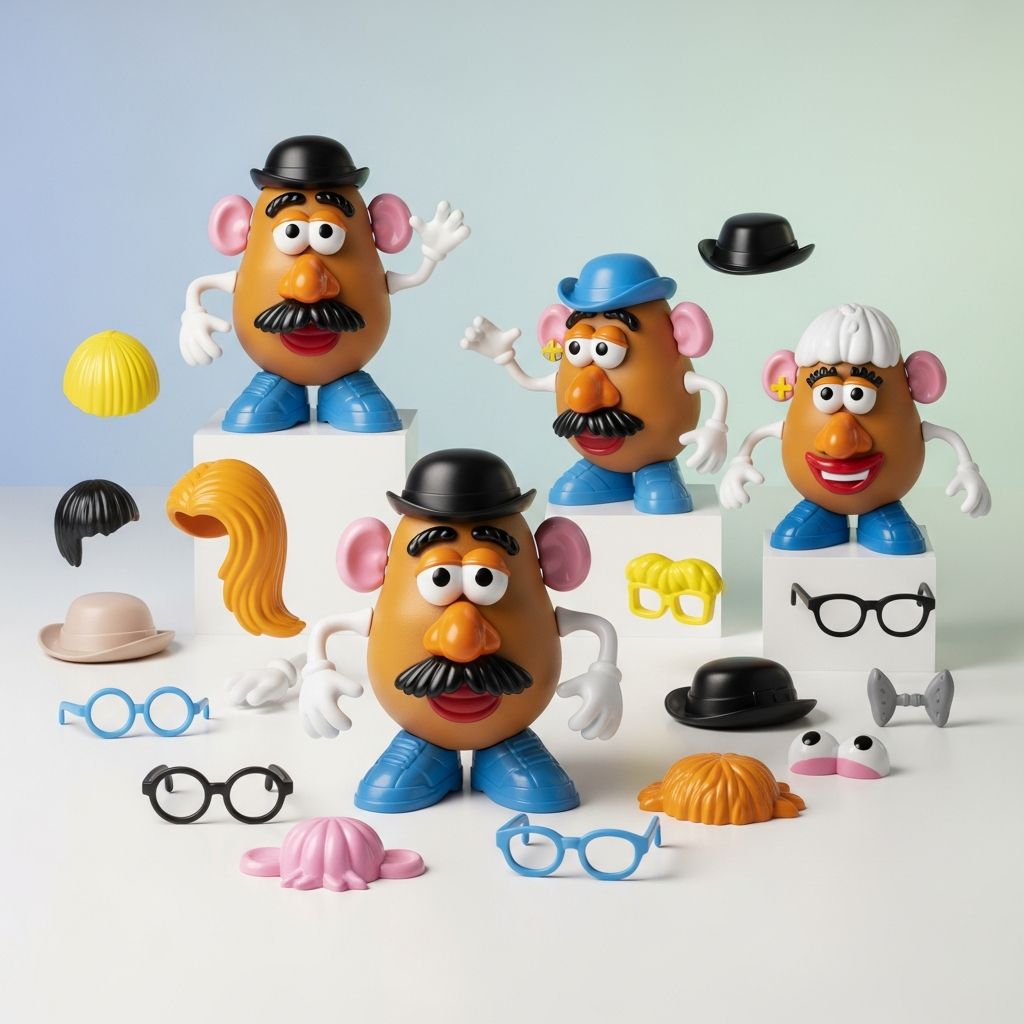
Hasbro’s announcement to retire the ‘Mr.’ title from its iconic Potato Head toy marked a significant shift in the toy industry, aiming to embrace broader family diversity through inclusive packaging and naming. This change, revealed in early 2021, allows children to envision any family configuration using the mix-and-match accessories.
The Origins of a Toy Icon
The Potato Head toy first sprouted in the early 1950s as a groundbreaking plaything, initially sold as separate plastic parts to be pushed into real vegetables before Hasbro introduced the plastic potato body in 1960. Over decades, it evolved into Mr. Potato Head, featuring a male character with a wife, Mrs. Potato Head, and later their animated adventures in Toy Story films, cementing its status as a cultural staple.
This rebrand does not alter the classic figures—Mr. and Mrs. Potato Head remain available—but updates the main product packaging to ‘Potato Head,’ promoting gender-neutral creativity. Families can now assemble parents, siblings, or any combination without predefined gender roles dictating the setup.
Why the Shift to Inclusivity?
Hasbro cited evolving societal norms around gender identity as the catalyst. ‘The world is changing, and so are we,’ the company stated, emphasizing that the toy’s modular design inherently supports limitless imagination. The new ‘Create Your Own Potato Family’ set includes two adult-sized potatoes, one child-sized, and over 40 accessories like hats, glasses, and mustaches, enabling personalized storytelling.
This move aligns with broader industry trends where toy makers like LEGO and Mattel introduce gender-neutral lines. Research from Common Sense Media highlights how traditional gender labeling on toys can limit children’s self-expression, with studies showing kids gravitate toward play based on interest rather than marketing categories.
Public Reactions: Cheers and Backlash
The rebrand ignited polarized responses across social media and news outlets. Supporters praised it as progressive, noting it empowers non-traditional families—same-sex parents, single guardians, or gender-diverse households—to see themselves in playtime. One parent shared, ‘Finally, my kids can build our family without forcing a ‘mom and dad’ mold.’
Critics, however, decried it as ‘woke capitalism’ erasing beloved traditions. Conservative commentators argued it erases gender distinctions unnecessarily, with some calling for boycotts. Hasbro clarified that iconic characters like Mr. Potato Head are preserved, addressing concerns about cultural heritage loss.
| Perspective | Key Arguments | Examples |
|---|---|---|
| Supportive | Promotes diversity; reflects real families; encourages creativity | LGBTQ+ advocates, progressive parents |
| Critical | Political overreach; erases history; unnecessary change | Conservative media, nostalgic fans |
| Neutral | Just a packaging update; core toy unchanged | Hasbro statements, toy reviewers |
Historical Context of Gender in Toys
Toys have long mirrored societal gender expectations. Post-World War II, marketing targeted boys to trucks and girls to dolls, reinforcing stereotypes. The 1970s saw pushback with gender-neutral campaigns, but pink/blue divides persisted. By the 2010s, ‘gender-creative’ parenting gained traction, urging parents to let kids choose toys freely.
Hasbro’s decision echoes this evolution. The U.S. Census Bureau reports rising numbers of same-sex married couples (from 0.3% in 2010 to 0.9% in 2020) and single-parent households (23% of children), underscoring the need for representative play options.
- 1952: Original Mr. Potato Head launches without body.
- 1960: Plastic body introduced; ‘Mr.’ title solidified.
- 1980s-90s: Mrs. Potato Head joins; family branding emerges.
- 2021: Gender-neutral rebrand announced.
Impact on Child Development
Psychologists emphasize toys’ role in cognitive and social growth. Modular toys like Potato Head foster problem-solving, fine motor skills, and narrative building. Gender-neutral options expand this by challenging binary norms early, potentially reducing bias. A 2019 study in Child Development found children exposed to diverse toys showed greater empathy and flexibility in gender roles.
Parents play a key role too. Selecting inclusive toys signals acceptance, helping kids navigate identity. Yet, balance is crucial—nostalgia provides continuity, so Hasbro’s dual approach (new packaging alongside classics) satisfies multiple needs.
Broader Toy Industry Trends
Hasbro isn’t alone. Mattel’s Creatables line offers doll clothes for all genders, while GoldieBlox targets girls with engineering toys. These shifts respond to consumer demand: a 2020 NPD Group report showed 70% of parents prefer gender-neutral toys. Retailers like Target removed gender labels from signage in 2015, amplifying the momentum.
Challenges remain, including backlash and market risks. Yet, sales data post-rebrand suggested minimal impact, with Potato Head remaining a top seller.
Parenting in a Changing World
For modern families, toys are more than entertainment—they’re tools for world-building. The Potato Head update invites conversations about identity, family, and acceptance. Encourage open play: let kids lead assemblies, discuss their creations, and explore emotions tied to them.
Educators recommend rotating toys to spark interest and combining with books or crafts for deeper learning. Ultimately, the toy’s enduring appeal lies in its simplicity: endless combinations from basic parts, now with even fewer limits.
Future of Play: What’s Next?
As inclusivity drives innovation, expect more customizable, story-driven toys. Augmented reality integrations could let kids scan builds for digital animations. Hasbro’s move positions Potato Head for longevity, adapting to generations while honoring roots.
Whether building a traditional family or a whimsical potato parade, the toy reminds us play transcends labels, nurturing imagination in every spud.
Frequently Asked Questions
Is Mr. Potato Head being discontinued?
No, the classic Mr. and Mrs. Potato Head figures are still produced. The change affects only the main product packaging, now labeled ‘Potato Head’ for gender neutrality.
Why did Hasbro make this change?
Hasbro aims to reflect diverse family structures and promote inclusive play, allowing kids to create any family configuration without gender-specific constraints.
Does this erase the toy’s history?
Not at all. Hasbro explicitly states the original characters from 1952 remain, preserving the legacy alongside modern updates.
Are there new accessories in the rebranded set?
Yes, the ‘Potato Family’ set includes 42 mix-and-match pieces, two adult potatoes, and a child potato for versatile family-building.
How have sales been affected?
Initial data showed sustained popularity, with no significant drop-off, indicating broad acceptance despite debates.
References
- Hasbro Official Pulse Announcement — Hasbro, Inc. 2021-02-25. https://hasbro pulse.com/en-us/news/potato-head-brand-update
- Good Morning America: Hasbro Rebrands Mr. Potato Head — ABC News. 2021-02-26. https://www.youtube.com/watch?v=rHlPZtA-K4M
- U.S. Census Bureau: Same-Sex Couple Households — U.S. Department of Commerce. 2021-08-26. https://www.census.gov/newsroom/press-releases/2021/same-sex-couple-households.html
- Gender-Neutral Toys and Child Development — Common Sense Media. 2020-10-15. https://www.commonsensemedia.org/articles/gender-neutral-toys
- Child Development Journal: Toys and Gender Role Flexibility — Wiley Online Library. 2019-06-01. https://srcd.onlinelibrary.wiley.com/doi/full/10.1111/cdev.13192
- Consumer Trends in Toys — NPD Group. 2020-03-12. https://www.npd.com/wps/portal/npd/us/news/press-releases/2020/npd-us-toy-industry-sales-surge-to-8-4-billion-in-2019/